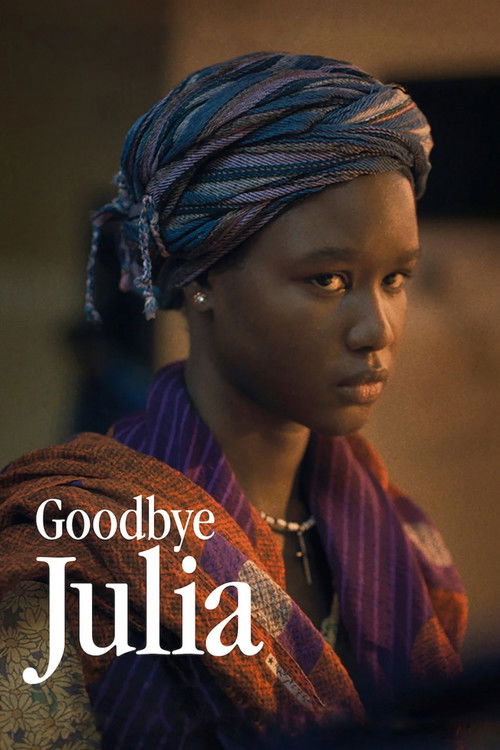
Goodbye Julia
2023 · Mohamed Kordofani
For when you want a serious, absorbing drama that treats you like an adult — something to sit with and argue about afterward. This is challenge viewing, but deeply human rather than punishing.
What it's about
In Khartoum, in the tense years before South Sudan votes on secession, a retired singer from the north conceals her role in a southern man's death — by hiring his unknowing widow, Julia, as her housekeeper. Two women of different faiths and different Sudans end up sharing one house, one built on a secret that the country's unrest keeps threatening to expose.
The experience
A slow-burning chamber drama that tightens like a knot — intimate, guilt-soaked, and quietly devastating. The suspense isn't about action but about a confession that hangs unspoken over every shared meal.
The craft
Mohamed Kordofani, a self-taught filmmaker who came from aircraft engineering, builds the whole national tragedy inside one household — the writing makes private guilt and political history mirror each other without ever lecturing. It's classically composed, performance-driven filmmaking where the tension lives in faces and rooms.
Why it matters
The first Sudanese film ever selected for Cannes, where it won the Freedom Prize in Un Certain Regard in 2023 — a breakthrough for a national cinema made against the odds of war at home.
Khartoum in the years before South Sudan's secession: a northern woman, a former singer silenced by marriage, conceals her part in a southern man's death by hiring his unknowing widow as her housekeeper. From that unbearable domestic arrangement, Mohamed Kordofani builds a chamber drama that is also a national autopsy — two women, two faiths, two Sudans sharing one house as the referendum of 2011 approaches. Kordofani, an aircraft engineer who taught himself filmmaking, has spoken of the film as an act of self-examination about the casual racism of his own upbringing, and that honesty is legible in every scene: guilt here is not a plot device but a civic condition. It became the first Sudanese film ever selected for Cannes, winning the Freedom Prize in Un Certain Regard in 2023 — even as war at home made both its production and its future audience precarious. The performances of Eiman Yousif and Siran Riak give the political its pulse: a friendship built on a lie that neither woman can afford to lose.
Reception
It premiered at Cannes 2023 as the first Sudanese film ever in the festival's official selection — weeks after civil war erupted back home, which turned a festival debut into something closer to a dispatch, and its stature as the flagship of new Sudanese cinema has only grown since.
How Goodbye Julia was received, from release to now →
Influences: the films it descends from and the films it influenced
- A Separation (2011) — Supplies the moral-secret engine Kordofani builds on — a single concealed culpability, known to one character and the audience but hidden from another, metastasizing through a domestic space and fracturing it along lines of class and belief.
- Caché (2005) — Establishes the bourgeois household as a crime scene of colonial/racial guilt, staging a privileged protagonist's complicity in an underclass other's ruin so that the family home becomes the literal container for national allegory.
- Imitation of Life (1959) — Models the mistress/servant dyad across the racial-religious line, weaponizing melodrama's emotional excess — maternal self-sacrifice, social passing, and unspoken shame — to indict a nation's caste order.
- The Servant (1963) — Pioneers the master-servant power inversion staged almost entirely within one house, using domestic confinement and shifting control of rooms and thresholds to dramatize class as intimate domination.
- Persona (1966) — Defines the two-hander chamber grammar of a silent woman and a speaking woman whose identities bleed together — the exact silence/confession asymmetry that carries Julia and Mona's scenes.
- Guelwaar (1993) — Provides the sub-Saharan template of political allegory built from a Christian-Muslim communal dispute, mapping national fracture onto a single faith conflict within a community.
- Xala (1975) — Demonstrates postcolonial national allegory delivered through a domestic/familial predicament, satirizing the new ruling class via one household's affliction rather than through overt historical spectacle.
- Bab el Hadid (Cairo Station) (1958) — Anchors the pan-Arab political-melodrama tradition, fusing class abjection and thwarted desire inside a tightly bounded social milieu — the melodramatic register Kordofani inherits and restrains.
- The Salesman (2016) — Extends the same Farhadian moral-thriller mechanics — an act of complicity buried inside a marriage detonating slowly through accreting guilt and dramatic irony rather than plot reveal.
- La Nana (The Maid) (2009) — Treats the live-in maid as pure chamber-drama subject, mining the claustrophobic employer-servant intimacy and its small daily cruelties for the whole of its drama within domestic walls.
- Roma (2018) — Centers the underclass domestic servant as moral anchor against a backdrop of national upheaval, rendering the household a microcosm of class and racial hierarchy.
- Secret Sunshine (2007) — Shares the study of guilt and faith working on a grieving woman — the way religious consolation and unresolved culpability collide inside a single, quietly disintegrating female interior.
- Wadjda (2012) — Extends the womanhood-and-silence study under a patriarchal-religious order, dramatizing a woman negotiating agency within faith constraints through domestic-scaled observation.
- Timbuktu (2014) — Dramatizes religious authority's intrusion into ordinary Sahelian lives through restrained, chamber-scaled human episodes rather than spectacle — the same de-escalated approach to faith-and-nation.
- You Will Die at Twenty (2019) — Co-founding feature of the contemporary Sudanese revival Goodbye Julia belongs to, sharing the slow chamber tempo and the interrogation of faith's determinist grip on an individual fate.
- Talking About Trees (2019) — Part of the same Sudanese cinema resurgence, framing the nation's political trauma through intimate, patient observation of a few figures rather than historical panorama.
Similar films
- A Separation (2011) — influence & lineage
- It Was Just an Accident (2025) — same viewing thread
- Misericordia (2024) — shared sensibility
- Fjord (2026) — shared sensibility
- Lingui, the Sacred Bonds (2021) — shared sensibility
- The Zone of Interest (2023) — shared sensibility
- The Seed of the Sacred Fig (2024) — shared sensibility
- Anatomy of a Fall (2023) — shared sensibility
All the films related to Goodbye Julia →
Watch it with: curated runs of related films
- Living With What Was Done — Watch these together for how differently a society answers harm — a room built for restorative justice, a survivor turning the camera on her attacker, a torture victim face-to-face with his interrogator — a run about testimony, guilt, and the slow labor of repair.