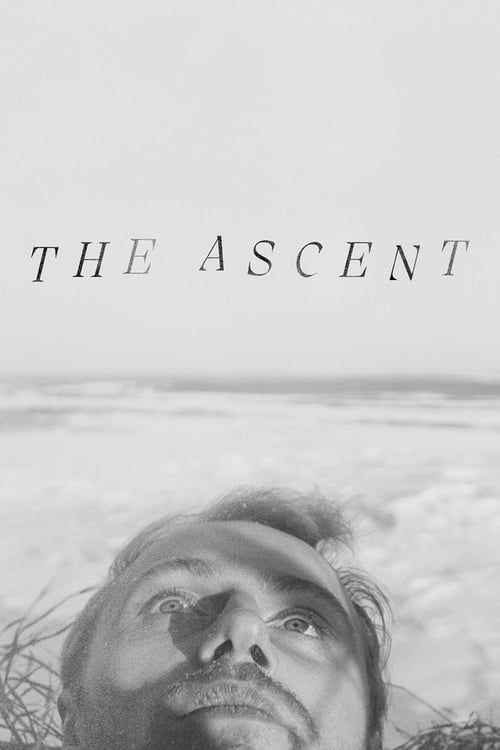
The Ascent
1977 · Larisa Shepitko
For when you want to be put through something and come out changed — a demanding, austere masterpiece for a night when you have the stillness to meet it. This is challenge, not comfort, and it's worth it.
What it's about
Deep in a freezing Belarusian winter under German occupation, two Soviet partisans leave their starving unit to forage for food. The mission goes wrong, and what began as a slog through the snow becomes a trial of the soul — a test of what each man will endure, and what he'll trade to survive. It follows the two of them into the hands of the occupiers and the collaborators who serve them.
The experience
Severe, hypnotic, and physically punishing to watch — the cold is real and you feel it in your bones — building to a moral intensity that's closer to religious ordeal than war movie. It leaves you shaken and very quiet.
The craft
Larisa Shepitko shot in genuinely lethal cold — the frost on the actors' lashes is real — and her camera studies faces with an almost sacred severity, blazing whites against deep blacks. The compositions carry Christian iconography in plain sight, smuggled past Soviet censors, and the film's stark black-and-white photography is devastating on a big screen.
Why it matters
The first Soviet film to win the Golden Bear at Berlin, and the summit of a career cut short — Shepitko died in a car crash two years later at forty-one, leaving this as her testament.
Two Soviet partisans trudge through Belarusian snow on a foraging mission that becomes a trial of the soul — Larisa Shepitko's final film transmutes the Great Patriotic War into something closer to religious ordeal. Made within a state cinema that preferred its war heroes uncomplicated, The Ascent smuggles Christian iconography past the censors in plain sight: haloed close-ups, a Judas figure, a Golgotha of the collaborationist village. Shepitko shot in genuinely lethal cold, and the frost on the actors' lashes is real; her camera studies faces with a severity worthy of Dreyer, whites burning against blacks. The film won the Golden Bear at Berlin in 1977 — the first Soviet film to do so — and stands as the summit of a career cut off two years later, when Shepitko died in a car crash at forty-one. Her husband, Elem Klimov, would carry her unfinished projects forward and, in Come and See, extend her vision of Belarus at war. Hers remains the more austere masterpiece: a war film in which the decisive battlefield is conscience.
A Deleuzian reading
Frost on eyelashes.
The full Deleuzian reading of The Ascent →
Reception
It won the Golden Bear at Berlin in 1977 — the first Soviet film to do so — yet stayed hard to see in the West for decades after Shepitko's death; the 2021 Criterion release and Letterboxd word-of-mouth turned it into a full-blown rediscovery.
How The Ascent was received, from release to now →
Influences: the films it descends from and the films it influenced
- The Passion of Joan of Arc (1928) — The template Shepitko openly copies: the martyr's tear-streaked face isolated in extreme close-up against blank sky, lit so the skin becomes a luminous, near-haloed surface that carries the whole spiritual argument without dialogue.
- Day of Wrath (1943) — Dreyer's slow, high-contrast chiaroscuro of persecution and confession — deep blacks around a pale accused face — supplies the monochrome grammar Shepitko uses for Sotnikov's interrogation.
- The Trial of Joan of Arc (1962) — Bresson's structuring of martyrdom as an interrogation transcript — flat, unadorned exchanges between captor and captive as a moral trial — is the narrative spine of the Sotnikov/Portnov cellar scenes.
- The Cranes Are Flying (1957) — Urusevsky's expressionist, subjectively mobile camera and blown-out white skies established the Thaw-era Soviet war image Shepitko inherits, then freezes into stillness on the Belarusian snowfields.
- Ballad of a Soldier (1959) — Chukhrai shifted the Soviet war film from mass heroics to the tested conscience of one ordinary soldier — the humanist scale of moral trial that The Ascent inherits and darkens.
- Ivan's Childhood (1962) — Tarkovsky's poetic, high-key monochrome of war — bare winter birches, water, faces held in silent duration — is the immediate Soviet precedent for Shepitko's lyrical treatment of the killing landscape.
- Andrei Rublev (1966) — Its explicitly Christian iconography and staging of physical torment as spiritual passage across a bleak monochrome Russia licenses Shepitko's overt religious ordeal within an officially atheist cinema.
- Earth (1930) — Dovzhenko's low-horizon lyricism, where sky-filling close-ups of peasant faces are fused to landscape, is the Soviet lineage of Shepitko's snow-and-sky compositions of the condemned.
- Winter Light (1963) — Bergman's austere, wintry study of a crisis of faith — cold light, unblinking close-ups, silence standing in for God — parallels the theological interrogation Shepitko dramatizes.
- Wings (1966) — Shepitko's own earlier film builds the method she perfects here: a single protagonist's interior moral pressure read almost entirely off a held, unglamorous face.
- Forever a Woman (1955) — A woman director confronting bodily suffering and mortality through an austere, unsentimental gaze that dignifies the flesh without exploiting it, echoing Tanaka's clinical compassion.
- Come and See (1985) — Made by Shepitko's widower on the same Belarusian WWII terrain, it extends her lethal-cold ordeal aesthetic — the war atrocity registered through the transfigured, staring face of a witness.
- Son of Saul (2015) — Nemes locks a shallow-focus camera to one man's face through an unbearable moral trial, updating Shepitko's principle that atrocity is best rendered as a haloed close-up rather than spectacle.
- The Sacrifice (1986) — Carries forward the Christian-ordeal narrative in which one man's self-immolating act redeems others — the martyr's logic Shepitko gives Sotnikov, staged with the same solemn duration.
- Beanpole (2019) — Deploys sustained close-up interrogation of faces under WWII moral duress as the film's primary dramatic instrument — the physiognomic method Balagov directly inherits, where endurance and moral weight are registered in the body and face rather than in action or dialogue.
- Tangerines (2013) — Soviet moral-fable war cinema staged as a spiritual reckoning between captor and captive, using austere framing and ethical legibility rather than combat spectacle — the parable-under-pressure mode Urushadze inherits.
- A Visitor to a Museum (1989) — Its Schnittke score fused to close-up martyrology — the tortured face lit as Christ-icon — models the marriage of avant-garde Soviet concert music to a narrative of spiritual suffering that Lopushansky reproduces.
- Ida (2013) — Shares the high-contrast monochrome of religious conscience — a novice's ascetic face framed against empty space and snow, the frame's silence carrying a spiritual reckoning.
- The White Ribbon (2009) — Deploys the same severe black-and-white moral austerity — cold, deep-focus monochrome as an instrument of ethical judgment over a community's collaboration and cruelty.
- The Turin Horse (2011) — Extends the endurance-as-ordeal image into monochrome extremis: wind, whiteness, and a face weathering privation, treating physical suffering as a metaphysical trial the way Shepitko does.
- The Fifth Seal (1976) — Contemporaneous Eastern Bloc film that stages martyrdom-versus-survival as an explicit moral test between two captured men, with chiaroscuro-lit faces and an overt Christological parable frame.
Similar films
- Come and See (1985) — influence & lineage · often watched together
- The Cranes Are Flying (1957) — influence & lineage · often watched together
- Andrei Rublev (1966) — influence & lineage · often watched together
- Ida (2013) — influence & lineage · often watched together
- The Sacrifice (1986) — influence & lineage
- Ballad of a Soldier (1959) — influence & lineage
- The Passion of Joan of Arc (1928) — influence & lineage · often watched together
- Woman in the Dunes (1964) — often watched together
All the films related to The Ascent →
Watch it with: curated runs of related films
- The Testing of Faith — Watch these together when you want cinema that puts belief on the rack — devout men pushed to the brink of renouncing everything while their bodies are broken and their souls interrogated.