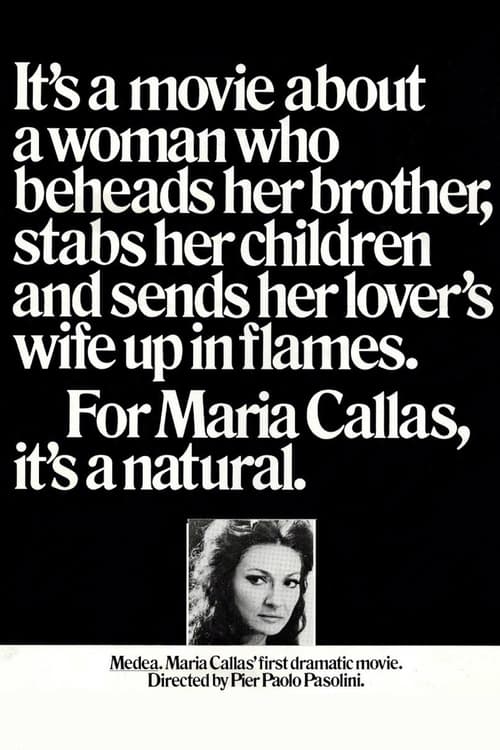
Medea
1969 · Pier Paolo Pasolini
For a night when you want something austere and haunting to chew on — myth taken seriously as myth, not as costume drama. A challenging watch that pays off in images you won't shake.
What it's about
A retelling of the Greek myth in which Medea — priestess of a remote, ritual-bound civilization — helps Jason seize the Golden Fleece and follows him into the Greek world, where she has no place and no power. Years later, when Jason sets her aside for a politically useful marriage, the story turns toward her revenge. Maria Callas, in her only film role, plays Medea.
The experience
Slow, strange, and hypnotic — long ritual passages with little dialogue, sun-scorched landscapes, and a mounting sense of dread as an ancient way of being collides with a colder, transactional world. It feels less like a filmed play than an excavation.
Performances
Maria Callas, the century's most famous opera singer, never sings a note — she acts largely in silence, all watchfulness and banked fury, and her face carries stretches of the film where almost nothing is spoken.
The craft
Pasolini shoots real archaic-looking landscapes and stages ritual with an anthropologist's patience, deliberately refusing prettiness in favor of texture — rock, dust, blood, ornament. The costuming and locations make the ancient world feel genuinely foreign rather than decorative, and the compositions reward a big screen.
Why it matters
Coolly received on release and long undervalued, it has grown in stature as the final panel of Pasolini's mythic cycle and as one of cinema's most radical treatments of Greek tragedy — and it preserves Callas's only screen performance.
Snapshot
Pasolini's Medea is the last and coldest panel of the mythic cycle he built in the second half of the 1960s, and the least conciliatory. Working from Euripides but discarding most of his text, Pasolini turns the tragedy into an anthropological argument: Medea is not a jealous wife but the last living representative of an archaic, sacral civilization stranded inside a rational, transactional one. The film is famous for a single piece of casting — Maria Callas, in her only screen role, acting rather than singing — and for the way that casting was almost immediately misread. Marketed on the fame of the century's most celebrated soprano, it delivered a nearly silent, ritual-heavy, deliberately unbeautiful film in which the star spends long stretches watching, walking, and saying nothing. It was received coolly, has been undervalued for decades relative to Teorema and Salò, and has since become one of the essential Pasolini texts for anyone interested in the encounter between cinema, myth, and ethnography.
Industry & production
Medea was made inside the Italian art-cinema economy of the late 1960s, a system in which a director with Pasolini's notoriety could still raise international money on the strength of scandal and a marketable name. The production was assembled by Franco Rossellini — nephew of Roberto Rossellini, and a producer with a taste for prestige literary and mythological material — as a European co-production with Italian, French and West German partners. The Callas casting was the financial engine: it gave the project a level of press attention that a Pasolini film about Bronze Age fertility rites could not otherwise have commanded.
That attention arrived pre-loaded. Callas had effectively withdrawn from the operatic stage by the late 1960s, and her separation from Aristotle Onassis, who married Jacqueline Kennedy in 1968, was among the most publicized private events in Europe. The press framing was irresistible and reductive: the abandoned woman playing the abandoned woman. Pasolini and Callas became genuine friends during and after the production, and he later dedicated poetry to her; but the promotional apparatus around the film sold a melodrama that the film itself refuses to deliver. The gap between what audiences were promised and what they got is a real part of the film's commercial history.
Shooting was ambitious and logistically demanding, consistent with Pasolini's practice since Il Vangelo secondo Matteo (1964) of finding his settings in the physical world rather than building them. Colchis, Medea's homeland, was shot in the volcanic tufa landscape of Cappadocia in central Anatolia, with its rock-cut dwellings and eroded cones. Corinth — the rationalized Greek city — was assembled from the medieval fortifications of Aleppo in Syria and, in a famous act of deliberate anachronism, the Romanesque ensemble of the Piazza dei Miracoli in Pisa. Additional Italian coastal work was done in the lagoon landscape around Grado. This geographic collage is not incidental: by building "Greece" out of Syrian and Italian medieval architecture, Pasolini strips the classical world of its neoclassical associations and makes it strange.
The film opened in Italy at the end of 1969 and did not perform to the expectations its star had generated. Precise commercial figures are not something I can responsibly reconstruct here; what the record supports is that it disappointed relative to Teorema, and that Pasolini himself spoke about it with a certain reserve. He moved almost immediately to Appunti per un'Orestiade africana (1970), a documentary-essay continuation of the same line of thinking, before abandoning the mythic register altogether for the Trilogy of Life.
Technology
Technologically, Medea is austere. It was shot on 35mm color negative in a widescreen frame, with no optical effects work of consequence and nothing that could be called a special effect in the industrial sense. The fire that consumes the palace and, in one version of events, Glauce's poisoned garment is practical. The mythological creature at the film's center — the centaur — is achieved with a horse-body prosthetic photographed at distance and in profile, an openly artisanal solution that Pasolini makes no attempt to naturalize; the seam is part of the meaning.
Two technological conditions shape the film decisively. The first is the zoom lens, which Pasolini had adopted as a signature instrument and which allows him to reframe within a shot without cutting — to move from a landscape to a face, or from a face to the crowd behind it, as an act of attention rather than of montage. The second is Italian post-synchronization. Like virtually all Italian production of the period, Medea was shot without usable direct sound and assembled its entire audio track in post: voices, atmospheres, and music are all laid onto the image afterward. This is normally treated as a limitation. Pasolini treats it as a freedom. It permits him to cast a Frenchman, a Greek-American soprano and an Olympic athlete in the same film without regard to their voices at the moment of shooting, and it makes the soundtrack a constructed, non-diegetic space rather than a record of the location. The film's characteristic acoustic — bone-dry wind, footsteps, and then an abrupt eruption of recorded traditional music with no source in the frame — is a direct consequence of that method.
Technique
Cinematography
Ennio Guarnieri photographed the film, and his work is one of the reasons Medea looks unlike either Edipo Re or Teorema. The palette is earth, ash, dust and blood — ochres, umbers, a bleached sky — with saturated ritual reds and golds concentrated in costume and object. Guarnieri shoots the Anatolian landscape in wide, static, often high compositions that dwarf the human figures and refuse the picturesque; the rock formations are photographed as geology, not scenery. Against this he sets Pasolini's most characteristic device: the frontal close-up, the face presented flat to the camera in the manner of a painted icon rather than a psychological portrait. Pasolini's long-standing interest in pre-Renaissance and Byzantine painting is visible less in specific quotation than in this refusal of depth — faces held in the plane of the image, addressing the viewer rather than the fictional space.
Editing
Nino Baragli, Pasolini's editor from Accattone onward, cuts the film in a way that consistently violates the smoothing conventions of continuity. Eyelines don't match; shot-reverse shot is used sparingly and without the connective glue of matched screen direction; ritual sequences unfold at documentary length, far past the point at which a conventional film would have extracted their narrative content. The most radical editorial decision is structural: the destruction of Glauce and Creon is presented twice, in two mutually exclusive versions. In the first, the poisoned robe and diadem work as magic, consuming the princess and her father in fire. In the second, the same events replay without any supernatural agency: Glauce, overwhelmed, throws herself from the walls, and Creon follows. Pasolini does not mark either as dream or reality. The duplication itself is the argument — magic and psychology are two languages describing one event, and the film declines to arbitrate.
Mise-en-scène / staging
The production design was by Dante Ferretti, in what became his first collaboration with Pasolini and the beginning of one of the most consequential careers in international art direction; costumes were by Piero Tosi, working in a register far from the Viscontian opulence he was best known for. Their joint achievement is a world assembled from real materials — felt, leather, bone, raw metal, unrefined wool — with no visible reference to the marble-and-column vocabulary of the classical film. Medea's Colchian costume is a construction of heavy layered fabric and metalwork that functions as armor and reliquary at once; her arrival in Corinth is staged as an unmasking, the ritual carapace exchanged for something plainer and thinner.
Staging is largely processional. Bodies move in groups, in lines, across ground; the film's central Colchian sequence is a fertility sacrifice in which a young man is bound, killed, dismembered, and his blood and body scattered across the fields — staged with a patient, non-sensational literalism drawn from ethnographic accounts of vegetation ritual rather than from any dramatic tradition.
Sound
Medea has no composed score. In place of one, Pasolini assembles a soundtrack from recordings of traditional and liturgical musics from outside the Western art tradition — Iranian, East Asian and Eastern European sources are the ones most consistently identified — deployed in blocks against silence and wind. The precise cue-by-cue provenance of these recordings is not well documented in the accessible record, and I won't invent attributions. The effect, though, is unambiguous: the music does not underscore emotion, it declares cultural belonging. When it enters, we are in the sacred world; when it withdraws into wind and footfall, we are in Corinth.
Dialogue is scarce. Pasolini retains fragments of Euripides but discards the great rhetorical set-pieces almost entirely, and eliminates the chorus as a speaking body. Long passages of the film are effectively wordless.
Performance
Callas gives a performance built almost entirely on stillness, weight, and the eyes — no operatic gesture, no vocal projection, an actor's instrument she had never used deprived of the one she had spent her life perfecting. It is not a conventionally "good" film performance and was not received as one; it is a presence, monumental and increasingly hollowed-out, which is precisely what the film requires. Around her, Pasolini deploys his usual mixed ecology of bodies: Giuseppe Gentile, a triple jumper who had taken bronze at the 1968 Mexico City Olympics, plays Jason as an athlete's physique with nothing behind the face — the point being that Jason is a man with no interior because his civilization has no sacred; Massimo Girotti, the star of Visconti's Ossessione a quarter-century earlier, brings professional gravity to Creon; Laurent Terzieff plays the Centaur; Margareth Clémenti is Glauce.
Narrative & dramatic mode
Pasolini reorganizes Euripides drastically. Euripides begins in Corinth, after the betrayal; Pasolini spends roughly the first half of his film on everything Euripides left as backstory — Jason's education by the Centaur, the Argonauts' voyage, the theft of the Golden Fleece, Medea's betrayal of her own father and brother. This is not padding. By dramatizing the Colchian material, Pasolini establishes what Medea is before she is wronged, so that her revenge reads not as passion but as the return of a suppressed cosmology.
The dramatic mode is anti-psychological and anti-rhetorical. There is no soliloquy of deliberation, no chorus mediating between protagonist and audience, minimal causal explanation. Instead the film proceeds by juxtaposed blocks — ritual, journey, exile, vision, act — and by the doubled catastrophe described above. The Centaur functions as the film's only expository voice, and Pasolini splits him into two: the mythic hybrid who educates the boy Jason, and a fully human man who addresses the adult Jason, with both eventually present in the same frame. The demythified centaur explains that the sacred one has not been replaced but persists alongside him, unconsulted. That doubling is the film's thesis in figural form.
Genre & cycle
Formally the film sits inside the international art-cinema "mythological" mode, but it belongs first to Pasolini's own internal cycle. Edipo Re (1967), Teorema (1968), Porcile (1969) and Medea (1969) constitute a sustained four-film investigation into myth, the sacred, and their liquidation by modern rationality; Appunti per un'Orestiade africana (1970) is its documentary coda. That cycle was itself continuous with Pasolini's theatrical work — the verse tragedies of his 1968 Manifesto for a New Theatre, including Pilade, an Orestes sequel — and with his 1960 translation of Aeschylus' Oresteia for Vittorio Gassman's company.
Set against the commercial peplum tradition and the muscular classical epics of the 1950s and 60s, Medea is a deliberate negation: no spectacle of empire, no heroism, no Mediterranean sunlight. Its nearest relatives are not Italian at all but the contemporaneous international turn toward ritual and ethnographic form.
Authorship & method
Pasolini wrote, directed, and — characteristically — theorized the film. His method here is the practical application of positions he had staked out in essays such as "Il cinema di poesia" (1965), where he proposed that cinema's raw material is reality itself, and that a poetic cinema works by making the camera's own perceptual choices felt rather than transparent. The zooms, the frontal faces, the refusal of eyeline matching, the ethnographic patience with ritual — these are the visible marks of that program.
His intellectual sources for Medea were anthropological rather than literary: Frazer's The Golden Bough on vegetation sacrifice and the killing of the divine king; Mircea Eliade on sacred and profane structures of time and space; and, in the Italian context, Ernesto de Martino's ethnographies of magic and ritual in the Italian south, which had made archaic religiosity a live subject for Italian intellectuals rather than a colonial curiosity. Pasolini's political conviction — that neocapitalism was completing a "cultural genocide" more total than fascism had achieved — gives this material its urgency. Colchis is not the past; it is the Third World, and the Italian peasant world, being erased in the present.
The key collaborators are consistent with that method. Baragli's editing, Guarnieri's photography, Tosi's costumes and Ferretti's sets each work against period prettiness and toward material fact. The absence of a composer is itself an authorial choice: Pasolini treats found ethnographic recording as more truthful than any score he could commission.
Movement / national cinema
Medea belongs to the late phase of postwar Italian art cinema, when the generation that had inherited neorealism was pushing its location-based, non-professional-cast methodology into territory neorealism never imagined. Pasolini's debt to Rossellini is structural rather than stylistic — the conviction that a film should be made in and out of the real world — but his conclusions are the opposite of humanist. Where Antonioni diagnosed modern alienation from inside the bourgeoisie and Fellini turned inward to memory and spectacle, Pasolini went outward and backward, to Anatolia, to Africa, to peasant survivals, seeking a form of life not yet processed by capital.
The film is also a document of the co-production Europe of its moment: Italian direction, French and German money, Turkish and Syrian locations, a Greek-American star, a French lead actor. That transnational assembly is inseparable from the film's subject.
Era / period
1969 is the hinge year. Italy was entering the autunno caldo of mass labor unrest, and within months the Piazza Fontana bombing would open the anni di piombo. Pasolini's relationship to the student movement was famously adversarial — he had attacked the protesting students of 1968 as bourgeois sons in a widely reprinted poem — and Medea should be read against that dissent. Its pessimism is not the left's optimism about revolution but a conviction that the revolution had already happened, consumerism had won it, and what was being lost was irrecoverable. That position hardened over the following years into the polemics collected as the Scritti corsari, and it is already fully formed here.
Themes
The governing opposition is sacred versus rational, embodied as Colchis versus Corinth. Medea's world is one in which the sun is addressed, the earth is fed with blood, and every act has cosmological weight; Jason's is one of technique, negotiation, and advantage, in which the Fleece is an object of value rather than a locus of power. When Medea arrives in Corinth she suffers something closer to ontological collapse than to jealousy — she has lost not a husband but the ground of meaning, and she says as much when she cries out that the ground beneath her no longer speaks.
From this flows the film's treatment of exile and barbarism: Medea is the foreign woman whose otherness is tolerated while useful and lethal once inconvenient, a configuration that has made the film central to postcolonial and feminist readings since the 1990s. There is also Pasolini's persistent theme of the body as the last site of the sacred, and the infanticide reframed not as maternal madness but as a ritual act — the sacrifice of what is most valuable, performed correctly, by the only person left who knows how.
Reception, canon & influence
Contemporary reception was mixed and, in Italy, tinged with disappointment. The film had been sold on Callas and delivered anthropology; reviewers who came for the diva found a performance stripped of everything she was famous for, and reviewers who came for Pasolini found a film less immediately provocative than Teorema or Porcile. It was not a scandal, which for Pasolini was itself a kind of failure. For roughly two decades it remained the least-discussed film of the mythic cycle.
Its backward lines are clear and multiple: Euripides, filtered through a rejection of Euripides' rhetoric; Frazer, Eliade and de Martino; Rossellini's location-based realism; Byzantine and pre-Renaissance painting's frontality; and Pasolini's own theater and translation work on Greek tragedy. The 1960s ethnographic film culture that produced Jean Rouch is a live context, and Pasolini's own Appunti per un film sull'India (1968) shows the method being tested before Medea applied it to fiction.
Forward, the film's influence runs along several channels. Most concretely, it launched Dante Ferretti's career with Pasolini, a partnership that continued through Salò and led to Ferretti's long collaborations with Fellini, Terry Gilliam and Martin Scorsese — a direct material line from this film to some of the most elaborate production design of the following half-century. Aesthetically, Medea became a reference point for filmmakers pursuing myth through landscape, ritual and non-professional bodies rather than through narrative: the strain in contemporary Italian cinema running through Michelangelo Frammartino, Alice Rohrwacher and Pietro Marcello is explicitly Pasolinian, and Medea's particular fusion of archaic ritual with a materialist critique of modernity is one of its clearest sources. Its treatment of the Callas persona has also made it a permanent object of opera and star studies.
Critical rehabilitation came with the broader reassessment of Pasolini from the 1990s, driven by postcolonial theory, gender studies, and renewed interest in his anthropological writings — the film's argument about cultural genocide reads considerably less eccentric now than it did in 1969. Restored versions have circulated widely in recent decades, and Medea now sits securely in the canon of the mythological art film, less as the Callas curiosity it was sold as than as the most rigorous statement Pasolini ever made about what modernity destroyed.
A Deleuzian reading
Maria Callas walks across volcanic rock in felt, leather and beaten metal, and says nothing.
The full Deleuzian reading of Medea →
Reception
A commercial flop on release and seen as one of Pasolini's most forbidding films, it has climbed steadily via restorations and the enduring Callas cult — now it's a prized deep cut rather than a footnote.
How Medea was received, from release to now →
How to watch Medea: what to notice on a first viewing
- Listen for music that isn't a composed score at all. Pasolini has no composer; instead he lays in traditional and liturgical recordings from outside the Western tradition, deployed in blocks against silence and wind. The music tells you which world you're standing in, not how you should feel about it.
- Watch faces held flat to the camera, like painted icons. Ennio Guarnieri shoots Pasolini's signature frontal close-up, a face presented directly to the lens rather than staged within a believable three-dimensional space. The face addresses you directly instead of just existing inside the story.
- Watch Callas hold stillness instead of any operatic gesture. In her only film role, Callas plays Medea on weight and the eyes alone, denied both her voice's projection and any conventional actor's expressiveness. Her stillness reads as one held quality rather than a performance shifting scene to scene.
- Watch costumes built from felt, leather, and raw metal. Piero Tosi and Dante Ferretti dress the world in real, unrefined materials, no marble or classical vocabulary, so Medea's Colchian dress functions like armor and reliquary at once. Her clothing carries as much of her identity as anything she says.
- Notice how little dialogue Medea actually has in this film. Pasolini discards most of Euripides's rhetoric and drops the chorus entirely, so long passages of the film advance through ritual and image rather than speech. With no chorus left to receive her, Medea's world has almost no one left to speak to.
The whole guide to watching Medea, with the keys for a rewatch →
Influences: the films it descends from and the films it influenced
- The Passion of Joan of Arc (1928) — Dreyer's grid of frontal, ground-less close-ups deliberately unmoored from matching eyelines gives Pasolini the exact device Guarnieri turns on Callas — the face shot head-on as a painted icon, with surrounding space refused rather than established.
- Stromboli (1950) — The tonnara sequence — a real fishing ritual filmed at its own documentary length with the actual fishermen, the imported star simply placed inside it — is the template for Colchis, where ceremony is granted ethnographic duration and the diva becomes a foreign body within it.
- Les maîtres fous (1955) — Rouch films a possession rite in continuous ethnographic duration and lays post-synchronized commentary over mute images; Pasolini imports both procedures into fiction for the vegetation sacrifice and dismemberment, including the wholly rebuilt post-sync soundtrack.
- The Gospel According to St. Matthew (1964) — Establishes the method Medea inherits intact: southern Italian sites cast as the ancient Levant, non-professionals chosen for physiognomy, pre-Renaissance frontality in the framing, and borrowed non-Western music (Missa Luba) used as found sacred sound instead of score.
- Oedipus Rex (1967) — The immediate prototype — Greek tragedy shot in Moroccan earth-and-ash locations, the myth split by bracketing time-frames, and the music assembled from Romanian doina and Japanese gagaku field recordings, the 'no composer' principle Medea then pushes to its limit.
- Notes Towards a Film on India (1968) — The handheld, zoom-driven ethnographic looking Pasolini tested on Indian ritual and faces transfers directly into fiction here; the intrusive zoom in Medea is documentary reflex made visible as authorial perception, not decoration.
- Elektra, My Love (1974) — Relocates Greek tragedy to the puszta as continuous ritual choreography of massed non-speaking bodies, with the zoom and the reframing camera declared as the film's perceptual instrument — cinema di poesia applied to the same tragic source.
- Salò, or the 120 Days of Sodom (1975) — The direct material line: Dante Ferretti, whose career Medea launched, carries forward its principle of sets built as historical fact rather than period decor — the discipline he then took to Fellini, Gilliam and Scorsese.
- Medea (1988) — Films the same Euripides text as landscape-determined fate on the Jutland flats and keeps Pasolini's anti-rhetorical solution — the killings performed as wordless ritual gesture in raw terrain, the acting stripped of tragic declamation.
- Antigone (1992) — Sophocles staged frontally in the real Greek theater at Segesta with performers forbidden expressive delivery, extending Medea's proposition that tragedy is recovered by refusing psychological acting and letting a site's actual duration and light carry the text.
- Le quattro volte (2010) — Films the charcoal kiln and the Calabrian pita — a fir felled, raised and brought down as communal vegetation rite — in near-wordless ethnographic long takes with villagers playing themselves: Medea's Frazerian staging executed as documentary.
- Hors Satan (2011) — Frontal, blank-faced non-professional close-ups held against a single landscape, a killing performed as unexplained ritual, and no music whatsoever — the most literal continuation of Pasolini's anti-psychological physiognomic casting.
- Lost and Beautiful (2015) — Mixes film stocks and registers to move a masked Pulcinella and a speaking buffalo through a genuinely ruined Campania, treating the peasant south as a mythic culture being erased in the present — Medea's cultural-genocide thesis in documentary-fable form.
- Happy as Lazzaro (2018) — Shoots a sharecropper world on grainy 16mm with local non-professionals and builds it as a saint's legend snapped in two by a leap into neocapitalist modernity — Medea's doubled catastrophe and its argument that modernity annihilates the archaic sacred.
- To the Left of the Father (2001) — Fuses ritual tableau, archaic costume and sun-baked agrarian ethnography into myth, the model for treating family-tragedy as pre-modern rite staged as living painting.
- Ballad of Tara (1979) — Archaic-mode method Beyzai converges with: myth performed by non-professional crowds in unmodified landscape, with declamatory post-synchronized dialogue laid over the image so speech reads as recitation rather than location sound.
- Fellini Satyricon (1969) — Fellini treats antiquity as an alien culture requiring translation — casting by physiognomy, crowds of unspeaking archaic faces, dialogue rebuilt in post as a polyglot dub — the same rejection of costume-drama legibility Pasolini pursues through anthropology.
- The Color of Pomegranates (1969) — Built the same year out of flat frontal tableaux in which ritual objects and gestures replace causal narrative and sound is deliberately non-synchronous — an identical substitution of iconographic presentation for psychological continuity.
- Antonio das Mortes (1969) — Rocha stages popular religiosity as actual ritual performance in raw landscape with non-actors and hieratic frontal blocking, folding the sacred into an anti-imperial argument — the Third Cinema counterpart to Pasolini's Colchis-as-Third-World.
- The Wicker Man (1973) — Arrives at Medea's material by the same route — Frazer's Golden Bough and the burned year-king who renews the crop — and builds its entire soundtrack from diegetic folk song rather than composed score.
- The Night of Counting the Years (1969) — Its ceremonial, near-anthropological staging of a pre-modern sacred order in real monumental locations, with performance calibrated as rite, runs exactly parallel to Al-Mummia's contemporaneous archaic tableau.
Similar films
- The Passion of Joan of Arc (1928) — influence & lineage
- Satyricon (1969) — influence & lineage
- Jason and the Argonauts (1963) — often watched together
- Titus (1999) — often watched together
- L'Avventura (1960) — often watched together
- L'Eclisse (1962) — often watched together
- Journey to Italy (1954) — often watched together
- Viridiana (1962) — often watched together
All the films related to Medea →
Watch it with: curated runs of related films
- Love Against the Grain — A run of films where desire refuses the shape its world demands — opera stages, drought-struck Taipei, an honor-bound Lahore household, drenched Buenos Aires — and burns brighter, and more dangerously, for the refusal.