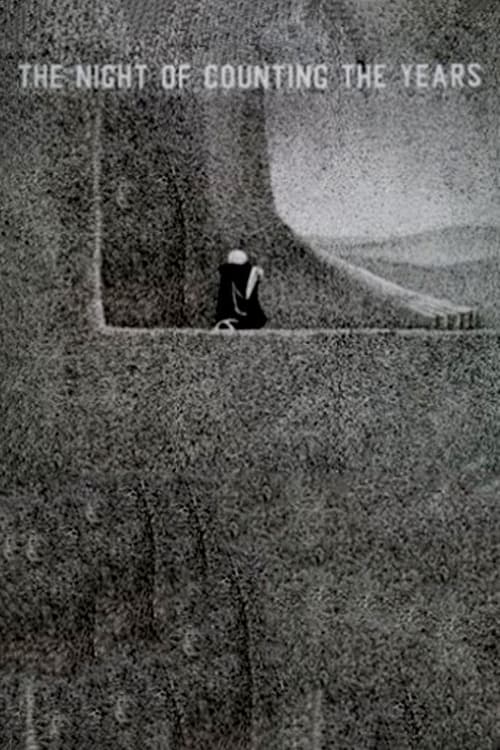
The Night of Counting the Years
1969 · Shadi Abdel Salam
For a patient night when you want cinema as trance — something austere and haunting to sink into slowly, not a quick fix. This is a challenge that pays off in atmosphere you won't shake for days.
What it's about
In 1881 Upper Egypt, a mountain clan near Luxor has quietly survived for generations by looting a hidden cache of royal mummies and selling the treasures piece by piece on the black market. When the patriarch dies and the secret passes to his sons, the youngest, Wanis, learns exactly what has been feeding his family — just as government antiquities men arrive by steamboat to hunt down the source of the relics. He's left carrying an impossible choice between his kin and his dead ancestors.
The experience
Slow, solemn, and hypnotic — it moves like a ritual, all silences, wind, and figures in black crossing pale desert rock. The mood is closer to a waking dream than a thriller, and it settles over you with a strange, mounting gravity.
The craft
Shadi Abdel Salam trained as an architect and it shows: every frame is composed like a monument, with formal classical Arabic dialogue delivered almost as incantation. The desert light, the funereal pacing, and the eerie score make it one of the most visually distinctive films ever made in Egypt — see it on the biggest screen you can.
Why it matters
Routinely named the greatest Egyptian film ever made and a landmark of Arab cinema, it was the only feature its director completed — a single, perfect statement that later restoration efforts brought back to world audiences.
Snapshot
The Night of Counting the Years — released in Arabic as Al-Mummia (The Mummy) — is the only completed feature film by the Egyptian architect, designer, and director Shadi Abdel Salam, and it is routinely named among the greatest films ever made in the Arab world. Adapted by Abdel Salam from a documented episode of the 1880s, it dramatizes the crisis of the Abd el-Rasul clan of Kurna (Gourna), on the Theban west bank near Luxor, who for years quietly sustained themselves by looting a hidden royal cache of mummies — historically the Deir el-Bahari cache designated DB320/TT320 — and selling antiquities on the black market. When the family patriarch dies and the two elder brothers initiate the two younger ones into the secret, the youngest, Wanis, is thrown into a moral vertigo: the wealth that feeds his people is drawn from the desecration and dispersal of their own ancestral dead. The film's power lies less in incident than in its hushed, ceremonial gravity — a meditation on heritage, conscience, and national identity rendered in a stately, near-hieratic style that has few parallels in Egyptian commercial cinema. It has since become a touchstone of Arab art film and, after a 2009 restoration championed by Martin Scorsese's World Cinema Foundation, a fixture of international repertory programming.
Industry & production
The film was produced within Egypt's nationalized film sector, under the umbrella of the state's General Egyptian Cinema Organization, the body through which the Nasser-era government funded and administered production in the 1960s. This state framework is essential context: a slow, formally austere, non-commercial film built around classical Arabic and archaeological ritual was possible precisely because it did not have to answer to the melodrama-and-star economics that dominated the private Egyptian market.
The production also carries a notable international dimension in the involvement of Roberto Rossellini, whose name is attached to the film as a presenter/sponsor. Rossellini's endorsement is generally understood to have helped the film reach festival and art-house audiences abroad rather than to have shaped its direction, which was wholly Abdel Salam's; the precise contours of his contribution are described somewhat variably across sources, and it is fair to say the record is thin on operational specifics. The music was composed by the Italian film composer Mario Nascimbene, a further sign of the film's cross-Mediterranean production culture. Reliable box-office figures do not exist in the public record, and it would be misleading to assign any; the film's commercial footprint at release was modest, and its reputation was built over subsequent decades.
Technology
The Night of Counting the Years was shot on 35mm color stock (Eastmancolor-era color negative), using extensive location work in Upper Egypt — the Theban necropolis, temple precincts, the desert plateaus, and the Nile itself — rather than studio reconstruction. This choice of real, weathered, monumental settings is inseparable from the film's technological and aesthetic identity: the antiquity is not built but found. I would avoid stating a definitive aspect ratio here, as the technical record commonly cited for the film is not unambiguous on that point. What can be said with confidence is that the film exploited the resources of a mature national industry — trained crews, color processing, sync-sound capability — while deliberately refusing that industry's habitual pace and register.
The film's most consequential later "technology" story is its restoration. By the 2000s surviving elements had deteriorated, and the film was digitally restored around 2009 under the aegis of the World Cinema Foundation (later the Film Foundation's World Cinema Project), the initiative founded by Martin Scorsese to rescue neglected films from outside the Euro-American mainstream. That restoration returned the film to wide circulation and is the version most viewers now encounter.
Technique
Cinematography
The cinematography, by Abdel Aziz Fahmy, is the film's signature achievement and one of the reasons it reads as unlike anything in the surrounding commercial cinema. Fahmy and Abdel Salam favor slow, deliberate camera movement — measured pans and creeping zooms — and long-held static compositions that treat the frame as an architectural or sculptural space. Figures are frequently arranged in the deep, arid expanses of the Theban landscape or against the columns and stone of the temples, so that human beings appear small, fixed, and monumentalized against a geology of the past. Light is used gravely: the harsh clarity of desert daylight and the pooled darkness of tombs and interiors carry much of the film's mood. The overall effect is contemplative and ceremonial, the visual equivalent of a dirge.
Editing
The cutting is unhurried, patient, and subordinated to composition and duration rather than to momentum. Shots are allowed to breathe; transitions tend toward the solemn rather than the propulsive, reinforcing the film's ritual tempo. (The specific editing credit is one place where readily verifiable documentation is comparatively thin, so I will not attach a name I cannot confirm.) What matters technically is the philosophy of the cut: the film privileges stillness and accumulation over action, and its rhythm is one of mourning and dawning realization rather than suspense.
Mise-en-scène / staging
As a former production and costume designer, Abdel Salam brought an exacting scenographic sensibility to every element within the frame. Costume, gesture, and the placement of bodies are handled with the deliberation of tableau. Characters often stand or sit in frozen, statuesque poses; group scenes are blocked with a frontal, almost friezelike formality that evokes the very Pharaonic art the story concerns. The staging repeatedly rhymes the living clan with the dead they exploit — both are treated as figures in a continuous, unbroken lineage of Egyptian time. This is mise-en-scène as argument: the form insists on continuity between the ancient dead and their modern descendants.
Sound
Sound is central to the film's estranging, elevated register — above all through language. The dialogue is delivered in classical/literary Arabic (fuṣḥā) rather than the Egyptian colloquial that was standard in the national cinema. This decision lifts the speech out of everyday realism into something incantatory and timeless, aligning the villagers' words with scripture and inscription. Mario Nascimbene's score compounds the effect: known for adventurous, texturally strange film music, Nascimbene supplies sonorities that feel archaic and otherworldly, evocative of wind, lament, and antiquity rather than conventional dramatic underscoring. Ambient sound — wind over stone, the movement of the river — is given room to register. The soundscape as a whole functions to remove the film from the present tense.
Performance
The performances are pitched to match the film's hieratic style: restrained, interiorized, and often static, closer to the bearing of figures in a ritual than to naturalistic acting. Ahmed Marei plays Wanis, the young man whose conscience drives the drama, and much of the film's emotional weight rests on his watchful, tormented stillness. The ensemble — including the established star Nadia Lutfi and other Egyptian players of the period — subordinates individual bravura to the collective, sculptural mood. Faces are frequently held in contemplative repose; emotion surfaces through gravity and gesture rather than outburst. The acting style is, in effect, another instrument of the film's mournful formality.
Narrative & dramatic mode
The dramatic mode is tragic and contemplative rather than suspenseful, even though the underlying events — grave robbery, black-market smuggling, a killing within the family, the arrival of the authorities — could readily support a thriller. Abdel Salam declines that option. The narrative unfolds as a slow moral awakening: Wanis must weigh loyalty to his clan and its livelihood against the recognition that this livelihood consists of selling off the body of the nation's past. The conflict is thus staged at three scales at once — within the family, within the individual conscience, and within the idea of Egypt itself. The structure moves toward a decision (the alerting of the Antiquities Service and the removal of the mummies) that resolves the plot without dispelling its melancholy; the ending is elegiac, the salvage of the past shadowed by loss. This is closer to the mode of tragedy and lamentation than to the redemptive arc of conventional drama.
Genre & cycle
Nominally a historical drama, the film sits athwart genre. It is a period film and a heritage film, but it belongs to no established Egyptian production cycle; its severity and pace set it apart from the historical epics and social melodramas that its home industry produced. It has affinities instead with international art cinema of the 1960s and with a small, transnational lineage of films about archaeology, national memory, and the ethics of the past. If it belongs to any "cycle," it is the loosely defined new/alternative Egyptian cinema that emerged in the late 1960s in tension with the mainstream — but even there it stands as a singular object rather than one film among many of a kind.
Authorship & method
The film is inseparable from the biography and method of Shadi Abdel Salam (1930–1986). Trained as an architect and steeped in the visual culture of Pharaonic Egypt, Abdel Salam made his name not as a director but as a production and costume designer, contributing his scenographic expertise to Egyptian and international historical productions — work in the orbit of directors such as Youssef Chahine and on large-scale historical films of the early 1960s. The Night of Counting the Years was his debut feature, and it remained his only completed one; everything he had absorbed as a designer of historical worlds is concentrated in it. His method was that of a designer-auteur: total control over the look, the costumes, the compositions, and the ceremonial calibration of performance and language.
His key collaborators shaped the film decisively. Cinematographer Abdel Aziz Fahmy realized the film's grave, monumental image. Composer Mario Nascimbene supplied its archaic, unsettling score. Roberto Rossellini lent his name and international standing to help the film travel. Abdel Salam himself wrote the screenplay, drawing on the historical record of the Abd el-Rasul affair. After Al-Mummia he directed the acclaimed short The Eloquent Peasant and worked for years on an ambitious, ultimately unrealized feature about the pharaoh Akhenaten (often referred to as Ikhnaton / The Tragedy of the Great House), which remained unfinished at his death in 1986. That unrealized project has become part of his legend — the sense of a monumental cinema of ancient Egypt only partly built.
Movement / national cinema
The film is a landmark of Egyptian national cinema, but a deliberately unrepresentative one. Egypt's was the dominant film industry of the Arab world, famous for its stars, musicals, and melodramas; Abdel Salam's film pointedly refuses that idiom in favor of art-cinema austerity and literary Arabic. It is best understood as part of the reformist, state-supported current of the late 1960s — a moment when the nationalized industry could underwrite work of ambition and difficulty — and as a bridge between Egyptian cinema and the international festival art film. Its stature has only grown as Arab film culture has canonized it: in influential polls and critics' surveys of the best Egyptian films, The Night of Counting the Years is regularly placed at or near the very top.
Era / period
The film is doubly period. Diegetically it is set in 1881, on the eve of the 1882 British occupation of Egypt, at the moment when the Antiquities Service moved to secure the Deir el-Bahari royal cache — a hinge point when a centralized, national (and colonially entangled) stewardship of the past asserted itself over local, informal use of the tombs. Historically the cache had been discovered by the Abd el-Rasul family around the early 1870s and its existence exposed to the authorities in 1881, after which the mummies were removed and taken downriver to the museum in Cairo (then at Bulaq). Made in 1969, the film reflects a very different era — the post-Nasserist, post-1967 climate of national self-examination — and its inquiry into who owns and safeguards Egypt's heritage clearly resonates with the anxieties of its own moment as much as with 1881.
Themes
The governing theme is heritage and its custodianship: to whom does the past belong, and what does it cost a people to sell it? Around this cluster several others. Conscience versus community: Wanis's individual moral awakening pits him against the survival strategy and blood loyalty of his clan. National identity and continuity: the film insists, formally and dramatically, on an unbroken line between the ancient dead and the living Egyptians who inhabit their landscape — a vision of the nation as a single body across millennia. Desecration and mourning: the plundering of the mummies is figured as a violation of the dead and, by extension, of the self, and the film's whole affect is elegiac. Knowledge, naming, and identity: the recovery of the mummies is also a recovery of names and history, a theme the title itself — evoking the language of ancient Egyptian funerary belief — quietly foregrounds. Underlying all of these is a meditation on time: the film asks the living to reckon with the weight of an ancestry they can neither escape nor fully honor.
Reception, canon & influence
Critically, the film's reputation has followed an arc from relative obscurity at release to canonization. It did not conquer the commercial market, but over the following decades it accrued enormous prestige among critics and filmmakers as a rare instance of Egyptian cinema operating at the level of world art film; it appears at or near the summit of major surveys of the best Egyptian and Arab films. Its 2009 restoration under Martin Scorsese's World Cinema Foundation and subsequent festival and repertory screenings introduced it to a new international audience and cemented its status as a rediscovered classic.
Influences on the film (backward): the work draws on the traditions of art cinema and slow, contemplative dramaturgy associated with 1960s international filmmaking; on Abdel Salam's own deep training in Pharaonic art, architecture, and design; and on the documented historiography of the Abd el-Rasul affair and the Deir el-Bahari cache. The Rossellini connection situates it, at least in spirit, near the humanist-historical strain of Italian postwar cinema.
Legacy (forward): the film's influence is felt less in direct imitation than in the standard it set for a serious, formally rigorous Arab art cinema concerned with history, memory, and national self-understanding. It became a foundational reference point for later Arab filmmakers and critics arguing that Egyptian cinema could produce work of the highest artistic ambition, and its restoration has kept it alive as an object of study and homage. Abdel Salam's own aborted Akhenaten project extended, in the imagination of admirers, the promise of Al-Mummia into a cinema that never fully came to be — which has only deepened the singular, monumental place this one completed feature holds in film history.
Reception
Barely seen on release — it went almost unscreened in Egypt for years while festivals abroad embraced it — the film was rescued from near-invisibility when Martin Scorsese's World Cinema Foundation restored it in 2009, and it's now routinely called the greatest Egyptian film ever made.
How The Night of Counting the Years was received, from release to now →
Influences: the films it descends from and the films it influenced
- The Rise to Power of Louis XIV (1966) — Rossellini's didactic historical method—ceremony and daily ritual observed at cool distance in long, static, non-dramatized takes with non-professional players—is the humanist-reconstruction template Abdel Salam inherits (and Rossellini personally lent his name to the film's travel).
- El Naser Salah el Dine (Saladin) (1963) — On this and other early-'60s historical epics Abdel Salam worked as costume/production designer, absorbing the scenographic construction of monumental period worlds that he later concentrated, as designer-auteur, into a single frame-obsessed feature.
- Day of Wrath (1943) — Dreyer's grave, frieze-like tableaux and glacial lateral compositions—figures arranged like carved reliefs in shadowed interiors—prefigure Al-Mummia's friezelike staging and hieratic solemnity.
- The Trial of Joan of Arc (1962) — Bresson's 'model' acting—affect drained from face and voice so performance becomes ceremonial recitation—underwrites the film's hieratic restraint and flattened, incantatory delivery of classical Arabic.
- L'Avventura (1960) — Antonioni's use of duration and architecture—human figures dwarfed and stranded within monumental stone landscapes, drama dissolved into contemplative dead time—anchors the slow-cutting, static-composition dramaturgy Al-Mummia adopts among the ruins.
- The Leopard (1963) — Visconti's heritage-period mode—a materially exact, mournful spectacle of a passing order photographed with monumental gravity—models the film's tragic-contemplative treatment of custodianship and continuity giving way to a new age.
- The Eloquent Peasant (1970) — Abdel Salam's own follow-up short extends the identical designer-auteur method—hieratic performance, classical Arabic, and painstakingly reconstructed ancient-Egyptian décor rendered as static ceremonial image.
- Ceddo (1977) — Sembène's historical film builds meaning through frontal, static communal staging and long-held tableaux dramatizing a people's cultural continuity under threat—the same post-colonial national-heritage cinema Al-Mummia pioneered for Africa/the Arab world.
- Wanderers of the Desert (1984) — Khemir's contemplative Arab art cinema—monumental desert compositions, hushed pacing, and a fable of custodianship over vanishing tradition—directly extends Abdel Salam's model of a formally rigorous Arab film about heritage and loss.
- Yeelen (1987) — Cissé stages ancestral ritual and knowledge as slow, sculptural images set against monumental landscape, carrying forward Al-Mummia's fusion of hieratic performance with a national-mythic sense of inherited custodianship.
- The Travelling Players (1975) — Angelopoulos's austere long-take tableaux mapping national history and memory across time inherit the contemplative-cutting, tableau-driven approach to a nation examining its own past.
- The Death of Louis XIV (2016) — Serra revives the Rossellinian historical-ceremony method Al-Mummia shares—duration, candlelit static composition, and ritual observed rather than dramatized—as a late descendant of this hieratic period-reconstruction lineage.
- Oedipus Rex (1967) — Pasolini reconstructs the ancient world through anti-naturalist, ritualized bodies and archaic sound rather than psychological realism—the same 'documentary of a myth' impulse that governs Abdel Salam's hieratic ancient Egypt.
- Medea (1969) — Its ceremonial, near-anthropological staging of a pre-modern sacred order in real monumental locations, with performance calibrated as rite, runs exactly parallel to Al-Mummia's contemporaneous archaic tableau.
- The Color of Pomegranates (1969) — Paradjanov's static, frontal, frieze-like tableaux that turn national cultural heritage into a sequence of living icons is the direct formal twin of Abdel Salam's monumental-static compositions made the same year.
- The Round-Up (1966) — Jancsó's choreographed long takes staging power and coercion across bare monumental landscape share the film's friezelike blocking and refusal of conventional shot/reverse-shot editing.
Similar films
- The Color of Pomegranates (1969) — influence & lineage
- L'Avventura (1960) — influence & lineage · often watched together
- Medea (1969) — influence & lineage · often watched together
- Cairo Station (1958) — often watched together
- Once Upon a Time in Anatolia (2011) — often watched together
- Last Year at Marienbad (1961) — often watched together
- The Adventures of Prince Achmed (1926) — often watched together
- Nosferatu the Vampyre (1979) — often watched together