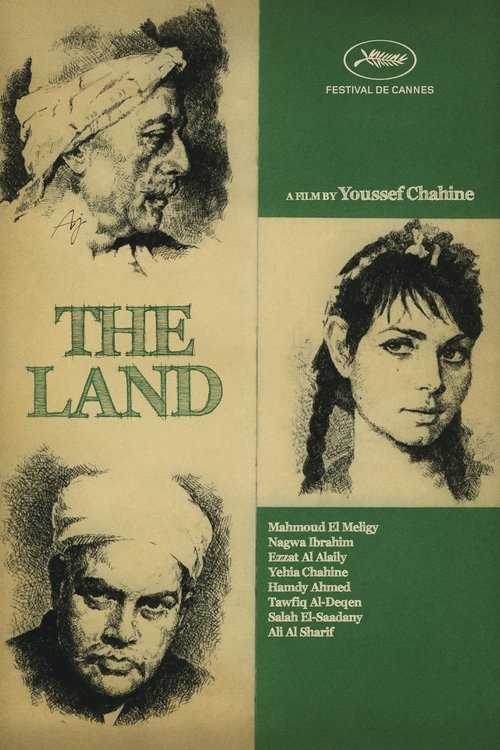
The Land
1970 · Youssef Chahine
For when you want a big, serious epic about ordinary people standing up to power — a film that leaves you moved and a little furious. This is a challenge night, not comfort viewing, and it earns the investment.
What it's about
In a Nile Delta village in 1933, peasant farmers learn their irrigation water is being cut so a feudal lord can take a bigger share. What starts as a dispute over watering days grows into a fight for the land itself when the landlord pushes a road project that would carve through their fields. The film follows the whole village — its proud farmers, its schemers, its educated go-between sent to petition the government — as solidarity is tested by intimidation, bribery, and force.
The experience
Earthy, impassioned, and steadily heartbreaking — it builds from village squabbles and stubborn pride to real dread as the pressure on the community tightens. You feel the heat, the mud, and the weight of people fighting for something they can't afford to lose.
Performances
Mahmoud El-Meliguy anchors the film as the aging farmer Abu Swailam, a performance of enormous dignity — proud, weathered, and devastating as the ground shifts under him.
The craft
Chahine directs a large ensemble with remarkable control, giving the village a lived-in texture — fields, canals, and crowded courtyards shot with real physical presence. The film moves like a novel, weaving a dozen characters into one collective story, and its final images are among the most famous in Arab cinema.
Why it matters
Widely considered one of the greatest films ever made in the Arab world and a peak of Youssef Chahine's career, it became the defining screen portrait of Egyptian peasant life and a touchstone for politically engaged cinema across the region.
Snapshot
The Land (al-Arḍ, الأرض) is Youssef Chahine's adaptation of Abdel Rahman al-Sharqawi's landmark 1954 novel of Egyptian peasant life, and it is routinely named alongside Cairo Station (1958) as one of the two summits of his career and one of the greatest films the Arab world has produced. Set in a Nile Delta village in 1933, under the monarchy and the residual weight of British influence, it dramatizes a community of fellahin (peasants) who unite to defend their water and their land against a feudal landlord, Mahmoud Bey, and the state apparatus that backs him. What begins as a dispute over irrigation days escalates into the expropriation of land for a road serving the Bey's estate, and the collective resistance fractures under intimidation, co-optation, and force. The film is remembered above all for its closing image — the peasant leader dragged across the fields by horses, fingers clawing the earth he will not release — one of the most quoted endings in Arab cinema. Its stature rests on this fusion of a rooted, materially specific portrait of rural labor with Chahine's restless, montage-driven style.
Industry & production
The Land was produced within the Egyptian public-sector film industry established after the 1961–63 nationalizations, when the state, through bodies associated with the General Egyptian Cinema Organization, became the principal financier and producer of ambitious features. This institutional context matters: it made possible a large-cast, location-shot, socially themed epic of a kind the commercial studio system rarely underwrote, and it aligned the film with the Nasser-era cultural project of a committed, socially conscious national cinema. Chahine had already worked at this scale on the state-backed historical epic Saladin (1963).
The project came to the screen after a long gestation of the source material in Egyptian culture: al-Sharqawi's novel had been a touchstone of the committed literary left since the 1950s. The film was made in the immediate aftermath of the 1967 defeat by Israel — the Naksa — a rupture that reoriented Egyptian and Arab intellectual life toward self-examination, and that gives the film's story of a betrayed collective struggle an unmistakable contemporary charge. Precise budget figures and box-office returns are not reliably documented in the accessible record, and I will not invent them. The film is generally dated 1969 for its Egyptian context and 1970 for its wider international circulation, including a presentation at the Cannes Film Festival; the exact festival status and any prizes should be treated cautiously, as sources are not consistent.
Technology
The Land was shot on 35mm color film — the Eastmancolor-type stock standard for Egyptian production of the period — a significant choice for a subject that could easily have been rendered in the austere monochrome of social realism. Color is used not decoratively but as a means of registering the physical world of the village: the ochres and greens of the fields, the dun of mud-brick, the whites of galabeyas against dark interiors. The production is heavily location-based, using real Delta landscape, canals, and village architecture rather than studio sets, which places demands on natural-light shooting and on moving a large ensemble through practical spaces. I cannot confirm the precise aspect ratio or lens package from the reliable record and will not assert specifics; the film's compositional language, however, clearly exploits a wide frame to hold crowds and to set the horizontal expanse of cultivated land against the human figures who work it.
Technique
Cinematography
The photography, by Abdelhalim Nasr — one of Chahine's recurring collaborators — is the film's sensory foundation. The camera is attentive to the texture of agricultural labor: hands in soil and water, the mechanics of irrigation, bodies bent to the ground. Chahine and Nasr repeatedly stage the human figure within, and dwarfed by, the landscape, so that the land is never merely a backdrop but a co-protagonist and the literal object of the drama. The film alternates between this expansive, near-documentary registration of place and a mobile, expressive camera that pushes into faces and crowds at moments of confrontation. The imagery of water — the canal, the irrigation turns that spark the conflict — recurs as both realistic detail and organizing motif.
Editing
Editing is where Chahine's authorial signature is most visible, and The Land is edited with the propulsive, associative energy that distinguishes his work from more sedate realist filmmaking. He favors dynamic cutting — rhythmic acceleration in scenes of collective action, confrontation, and violence — closer to a Soviet montage sensibility than to the long-take contemplation often associated with peasant realism. The film's structure builds a broad social canvas out of many threads and then tightens toward the crushing of the resistance, so that the montage itself enacts the movement from communal breadth to isolated defeat. Chahine's longtime editor Rashida Abdel Salam is associated with this phase of his career; readers should verify the specific credit against the film's titles, as I am relying on the pattern of his collaborations rather than a confirmed source for this title.
Mise-en-scène / staging
The staging is fundamentally collective. The Land is a film of the group — village councils, arguments in courtyards, work in the fields, processions and confrontations — and Chahine choreographs crowds with real command, letting the ensemble carry the political meaning that a single protagonist could not. Individual figures emerge from and recede into this mass. The village is built as a dense social organism, with its solidarities and its fault lines (the small landholder's interests diverging from the landless, the ambitions of the educated son, the pressures on the mayor) rendered spatially in who stands with whom. The result resists the sentimental homogenization of "the peasantry": the community is shown to contain the very divisions that its enemies will exploit.
Sound
The soundscape is grounded in the rural environment — water, work, the massed voices of the village — and the score is by the Egyptian composer Ali Ismail, whose music supports the film's oscillation between lyrical attachment to the land and mounting dread. Chahine draws on the affective resources of Egyptian popular and folk musical idiom without letting the film collapse into the song-driven structure of commercial melodrama. Specific details of the sound mix and any use of source music should be confirmed against the film itself; the reliable secondary record is thin on technical sound particulars.
Performance
The performances anchor the film's realism. Mahmoud El-Meliguy, one of the great character actors of Egyptian cinema, gives the peasant leader Muhammad Abu Suwailim a stubborn, weathered dignity that culminates in the film's harrowing final sequence. Ezzat El Alaili plays the younger, more radical Abd al-Hadi, embodying a generational and temperamental counterpoint. The ensemble — including performers such as Nagwa Ibrahim, Hamdy Ahmed, Tewfik El Deken, and Yehia Chahine — is directed toward a lived, unglamorous physicality appropriate to the material. Casting recognizable stars in a peasant milieu was itself a statement, lending weight and visibility to lives usually marginal to commercial cinema.
Narrative & dramatic mode
The dramatic mode is social-realist tragedy built on a collective, not individual, protagonist. The narrative engine is deceptively small — the reduction of the peasants' irrigation share, then the appropriation of land for a road — but Chahine expands it into a study of how power dismantles solidarity: through legal machinery, bribery and self-interest, the seduction of the ambitious, and finally naked violence. The arc is one of hope curdling into defeat; the "rising action" of collective resistance is systematically undone. Crucially, the film refuses the consolations of both melodrama and triumphalist agitprop. There is no rescue and no easy moral. The tragic ending is unsparing, and its power comes precisely from the film's refusal to redeem the loss — the land is held only in the dying grip of a man being destroyed for it.
Genre & cycle
The Land belongs to the cycle of socially committed realist cinema (what Arab criticism often calls al-cinema al-multazima, engaged or committed cinema) that flourished in Egypt in the 1960s under state patronage, and it stands among the defining "peasant films" of world cinema. It participates in a broader mid-century international current — the cinematic representation of rural class struggle and land — that includes European neorealist descendants and the emerging Third Cinema of Latin America, Africa, and Asia. Within Chahine's own filmography it forms, with the subsequent The Sparrow (1972), a loose sequence of politically searching works produced around the trauma of 1967, before he turned toward the more personal, formally hybrid autobiographical mode of the Alexandria films.
Authorship & method
Youssef Chahine (1926–2008), born in Alexandria to a family of Levantine Christian background and trained in part at the Pasadena Playhouse in California, was Egypt's most internationally recognized filmmaker and one of the great cosmopolitan auteurs of world cinema. His method was eclectic and unafraid of contradiction: he absorbed Hollywood craft, Soviet montage, and Italian realism, and fused them with Egyptian popular idiom into a style at once emotional and analytically sharp. The Land shows the analytical, collective, socially rigorous side of his sensibility, in contrast to the flamboyant self-portraiture of his later work — yet the restless editing and the refusal of tidy resolution are recognizably his.
The film is a genuine collaboration. Its bedrock is Abdel Rahman al-Sharqawi's novel, a canonical work of the Egyptian literary left; the screenplay adaptation is credited to Hassan Fuad. The cinematography is by Abdelhalim Nasr and the score by Ali Ismail, both figures Chahine worked with across this period, and the editing continues the montage-forward approach central to his authorship. The achievement of The Land is that Chahine translated a dense, discursive social novel into fully cinematic terms — landscape, crowd, rhythm, and image — without flattening its politics.
Movement / national cinema
This is a foundational text of modern Egyptian and Arab national cinema. It emerges from, and helped define, the ambition of 1960s Egyptian public-sector filmmaking to produce a cinema adequate to the nation's own social realities rather than an imitation of commercial or foreign models. In pan-Arab terms, The Land became a reference point for the idea that Arab cinema could be both popular and politically serious, rooted in the specificity of place. It is frequently discussed in relation to Third Cinema's project of decolonized, socially committed filmmaking, even as Chahine's exuberant, star-driven, emotionally maximalist manner keeps him distinct from the more austere theorists of that movement.
Era / period
The film sits at a hinge in Egyptian history. Its diegetic period is 1933 — the monarchy, large landholding, and indirect colonial pressure — a setting that lets Chahine examine the deep structures of rural exploitation that predate the 1952 revolution. Its production period is the late 1960s, in the shadow of the 1967 defeat and the last years of Nasser (who died in 1970). This double temporality is essential: the 1933 story of a betrayed collective struggle inevitably reads against the disillusionment of the post-Naksa present, and the film's tragic pessimism can be felt as a meditation on the gap between revolutionary promise and lived outcome. The land reforms of the Nasser era form the unspoken horizon against which this earlier defeat is measured.
Themes
Land is the film's absolute center — as livelihood, identity, dignity, and the material basis of freedom — figured most literally in the dying man's refusal to let go of the soil. Water and its control provide the concrete mechanism through which abstract power is exercised over life. The film anatomizes class and feudal domination, and, with unusual honesty, the internal fractures of the oppressed: the way self-interest, ambition, fear, and the lure of upward mobility corrode solidarity from within. It examines the collusion of law, bureaucracy, and violence in the service of property. And it dramatizes the relationship between the individual and the collective, insisting that meaning resides in the group even as it grants its individual figures full tragic weight. Underlying all of this is a reflection on defeat itself — its causes and its costs — that resonates far beyond 1933.
Reception, canon & influence
The Land is firmly established in the canon. It is consistently cited among the greatest Egyptian and Arab films of all time and has appeared on regional and international "best of Arab cinema" lists compiled by critics and film organizations; it circulated at international festivals, with a Cannes presentation associated with 1970, and helped consolidate Chahine's standing abroad — recognition that culminated decades later in a lifetime honor at Cannes in 1997. (Exact contemporaneous prize records for this title are inconsistently reported, and I flag that rather than assert specifics.)
Looking backward, the film's influences are legible: al-Sharqawi's novel and the committed literary realism of the Egyptian left; the Italian neorealist attention to non-mythologized labor and place; and, in its cutting, the Soviet montage tradition of political cinema. Chahine's own Hollywood-inflected craft and his prior experience marshaling scale on Saladin also feed into it.
Looking forward, The Land became a benchmark for socially engaged Arab cinema, a demonstration that a national film industry could produce work of both popular reach and lasting artistic seriousness. Its uncompromising vision of collective struggle and defeat, and its indelible final image, have made it a touchstone for later filmmakers and a fixture of film education across the Arab world and in international surveys of world cinema. Within Chahine's own trajectory it stands as the fullest statement of his political-realist mode before The Sparrow extended that inquiry directly into the 1967 catastrophe, after which his cinema turned inward toward memory and self. More than half a century on, it remains the film most often invoked to argue for Chahine's place among the major directors of the twentieth century.
Reception
Acclaimed from the start — it competed for the Palme d'Or at Cannes in 1970 — and its stature has only grown: Egyptian critics have voted it the greatest Egyptian film ever made, and a 2019 restoration by the Association Youssef Chahine brought it back to festival screens and the Criterion Channel.
How The Land was received, from release to now →
How to watch The Land: what to notice on a first viewing
- Watch how often bodies are shown small against the fields. Chahine and cinematographer Nasr repeatedly place figures within, and dwarfed by, the landscape rather than isolated against a plain backdrop. The land is filmed as a co-protagonist, not scenery behind the human story.
- Notice who stands with whom during the village's arguments. Chahine stages councils and courtyard disputes as a moving mass, with individual figures emerging from and receding into the crowd rather than being singled out. The blocking shows a community's fault lines, not just its solidarity, before anyone says so out loud.
- Watch the canal and the irrigation turns whenever they appear. Water and its control recur across the film as the concrete mechanism the story keeps returning to. The film locates political power in something you can watch flow or stop, not in abstract argument.
- Notice how much faster the cutting gets in scenes of confrontation. Chahine favors rhythmic, accelerating cuts during collective action and conflict, closer to montage than to slow observational realism. The editing's own energy carries the film's movement from communal hope toward crisis.
- Watch El-Meliguy's hands and back during the field labor scenes. He plays the peasant leader with a stubborn, weathered physicality built from unglamorous, lived-in gesture rather than star polish. Casting a famous actor in this rough, physical register was itself a statement about whose lives deserve the camera's attention.
The whole guide to watching The Land, with the keys for a rewatch →
Influences: the films it descends from and the films it influenced
- La Terra Trema (1948) — Neorealist chronicle of an exploited fishing community dramatized as a collective body rather than a single hero, with long figure-in-landscape framings of labor — the collective-protagonist architecture Chahine builds his village on.
- Earth (Zemlya) (1930) — Lyrical peasant montage cutting rhythmically between faces, crops, water and soil, sanctifying land-and-labor — the associative editing of the fields that Chahine's field sequences directly echo.
- Battleship Potemkin (1925) — Dialectical montage that builds collective outrage and stages mass violence as choreographed crowd set-pieces — the source of Chahine's rhythmic cutting and crowd choreography under repression.
- Mother (1926) — Soviet montage dramatizing political awakening — an individual radicalized into collective struggle — the editing grammar of consciousness-raising Chahine applies to his peasants' mobilization.
- Bicycle Thieves (1948) — Neorealist location shooting and non-mythologized manual labor as dramatic material, treating economic hardship with documentary attention to real place.
- Rome, Open City (1945) — Committed cinema fusing popular melodrama with resistance politics and closing on martyrdom/defeat — the tragedy-of-defeat structure that refuses tidy resolution.
- Cairo Station (Bab el Hadid) (1958) — Chahine's own earlier fusion of location realism with a star working in a lower-class milieu, developing the performance register of 'star in peasant/worker milieu' seen in The Land.
- Saladin (1963) — Chahine's large-scale crowd and battle staging, whose logistics of marshaling masses in landscape he repurposes for the village's collective resistance.
- The Sparrow (Al-Asfour) (1972) — Extends the same collective-protagonist political realism and montage-forward cutting directly into the 1967 Naksa, deepening the tragedy-of-defeat mode The Land crystallized.
- Chronicle of the Years of Fire (1975) — Algerian epic of peasant dispossession escalating into revolt, extending land-and-labor and figure-in-landscape onto a wide Eastmancolor-location canvas.
- Wedding in Galilee (1987) — Palestinian committed cinema centering a village community and its bond to land under occupation, carrying forward the peasant-collective-and-land craft into Arab art cinema.
- Land of Fear (2000) — Abdel Sayed came up as an assistant in Chahine's orbit on this production; its fusion of dense location realism with charged, near-allegorical framing is the schooling behind his own realist-plus-parable grammar.
- The Dupes (Al-Makhdu'un) (1972) — Committed Arab cinema translating a canonical leftist novel (Kanafani) into austere realism ending in collective death — the same literary-adaptation-into-cinema and tragedy-of-defeat aims.
- The Battle of Algiers (1966) — Third-cinema crowd choreography and collective protagonist rendered through documentary-inflected montage of mass action under colonial repression.
- Blood of the Condor (Yawar Mallku) (1969) — Third-cinema collective protagonist dramatizing peasant/indigenous exploitation as a communal rather than individual struggle.
- The Night of Counting the Years (Al-Mummia) (1969) — Contemporaneous elevation of Egyptian cinema through monumental figure-in-landscape compositions, a formally rigorous parallel to Chahine's serious national-art ambition.
- Xala (1975) — African third-cinema social critique staged through a collective social body and adapted from committed literature, sharing the peasant/committed-cinema project of a national industry.
Similar films
- The Night of Counting the Years (1969) — shared sensibility
- Land of Fear (2000) — shared sensibility
- No Other Land (2024) — shared sensibility
- Palestine 36 (2025) — shared sensibility
- Earth (1930) — shared sensibility
- Lawrence of Arabia (1962) — shared sensibility
- Leila and the Wolves (1986) — shared sensibility
- Cairo Station (1958) — shared sensibility