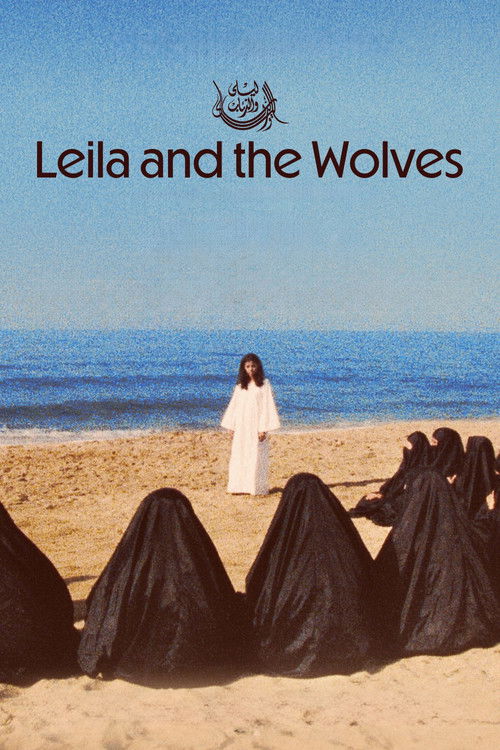
Leila and the Wolves
1986 · Heiny Srour
For when you want cinema as excavation — a challenging, one-of-a-kind film to sit with and think about for days, not a passive night on the couch.
What it's about
A young Lebanese woman named Leila moves through fifty years of Palestinian and Lebanese history — from the 1936 revolt in Palestine to the siege of Beirut — searching out the women that the official record erased. It isn't a straight-line story: scenes, songs, and reenactments accumulate like tiles in a mosaic, showing women who smuggled weapons, held communities together, and kept memory alive, only to be written out of the histories afterward.
The experience
Dreamlike and defiant at once — it drifts between eras like a séance, and its pattern-based structure asks you to lean in rather than be carried. Patient, haunting viewing that keeps rearranging what you thought you knew.
The craft
Heiny Srour spent nearly a decade making it, shooting in fragments through the disruptions of the Lebanese civil war, and built its structure from Arab oral storytelling and mosaic patterning — tableaux and songs that repeat and rhyme instead of a plot that marches forward. The form is the argument: history told the way women actually kept it.
Why it matters
Srour was the first woman from the Arab world with a film selected at Cannes, and this restored landmark has become a touchstone for Arab feminist cinema and for filmmakers reclaiming histories told from below.
Heiny Srour, the first woman from the Arab world to have a film selected at Cannes, spent the better part of a decade assembling this mosaic — a fiction, an essay, a séance — in which a young Lebanese woman named Leila moves through half a century of Palestinian and Lebanese history, recovering the women that official chronicles erased. Shot piecemeal through the disruptions of the Lebanese civil war, the film borrows its structure from Arab oral storytelling and the patterned repetitions of mosaic tilework: tableaux, songs, and reenactments accumulate rather than progress, so that the 1936 revolt in Palestine and the siege of Beirut become panels in a single design. Srour's feminism is inseparable from her anti-colonialism; the women here smuggle weapons, hold funerals, keep memory alive, and are then written out twice over — by occupiers and by their own men. Long nearly impossible to see, the film circulated in battered prints until a 4K restoration returned its saturated colors and its argument to circulation, where it now reads as a founding text of Arab feminist cinema.
Reception
Barely seen for decades — banned across much of the Arab world and nearly impossible to find — it was rescued by a French CNC restoration that premiered in Venice Classics in 2021, and its 2025 North American tour turned a lost film into a rediscovered landmark of Arab feminist cinema.
How Leila and the Wolves was received, from release to now →
Influences: the films it descends from and the films it influenced
- The Hour of Liberation Has Arrived (1974) — Srour's own militant Dhofar documentary establishes her method of foregrounding women fighters and cutting field footage against agitprop commentary, the Third-Cinema toolkit she later fictionalizes into mosaic tableaux here.
- The Hour of the Furnaces (1968) — Its chaptered essay-film architecture — militant montage welding documentary, title-card polemic and staged material into an anti-colonial argument — is the structural template for the film's numbered mosaic of women's resistance.
- The Battle of Algiers (1966) — Pioneers reenacting anti-colonial struggle in a newsreel-grain vérité register with a collective rather than individual protagonist, the docufiction grammar Srour borrows to restage buried women's history.
- Chronicle of a Summer (1961) — Founds the docufiction hybrid — subjects performing/reflecting on their own lives for the camera — that licenses Srour's blending of interview, song and staged reenactment.
- Sambizanga (1972) — Maldoror routes anti-colonial armed struggle through a woman's point of view with lyrical, saturated compositions, the woman-as-resistance framing Srour extends across four historical epochs.
- Salt of the Earth (1954) — Its device of women stepping into the front line of a labor/liberation struggle, narrated as collective testimony, is the political-feminist gesture Srour rebuilds as oral history.
- Riddles of the Sphinx (1977) — Feminist avant-garde essay film that formally interrogates women's erased place in patriarchal narrative, supplying the self-conscious 'writing women back into history' structure Srour adopts.
- Measures of Distance (1988) — A Palestinian feminist video-essay built from a mother's letters and voice, extending Srour's fusion of oral testimony and image to narrate exile and erased women.
- Daughters of the Dust (1991) — Non-linear women's oral-history structure narrated through ancestral memory, painterly tableaux and saturated color — Srour's mosaic of intergenerational women's voices given a fuller diasporic form.
- The Silences of the Palace (1994) — An Arab-feminist memory film that reconstructs women's confined history non-linearly through remembered song and gesture, directly inheriting Srour's project of recovering erased women's lives.
- Chronicle of a Disappearance (1996) — Fragmentary, essayistic docufiction on Palestinian existence built from discontinuous tableaux rather than plot, carrying forward Srour's mosaic anti-narrative approach to occupation.
- Reassemblage (1982) — A near-contemporary feminist essay film that refuses linear documentary authority through fragmentary, rhythmic montage and questioning voice — the same critique of who narrates colonized women.
- Sans Soleil (1983) — Contemporary essay-film that assembles memory non-linearly through layered narration and collaged image, paralleling Srour's mosaic-tableaux editing across time and place.
- Handsworth Songs (1986) — Same-year mosaic essay weaving archive, song, reenactment and testimony to reclaim a suppressed anti-colonial diasporic memory — the identical collage-of-fragments method.
- Wedding in Galilee (1987) — Palestinian docufiction using ritual, song and saturated ethnographic imagery as coded resistance, the same aestheticized reenactment of occupied life under colonial rule.
- Nice Coloured Girls (1987) — Experimental essay-film layering historical text, reenactment and women's voice-over to reverse the colonial gaze, sharing Srour's collage method of writing indigenous/colonized women back into the record.
Similar films
- The Battle of Algiers (1966) — influence & lineage
- Waltz with Bashir (2008) — shared sensibility
- Palestine 36 (2025) — shared sensibility
- Sambizanga (1973) — shared sensibility
- The Little Sister (2025) — shared sensibility
- Hiroshima Mon Amour (1959) — shared sensibility
- All That's Left of You (2025) — shared sensibility
- This Is Not a Burial, It's a Resurrection (2020) — shared sensibility