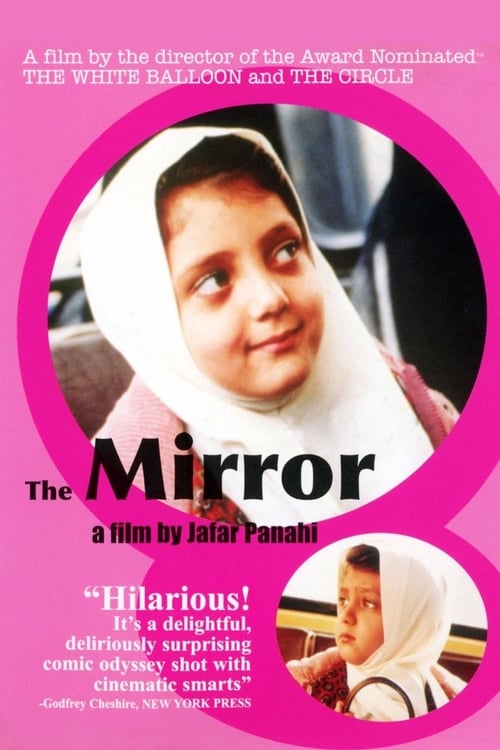
The Mirror
1997 · Jafar Panahi
Imprisoned by Iran in 2022, released after a hunger strike, then won the 2025 Palme d'Or with It Was Just an Accident — the era's definitive dissident-filmmaker story, complicated by discourse over France (not Iran) submitting his film to the Oscars. Naming him signals cinema-as-resistance.
For when you want something small that turns out to be big — a film to make you grin at its nerve and then argue about what you just watched. Gentle on the surface, a brain-tickler underneath.
What it's about
Mina, a first-grader with her arm in a sling, waits outside her Tehran school for a mother who never arrives — so she decides to find her own way home, alone, across a huge, fast, indifferent city of buses, traffic, and strangers. Then, partway through, the film does something sly with its own story that's best discovered cold.
The experience
Tender and nerve-racking at first — you're a small child in giant traffic — and then delightfully disorienting, as the film starts playing an honest game with what's real and what's staged. It's short, warm, and quietly mind-bending.
Performances
Young Mina Mohammadkhani carries the whole film — stubborn, unguarded, and so genuinely herself that she ends up steering the movie in ways no script could fake.
The craft
Panahi shoots Tehran's streets with documentary immediacy — real crowds, real buses, real noise — and builds the film's structure around a single audacious formal gamble that turns a simple lost-child story into a hall of mirrors. The city itself is the co-star.
Why it matters
A festival-acclaimed key work of Iranian cinema's great 1990s flowering, and the film where Panahi's career-long fascination with the line between filming life and living it first came into the open.
Snapshot
The Mirror (Persian: Ayneh) is Jafar Panahi's second feature, and the film in which his cinema first turns to look at itself. Its premise could not be simpler: Mina, a first-grader with her arm in a sling, waits outside her Tehran school for a mother who does not come, and sets out to find her own way home across a city too big and too fast for a small child. For roughly its first half, the film plays this as tender, suspenseful realism in the mode of Panahi's acclaimed debut, The White Balloon (1995). Then something extraordinary happens: the child actress, visibly fed up, looks at the camera, announces that she no longer wants to act, tears off her sling, and walks off — and the film keeps rolling, now trailing the real girl as she tries to get home for real. What began as fiction becomes a documentary chase, and the seam between the two becomes the film's true subject. The Mirror won the Golden Leopard, the top prize at the Locarno International Film Festival, in 1997, confirming Panahi as a major figure of the Iranian New Wave and laying down the reflexive preoccupation — where does the film end and life begin? — that would organize his entire career.
Industry & production
The Mirror was made within the ecosystem of 1990s Iranian art cinema, a system shaped by state institutions (chiefly the Farabi Cinema Foundation and the Institute for the Intellectual Development of Children and Young Adults, or Kanoon) that had nurtured filmmakers from Abbas Kiarostami onward, and by a growing international festival appetite for Iranian films. Panahi had come out of this world directly: a graduate of Tehran's film-and-television college and a veteran of television documentary, he served as assistant director to Kiarostami on Through the Olive Trees (1994) before directing The White Balloon, whose screenplay Kiarostami wrote and which won the Caméra d'Or at Cannes.
The Mirror was, by contrast, a more independent and self-directed undertaking — Panahi originated and wrote it himself, and it carries the marks of a modestly budgeted, small-crew production shot largely on the streets and buses of Tehran. The specifics of financing and the exact production company are not something I can state with confidence from the historical record, and I will not invent them; what is clear is that the film was made cheaply and quickly, with a method that turned budgetary and logistical constraint into aesthetic principle. Its festival trajectory — culminating in the Locarno Golden Leopard — is the securest fact of its commercial and institutional life; reliable theatrical box-office figures for a film of this scale essentially do not exist, and I will not fabricate any.
Technology
The film was shot on 35mm, the standard professional gauge of its moment, well before the digital tools that would later define Panahi's clandestine features. Its most consequential technological choices are those governing the second, documentary half. To follow a real child through real streets and buses without staging her, the production leaned on long lenses that let the camera keep its distance, on handheld and vehicle-adjacent camera positions, and — crucially — on a wireless lavalier microphone worn by the girl. That radio mic is the hinge of the film's ethics and its suspense: even after Mina declares she is done acting and removes herself from the fiction, she is still wired for sound, so the crew (and we) can continue to hear her negotiate her way home. The apparatus that was supposed to record a performance becomes the apparatus that records a person, and the film makes no secret of this. The technology is not hidden behind the image; it is exposed as part of the drama.
Technique
Cinematography
The camera was handled by Farzad Jodat, who had also shot The White Balloon and became a recurring Panahi collaborator. The film's visual argument depends on a deliberate stylistic rupture. The first half is composed with the controlled, child's-eye framing of a scripted fiction: Mina held in tight, sympathetic shots, the adult world looming at the edges of the frame, the city rendered legible and dramatic. After the break, the grammar loosens toward observation — longer lenses that flatten and surveil, less certain framings, the camera scrambling to keep a moving child in view amid traffic and crowds. The switch is not merely practical; it is expressive. We are made to feel the difference between looking at a performance and looking for a person, and the cinematography stages that difference as a change in how the city itself is photographed.
Editing
The editing carries the film's central gambit, and its most audacious stroke is a cut that refuses to conceal the rupture rather than one that smooths it. The moment of Mina's revolt is left in — the address to the camera, the removal of the sling, the crew's audible uncertainty about whether to keep shooting — so that the edit foregrounds, rather than hides, the collapse of the fiction. Thereafter the assembly must work with contingent, unrepeatable documentary material, shaping a coherent journey out of a real one. I am not able to confirm from the record precisely who is credited with the editing (Panahi cut several of his own films, but I will not assert it here without certainty); what can be said with confidence is that the film's meaning is built in the cutting room's decision to keep the seam visible.
Mise-en-scène / staging
The staging is a study in two registers of control. In the fiction, Tehran is arranged as a legible obstacle course — the bus, the busy intersection, the indifferent or kindly adults — each encounter blocked to dramatize a child's vulnerability. Once the documentary takes over, staging in the conventional sense evaporates: the "set" is the actual, unchoreographed city, and the filmmakers can only follow, not compose. The power of the second half lies exactly in this loss of control, and in Panahi's willingness to let the real street dictate the mise-en-scène. The recurring motif of the arm sling — worn, then torn off, then absent — is the film's most economical piece of staging, a single prop that marks the boundary between the character Mina plays and the girl who refuses to keep playing.
Sound
Sound is arguably the film's decisive technical dimension. The lavalier mic that keeps Mina audible after she has walked out of the fiction is what makes the documentary half possible and what makes it uncanny: we hear a child who believes, or half-believes, she is no longer being filmed, and the intimacy of that sound is both moving and ethically vertiginous. The ambient soundscape — bus engines, horns, the overlapping talk of strangers — supplies the texture of an actual city rather than a designed one. As with much Iranian cinema of the period, there is little reliance on a conventional underscore; I cannot confirm the presence or authorship of an original score and will not invent one. The film's aural power comes chiefly from location sound and from the disquieting proximity of that wireless mic.
Performance
The film hinges on a single, remarkable child performance and then on its refusal. Mina — played by a young non-professional whose surname is generally given as Mohammad Khani — first delivers exactly the kind of natural, unforced child acting that Iranian cinema had become celebrated for, then delivers something no direction can produce: genuine exasperation, a real child's boredom and will, breaking through the artifice. That double turn is the performance. The surrounding adults are largely real Tehranis and non-professionals caught in passing, whose unrehearsed responses to a lost-seeming child give the second half its documentary charge.
Narrative & dramatic mode
The Mirror operates in two dramatic modes stitched together at a visible seam. The first is a classical child's-quest narrative — a small protagonist, a clear goal (get home), a hostile-indifferent adult world, mounting obstacles — descended from neorealism and perfected by the Iranian children's film. The second is reflexive documentary: once the fiction is renounced, the "plot" becomes the literal, contingent question of whether this actual child can get home, and the meta-question of whether the crew has the right to keep filming her. The genius of the structure is that the second mode retroactively reframes the first: having watched a staged lost girl, we now watch a real one, and the emotional stakes of the opening are both punctured and intensified. Panahi thus dramatizes the act of filmmaking itself, making the boundary between representation and reality the film's true line of suspense.
Genre & cycle
On its surface the film belongs to the Iranian "child's-journey" cycle — the strand of 1980s–90s Iranian cinema, associated with Kiarostami's Where Is the Friend's House? (1987) and Panahi's own The White Balloon, in which a small child pursuing a simple goal becomes a lens on an entire society. But The Mirror also belongs to, and helps define, a reflexive or metacinematic cycle within the same national movement — films that fold documentary and fiction into each other, of which Kiarostami's Close-Up (1990) is the landmark. The Mirror sits precisely at the crossing of these two cycles, using the innocent conventions of the first to set up the rupture of the second.
Authorship & method
The film is Panahi's in a fuller sense than The White Balloon had been. Where the debut was written by Kiarostami, The Mirror is Panahi's own conception, and it announces the method that would become his signature: build a fiction, then let reality break in and interrogate it. His key collaborators here are continuous with his debut — above all cinematographer Farzad Jodat, whose camera makes the tonal switch legible. The film's authorship is inseparable from its apprenticeship: the fiction/documentary porousness Panahi learned watching Kiarostami is here made into a self-standing structural principle. On the specifics of a credited editor, composer, or producing entity I will stay silent rather than guess; the demonstrable authorial fact is that The Mirror is where Panahi's directorial voice — playful, ethical, self-questioning — becomes fully his own.
Movement / national cinema
The Mirror is a central document of the Iranian New Wave's international heyday in the 1990s, a movement defined by non-professional casts, location shooting, child protagonists, humanist observation, and — increasingly — a philosophical fascination with cinema's relationship to reality. Working under the constraints of the post-revolutionary Iranian system, filmmakers turned limitation into a poetics of the everyday, and Panahi's film distills that tendency to an essence: the city of Tehran itself, its buses and sidewalks and citizens, becomes both setting and co-author. The film also belongs to the movement's reflexive wing, alongside Kiarostami and Mohsen Makhmalbaf, for whom the camera's presence was not to be disguised but examined.
Era / period
Made and set in the Tehran of the mid-1990s, the film captures a specific urban moment — a crowded, modernizing capital navigated by public bus, its streets thick with commerce and strangers — without editorializing about it. Within Panahi's own career it marks the crucial transition from inherited material to authored method, the pivot between the Kiarostami-scripted debut and the socially pointed, formally daring films to come, from The Circle (2000) onward. Historically it belongs to the last decade of predominantly celluloid Iranian art cinema, before digital tools and, in Panahi's case, state persecution reshaped the terms of what a film could be.
Themes
The film's deepest theme is the porous boundary between fiction and reality — the "mirror" of the title reflecting not a face but the filmmaking apparatus back at itself. Around that sit several others: the vulnerability and agency of a child in an adult city; the ethics of looking, and specifically the question of a filmmaker's right to keep watching a person who has asked to stop performing; and the texture of ordinary Tehran life — its kindnesses and indifferences — glimpsed through a child's-eye passage across it. There is also a quiet, recurring Iranian preoccupation with autonomy and constraint: a small girl asserting her will against the plan laid out for her by adults is not, in Panahi's cinema, a politically neutral image, and it rhymes with the studies of confinement and self-determination that would dominate his later work.
Reception, canon & influence
Critically, The Mirror was received as confirmation that The White Balloon had been no fluke and that Panahi possessed a formal daring of his own; its Golden Leopard at Locarno in 1997 is the anchoring fact of its reception and secured its international festival life. In the broader critical narrative of Iranian cinema, it is regularly cited as one of the key reflexive films of the movement, discussed alongside Kiarostami's Close-Up as an exemplar of the fiction/documentary blur.
The influences on the film run backward through two lineages: Italian neorealism, whose child-in-the-city archetype (De Sica's Bicycle Thieves is the touchstone) underlies the opening quest; and Panahi's direct apprenticeship to Kiarostami, whose Close-Up had already made the collapse of staged reality into a subject in its own right. The Mirror takes that inheritance and gives it a cleaner, more startling mechanism — the on-camera revolt of the actress.
Looking forward, the film's legacy is most vivid within Panahi's own filmography. Its central gambit — a film that dismantles its own fiction and turns to interrogate the act of filming — becomes the through-line of his later, more embattled work: This Is Not a Film (2011), shot while under house arrest and a filmmaking ban, and Taxi (2015), where staged and documentary encounters again become indistinguishable, are unthinkable without the experiment first run in The Mirror. More broadly, the film stands as an influential instance of the Iranian reflexive tradition that shaped international art cinema's ongoing conversation about documentary, performance, and truth. Its precise measurable "impact" beyond this is not something the historical record quantifies, and I will not overstate it; what can be said plainly is that The Mirror is where one of world cinema's great self-questioning artists first taught his camera to doubt itself.
Reception
It took the Golden Leopard at Locarno in 1997, yet for years lived in the shadow of Panahi's debut The White Balloon as 'the other kid-in-Tehran film' — now it's widely read as the hinge of his career, the moment the crowd-pleasing neorealist turned into the reflexive rule-breaker of his later, banned work.
How The Mirror was received, from release to now →
Influences: the films it descends from and the films it influenced
- Bicycle Thieves (1948) — Establishes the child-across-the-city quest shot with non-professionals in real streets — the neorealist template Panahi reworks in Mina's bus-and-taxi journey home before the fiction cracks.
- Germany Year Zero (1948) — A non-professional child threading location streets in long observational takes, the neorealist grammar of placing a small figure inside an unstaged urban environment that Panahi inherits directly.
- The Traveler (1974) — Kiarostami's deadpan, single-minded-child-quest structure built on a non-professional lead and patient observation — the foundational Iranian child-journey grammar Panahi's opening half is built on.
- Where Is the Friend's House? (1987) — Long-lens observation of a determined child negotiating an indifferent adult world of doorways and streets, the exact watching-a-child method Farzad Jodat's camera reprises.
- Close-Up (1990) — Makes the collapse of staged reality into documentary its own subject; The Mirror takes this reflexive mechanism and sharpens it into the actress's live on-camera revolt.
- Life, and Nothing More... (1992) — The director re-enters and interrogates his own prior fiction, modeling the porous fiction/documentary boundary Panahi turns into a structural pivot mid-film.
- Through the Olive Trees (1994) — A film-within-a-film where a non-professional actor's real feelings breach the staged take between director calls — the precise 'performer breaks the fiction' device The Mirror detonates.
- The White Balloon (1995) — Panahi's own near-real-time child's-errand structure with a non-professional girl and street staging — the film The Mirror first duplicates, then ruptures when its child actor quits.
- Symbiopsychotaxiplasm: Take One (1968) — An on-camera cast-and-crew revolt against the production folded back into the film's real structure — the earliest full expression of the 'the actor refuses to perform' gambit The Mirror stages.
- F for Fake (1973) — Essayistic reflexive documentary that interrogates truth, fakery and the act of filming itself, the meta-nonfiction impulse to distrust one's own camera that The Mirror inherits.
- This Is Not a Film (2011) — Dismantles its own fiction and turns the camera to doubt the very act of filming under a state ban — unthinkable without the self-interrogation first run in The Mirror.
- Closed Curtain (2013) — A staged scenario visibly disintegrates as the director-figure intrudes, pushing The Mirror's mid-film seam into a full structural collapse of the fiction.
- Taxi (2015) — Wireless-mic'd staged and documentary encounters in a moving car become deliberately indistinguishable, directly extending The Mirror's fiction/reality blur into a whole feature.
- 3 Faces (2018) — An actress and a road trip fuse the real and the staged, carrying forward the on-camera-performer-versus-fiction tension The Mirror pioneered.
- Hit the Road (2021) — Its rupture of the naturalist frame — the child-actor breaking the fiction mid-film — prefigures Hit the Road's fantastical star-field interlude that steps outside the documentary-real register.
- No Bears (2022) — Panahi's own earliest rupture of the frame, where the child actor abruptly quits and the crew keeps filming, establishing the reflexive break between fiction and its making that culminates in No Bears' folding of production conditions into plot.
- The President's Cake (2026) — The rupture device — a children's fiction that breaks its own frame partway to admit the recording apparatus and the real, the precedent for closing on documentary material that reframes everything staged before it.
- Salaam Cinema (1995) — Turns the filmmaking apparatus and the audition performance into the documentary subject, the same Iranian-New-Wave reflexive move of filming the frame's own construction.
- A Moment of Innocence (1996) — Non-professionals restage a real event until memory and performance collide on camera, a parallel fiction/documentary-hybrid experiment made the same season as The Mirror.
- The Apple (1998) — Has real people re-enact their own lives in their actual locations, extending the non-professional documentary-fiction hybrid into pure lived material.
- Ten (2002) — Fixed dashboard cameras capture non-professional performance in a moving car until documentary and script are indistinguishable — the in-vehicle reflexive method Panahi later adopts wholesale.
Similar films
- Where Is The Friend's House? (1987) — influence & lineage · same viewing thread
- Close-Up (1990) — influence & lineage · same viewing thread
- Life, and Nothing More… (1992) — influence & lineage · same viewing thread
- A Moment of Innocence (1997) — same viewing thread
- No Bears (2022) — same viewing thread
- Through the Olive Trees (1995) — same viewing thread
- Hit the Road (2021) — shared sensibility
- Children of Heaven (1997) — shared sensibility
All the films related to The Mirror →
Watch it with: curated runs of related films
- Where Fiction Meets the Real — Watch these in sequence for the way each lets a staged fiction quietly dissolve into something documentary-real — and the real get restaged as fiction — usually while someone is on a road or a walk.