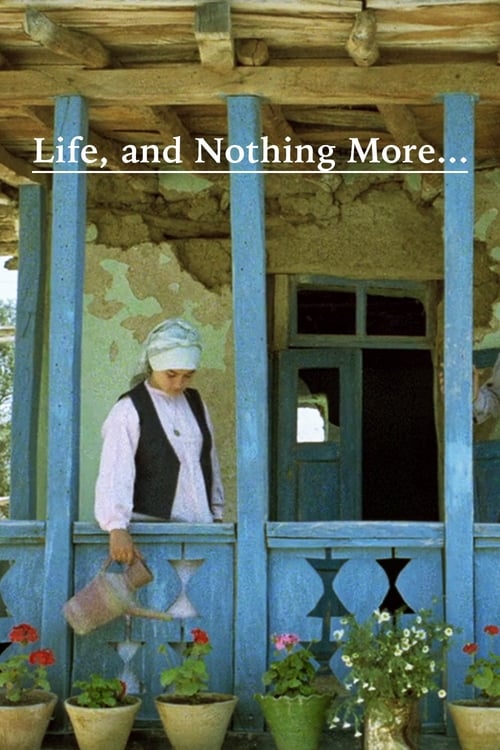
Life, and Nothing More…
1992 · Abbas Kiarostami
For when you want a film to restore your faith in people without sentimentality — a meditative watch for a reflective evening, not a tearjerker and not a thriller. Comfort of an unusual, earned kind.
What it's about
After a catastrophic earthquake levels villages in northern Iran, a film director and his young son drive from Tehran into the disaster zone to find out whether two boys who acted in his earlier film survived. The search becomes a slow road trip through rubble and blocked highways, and through encounters with survivors who, having lost nearly everything, are already rebuilding, marrying, and getting on with living.
The experience
Quiet, patient, and unexpectedly warm — it moves at the speed of a car picking its way through broken roads, and its power sneaks up on you. What sounds like a grim premise plays as something gentle and life-affirming, the kind of film that leaves you calm and a little changed.
The craft
Kiarostami blurs fiction and documentary until the line stops mattering: real ruins, real survivors, and a staged search woven together so naturally you forget which is which. Long takes through car windows and winding hillside roads turn landscape into storytelling, and the unhurried framing rewards viewers who let the film set its own pace.
Why it matters
A key work in the wave of Iranian cinema that captivated international festivals in the 1990s, and the middle film of the loose trilogy that made Kiarostami a global name. Its self-referential premise — a director searching for his own former actors — became one of cinema's most admired blends of life and filmmaking.
Snapshot
Life, and Nothing More… — released internationally under several titles, most often And Life Goes On (Persian: Zendegi va digar hich) — is Abbas Kiarostami's fiction-documentary hybrid made in the aftermath of the catastrophic Manjil–Rudbar earthquake that struck Gilan province in northern Iran in June 1990, killing tens of thousands. The premise is deceptively simple and pointedly self-referential: a film director and his young son drive from Tehran into the earthquake zone to learn whether the two boys who had starred in Kiarostami's earlier Where Is the Friend's House? (1987) survived. What begins as a rescue errand becomes a road film and a meditation, as the pair edge through blocked highways and ruined villages and encounter survivors who, amid unfathomable loss, are already rebuilding, marrying, and — famously — rigging antennas to watch the World Cup. The film occupies the central position in what critics later called Kiarostami's "Koker trilogy," and it is a foundational document of the Iranian New Wave's arrival on the world stage. Its animating conviction is contained in its title: life, and nothing more.
Industry & production
The film was produced under the auspices of Kanoon — the Institute for the Intellectual Development of Children and Young Adults — the Tehran state cultural body that had employed Kiarostami since 1969 and had produced Where Is the Friend's House? Kanoon's remit nominally centered on children's media, and Kiarostami's habitual use of children as protagonists and moral touchstones grew partly from that institutional context. Production followed within roughly a year to two years of the June 1990 quake, and the shoot took Kiarostami and a small crew back into the actual devastated region around Koker, Poshteh, and the surrounding Gilan hill villages. This was low-budget, lightweight filmmaking of necessity and philosophy alike: a compact unit, portable equipment, real locations still bearing rubble, and a cast dominated by non-professionals — many of them genuine earthquake survivors playing versions of themselves. The lead role of the director-surrogate was taken by Farhad Kheradmand (not Kiarostami himself), a crucial distancing device that keeps the film a constructed fiction rather than a personal documentary. Iranian cinema of this period operated under the constraints and cultural priorities of the post-revolutionary state, but Kiarostami's rural, humanist, largely apolitical register gave his work unusual latitude at home and, increasingly, unusual mobility abroad. The film's international breakthrough was sealed at the 1992 Cannes Film Festival, where it screened in Un Certain Regard and won the Rossellini Prize — an award whose namesake could hardly have been more apt.
Technology
Technologically the film is defined by restraint and portability. It was shot on 35mm color film using compact, mobile setups suited to unpaved mountain roads and unstable terrain. Kiarostami's method — much of the action staged inside a moving car, observed at a distance across valleys, or captured in extended real-time takes — depended less on advanced apparatus than on the discipline of lightweight equipment and a small crew that could move quickly through difficult ground. The car itself functions as a piece of technology and a mobile studio: a framing device, a sound booth, and a moral chamber all at once, a recurring Kiarostami instrument here developed into a full aesthetic system. There is no reliance on the era's optical trickery or elaborate rigs; the film's power derives from placement, duration, and the documentary weight of real ruins captured on photochemical stock. In this sense its "technology" is inseparable from its ethics — the choice to record actual devastation with minimal mediation.
Technique
Cinematography
The cinematography, credited to Homayoun Payvar, favors the long shot and the long take. Kiarostami repeatedly places the camera at a contemplative distance — cars reduced to specks crawling along switchback roads, human figures set against vast landscapes of collapse and regrowth. The film's most celebrated image is its final shot: an extreme long take, held for minutes, of the director's small car struggling up a steep zigzag road, stalling, and — after a passing man is picked up — finally cresting the hill. Photographed from across the valley so that the car nearly disappears and reappears against the green slope, it converts a mundane act of driving into an image of persistence itself. The palette is naturalistic — dust, rubble, and the insistent green of the northern hills — and the compositions consistently subordinate the human protagonists to the terrain, a formal expression of the film's humility before catastrophe.
Editing
Kiarostami was closely involved in the cutting of his films, and the editorial signature here is unmistakable regardless of formal credit: a patient, elliptical rhythm that trusts duration over incident. Scenes are allowed to run past the point at which conventional narrative would cut, and transitions frequently withhold information, so that the viewer, like the traveling director, must piece the world together from fragments and hearsay. The editing sustains the film's central ambiguity between documentary and fiction by refusing the reassuring shot patterns of either mode.
Mise-en-scène / staging
The staging is built around the automobile and the roadside encounter. Conversations unfold through windshields and open windows, framed by the car's interior; survivors appear at the edges of the frame carrying water, salvaging belongings, or pausing to answer the driver's questions. Kiarostami stages real ruin as backdrop without aestheticizing it into spectacle, and he repeatedly folds his own filmmaking apparatus into the frame — references to the earlier film, to actors, to the act of looking — so that the mise-en-scène becomes a running commentary on representation.
Sound
The soundtrack is dominated by the diegetic: engine noise, radio broadcasts, wind, and the murmur of survivors. The car radio — carrying news of the disaster and, memorably, World Cup football — is a key sound element, tethering private grief to the ongoing hum of the wider world. The film is largely free of conventional non-diegetic scoring; a rare passage of Western classical music accompanies the climactic hillside ascent, an intrusion made powerful precisely by its scarcity. (The exact attribution of that musical cue is not something I can confirm from the record without guessing, so I leave it undescribed rather than invent one.)
Performance
Performance rests on the non-professional ensemble. Farhad Kheradmand anchors the film with an understated, watchful presence as the director-figure, while the child and the survivors supply the film's texture of authenticity. Kiarostami's celebrated technique of drawing unselfconscious, quasi-documentary behavior from non-actors — often by shooting real people in lightly fictionalized versions of their own situations — is central to the film's emotional credibility. The performances feel less "acted" than caught.
Narrative & dramatic mode
The film's dramatic mode is quest-as-pretext. The search for the two boys provides forward motion, but Kiarostami is uninterested in resolution; the film ends without a definitive answer, its true subject having shifted from who survived to how one lives on. It operates in a deliberately porous register between documentary and fiction — a "docufiction" that stages reality and reals its stagings, continually reminding us that the director we follow is himself a fiction inside a film about a film. This reflexivity is not academic gamesmanship but an ethical stance: by foregrounding the artifice, Kiarostami declines to exploit real suffering as raw drama, and instead turns the act of looking at catastrophe into the film's central moral question.
Genre & cycle
Nominally a drama-adventure and a road movie, the film is better understood as part of a cycle in two senses. First, it belongs to the loosely defined "Koker trilogy," bracketed by Where Is the Friend's House? (1987) and Through the Olive Trees (1994) — the latter of which fictionalizes the very making of Life, and Nothing More…, creating a hall-of-mirrors structure across the three films. Kiarostami himself was notably ambivalent about the "trilogy" label, which was applied by Western critics rather than declared by the filmmaker; the connective tissue is the shared Koker region and the recurring motif of the winding road as much as any planned design. Second, it belongs to the broader tradition of humanist disaster cinema, though it pointedly inverts that genre's conventions by refusing spectacle and dwelling instead on aftermath and endurance.
Authorship & method
Life, and Nothing More… is a paradigmatic Kiarostami work, and it consolidated the method for which he became world-renowned: fiction built on documentary foundations, non-professional actors, rural Iranian settings, the car as a mobile stage, long takes and long shots, open endings, and a persistent reflexive interrogation of cinema's relationship to reality. Kiarostami wrote and directed, and his controlling authorship extends into the editing and conceptual design of the film. Among collaborators, cinematographer Homayoun Payvar realized the distant, patient visual scheme, and the ensemble of non-professionals — survivors and locals — functioned almost as co-authors of the film's texture. The absence of a conventional composer is itself a signature: Kiarostami's soundworld is built from the real. The most striking authorial gesture is the casting of a surrogate director rather than himself, a move that turns the film into an essay on its own making without collapsing into autobiography.
Movement / national cinema
The film is a cornerstone of the Iranian New Wave in its post-revolutionary flowering — the movement that, through Kiarostami, Mohsen Makhmalbaf, Jafar Panahi (Kiarostami's assistant and disciple), and others, made Iranian cinema one of the most acclaimed national cinemas of the 1990s. Kiarostami's rural humanism, his fusion of neorealist observation with modernist self-reflexivity, and his ability to work within — and quietly around — the constraints of the Iranian film system made him the movement's international standard-bearer. This film, more than any single prior work, was the vehicle that carried that reputation to Cannes and the West.
Era / period
Made in the early 1990s, the film sits at the hinge of Iran's post-war reconstruction era (following the Iran–Iraq War that ended in 1988) and at the beginning of Iranian cinema's global ascendancy. Its immediate historical occasion — the 1990 earthquake — roots it firmly in a specific national trauma, while its contemplative, essayistic form aligns it with an international art-cinema moment increasingly receptive to slow, reflexive, non-Western filmmaking. The presence of the 1990 World Cup on the survivors' radios date-stamps the world of the film precisely.
Themes
The film's governing theme is the tenacity of life in the face of annihilation — not as sentimental uplift but as stubborn, unremarkable fact. Survivors bury their dead and then ask about the football scores; a young couple marries days after the quake because, as they explain, one cannot wait for a better time that may never come. Around this run Kiarostami's abiding preoccupations: the porous boundary between reality and its representation; the ethics of the filmmaker who arrives to look at others' suffering; chance and contingency (the road that may or may not lead anywhere); the relationship between fathers and children; and the moral seriousness of ordinary human resilience. The recurring image of the winding road — climbing, stalling, doubling back — serves as the film's controlling metaphor for continuance against gravity.
Reception, canon & influence
Critically, the film was a landmark. Its Rossellini Prize at Cannes 1992 announced Kiarostami to Western audiences and critics, and the ensuing years saw him elevated to the front rank of living filmmakers — a status crowned when Taste of Cherry took the Palme d'Or in 1997. The film is frequently cited among the essential works of 1990s world cinema and, together with its two companion films, is regularly canonized as one of the great achievements of modern Iranian film.
Looking backward, the film's clearest lineage is Italian neorealism — the tradition of Roberto Rossellini above all, whose Rome, Open City and Paisan Kiarostami's rubble-strewn, non-professional, on-location humanism openly echoes; the Cannes prize bearing Rossellini's name reads almost as an act of critical genealogy. The film also draws on documentary practice and on Kiarostami's own earlier Kanoon shorts and features, especially Where Is the Friend's House?, which it literally revisits.
Looking forward, the film's influence has been broad and durable. Most immediately, it generated its own sequel-of-sorts in Through the Olive Trees, completing the reflexive spiral of the Koker films. More widely, it helped establish the template — the docufiction hybrid, the moving car as narrative space, the long-take realism, the open ending — that shaped a generation of Iranian filmmakers (Panahi, Samira Makhmalbaf, and others) and reverberated through international slow cinema and festival filmmaking well beyond Iran. Kiarostami became a touchstone for critics and directors across the world; Jean-Luc Godard's admiration for him is often invoked as a marker of his standing among cinephiles, though the specific remarks attributed to Godard circulate in various forms and I would not vouch for any single quotation. What is not in doubt is that Life, and Nothing More… was the film that made the case, on the world's largest stage, for a cinema of humility, contingency, and endurance — and that its influence on how filmmakers think about the line between the recorded and the staged remains active today.
A Deleuzian reading
Men who have lost everything are hauling a television aerial up onto a heap of rubble, because the World Cup is on and there's a match tonight.
The full Deleuzian reading of Life, and Nothing More… →
Reception
It premiered at Cannes 1992 (winning the Rossellini Prize) and was the film that turned Kiarostami from festival curiosity into international art-house giant — today it's fully canonized as the middle panel of the beloved Koker trilogy, boxed up by Criterion and treated as essential viewing.
How Life, and Nothing More… was received, from release to now →
How to watch Life, and Nothing More…: what to notice on a first viewing
- Watch how far back the camera sits on the switchback road. Kiarostami and cinematographer Homayoun Payvar hold this distance throughout, turning cars and people into small marks against vast rubble and green hillside. The scale keeps the disaster and the recovery bigger than any one person's effort to fix it.
- Listen for the car radio: news bulletins and football commentary. The soundtrack stays almost entirely diegetic, engine noise, wind, survivors talking, and this radio. There is barely any composed music. The radio keeps the wider world's ordinary hum, a match still to be played, running alongside private grief.
- Notice how many conversations happen through the car's open window. Kiarostami frames survivors from inside the car, at the edge of the windshield, as they carry water or pause to answer questions. The car becomes the film's real stage, a mobile point of view that never fully enters the wreckage it studies.
- Watch the director's face as he asks questions with no clear answers. Farhad Kheradmand plays the role watchful and still, listening more than acting, while the boy beside him and the survivors carry the film's texture. His stillness is the film's real subject, a man whose looking cannot change what he sees.
The whole guide to watching Life, and Nothing More…, with the keys for a rewatch →
Influences: the films it descends from and the films it influenced
- Rome, Open City (1945) — The founding neorealist method Kiarostami transplants: shooting on actual devastated locations with non-professionals so that history's rubble becomes the mise-en-scène rather than a set.
- Paisà (1946) — Its episodic docufiction structure and roaming, observational camera crossing a war-ravaged landscape prefigure the Koker film's loose journey across earthquake ruins.
- Journey to Italy (1954) — Establishes the automobile as a mobile confessional stage, carrying protagonists through a landscape that reframes their inner crisis — the direct model for Kiarostami's car-bound narration.
- Bicycle Thieves (1948) — The search-quest narrative propelled by an ordinary, non-professional protagonist moving through real streets, with the missing object (bicycle / earthquake survivors) as engine.
- Umberto D. (1952) — Its durational attention to mundane real time — dead moments held past dramatic necessity — as the substance of realist drama.
- Where Is the Friend's House? (1987) — The literal prior text: the director-protagonist drives back into Koker to find this film's own child actors, and its zigzag hillside geography is revisited as physical and reflexive terrain.
- The Traveler (1974) — Early Kanoon establishment of the non-professional child protagonist on a single-minded journey, the realist-quest grammar later scaled up to the Koker films.
- Close-Up (1990) — Perfects the docufiction method of restaging a real event with its actual participants, dissolving the boundary between the recorded and the staged that this film then interrogates.
- Through the Olive Trees (1994) — Completes the reflexive spiral by fictionalizing the making of Life, and Nothing More… — re-casting its non-professionals and turning its production into the next film's plot.
- Taste of Cherry (1997) — Extends the car-as-mobile-stage into a sequence of driver's-seat dialogues shot in shot/reverse-shot from separate passes, capped by an open, medium-breaking ending.
- Ten (2002) — Radicalizes the car interior into the film's entire set, fixing two dashboard-mounted digital cameras so the vehicle becomes both frame and dramaturgy.
- Certified Copy (2010) — Returns to the Journey to Italy device of a couple driving and walking through Tuscany, sustaining the recorded-vs-performed ambiguity as the film's whole subject.
- The White Balloon (1995) — A Kiarostami-scripted real-time child quest that applies Koker realism — non-professional lead, contingent street incident, ticking-clock structure — to Tehran.
- The Mirror (1997) — Stages the reflexive rupture in which the non-professional child actor abruptly 'quits' mid-shot, pushing Kiarostami's recorded/staged interrogation to a self-shattering extreme.
- The Apple (1998) — Has its real subjects reenact their own recent lives on their actual locations, carrying forward the docufiction-with-actual-participants method as a next-generation Iranian practice.
- Once Upon a Time in Anatolia (2011) — Turns a nocturnal convoy of cars winding through the Anatolian steppe into a mobile stage for elliptical, long-take, diegetic-sound conversation — Kiarostami's road grammar carried into international slow cinema.
- No Bears (2022) — The template of a filmmaker driving into a rural community and probing it with a camera, using the car and the road as a mobile threshold between the director's world and the villagers', which No Bears rewrites at the Turkey–Iran border.
- A Moment of Innocence (1996) — Reflexively restages a real event from the director's own past with the actual people who lived it, kin to the Close-Up/Koker docufiction of participants replaying themselves.
- The Wind Will Carry Us (1999) — Perfects the automobile as a mobile interview-and-observation chamber and the outsider-in-a-car driving into a rural community, the exact structural template the later film adopts.
Similar films
- Taste of Cherry (1997) — influence & lineage · same viewing thread
- Close-Up (1990) — influence & lineage · same viewing thread
- Where Is The Friend's House? (1987) — influence & lineage · same viewing thread
- Certified Copy (2010) — influence & lineage · same viewing thread
- The Mirror (1997) — influence & lineage · same viewing thread
- Through the Olive Trees (1995) — same viewing thread
- The Wind Will Carry Us (1999) — same viewing thread
- No Bears (2022) — same viewing thread
All the films related to Life, and Nothing More… →
Watch it with: curated runs of related films
- Where Fiction Meets the Real — Watch these in sequence for the way each lets a staged fiction quietly dissolve into something documentary-real — and the real get restaged as fiction — usually while someone is on a road or a walk.