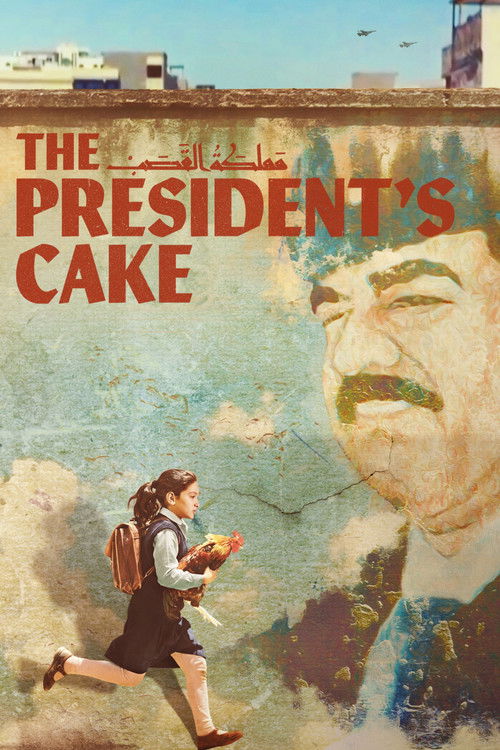
The President's Cake
2026 · Hasan Hadi
For when you want a film that moves you and means something — a good cry earned honestly, not manipulated. It's emotionally demanding but propulsive; you'll be gripped the whole way and thinking about it long after.
What it's about
In 1990s Iraq, ground down by sanctions and ruled by fear, nine-year-old Lamia draws the school lot that obliges her to bake a cake for the President's birthday — in a country where flour, sugar, and eggs have become nearly unobtainable. From her home in the reed houses of the marshes she sets out for the city with her grandmother, her loyal friend Saeed, and a rooster, on a day-long quest to assemble the impossible.
The experience
A child's-eye adventure laid over a portrait of scarcity and dread — tender, suspenseful, sometimes funny, and quietly heartbreaking. You watch through Lamia's eyes, so the danger registers the way it would to a nine-year-old: as obstacles on a quest, which makes it hit harder, not softer.
Performances
Baneen Ahmad Nayyef, as Lamia, carries the entire film on her small shoulders — a remarkably unaffected child performance, determined and watchful, with Sajad Mohamad Qasem a lively foil as her friend Saeed.
The craft
Hasan Hadi's first feature is shot in real Iraqi locations, from the reed houses of the Mesopotamian Marshes to crowded city markets, and that texture — water, dust, noise, want — is the film's spine. The camera stays at the child's level, turning a political landscape into lived, sensory experience.
Why it matters
An audience favorite at Cannes and a landmark debut for Iraqi cinema — one of the rare films to bring the sanctions decade to international screens through the people who lived it.
Snapshot
Hasan Hadi's first feature is a child's-eye survival picaresque set in southern Iraq during the sanctions decade that followed the 1991 Gulf War. Nine-year-old Lamia (Baneen Ahmad Nayyef), an orphan living with her grandmother Bibi in the reed houses of the Mesopotamian Marshes, draws the lot at school that obliges her to produce a cake for the President's birthday — a ritual of compulsory devotion in a country where flour, sugar and eggs have become objects of speculation. With her friend Saeed (Sajad Mohamad Qasem) and a rooster named Hindi, she walks into the city to assemble the impossible.
The film's dates are doubled, and the atlas's 2026 reflects its release rather than its premiere. It played the Quinzaine des Cinéastes (Directors' Fortnight) at Cannes on 16 May 2025, took both the section's Audience Award and the festival-wide Caméra d'Or for best first feature, and reached American screens through Sony Pictures Classics on 6 February 2026 after a December 2025 qualifying run. Iraq submitted it for the 98th Academy Awards, where it became the first Iraqi film ever to reach the International Feature shortlist; it was not among the five nominees announced for the 15 March 2026 ceremony, which went to Joachim Trier's Sentimental Value.
It is an Iraq–Qatar–United States co-production, shot entirely in Iraq in Iraqi Arabic, running between 102 and 105 minutes depending on the listing. Its original-language title is given at some festivals as Mamlaket Al-Qasab — "Kingdom of Reeds."
Industry & production
The film's production history is a case study in how a national cinema with no domestic industry gets a feature made in the 2020s. Iraq's state film apparatus — the Ba'athist General Establishment for Cinema and Theatre, which funded prestige nationalist epics like Clash of Loyalties (1983) — did not survive 2003, and no functioning replacement emerged. There is no equipment rental ecosystem, no crew depth, no acting schools for children. Hadi's answer was the festival-lab circuit.
The project passed through the Sundance Institute's Screenwriters and Directing Labs in 2022 and took the Sundance/NHK Award; it drew grants from the Doha Film Institute, the SFFILM Rainin fund, and the Alfred P. Sloan Foundation. Michelle Satter of the Sundance Institute made the introduction that brought Chris Columbus and his Maiden Voyage Pictures aboard as backers. Eric Roth and Marielle Heller, who had encountered the project through the labs, came on as executive producers; Heller also connected Hadi with US representation. Leah Chen Baker produced. Production entities include Maiden Voyage Pictures, Working Barn Productions, Spark Features and Missing Piece Films, with TPC Film LLC as the production vehicle of record at Cannes. Films Boutique handled international sales, with pre-Cannes deals for France and Benelux; Sony Pictures Classics acquired North America in May 2025, and Film Clinic Indie Distribution took Iraq and Qatar.
Two credit ambiguities are worth flagging rather than smoothing over. Hadi is the sole screenplay credit on the Quinzaine's own technical sheet, while several downstream listings — including Wikipedia's infobox — name Eric Roth as co-writer alongside his executive-producer credit. The trade reporting describes Roth's involvement as mentorship and creative guidance through the labs. The record is inconsistent, and this dossier does not resolve it.
Hadi refused offers to shoot the film in a more production-friendly neighbouring country. "The DNA of this film is in Iraq, in the Marshes and Baghdad," he told Screen. "I wanted to break the stigma about Iraq." The practical cost was a hard window: Iraqi summer heat confined the shoot to the months between November and April.
Commercially the film performed as a specialty release rather than a breakout. Reported figures diverge sharply across aggregators — a worldwide total around $3 million against a US gross reported in the low six figures — and this dossier declines to treat either number as settled.
Technology
The technical record on this film is genuinely thin: no camera package, lens set or acquisition format has been widely published, and it would be invention to supply one. What is documented is the poverty of the toolkit rather than its specification. The production carried four metres of dolly track. Crew fabricated rigging that could not be rented, because in Iraq it could not be rented. Sequences were staged on water — the marsh is not a location you light, it is a location you negotiate.
The consequential technology story is therefore logistical, not optical. A feature-scale shoot ran in a country whose last continuous film infrastructure was dismantled a generation ago, and the gap was closed by importing craft rather than equipment: a Romanian camera, cutting and design team, a Hungarian sound designer, a European post chain. That is now the standard architecture for a first feature from a cinema without an industry, and The President's Cake is an unusually clean example of it.
Technique
Cinematography
Tudor Vladimir Panduru (RSC) shot the film, and his presence is the single most legible craft decision. Panduru is a central cinematographer of the later Romanian New Wave — Cristian Mungiu's Graduation (2016) and R.M.N. (2022), Cristi Puiu's Malmkrog (2020), Radu Muntean's Întregalde (2021) — a body of work built on long takes, unglamorised interiors, and a camera that observes rather than arranges.
What he brings here is deployed against type. The marsh sequences are lyrical and deep-focused, reeds and water rendered with a clarity that reviewers repeatedly described as beautiful to the point of danger — the risk being that a landscape Saddam Hussein systematically drained after the 1991 Shia uprising gets aestheticised into travelogue. The city material inverts this: compressed, transactional, crowded with the small commerce of scarcity. Hadi has described building a shooting style with Panduru that minimised cutting while providing enough coverage to protect non-professional performances, and that positions the audience as eavesdroppers rather than witnesses — a framing philosophy directly continuous with the Romanian school's ethics of distance.
Editing
Andu Radu cut the film. He is Radu Muntean's long-standing editor — The Paper Will Be Blue (2006), Tuesday, After Christmas (2010), Întregalde — which means the same Romanian grammar governs the assembly as the photography: scenes allowed to run, cuts made under duress rather than for rhythm. Hadi shot in sequence where he could and left room for improvisation, and the reported instance of him discarding three scripted pages of dialogue in favour of silent footage after finding his young actors genuinely drowsy suggests an edit built around what was captured rather than what was planned.
Mise-en-scène / staging
Production design is credited to Annmarie Tecu. The film's world is organised around two incompatible economies: the marsh household, where subsistence is material and legible (a rooster, a diabetic grandmother's insulin, a dead father's watch), and the city, where everything is priced and most things are fake. The watch Lamia sells to raise money turns out to be counterfeit — the film's most economical statement of what sanctions did to value itself.
Above both sits the regime's iconography: the schoolroom, the portrait, the birthday. Sheri Linden in The Hollywood Reporter singled out Hadi's staging as having "fluent energy," and the compliment is precise — the film moves, and its movement is what keeps the allegory from stiffening into tableau.
Sound
The sound designer is Tamás Zányi, which is the credit most likely to reward attention. Zányi has worked on all of László Nemes's films and won the Cannes Vulcan Award for Son of Saul (2015), a film whose entire method is the construction of an off-screen world through sound while the frame withholds it. That skill set is exactly what a film about a child moving through a police state needs: the threat in The President's Cake is largely ambient — vendors, patrols, the radio, the sirens that arrive at the end.
Music is the one credit the film does not really have. The Quinzaine sheet lists music simply as "various," and no composer of record has been identified; the score-function is carried by traditional Iraqi music, with the oud dominant, and named musicians and a vocalist appear in the cast list rather than in a composing credit. If an original score exists under a name, it has not surfaced in the published record.
Performance
The cast is overwhelmingly non-professional and locally recruited through street casting. Hadi cast Baneen Ahmad Nayyef off a thirty-second video, on "her presence and her eyes." Rather than rehearse, he ran workshops to learn each performer's speech patterns and what he called their "musicality," then rewrote dialogue to fit them. He has summarised the gamble as taking on every prohibition at once: "there are five forbiddens, especially in your 1st feature: working with non-actors, children, animals, crowds and on water. I have all of them."
Sajad Mohamad Qasem plays Saeed; Waheed Thabet Khreibat plays Bibi. The most resonant piece of casting is Rahim AlHaj, the exiled Iraqi oud master — imprisoned under the Ba'ath, resettled in the United States after 1991 — who appears as Jasim. Diane Carson, writing for the Alliance of Women Film Journalists, called Nayyef's performance "a treasure of expressive joy and heartbreaking sadness, of frustration and determination."
Narrative & dramatic mode
The structure is the oldest one available: a quest for objects, undertaken by someone too small to obtain them. A single day's errand expands to hold a political system. The mode is neorealist fable — the film observes documentary constraints (real locations, non-actors, real scarcity) while organising them into a shape closer to folk tale, with a talisman (the watch), a companion animal (Hindi), and a deadline.
Hadi has said he wanted a register that was fable-like and touched by magical realism, partly to show an Iraq that news coverage had made unimaginable. The dramaturgy is comic in texture and tragic in structure: Bibi's attempt to place Lamia in foster care, the girl's flight, the grandmother's collapse and death from hypoglycaemia while Lamia is out chasing sugar. The cake is finished. The teacher approves it. Then the air-raid sirens start, the children cry, and the film cuts to archival footage of the President's televised birthday celebration — a documentary rebuke that pulls the fable's floor out.
Genre & cycle
It belongs to the international child's-perspective-under-authoritarianism cycle, and critics placed it there immediately and almost unanimously: Jafar Panahi's The White Balloon (1995), Abbas Kiarostami's Where Is the Friend's House? (1987), Majid Majidi's Children of Heaven (1997). The lineage runs back through Iranian post-revolutionary cinema to Italian neorealism proper — Bicycle Thieves is the reference reviewers reach for when the object-quest turns humiliating — and sideways to Albert Lamorisse's The Red Balloon (1956) for the animal-companion register.
The distinction worth preserving is political intent. The Iranian films used children partly because a child's story could pass censorship; Hadi is filming a regime that no longer exists, from outside it, with the archive available to him. The mode is inherited; the freedom is not.
Authorship & method
Hasan Hadi grew up in southern Iraq during wartime, worked in journalism — including as a researcher for The Wall Street Journal — and took an MFA at NYU's Tisch School of the Arts, where he later taught as an adjunct in the graduate film program. His short Swimsuit won Best Narrative Short at the 2021 Urbanworld Film Festival. His own repeated visa denials before reaching film school are part of the film's biography.
The film's origin is autobiographical in its mechanism rather than its plot: Hadi has described the annual classroom draw in which the teacher assigned students responsibility for the President's birthday items, and a friend who faced expulsion after failing to deliver a cake. That is the whole engine — a bureaucratic lottery that converts a child into a subject of the state.
His method, as described in interviews, is the opposite of the auteur-as-controller: cast for face and presence, rewrite dialogue into the performer's own speech, shoot in order, and abandon the script when the room contradicts it. What holds it together is the craft team he hired around that looseness — Panduru, Radu, Tecu, Zányi — professionals from cinemas (Romanian, Hungarian) whose whole discipline is rigour applied to apparent artlessness.
Movement / national cinema
Iraqi feature cinema is one of the great interrupted traditions. A modest studio culture in the 1950s–70s gave way to state-directed production under the Ba'ath, then to near-total collapse across the sanctions years and the 2003 invasion. What followed was a diaspora-and-grant cinema: Oday Rasheed's Underexposure (2005), shot on expired stock and Iraq's first Academy submission; Mohamed Al-Daradji's Ahlaam (2005) and Son of Babylon (2009); a parallel and often stronger Kurdish-Iraqi strand including Bahman Ghobadi's Turtles Can Fly (2004) and Hiner Saleem's Kilomètre zéro (2005).
That last title matters for calibrating the "first Iraqi film at Cannes" claim now attached to The President's Cake: Kilomètre zéro, a French–Iraqi co-production, played the main Competition in 2005. The unambiguous firsts here are the awards — the Caméra d'Or and the Directors' Fortnight Audience Award, the first Cannes prizes for an Iraqi production — and the Oscar shortlist, which no Iraqi submission had reached across roughly fourteen attempts since 2005. Outlets have compressed these into looser phrasings; the prizes are the durable fact.
Nabil Salih's dissent in Jacobin belongs to this section rather than to reception alone: he argued the film is "both entertaining and compelling, but only if you know little about Iraq," and that it "fulfills misconceptions of morbid Oriental cities." It is the standing critique of festival-funded national cinema — that the funding circuit selects for legibility to outsiders — and it is worth recording alongside the acclaim.
Era / period
Two eras are in play. The diegetic one is Iraq between 1991 and the late 1990s: comprehensive UN sanctions imposed in August 1990 and only partially relieved by the Oil-for-Food programme from 1996, an infrastructure wrecked by the Gulf War, hyperinflation, and a population reduced to improvisation. The compulsory celebration of the President's 28 April birthday ran through the schools throughout. And the marshes themselves are period evidence: after the 1991 Shia uprising, the Ba'athist state drained the Ahwar as a counterinsurgency measure, destroying a way of life that UNESCO would later inscribe as World Heritage in 2016. Filming there is a historical argument.
The production era is the 2020s festival-lab economy — Sundance labs, Doha Film Institute money, a European craft team, an American specialty distributor, a Caméra d'Or as market-maker. The film's existence and its subject are separated by thirty years and by a complete reconstruction of how such a film can be financed.
Reception, canon & influence
Critical reception was close to uniform. Aggregators recorded a 99% positive rate from 81 critics on Rotten Tomatoes (average 8/10) and 84/100 on Metacritic. Sheri Linden in The Hollywood Reporter called it "a tragicomic gem"; Peter Bradshaw gave it four stars in The Guardian; Screen framed it as a Quinzaine crowd-pleaser. Beyond Cannes it took Best Debut at Stockholm, Best Narrative Feature at the Hamptons, and CICAE, FIPRESCI and Ecumenical jury prizes at Miskolc, with an Asia Pacific Screen Award nomination for Best Youth Film. Salih's Jacobin piece is the substantive counter-position.
The backward influences are the ones the film wears openly: Italian neorealism's object-quest, the Iranian children's cycle of Kiarostami, Panahi and Majidi, Lamorisse's Red Balloon, and — several reviewers noted — a Chaplinesque handling of humiliation played for comedy. Less discussed but more materially present is the Romanian New Wave, imported through Panduru, Radu and the film's whole approach to duration and unemphatic observation.
Forward influence cannot honestly be assessed yet. The film is months old in theatrical terms, and the record is empty. What can be said is structural: it is the first Iraqi film to convert festival prestige into a full international specialty release and an Oscar shortlist berth, and it did so while shooting in Iraq with local non-professionals rather than reconstructing Iraq elsewhere. If it shapes anything, that is the template it offers — proof of concept for a domestic shoot financed abroad. Whether an Iraqi production base follows, or whether The President's Cake remains a singular achievement by a director working out of New York, is a question the next decade answers.
Reception
It arrived as a genuine Cannes 2025 fairy tale — a first-time Iraqi director pulling off the rare double of the Caméra d'Or and the Directors' Fortnight Audience Award — and its stature has only grown since, riding an awards run to become Iraq's first-ever Oscar-shortlisted film before Sony Pictures Classics brought it to US theaters in early 2026.
How The President's Cake was received, from release to now →
Influences: the films it descends from and the films it influenced
- Bicycle Thieves (1948) — The template of the object-quest as total narrative engine — an ordinary item whose loss carries a family's survival, walked out across real streets by non-professionals cast for face, with the child positioned as the witness who watches an adult world fail him.
- Germany Year Zero (1948) — A boy sent alone through a wrecked state to transact for his household, shot in unreconstructed real locations with a child chosen for presence rather than training — the neorealist proof that a regime can be filmed entirely through a child's errands.
- The Kid (1921) — Humiliation staged as comic business — the gag built out of deprivation and of authority's indifference, timed so the laugh and the cruelty arrive in the same beat, which is how Hadi plays the bakery and marketplace scenes.
- The Red Balloon (1956) — A fragile perishable object elevated to co-protagonist, carried by a near-wordless child through hostile public space, with the object's physical survival — not psychology — supplying the entire dramatic arc.
- Where Is the Friend's House? (1987) — The errand film's grammar: a child's small school obligation expanded to feature length by a chain of adult refusals, played in real geography at walking pace with non-professional villagers speaking their own idiom.
- The White Balloon (1995) — Near-real-time construction around a child, a banknote and a deadline, where suspense is manufactured purely from transactional adult indifference and an unforgiving clock rather than from incident.
- The Mirror (1997) — The rupture device — a children's fiction that breaks its own frame partway to admit the recording apparatus and the real, the precedent for closing on documentary material that reframes everything staged before it.
- Children of Heaven (1997) — Loss of a mundane possession converted into a race against institutional shame, with the school and its authority figures as the ticking mechanism and a child's fear of exposure doing the work of a thriller's antagonist.
- Osama (2003) — Casting a child lead off the street in the country being depicted and building the film around an authoritarian order's demand for compliance, shot domestically with local non-professionals rather than reconstructed in a friendlier territory.
- Turtles Can Fly (2004) — The direct precedent for shooting inside Iraq with local non-professional children under a Saddam-era power structure — production method as argument, the landscape and its inhabitants furnishing themselves rather than being doubled abroad.
- The Death of Mr. Lăzărescu (2005) — The Romanian New Wave's duration discipline that Panduru and Radu carry in: long unemphatic takes on bureaucratic procedure until the accumulation of small official humiliations turns deadpan-funny and then unbearable.
- The Way I Spent the End of the World (2006) — A dictatorship rendered through classroom ritual and the leader's image as literal school-assigned object, filmed at child height so the personality cult registers as homework rather than history.
- Beasts of the Southern Wild (2012) — Shooting a wetland community in the water itself — boats, mud, weather-dependent coverage — with a non-professional child lead and locals cast from the marsh, the same logistical bet Hadi makes in the Iraqi marshes.
- Homeland (Iraq Year Zero) (2015) — The Iraqi domestic record built from actual footage of ordinary household life under sanctions — the documentary reservoir that a fiction's archival coda draws its authority from, and the same insistence on Iraqi faces recorded in Iraq.
- Capernaum (2018) — Casting non-professionals off the street, rewriting scripted lines into the performer's own speech and shooting largely in sequence so a child's real development registers on camera — the working method Hadi describes for his own set.
- Metronom (2022) — Tudor Panduru's camera on adolescents under a surveillance state — sustained takes and deep-focus staging that hold the whole room and its exits in frame, refusing the cut that would tell you where to look.
Similar films
- Turtles Can Fly (2004) — influence & lineage · same viewing thread
- Capernaum (2018) — influence & lineage
- Where Is The Friend's House? (1987) — influence & lineage
- Children of Heaven (1997) — influence & lineage
- Beasts of the Southern Wild (2012) — influence & lineage
- Germany, Year Zero (1948) — influence & lineage · same viewing thread
- My Father's Shadow (2025) — same viewing thread
- All That's Left of You (2025) — same viewing thread
All the films related to The President's Cake →
Watch it with: curated runs of related films
- War Through a Child's Eyes — Watch these in a run for how each sets a small, watchful child in front of a history far too big to understand — occupation, civil war, dictatorship, genocide — so the child's innocence throws the adult brutality into unbearable relief.
- Bearing Witness — Watch these when you want cinema as testimony — ordinary people caught between armies, borders, prisons, and markets, filmed close to the ground and close to documentary.