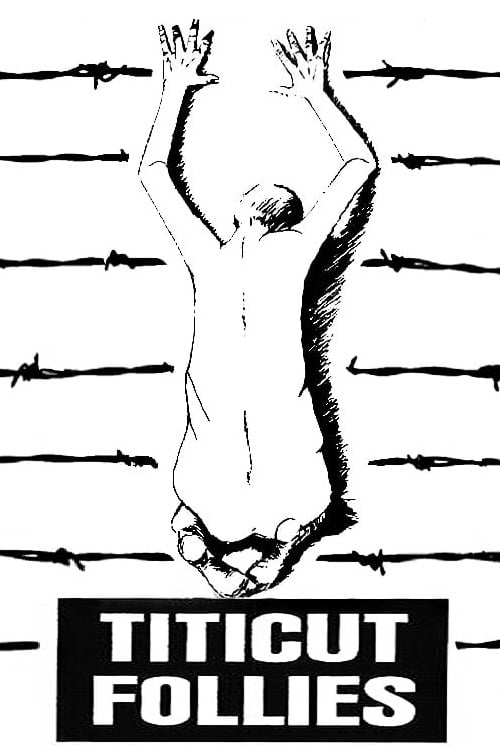
Titicut Follies
1967 · Frederick Wiseman
When you want to be confronted rather than comforted — a demanding, unforgettable watch for a night you're prepared to sit with something genuinely disturbing. Definitely challenge, not comfort.
What it's about
A black-and-white documentary shot inside Bridgewater, the Massachusetts state institution for men judged criminally insane, recording how inmates are handled by guards, social workers, and psychiatrists. There's no narrator and no interviews — the film simply watches daily life on the wards, framed by the annual inmate-and-staff variety show that gives it its title.
The experience
Harrowing and stark — it confronts you with strip searches, force-feeding, and casual institutional cruelty without commentary, leaving you to draw the verdict yourself. The silence where a narrator would be makes it more damning, not less, and some images stay with you for a long time.
The craft
Frederick Wiseman's first film established the method he'd use for fifty years: no narration, no score, no captions, no stated argument — just patient observation and razor-sharp editing that builds meaning through juxtaposition. The bookending variety-show sequences are a masterstroke of structure, and the grainy black-and-white gives it the weight of evidence.
Why it matters
It was banned from public exhibition in Massachusetts for decades — the rare American film suppressed by court order — and it helped force reform of the institution it documented, while founding the observational tradition in American documentary.
Snapshot
Frederick Wiseman's first film as director is an eighty-four-minute black-and-white record of daily life at the Massachusetts Correctional Institution at Bridgewater, the state hospital where men judged criminally insane — and a good many men merely inconvenient — were held under the joint authority of the departments of correction and mental health. It has no narrator, no interviews, no score, no titles identifying anyone on screen, and no argument stated in words. It opens and closes with the institution's annual variety revue, the "Titicut Follies" of the title (Titicut being the old Wampanoag name for the Taunton River country around Bridgewater), staged by inmates and correctional officers together behind a tinsel curtain. Between those bookends the film moves through strip searches, cell corridors, psychiatric interviews, a birthday party, a force-feeding, an embalming, and a burial.
It is also the only American film ever restrained from general exhibition by a court on grounds other than obscenity or national security. Massachusetts sued to suppress it within weeks of its 1967 New York Film Festival premiere, and for roughly a quarter century it could legally be shown only to specialized professional audiences. That double life — as a founding text of American observational documentary and as the central case study in documentary ethics — is inseparable from what the film is.
Industry & production
Wiseman came to filmmaking from law. He had taught at Boston University's law school and, in the early 1960s, took students on field trips to Bridgewater, which is how he knew the place and its superintendent, Charles Gaughan. His prior film experience was as producer of Shirley Clarke's The Cool World (1963), a rights purchase and production credit that gave him a working knowledge of independent film economics and almost no experience of directing.
Titicut Follies was made outside every institution that normally financed documentary in 1966: no network, no foundation, no studio. Wiseman raised a very small budget privately and shot with a crew of essentially two — himself on sound, John Marshall on camera. (Figures for the budget circulate in the literature but vary; the precise number is not reliably established.) Shooting took place at Bridgewater in the spring of 1966 over roughly a month, with a shooting ratio far beyond conventional documentary practice, followed by nearly a year of editing.
Permission came through Gaughan and, crucially, through Elliot Richardson, then lieutenant governor of Massachusetts. By the time the film premiered, Richardson was the Commonwealth's attorney general, and it was his office that went to court to stop it. The state's stated ground was the privacy and dignity of inmates who could not meaningfully consent; the film's defenders read the suit as a state protecting itself from evidence. In 1968 Superior Court Judge Harry Kalus enjoined the film and ordered prints destroyed. The Supreme Judicial Court, in Commonwealth v. Wiseman (1969), softened this: no destruction, but exhibition limited to audiences of doctors, lawyers, social workers, students in those fields, and legislators. A Superior Court ruling in 1991 finally lifted the restriction, requiring only that the film carry a notice of subsequent changes at Bridgewater; general release followed in 1992 and a PBS broadcast in 1993.
The suppression shaped Wiseman's career structurally. Blocked from the commercial and broadcast life a first feature normally has, he built his own apparatus: a long-running relationship with public television from High School (1968) onward, and Zipporah Films, the distribution company he founded in 1970 and named for his wife, which has controlled his catalog ever since. Almost no other American documentarian of his generation retained that degree of ownership.
Technology
The film sits precisely on the technological threshold that made it possible. The lightweight synchronous-sound rig — a magazine-loading, self-blimped 16mm camera (Marshall was an early American user of the Éclair NPR) paired with a Nagra quarter-inch recorder — had only become reliable in the first half of the 1960s. It meant one operator could carry the picture and one the sound, hold sync without an umbilical cable between them, and follow people through doorways, down corridors, and into rooms where a tripod, a lighting kit, and a five-person crew would have ended the event being filmed.
Everything visible in Titicut Follies was shot in available light: fluorescent tubes, barred windows, the naked bulb of a bare cell. Fast black-and-white stock, wide-angle lenses, and hard processing produce the film's characteristic look — coarse grain, blown highlights on tiled walls, faces sliding into shadow. This is not stylization after the fact; it is the visual residue of a technology used at its limit. The same limit governs the sound, which is close, reverberant, and often overloaded, because there is no boom operator finessing perspective, only Wiseman standing within a few feet of the camera with a microphone.
Technique
Cinematography
John Marshall's camera is the film's most underrated element. Marshall was not a news cameraman but an ethnographic filmmaker, the maker of The Hunters (1957) and, over decades, the great body of Ju/'hoansi films; he had developed at Harvard's Film Study Center an idea of the "sequence film," in which the camera stays with a single unfolding event long enough for its internal logic to emerge. That discipline is everywhere here. Shots run long. The camera reframes rather than cuts, holding on a face after the speech has ended, drifting to a bystander's reaction, following a body being turned or lifted. Wide lenses put the operator physically inside conversations, so proximity registers as intimacy and as intrusion at once — the viewer is never granted the safe middle distance of reportage.
The film's most notorious images derive their force from duration rather than framing: a naked man standing in an empty cell while officers ask him, over and over, whether his room is clean; a psychiatrist inserting a feeding tube while cigarette ash lengthens above the funnel. The camera does not underline either. It stays.
Editing
Wiseman edited the film himself, as he has edited nearly all his work, and he has consistently described editing as the stage where the film's meaning is discovered rather than executed. Titicut Follies has no chronology to speak of. It is built as a mosaic: sequences are ordered by rhyme, contrast, and escalation, so that the institution emerges as a set of recurring procedures rather than a story with a beginning.
The single most analyzed cut in American documentary is here — the intercutting of the force-feeding of an inmate with the preparation of his corpse for burial. The two events did not occur in immediate succession; the edit asserts a relation between them that the footage alone does not prove. Every subsequent debate about observational documentary's claim to non-intervention runs through this passage. It is where Wiseman's own term for his method, "reality fictions," stops being modest and becomes precise: the material is unstaged, the meaning is authored.
The revue frame performs a comparable operation. By ending where it began, the film converts what could have been an exposé's forward march toward revelation into a closed loop — nothing is resolved, the show goes on next year.
Mise-en-scène / staging
Nothing is staged, and the film is nonetheless full of staging. Bridgewater supplies its own: the proscenium of the Follies, the ritual choreography of the strip search, the semicircle of clinicians at a staff review, the processional of a burial. Wiseman's contribution is to recognize these as theater and to shoot them as such, letting institutional space do the work a production designer would otherwise do. The recurring architecture — tiled corridors, barred galleries, the bare cells, the stage with its tinsel — reads as a single continuous set in which the same men appear in different costumes and roles.
Sound
Wiseman recorded the sound, and the film is arguably organized by it. There is no non-diegetic music; every note is sung or played by someone at Bridgewater. Voices carry the argument: the flattened bureaucratic questioning of the intake interview, with its remorseless inventory of a man's sexual history; the officers' patter, jocular and unceasing; and above all the voice of Vladimir, the inmate who explains at a staff conference, with complete lucidity, that the institution is making him worse and that he wishes to be returned to prison, and whose reward is an increase in medication. The clinicians' reply is the film's thesis, delivered by the institution about itself.
Ambient sound is left raw — echo, clatter, overlapping shouting from unseen cells — so that the acoustic environment communicates confinement even in shots that show nothing alarming.
Performance
Everyone in the film performs, which is its deepest subject. The Follies is literal performance; the officers perform competence and good humor for the camera; the psychiatrists perform professional method; the inmates perform sanity, madness, or dignity depending on what the situation seems to require. Wiseman has long maintained that people alter their behavior less for a camera than is assumed, and that what they do alter is itself revealing. The film supports him: the guards' awareness of being watched does not soften their conduct, it stylizes it. Erving Goffman's dramaturgical account of the "total institution" in Asylums (1961) is the obvious intellectual companion, and Titicut Follies often plays as its cinematic demonstration, though the film makes no citation and Wiseman has resisted claims of illustrating any theory.
Narrative & dramatic mode
The film refuses the two dominant documentary grammars of its moment. It has none of the expository voice-over authority of the network documentary (Harvest of Shame, 1960), and none of the crisis structure — a protagonist, a deadline, an outcome — that Robert Drew's unit had made the signature of American direct cinema in Primary (1960). There is no central figure, no problem posed and solved, no arc.
What replaces narrative is accretion. Sequences are self-contained and roughly equal in weight; meaning arises from adjacency and repetition. The mode is closer to essay or to the naturalist novel than to reportage: a place is entered, inhabited at length, and left, and the reader is expected to draw conclusions the text declines to state. Because judgment is never voiced, the viewer is placed in the uncomfortable position of supplying it — which is exactly what the Commonwealth objected to, and exactly what makes the film durable.
Genre & cycle
Titicut Follies belongs to observational documentary, and it effectively founds a sub-genre: the institutional film, in which a bounded organization rather than a person is the subject. Its immediate cycle-mates are the direct-cinema works of Leacock, Pennebaker, and the Maysles, and — strikingly — Allan King's Warrendale, made in Canada the same year inside a residential treatment center for disturbed children, and likewise refused broadcast by the institution that had commissioned it. Two 1967 observational films about the care of troubled people, both suppressed, is not coincidence; it marks the point at which the new technology's access outran the consent frameworks around it.
Behind the film lies the older muckraking tradition — Riis, Hine, the asylum exposé — and beside it the fictional asylum cycle of The Snake Pit (1948) and Shock Corridor (1963), which Wiseman's material renders instantly implausible by comparison. Ahead of it lies Wiseman's own cycle, the institutional series that now runs to more than forty films: High School (1968), Law and Order (1969), Hospital (1970), Juvenile Court (1973), Welfare (1975), Near Death (1989), and onward through the late civic and cultural portraits.
Authorship & method
Wiseman's method, established here and essentially unchanged since, is: no research shooting, no advance script, minimal negotiation with subjects beyond initial access; record for weeks; then edit alone for months, discovering structure in the material. He does the sound himself, which keeps him physically inside every scene and gives him an editor's memory of it. He rejects the label cinéma vérité — the Rouch–Morin practice of Chronique d'un été (1961), with its provocations and on-camera reflexivity — preferring to describe the results as fictions built from real material.
John Marshall's camerawork is the essential collaboration, and the film is unimaginable without his ethnographic patience; the two did not work together again, and Wiseman subsequently used other cinematographers (most durably William Brayne and later John Davey) while retaining the same visual grammar. There is no composer, no writer, and no credited editor other than Wiseman: the authorship model is deliberately concentrated, a documentary equivalent of the politique des auteurs arrived at by economic necessity as much as by conviction.
Movement / national cinema
The film is American direct cinema, but its roots are specifically Bostonian and specifically ethnographic. Harvard's Film Study Center, founded by Robert Gardner and the base for Marshall's work, cultivated a long-take, non-narrated approach to filming other people's institutions and rituals; Titicut Follies turns that anthropological gaze on an American state facility, which is part of its shock. Wiseman has said, in various formulations, that his subject is how American institutions actually behave as against how they describe themselves — an ethnography of the domestic.
That lineage has proved unusually continuous. It runs from Gardner and Marshall through Wiseman to Harvard's Sensory Ethnography Lab (Lucien Castaing-Taylor and Véréna Paravel's Leviathan, 2012, and their hospital film De Humani Corporis Fabrica, 2022), which shares the New England institutional base while pushing the camera far past Wiseman's classical restraint.
Era / period
1966–67 places the film at the intersection of several American arguments. The Community Mental Health Act of 1963 had begun the long, badly funded process of deinstitutionalization; the antipsychiatry writings of Szasz, Laing, and Foucault (translated into English as Madness and Civilization in 1965) were making psychiatric authority itself contestable; and Great Society liberalism had raised expectations of what the state owed its custodial populations. Bridgewater was a Massachusetts embarrassment already known to reformers.
The film also arrives at the moment when documentary's technical capacity to enter closed spaces had outrun both law and professional ethics. There was no established regime for informed consent by institutionalized subjects. The litigation that followed was, in effect, the American legal system improvising one under pressure, and its resolution — restricted professional exhibition — was itself a period artifact, a compromise inconceivable either a decade earlier or a decade later.
Themes
The governing theme is the total institution: a closed world that absorbs every function of life and, in doing so, dissolves the distinction between care and custody. Bridgewater's staff are not monsters; they are men doing a job under conditions that make the job impossible, and the film's refusal to villainize them is what makes its indictment structural rather than personal.
Language is a second theme, and the film treats speech as an instrument of power. The intake questionnaire, the staff conference, the psychiatrist's diagnostic idiom — each is a procedure that converts a person into a case, and Vladimir's articulate protest is neutralized precisely by being processed through that idiom.
The body is a third: stripped, shaved, fed through a tube, laid out, embalmed, buried. Wiseman films flesh with a clinical steadiness that has been read both as necessary witness and as violation, and the film supplies no defense against the second reading. Finally there is performance and the porousness of roles — the revue in which keepers and kept share a stage is the film's compressed argument that the line between them is administrative rather than natural.
Reception, canon & influence
Backward. The film absorbs Marshall's ethnographic sequence method, Drew-unit portable technology stripped of its crisis dramaturgy, the muckraking exposé tradition, and the sociological climate of Goffman's Asylums. Wiseman's legal training is a genuine formal influence: the film is built like the presentation of evidence, with the argument left to the finder of fact.
Contemporary reception. It premiered at the New York Film Festival in 1967 to strong notices and took prizes on the European festival circuit before the injunction fell. Robert Coles's response in The New Republic became the standard defense — that the indecency lay in the conditions, not in their filming — while the exploitation charge, that men incapable of consent had been exposed to strangers for the benefit of a filmmaker's career, was never fully answered and has not gone away. The case became the permanent reference point in documentary-ethics writing, notably Calvin Pryluck's work on consent in observational filming, and it is the subject of book-length treatment by Thomas Benson and Carolyn Anderson (Documentary Dilemmas: Frederick Wiseman's Titicut Follies, 1991); Barry Keith Grant's Voyages of Discovery (1992) and Bill Nichols's writing situate it within Wiseman's larger project. Whether the film materially improved conditions at Bridgewater is contested; the more defensible claim is that the litigation kept the institution in public argument for decades.
Forward. Its immediate progeny is Wiseman's own catalog, which established the institutional documentary as a durable form. Beyond that, its influence is visible wherever a filmmaker enters a closed institution without narration and lets duration make the case: Raymond Depardon's psychiatric and emergency-room films (San Clemente, 1982; Urgences, 1988), Nicolas Philibert's La Moindre des choses (1996), shot at the La Borde clinic, Wang Bing's 'Til Madness Do Us Part (2013), a Chinese psychiatric-ward film that is unmistakably in this lineage, and the Sensory Ethnography Lab's institutional work. The American verité-adjacent tradition of Steve James and the observational strain in Errol Morris's early films share the inheritance, though by affinity more than direct descent.
Titicut Follies was restored and reissued in the 2010s, and Wiseman received an honorary Academy Award in 2016, a late institutional embrace of a filmmaker whose first film an institution had tried to destroy. That irony is not incidental to its canonical standing: the film is remembered both for what it shows and for what happened when it showed it.
A Deleuzian reading
A cigarette burns down between a psychiatrist's fingers while he threads a feeding tube into a man's nose.
The full Deleuzian reading of Titicut Follies →
Reception
It premiered at the 1967 New York Film Festival to serious acclaim — then Massachusetts sued and got it banned from general release, so for over two decades almost nobody could legally see it. Since the ban lifted in 1991 it's been enshrined as the founding text of Wiseman's career and a landmark of American documentary.
How Titicut Follies was received, from release to now →
How to watch Titicut Follies: what to notice on a first viewing
- Listen for shouting and clatter from cells the camera never shows. Wiseman recorded the sound himself, close to the action, and leaves it raw: echo, overlapping voices, noise from rooms you never enter. The confinement reaches you through what you hear happening just out of view.
- Watch how long the camera holds on a face without cutting. John Marshall's camera stays on a moment well past the point most films would cut away, reframing rather than editing, so intimacy and intrusion arrive together. There is nowhere else for your attention to go, so you end up seeing more than you meant to.
- Notice the strip search staged like a routine with steps. Wiseman treats the institution's own procedures, the search, the staff conference in a semicircle, as choreography, shooting them exactly as theater rather than adding any of his own. The film's staging is found, not invented, which is what makes it read as evidence rather than argument.
- Notice there is no narrator, no score, and no names on screen. Sequences follow one another by rhyme and contrast rather than by story, and some stretches move nothing forward at all, just hold on the institution's routine. Nothing is telling you what to conclude, so the film leaves that job entirely to you.
The whole guide to watching Titicut Follies, with the keys for a rewatch →
Influences: the films it descends from and the films it influenced
- The Hunters (1957) — Marshall's ethnographic sequence method — hold position and film an action through to its completion rather than cutting for coverage — is the shooting discipline he carried intact into Bridgewater, where the wide-angle lens stays close enough to keep the whole room in frame around a body.
- Primary (1960) — Supplies the physical apparatus Wiseman adopts wholesale: shoulder-braced Auricon crystal-synced to a Nagra, a two-person camera/sound pair working without lights — except that Wiseman runs the recorder himself, so the sound man is also the man who will cut the film.
- Crisis: Behind a Presidential Commitment (1963) — The Drew unit's 'crisis structure' — a pre-selected deadline that manufactures suspense — is precisely what Titicut Follies strips out; Wiseman keeps the gear and the access protocol but replaces the ticking clock with accretion, so no scene is justified by what it sets up.
- Chronique d'un été (1961) — Shares the Coutant-Mathot lightweight sync-camera lineage but functions as Wiseman's declared negative model: no provocation, no on-camera interview, no filmmakers in shot — the crew's presence registers only when an inmate or guard glances at the lens.
- On the Bowery (1956) — The flophouse filmed in available light with men re-performing their own daily routines for the camera — the 'found theater' of institutional role-play that Wiseman relocates to a locked ward, where guards and inmates both play their assigned parts on cue.
- The Cool World (1963) — Wiseman produced it, and the schooling is visible: real interiors rather than sets, non-professionals performing versions of themselves, and a track built from location ambience instead of score — the three rules he never afterward broke.
- Point of Order (1964) — Institutional footage assembled as the presentation of evidence, with no narrator to state the conclusion — the lawyer's structure Wiseman's own legal training arrives at independently, leaving the argument to the finder of fact.
- Le Sang des bêtes (1949) — Establishes the tactic of filming institutional procedure at its own unhurried working tempo so that horror emerges from the competence of the technique rather than from emphasis — the direct formal ancestor of the force-feeding sequence.
- Shock Corridor (1963) — The literal documentary of the institution that realizes Fuller's thesis — the asylum ward filmed as a direct diagnosis of the nation's mind.
- One Flew Over the Cuckoo's Nest (1975) — Shot inside a working state hospital with actual staff and patients in supporting roles, staging its ward rounds and group sessions on the observational record Titicut Follies had made available — the institutional documentary's grammar borrowed back into fiction.
- High School (1968) — The immediate sequel in method: mosaic of self-contained scenes with no protagonist, no titles identifying anyone, and a closing statement placed in a subject's mouth rather than a narrator's — the bookend device from Titicut Follies made repeatable.
- Hospital (1970) — Extends the total-institution survey to a voluntary one, with Wiseman again on sound and William Brayne on camera reproducing Marshall's wide-angle proximity — proof the visual grammar was transferable to a new cinematographer.
- Near Death (1989) — Pushes the long take past endurance across six hours in an ICU, letting duration itself carry the ethical weight that the Bridgewater film compressed into single scenes.
- San Clemente (1982) — Enters a Venetian asylum with sync sound and no commentary, holding on patients' self-directed speech until it becomes performance — the found-theater observation of Titicut Follies transposed to Basaglia-era Italy.
- La Moindre des choses (1996) — Films the La Borde clinic's residents rehearsing and staging a play, making explicit the institutional role-play Wiseman found latent in the Bridgewater inmates' variety show — the same bookend structure of performance framing the ward.
- 'Til Madness Do Us Part (2013) — Handheld available-light shooting inside a Yunnan psychiatric ward, following bodies along corridors in unbroken takes with diegetic sound only and no titles or narration — the Titicut Follies method reconstituted with digital gear and no access agreement worth the name.
- Leviathan (2012) — Sensory Ethnography Lab's extension of the same premises — no narration, no interviews, no score, and a wall of raw ambience carrying the whole soundtrack — with the camera pressed into industrial process the way Marshall's was pressed into the ward.
- Even Dwarfs Started Small (1971) — Wiseman applies strict observational duration with diegetic-only sound to institutional subjects performing degrading ceremony, using formal refusal of commentary as the political stance itself — the documentary grammar Even Dwarfs absorbs into fiction, where the camera's non-intervention becomes its most radical act.
- Land of Silence and Darkness (1971) — Establishes the unnarrated observational documentary confronting institutionalized marginal subjects; Herzog adopts Wiseman's no-voiceover, no-didactic-framing stance as a position of ethical witness rather than journalistic explanation — the dossier names this film explicitly as the structural and ethical template.
- Man Bites Dog (1992) — Models the narration-free observational direct-cinema grammar — long handheld takes, no music, no authorial commentary — whose 'neutral' camera Man Bites Dog weaponizes by attaching it to a murderer.
- Gummo (1997) — Direct-cinema tableaux of institutional grotesquerie — the unblinking vérité observation of the abject that Gummo restages as fiction.
- Warrendale (1967) — Made the same year inside a treatment center for disturbed children: sync-sound, no narration, no interviews, camera holding through restraint scenes — and, like Titicut Follies, suppressed by the institution that granted access, making consent-in-observational-filming a shared problem, not an inherited one.
- Salesman (1969) — The other 1960s American film to build structure by accretion of repeated occupational routine rather than by dramatic arc, with Zwerin discovering the shape in the cutting room months after shooting — Wiseman's editing model minus the credited editor.
- Gimme Shelter (1970) — Demonstrated narration-free observational form whose entire meaning is constructed through editing juxtaposition rather than commentary — the same 'authorship resides in the cut' principle Zwerin applies.
- Punishment Park (1971) — Unnarrated observational vérité exposing state custodial power over confined bodies — the documentary scrutiny Punishment Park converts into fiction to reach what real cameras could not.
- The House Is Black (1963) — The same ethical knife-edge worked with the opposite tool: permitted access to a closed institution, handheld proximity to inmates' bodies, and a performed recital bracketing the film — but with the poetic voice stripped out entirely, which isolates exactly what Farrokhzad's narration was doing to the images.
Similar films
- One Flew Over the Cuckoo's Nest (1975) — influence & lineage
- Primary (1960) — influence & lineage
- The War Game (1966) — same viewing thread
- Tower (2016) — same viewing thread
- Belfast, Maine (1999) — often watched together
- Battleship Potemkin (1925) — often watched together
- In the Realm of the Senses (1976) — often watched together
- Mad God (2021) — often watched together
All the films related to Titicut Follies →
Watch it with: curated runs of related films
- The Machinery of Catastrophe — A run of hour-by-hour reconstructions and unblinking documentaries that watch disaster as procedure — ice warnings, intercepted cables, evacuation drills, ward routines — and refuse to sentimentalize what the systems grind out.