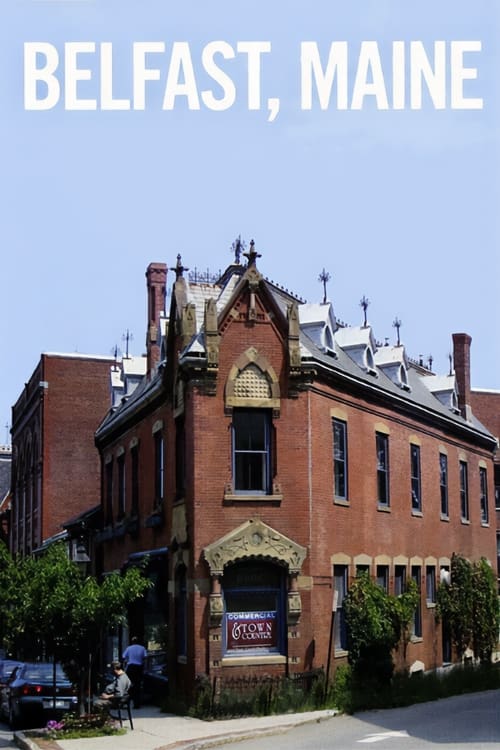
Belfast, Maine
1999 · Frederick Wiseman
For when you want total immersion rather than a story — a long, contemplative watch for a patient mood, best taken as a whole day's or evening's commitment. Demanding in length, gentle in tone.
What it's about
A four-hour portrait of a small working port town on the Maine coast, moving among lobstermen, a fish-processing plant, a tugboat, a hospital, a courtroom, a church, a police cruiser, a classroom, and the homes of the elderly. Nobody is named and nothing is explained; the subject is the town itself — how a whole community works, cares for its people, and holds itself together.
The experience
Meditative and quietly monumental — you settle into its rhythm the way you'd settle into a long stay somewhere, and ordinary work starts to feel riveting. It's unhurried but never dull, and by the end you feel you know a place from the inside.
The craft
Wiseman strips away every conventional aid — no narration, music, interviews, or captions — and builds the film entirely through observation and editing, letting scenes of labor and care accumulate into an argument about what a community is. The rhythm of the cutting, moving from boats to hospital beds to town meetings, is the whole art.
Why it matters
Made three decades into Wiseman's institutional project, it marks his most ambitious expansion of the method — from a single institution to an entire town — and stands among the great documentary portraits of American communal life.
Snapshot
Four hours and eight minutes long, without narration, interviews, music score, chapter titles, or a single identifying caption, Belfast, Maine is Frederick Wiseman's most sustained attempt to take an entire community — rather than a single institution — as the unit of observation. Shot in a small port town on Penobscot Bay in Waldo County, Maine, the film moves among lobster boats, a waterfront fish-processing plant, a tugboat, a hospital, a courtroom, a church, a police cruiser, a high school classroom, a dance studio, a choir rehearsal, and the front rooms of the elderly and the dying. Nothing is explained; nobody is named. What holds the film together is not a story but an accumulating argument about what a place is: work, care, ritual, weather, and the constant labor of maintaining a common life.
It arrives at a specific historical moment for its subject. Belfast had been a poultry-processing and sardine-canning town whose industrial base largely collapsed in the 1970s and 1980s, and by the mid-1990s it was absorbing a very different kind of employment as a credit-card operation opened white-collar offices there. Wiseman does not narrate this transition — he never narrates anything — but the film is saturated by it: hands still gutting fish on a line, and a town whose economy is quietly changing underneath them.
Industry & production
Belfast, Maine was produced by Wiseman through Zipporah Films, the Cambridge, Massachusetts company he founded in the early 1970s and named for his wife, the legal scholar Zipporah Batshaw Wiseman. Zipporah is the crucial structural fact of Wiseman's career: by owning and self-distributing his own catalog, chiefly through non-theatrical rental to universities, libraries, and museums, he built an economic base that freed him from the commissioning logic that shapes most documentary. He did not have to pitch a four-hour film about an unremarkable town of a few thousand people to anyone who needed it to be shorter or more clearly "about" something.
Financing followed the mixed pattern typical of his later work — American public television, foundation and endowment support, and, increasingly from the 1990s onward, European (particularly French) broadcast partners, where his reputation ran ahead of his standing at home. The itemized budget is not part of the public record, and the exact production dates and shooting schedule are not documented in detail in accessible sources; what is consistent across accounts of his practice is the shape of it — a shooting stretch of a few weeks to a few months, followed by roughly a year of editing.
The crew was tiny by design: Wiseman directing and recording sound himself, John Davey on camera, and generally one assistant. This is not asceticism but method. A two-person unit can enter a hospital room, a factory line, or a courtroom without becoming the event. Wiseman has consistently described asking permission openly, using no hidden cameras, and obtaining releases, and has repeatedly noted how rarely people decline.
Distribution followed the Wiseman norm: festival play (the film circulated on the late-1999 festival circuit, including in New York), a public-television broadcast, and then permanent life in the Zipporah rental catalog. That afterlife is central to how his films were actually seen for decades — not as releases but as a standing library, later migrated to institutional streaming platforms and, more recently, to curated retrospectives.
Technology
The film was shot on 16mm color negative with sync sound — the same lightweight double-system rig that had defined Wiseman's practice since Titicut Follies (1967): a handheld sync camera on the operator's shoulder, a portable recorder on the director's, joined by a cable that in effect makes the two operators one instrument. Wiseman recorded sound himself, which is why the cable matters: he chooses what to hear, and by pulling on the tether he shapes where the camera goes.
Working on film rather than tape in 1999 was a deliberate constraint, not a lag. Ten-minute magazines impose a discipline of judgment — someone has to decide, continuously, that this is worth exposing. The material is thin on precisely which camera bodies and stocks were used on this production, and it would be invention to specify them; what can be said is that Wiseman remained committed to 16mm origination for years after affordable video was available to him, and only moved to digital acquisition in the following decade. Editing was photochemical-era flatbed work in his Cambridge cutting room, on a shooting-to-finished ratio that in his practice has always been extreme — the vast majority of exposed footage discarded.
Technique
Cinematography
John Davey, who shot for Wiseman from the mid-1970s onward and became his single most important collaborator, works here in a register that is often mischaracterized as neutral. It is not. The camera is handheld but rarely restless; it holds, and it holds longer than expectation. Framing tends toward the medium shot that keeps a body and its task in the same image — hands, tool, face — so that labor is legible as labor rather than illustrated by close-up. Available light dominates: the flat cold light of a processing floor, the gray maritime light off the bay, the yellow interior light of a kitchen where a home health aide is working.
Equally important is what Davey shoots between scenes: storefronts, gulls, the harbor, snow, empty streets, the water changing under changing weather. In lesser hands these are transitions. In Wiseman's cutting they function as the film's connective tissue and its meteorology, giving the town a body and the film its seasonal drift. The image is 1.33:1, which suits a film built out of rooms and faces rather than landscape.
Editing
Wiseman edits his own films, and he has been explicit for decades that this is where the film is written — that shooting gathers material and cutting makes the thought. There is no shooting script and no post-hoc narration to paper over gaps; structure has to be carried entirely by adjacency. A sequence in the fish plant next to a sequence in a hospital room is not a claim spoken aloud, but it is a claim.
The organizing logic in Belfast, Maine is rhyme and rotation rather than progression. The film returns repeatedly to three registers — work, institutional care, and cultural performance — and lets them comment on each other. Duration is the argument: at four-plus hours, individual sequences are permitted to run past the point where their "information" has been delivered, into the region where behavior, boredom, tenderness, and effort become visible. Wiseman has described his films as "reality fictions," a phrase that insists the editing is authored and interpretive rather than transparent.
Mise-en-scène / staging
Wiseman stages nothing, but he chooses spaces with a dramatist's eye, and the film is unusually attentive to the architecture of American public life: the counter, the pew, the bench, the classroom desk, the hospital bed, the conveyor. These are all arrangements that assign people positions relative to one another — who speaks, who waits, who is examined. The film's recurring formal unit is a room in which one person's authority or care is exercised on another, and its recurring counter-unit is the open water, where the town's oldest work is done alone against weather.
Sound
Wiseman's sound is his signature as much as any image. There is no score. There is no non-diegetic sound of any kind. Every note of music in the film is being made by someone in front of the camera — a choir rehearsing, a dance class, a music lesson, a theatrical rehearsal. The absence of score is an ethical position: no cue tells the viewer how to feel about a dying woman or a factory line.
Because he mixes his own recordings, Wiseman is also unusually attentive to the sound between speech — machinery, wind, gulls, the ambient hum of institutional rooms — and he uses ambient beds across cuts to bind the town into a continuous acoustic space. Dialogue is left in its real acoustics, overlapping, half-audible at the edges, unsubtitled and uncorrected.
Performance
There are no performers, and yet performance is one of the film's explicit subjects. The film is full of people executing practiced roles: a teacher teaching, a minister preaching, a judge adjudicating, a nurse instructing, an actor rehearsing. Wiseman's camera treats professional competence as a kind of theater — and by placing an amateur stage rehearsal beside a courtroom or a classroom, invites the comparison without stating it. The counterweight is the film's unguarded material: the elderly in their homes, the sick, the tired, people whose social role has thinned out and who are simply present.
Narrative & dramatic mode
The film has no protagonist, no plot, and no resolution — and yet it is not shapeless. Its dramatic mode is closest to the nineteenth-century social novel that Wiseman has long cited as his model: a cross-section held together by a place, in which characters appear once and vanish, and meaning accumulates from juxtaposition rather than causation. Sequences function as chapters. Motifs return — care for the aged, the handling of the dead and the dying, the transmission of skills and texts — with a persistence that produces something very close to a theme in the musical sense.
Its most quoted self-reflexive gesture is a high-school English class working through Moby-Dick. The choice is not accidental: Melville's book is the great American attempt to catalog a working world exhaustively enough to reach its metaphysics, and it is the obvious literary ancestor of a four-hour film about a Maine port that spends much of its length on the mechanics of processing fish.
Genre & cycle
Formally, this is observational documentary in the American direct-cinema line. Structurally, it belongs to a different lineage — the city symphony, from Ruttmann and Vertov forward — though stripped of montage euphoria and rhythmic abstraction and rebuilt out of long takes and speech.
Within Wiseman's own filmography it marks a cycle turn. Through the late 1960s and 1970s his subject was the institution: High School, Hospital, Welfare, Juvenile Court, Meat. From Central Park (1989) and Aspen (1991) onward, the frame widened toward places rather than agencies, and Belfast, Maine is the fullest realization of that widening. It became the template for a late-career American cycle: In Jackson Heights (2015), Monrovia, Indiana (2018), and City Hall (2020) all descend from it directly.
Authorship & method
Wiseman came to film sideways. Trained as a lawyer and teaching law when he produced Shirley Clarke's The Cool World (1963), he made Titicut Follies in 1967 and spent the next half-century refusing the conventions of the form — no narration, no interviews, no talking heads, no archival inserts, no captions, no score. He also rejected the label cinéma vérité, calling it a pretentious French phrase for something that is anything but unmediated, and offered "reality fiction" instead.
His method is nearly invariant: minimal advance research, a short scouting period, a compressed shoot, an enormous surplus of footage, and a long solitary edit during which the film's structure is discovered. He does not pre-select "characters." He does not return for pickups to complete an arc.
The key collaborator is John Davey, whose long tenure as cinematographer gave the late films their consistency of eye; the working relationship is unusual for its duration and for how completely the two operators function as one apparatus. The other credits are Wiseman himself — director, producer, sound recordist, editor. There is no writer, because there is no script; there is no composer, and that vacancy is a statement of principle. Wiseman's honors accumulated around the whole body of work rather than any single title: a MacArthur Fellowship in 1982, the Golden Lion for Lifetime Achievement at Venice in 2014, and an Academy Honorary Award in 2016.
Movement / national cinema
Belfast, Maine is a late, mature product of American direct cinema — the movement associated with Robert Drew, Richard Leacock, D.A. Pennebaker, and the Maysles brothers, which lightweight sync-sound equipment made possible around 1960. But Wiseman departed from that movement's founding assumptions almost immediately. Drew-style direct cinema chased crisis, celebrity, and event; Wiseman chased the un-newsworthy operations of ordinary institutions and rejected the idea that the camera's presence is neutral.
It is also, distinctly, a film of American public television and of the non-theatrical distribution economy — a body of work that was for decades far more central to the American classroom than to the American cinema, and whose critical canonization ran ahead in France and elsewhere in Europe before it consolidated at home.
Era / period
1999 sits at a hinge. The film was made on the last practical edge of the 16mm documentary era, just before digital video and non-linear editing rewrote the economics of the form. It was also made at the far end of the 1990s American boom, in a town that the boom had reached only obliquely — a deindustrialized coastal community absorbing service and back-office work while its older trades persisted at the water's edge. The film neither laments nor celebrates this; it records what a place looks like mid-transition, when both economies are visible in the same week.
Themes
Work as the substrate of community. The film's largest theme is labor in its unglamorous specificity — hauling traps, gutting fish, hauling a barge, cutting hair, filing papers. Wiseman's insistence on showing processes at length is an argument that a town is constituted by what its people do with their hands and hours.
Care and its institutions. Running beside work is a sustained study of how a community handles frailty: visiting nurses, home health aides, social workers, hospital staff, the police as de facto first responders to psychiatric crisis. The film accumulates a portrait of people managing decline with limited resources and considerable patience.
Mortality. Old age, illness, and dying are so persistent across the film that several critics read the town as a memento mori. Wiseman had already devoted a film to this (Near Death, 1989); here it is folded into ordinary life rather than isolated in a ward.
Transmission. Teaching recurs at every level — literature, dance, music, theater, trade skills — as the mechanism by which a place reproduces itself. The Moby-Dick class is the apex of this theme and its self-portrait.
The dignity and the limits of the ordinary. The film has been read in two opposed ways, and both are defensible: as a humane account of a functioning community, and as a grave one, attentive to poverty, isolation, and diminished prospects. Wiseman characteristically supplies the evidence for both and adjudicates neither.
Reception, canon & influence
Critically, the film was received as a major work by an established master — praised for its ambition and its refusal of shortcuts, and singled out for the Moby-Dick sequence as an interpretive key. It is regularly ranked among the strongest of his late films and cited as the pivot from institutional study to community portrait. It also drew the familiar objection to Wiseman's late work: that four hours without orientation asks a great deal, and that the absence of context can shade into opacity. There are also reports of ambivalence in Belfast itself, with some residents feeling the portrait dwelt disproportionately on hardship, illness, and decline — a recurring pattern in the reception of Wiseman's place films, most visibly later with Monrovia, Indiana. The documentary record on that local response is anecdotal rather than systematic, and worth treating as such. The film's own awards record is likewise thin in accessible sources; Wiseman's major honors are career awards rather than title-specific ones.
Backward — what shaped it. The technological and ethical inheritance is direct cinema, filtered through Wiseman's early rejection of its taste for crisis. The structural inheritance is literary: the panoramic social novel of Balzac, Dickens, and Tolstoy, which Wiseman has repeatedly named as his model, and behind that a specifically American small-town literature — the cross-sectional portraiture of Winesburg, Ohio and Spoon River Anthology. Melville is invoked inside the film itself. The city-symphony tradition supplies the idea that a place can carry a feature-length structure without a story. And Wiseman's own three decades of institutional films supply the grammar: this is what happens when the method built for a hospital is turned on everything a town contains.
Forward — what it shaped. Its most direct legacy is Wiseman's own late cycle of community portraits, from In Jackson Heights to City Hall. More broadly, it stands as a founding text for the durational observational documentary that flourished in the two decades after it — a mode in which extended running time is itself the method. The lineage runs through Wang Bing's monumental accounts of Chinese industrial decline, through the ethnographic-formal work associated with Harvard's Sensory Ethnography Lab (Sweetgrass, Leviathan), through Nicolas Philibert's and Raymond Depardon's studies of French rural and institutional life, and through a generation of American filmmakers who film American places without narration or thesis. The specific things later filmmakers took from it are identifiable: no score, no interviews, no captions, process filmed to completion, and structure built from adjacency rather than argument.
Its deeper influence is conceptual. Belfast, Maine proposed that a place is a legitimate and sufficient subject — that you can make a serious film about a town where nothing in particular happens, provided you stay long enough and look at the work.
A Deleuzian reading
Hands take a fish off the belt, open it, drop it, take the next one.
The full Deleuzian reading of Belfast, Maine →
Reception
Critics greeted it as one of Wiseman's major works, but the town itself was split — plenty of Belfast residents felt the four-hour portrait lingered on their hardest-luck corners. It's since settled in as a peak of his small-town-America mode, and it still draws a crowd when it returns to Maine screens.
How Belfast, Maine was received, from release to now →
How to watch Belfast, Maine: what to notice on a first viewing
- Listen for the total absence of any music score. Wiseman uses no non-diegetic sound anywhere in the film; every note of music comes from someone in frame, a choir, a dance class, a rehearsal. No cue tells you how to feel about what you are watching, which is the film's whole ethical stance.
- Watch a shot outlast the point where you understood it. Wiseman lets sequences, a fish being gutted, a class, a home visit, run well past the moment their information has been delivered. Staying past the point of information is exactly where the film's argument about a town actually lives.
- Notice the camera hold steady instead of roaming. Davey's handheld camera favors the medium shot that keeps hands, tool, and face together in one frame, rather than cutting to close-ups for emphasis. Keeping the whole body in frame lets labor read as labor, not as an illustrated gesture.
- Watch storefronts, gulls, and snow appear between the scenes. Between sequences the film cuts to empty streets, weather, and the harbor, images that do not advance any single story but keep recurring throughout. These pauses give the whole town a sense of season and change beyond any one person's life.
The whole guide to watching Belfast, Maine, with the keys for a rewatch →
Influences: the films it descends from and the films it influenced
- Nanook of the North (1922) — Flaherty's rule of filming a skilled task through to its completion — the seal hunt, the sled build — in sustained medium shot is the template for the sardine line, the lobster trap-haul and the blueberry rake in Belfast, where the shot lasts as long as the job does.
- Berlin: Symphony of a Great City (1927) — Supplies the cross-sectional architecture — a place organized by the daily rhythm of its labor and public spaces rather than by a protagonist — which Wiseman keeps intact while replacing montage tempo with sync-sound duration.
- Farrebique (1946) — Rouquier shot a working farm across a full agricultural cycle with its own inhabitants performing their own labor, establishing that unstaged rural work can carry a feature's structure without a story imposed on it.
- Le Sang des bêtes (1949) — The flat, unaverted, medium-distance record of abattoir workers' practiced hands is the ethical grammar behind Belfast's fish-gutting and butchering scenes: hold on competence, never cut to a reaction shot for the audience's benefit.
- Primary (1960) — The lightweight 16mm camera synchronized to a portable quarter-inch recorder, engineered for this film, is the exact two-person no-lights rig Wiseman still uses — though he discards Drew's crisis-and-outcome dramaturgy in favor of routine.
- The Cool World (1963) — Wiseman's own apprenticeship as producer: handheld shooting in actual streets and rooms with direct location sound, cut for behavioral rhythm rather than plot, is the working posture he carried into his first film.
- Titicut Follies (1967) — The founding statement of the method Belfast applies to an entire town — no narration, no interviews, no captions, no score — with the argument carried entirely by cut order, as in the force-feeding intercut with the corpse's preparation.
- Welfare (1975) — Belfast inherits Welfare's core unit — the long uninterrupted desk encounter between a citizen and an institution's language, shot in patient shot/reverse and held past the point of comfort — and redistributes it across a town's agencies, clinics and home visits.
- Profils paysans: L'approche (2001) — Long static takes in farm kitchens, dialogue left in unsubtitled regional idiom, and a refusal to build a thesis about agricultural decline — the Belfast bet that a shrinking rural community filmed patiently is itself sufficient subject.
- Être et avoir (2002) — Wiseman's observational grammar compressed into a single room: no interviews, no narration, fixed medium shots of teaching sessions filmed to completion, with the year's dramaturgy discovered in the edit rather than scripted in advance.
- Tie Xi Qu: West of the Tracks (2002) — Takes Belfast's proposition that duration is the method out to nine hours, using continuous ambient factory sound carried across cuts as connective tissue exactly where Wiseman uses harbor and machine-room beds, and filming industrial labor at the pace of the shift.
- Mental (2008) — Soda's declared 'observational film' commandments — no narration, no score, no advance research, shoot alone, find the structure in the edit — are Wiseman's method written down as rules and applied to a psychiatric clinic.
- Sweetgrass (2009) — The most literal extension of the method: sheep-driving labor filmed to completion with no score, narration or interviews, and sync ambience recorded on the bodies of the workers rather than added in post.
- Foreign Parts (2010) — A single bounded economy — a Queens auto-salvage district — filmed as a cross-section with no protagonist, no captions and no thesis, extending Belfast's insistence that the work itself, filmed at length, is the narrative.
- Leviathan (2012) — Radicalizes Belfast's fishing sequences — the same refusal of commentary, context or captions over commercial labor — by mounting the camera inside the gear and letting overwhelming ambient sound do the work exposition would otherwise do.
- In Jackson Heights (2015) — The direct methodological sequel: a bounded geography with no protagonist, structured by adjacency between shop, church, meeting hall and street, with the community meeting carrying the same load-bearing function the town gatherings carry in Belfast.
- Fire at Sea (2016) — Builds an entire island from adjacency — clinic, radio room, fishing boat, rescue deck — with no interviews or narration and ambient beds bridging cuts, applying the Belfast structure to a place under emergency.
- D'Est (1993) — Arrives from the avant-garde side at Wiseman's same wager: a place rendered with no protagonist, no commentary and no captions, structured only by duration and the lateral tracking pan across people waiting and working.
Similar films
- Titicut Follies (1967) — influence & lineage · often watched together
- The Tree of Wooden Clogs (1978) — often watched together
- Edvard Munch (1974) — often watched together
- The Straight Story (1999) — often watched together
- Babette's Feast (1987) — often watched together
- The Company of Strangers (1990) — often watched together
- News from Home (1977) — often watched together
- Small Things Like These (2024) — shared sensibility