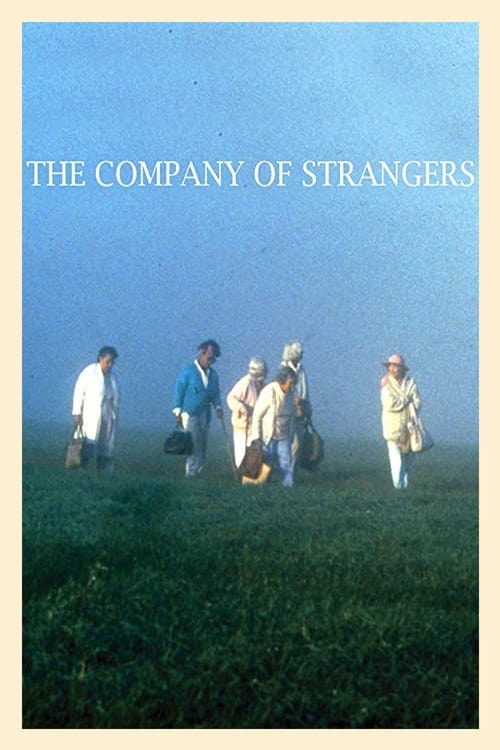
The Company of Strangers
1990 · Cynthia Scott
For when you're tired of noise and want something humane and restorative — a film to watch when you need company more than spectacle, or when you're thinking about the people in your life who are getting older.
What it's about
A bus breaks down in remote Quebec countryside, stranding seven women in their seventies and eighties, along with their younger driver, at a derelict farmhouse. While they wait for rescue they forage, mend, sing, and above all talk — about widowhood, faith, lost children, first loves, and the nearness of death. The women are non-professionals playing versions of themselves, improvising from the barest scaffold of a script.
The experience
Unhurried and quietly radiant — less a plot than a long, generous conversation you're lucky to overhear. It's funny, frank about mortality, and leaves you feeling unexpectedly light, like time spent with people you'll miss.
Performances
The cast of non-professional elders is the film's miracle — among them painter and memoirist Mary Meigs and Mohawk elder Alice Diabo, whose stillness anchors the ensemble. Because they're improvising from their own lives, every story lands with the grain of truth.
The craft
Cynthia Scott, an Oscar-winning documentarian, engineered a rare hybrid: fiction with the texture of lived testimony. Real photographs from each woman's youth surface onscreen, quietly measuring the distance a life travels, and the wilderness setting is filmed with a documentarian's unforced beauty.
Why it matters
A landmark of docufiction and one of cinema's rare films to put elderly women at its absolute center, it became a quiet classic passed hand to hand — proof that improvisation and non-actors could carry a feature on warmth alone.
Seven women in their seventies and eighties, plus their younger bus driver, are stranded at a derelict farmhouse in the Quebec countryside — and while they wait, they forage, mend, sing, and talk: about widowhood, faith, lost children, first loves, the nearness of death. Cynthia Scott, an Oscar-winning documentarian at the National Film Board of Canada, cast non-professionals essentially as themselves and let them improvise from the merest scaffold of a script, producing that rarest of hybrids — fiction with the grain of lived testimony. Among them are Mary Meigs, the painter and lesbian memoirist, and Alice Diabo, a Mohawk elder whose stillness anchors the ensemble; real photographs from each woman's youth surface onscreen, quietly measuring the distance a life travels. Released in the U.S. as Strangers in Good Company, it stands in the NFB's proud line of documentary-fiction experiment, and remains almost without peer: a feature in which old women are neither grandmothers nor victims but the entire subject. The stockings-as-fishnet scene alone justifies its cult.
Reception
A festival darling in 1990 — Best Canadian Film at Vancouver, a Genie Best Picture nomination — it then quietly slipped out of circulation for decades, and has since been rediscovered as a word-of-mouth treasure among fans of gentle, humane cinema.
How The Company of Strangers was received, from release to now →
Influences: the films it descends from and the films it influenced
- Nanook of the North (1922) — Establishes the docufiction contract of having real people restage their own daily existence for the camera — the reenactment-of-self premise Scott's women perform at the farmhouse.
- Bicycle Thieves (1948) — Neorealism's casting of non-professionals whose actual faces and biographies supply the film's texture, the principle Scott extends by casting seven elderly women essentially as themselves.
- Shadows (1959) — Pioneers building narrative from actor improvisation over a loose emotional scaffold rather than a locked script — the exact working method of Scott's stranded ensemble.
- Chronicle of a Summer (1961) — Rouch's participatory cinéma-vérité provokes non-actors to reflect aloud on their own lives to the lens, the interview-into-drama technique behind the women's confessional monologues.
- La Jetée (1962) — The photo-insert device — a whole life and its memory conveyed through still photographs — which Scott echoes by cutting from each aging face to its youthful snapshot.
- Pour la suite du monde (1963) — The NFB's founding docufiction, prompting a real community to revive a beluga hunt from memory; Scott inherits its in-house method of scripting real lives loosely and letting participants improvise.
- Grey Gardens (1975) — Direct-cinema portrait of aging women whose performed self-mythologizing and reminiscence to camera anticipates Scott's improvised recollection of a life lived.
- The Tree of Wooden Clogs (1978) — Olmi directs actual peasants speaking their own dialect and unhurried rhythms, the non-professional authenticity Scott seeks from her rural-stranded women.
- Colossal Youth (2006) — Costa has slum residents perform stylized versions of their own memories and losses, extending Scott's non-professionals-playing-themselves into an elegiac register of aging and dispossession.
- The Florida Project (2017) — Baker embeds non-professional locals in a loosely scripted ensemble to win documentary texture inside fiction — Scott's hybrid recipe transposed to a Florida motel.
- The Rider (2017) — Zhao casts a real rodeo cowboy to reenact his own injury and biography, the self-portraiture-as-fiction method Scott used with her women.
- Faces Places (2017) — A road-trip docufiction that photographs elderly rural subjects and mounts their images as memorials to lives and mortality, uniting Scott's photograph-insert impulse with her subjects of aging and remembrance.
- Leave No Trace (2018) — Granik's regional realism folds real communities and non-actors into a scripted frame, continuing the docufiction integration Scott practiced at the farmhouse.
- Nomadland (2020) — An ensemble of real elderly nomads plays themselves adrift in the landscape — the closest heir, marrying Scott's aging non-professional cast, transient-ensemble structure, and improvised reminiscence.
- Vagabond (1985) — Varda braids staged drama with witness-testimony to camera, the same weave of performed scene and direct life-account that structures Scott's hybrid.
- Close-Up (1990) — Made the same year, it has real people reenact their own lives and dissolve the documentary/fiction boundary exactly as Scott's project does.
Similar films
- Vagabond (1985) — influence & lineage
- The Tree of Wooden Clogs (1978) — influence & lineage · often watched together
- Limite (1931) — often watched together
- Thelma & Louise (1991) — shared sensibility
- Nomadland (2021) — shared sensibility
- Secrets & Lies (1996) — shared sensibility
- Meek's Cutoff (2011) — shared sensibility
- Society of the Snow (2023) — shared sensibility