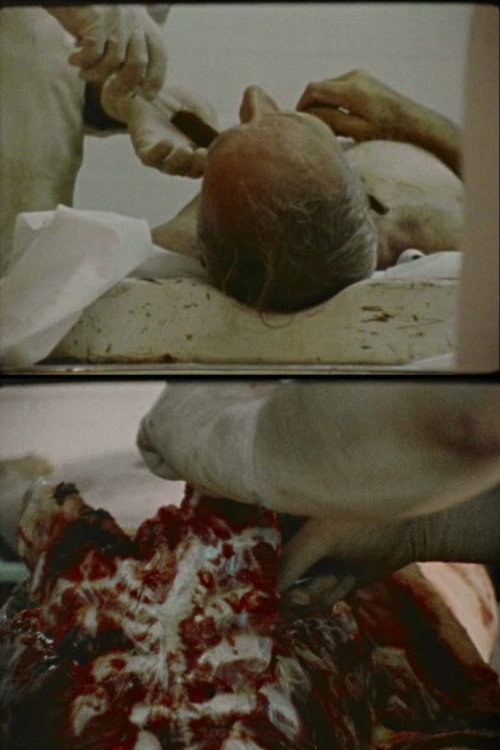
The Act of Seeing with One's Own Eyes
1972 · Stan Brakhage
Only for when you're prepared to look at what our culture keeps hidden — a solemn, demanding experience, closer to a rite than a movie. Not for a casual evening, and not for the squeamish; for the curious and the brave, it can be unforgettable.
What it's about
Thirty-two minutes inside the autopsy room of the Pittsburgh coroner's office, filmed by one man with a hand-held camera. There is no narration, no music, and no explanation — just the actual work of forensic pathologists as bodies are examined, opened, and attended to. The title translates the Greek root of the word 'autopsy': the act of seeing with one's own eyes, and that is exactly what the film asks of you.
The experience
Silent, unflinching, and genuinely confronting — this is real death, seen plainly, with nowhere to hide. Yet many viewers come out the other side describing something closer to awe than horror: it forces a reckoning with mortality that almost no other film attempts.
The craft
Stan Brakhage shot it alone on 16mm with a spring-wound camera, and the silence is the boldest choice — with no commentary or score to interpret for you, your own eye does all the work. The framing moves between clinical distance and abstract closeness, turning the body into landscape and back again. Its power depends on the absence of any cushioning: no cutaways, no relief.
Why it matters
The final panel of Brakhage's Pittsburgh Trilogy and a landmark of avant-garde documentary — endlessly cited in arguments about what cameras should be allowed to show and what viewers can bear to witness.
Snapshot
Thirty-two minutes, 16mm, color, silent. A single man with a spring-wound camera stands in the autopsy room of the Allegheny County Coroner's Office in Pittsburgh and films what is done there: bodies unwrapped, weighed, opened, emptied, examined, sewn shut, tagged, shelved. There is no narration, no music, no title card explaining what we are about to see, and no cutaway when the scalpel goes in. The film's title is a translation — autopsy, from the Greek autopsia, "the act of seeing with one's own eyes" — and that etymology is the whole argument. Brakhage takes a word that medicine has worn smooth into a procedure and restores its literal claim on the viewer.
It is the third and final panel of what has come to be called the Pittsburgh Trilogy, after eyes (1971), shot riding with the Pittsburgh police, and Deus Ex (1971), shot in a hospital. (Catalogs split on the date of the autopsy film: it is variously listed as 1971 and 1972, depending on whether completion or first circulation is being cited.) Together the three constitute the closest thing in Brakhage's several-hundred-film career to documentary — his examination of the institutions a society appoints to stand between itself and its own mortality.
Among the most difficult films in the American avant-garde canon, and among the most consequential: it is the standing reference point in nearly every serious argument about what a camera owes to a body that cannot consent.
Industry & production
There is no industry here in any conventional sense. The film had no producer, no budget line, no distributor advance, no release, no box office. Brakhage worked as he had since the 1950s — financing films out of rental income, teaching, occasional grants, and personal debt, shooting alone, editing at home in Colorado, and circulating prints through the filmmaker-run cooperatives, chiefly Canyon Cinema and the Film-Makers' Cooperative, which rented to universities, museums, and microcinemas.
What made the Pittsburgh films possible was institutional access rather than money. Their proximate cause was Sally Dixon, who founded the Film Section at the Museum of Art, Carnegie Institute in Pittsburgh in 1970 and turned it into one of the few American museum programs actively hosting avant-garde filmmakers. Dixon's advocacy opened doors in the city that would have stayed shut to an unaffiliated artist arriving with a Bolex — the police department, a hospital, and finally the coroner's office. The films are, in a real sense, products of a small municipal patronage arrangement, and they are inconceivable without it.
Everything downstream was Brakhage's: he shot, he edited, he supervised the lab work (his printing was done in Denver, near his home outside Boulder), and he made the decisions about what a viewer would and would not be shown. The film's production history is therefore unusually short to tell and unusually heavy to carry. Brakhage spoke afterward about the personal cost of the shoot, and the account he gave — of nightmares, of difficulty steadying himself — is consistent across the interviews. The record on day-to-day production detail is genuinely thin: there is no call sheet, no crew, no dailies log, and much of what circulates about the shoot comes from Brakhage's own retrospective statements decades later.
Technology
The technology is deliberately minimal, and the minimalism is a method. Brakhage worked with a hand-cranked 16mm Bolex, a reflex camera whose spring motor gives roughly twenty-odd seconds of run per wind. That constraint is audible in the film's structure even though the film is silent: shot lengths are bounded by the mechanism, and the rhythm of winding, shooting, and rewinding becomes a kind of respiration.
The room offered whatever light it had — overhead fluorescents, task lamps over the tables, tile and stainless steel throwing it back. Brakhage brought no lighting package. He shot on fast color reversal stock of the period, worked near or at wide open, and accepted the consequences: shallow depth of field, visible grain, a color rendition that swings between the greenish cast of fluorescent light and the astonishing, unmediated reds of opened tissue. Reversal stock also means the camera original is the image — there is no negative offering a second chance at the grade, and the colors you see are close to what the emulsion made of that room.
No sync sound was recorded, and none was needed; the Bolex is not a sync camera, and Brakhage had no intention of using sound. Post-production was a rewind bench, a viewer, and a splicer. The film is a demonstration that the entire apparatus of professional cinema is optional, and that its absence is not a limitation but a position.
Technique
Cinematography
Brakhage's camera is hand-held throughout and is never a neutral instrument. It approaches and withdraws; it holds steady on an incision and then breaks away in a whip pan; it drifts out of focus until an organ becomes an abstract field of red and ochre and then resolves back into anatomy. The two states — legible body, pure color — are not alternatives but a continuous oscillation, and the film keeps sliding between them.
There are almost no establishing shots. Brakhage refuses the master-shot grammar that would let a viewer construct a safe spatial map of the room and then observe from it. Instead we get proximity: gloved hands, the lip of a drain, a scale, a face. The face matters enormously. Brakhage repeatedly returns to the faces of the dead, which is precisely the shot documentary convention would suppress, and Hollis Frampton's catalog note names the reason — the autopsy room is "the last ditch of individuation," the place where mortality in the abstract acquires "the names and faces of OTHERS."
The camera's movement is the film's only performance, and it is expressive in the way handwriting is expressive. You can read hesitation in it, and flinch, and a kind of forced steadiness. Brakhage had learned this liberated hand-held syntax in part from Marie Menken, whose freed camera he credited with showing him that the operator's body could be the film's subject.
Editing
Brakhage cut the film himself, as he did all his work, and the editing is where the material becomes a film rather than a record. He shot far more than he used, and the cutting establishes a loose but real procedural arc — arrival and unwrapping, external examination, the opening of the torso, the removal and dissection of organs, the opening of the skull, closure and suturing, washing, tagging, storage. Within that arc the rhythm is highly variable: passages of relatively sustained observation give way to rapid clusters of a few frames, so that anatomy registers as a pulse rather than a demonstration.
Crucially, the film does not build to a climax and does not resolve. It ends the way a shift ends. The refusal of dramatic shape is itself a statement about what the room is: not an event but a routine, repeated, on bodies that keep arriving.
Mise-en-scène / staging
Nothing is staged, and that is the point of listing it. The mise-en-scène belongs to the county: stainless tables with gutters, hanging scales, tile, instruments laid out, wrapped forms on gurneys, refrigerated storage. Brakhage's only staging decision is where to stand and what to include in the frame — but in a documentary of this kind that is the entire authorial act, and he exercises it constantly. He excludes the paperwork, the conversation, the professional banter, the world outside. The room is presented as a sealed chamber, which is a strong interpretive choice masquerading as observation.
The pathologists and attendants are shown at work, competent and unhurried, but they are rarely individuated. The living are functions; the dead are persons. That inversion is the film's most audacious formal decision.
Sound
There is none. Brakhage made the overwhelming majority of his films silent on principle, arguing that a soundtrack tells the eye how to feel and thereby forecloses seeing. Here the principle has extraordinary consequences. The autopsy room is in reality a loud place — saws, water, ventilation, voices — and Brakhage strips all of it. What remains is the ambient sound of wherever the film is being projected: the projector, the room, the audience's own breathing and shifting and occasional exit. The film effectively conscripts the screening space as its soundtrack, and the discomfort of a silent audience watching this material is not a side effect but part of the work.
Performance
There are no performers in the ordinary sense, and the vocabulary strains here in a way worth naming rather than papering over. The pathologists perform their profession. The dead cannot perform, cannot consent, and cannot object — which is the ethical fact the film is built on. The one figure genuinely giving a performance is the unseen one: Brakhage, whose bodily presence is legible in every frame through the camera's movement. The film is, among other things, a record of one person's nervous system under duress.
Narrative & dramatic mode
Non-narrative, but not unstructured. The film borrows the shape of a procedure — the autopsy has its own sequence, and Brakhage largely honors it — and lets that stand in for plot. There is no protagonist, no conflict, no exposition, and no arc of the sort that would let a viewer convert the material into a story and thereby digest it.
Its dramatic mode is closer to ritual than to drama: repetition, prescribed gesture, a body handled according to rules. Brakhage does not editorialize and provides no interpretive frame, which has the effect of pushing the entire burden of meaning-making onto the viewer. The absence of a narrator is not neutrality; it is a refusal to supply the anesthetic that commentary would provide.
Genre & cycle
Formally it is a documentary — unstaged actuality footage of a real institution — and Brakhage himself used the word document about the Pittsburgh films. But it sits badly in the genre and always has. It has none of documentary's usual apparatus: no interviews, no context, no argument, no informational payload. It is closer to what critics later called the "city symphony" tradition inverted into a single room, or to the observational fixation of the structural film with which its era overlapped.
Its cycle is the Pittsburgh Trilogy itself — police, hospital, morgue — and within Brakhage's larger body of work it belongs to a long line of films about death and the material persistence of bodies: Sirius Remembered (1959), on the slow decay of a dead dog; The Dead (1960), shot in Père Lachaise. Against these stand his birth films, Window Water Baby Moving (1959) and Thigh Line Lyre Triangular (1961), which filmed his wife Jane giving birth with the same refusal to look away. Brakhage's career brackets human life at both ends with the same camera and the same insistence.
It is also, unavoidably, adjacent to a disreputable genre it precedes and rebukes: the commercial shock documentary, of which Faces of Death (1978) became the emblem. The comparison is instructive precisely because the films share subject matter and share nothing else — one is organized around the spectacle of the corpse, the other around the difficulty of looking at it.
Authorship & method
Brakhage is the entire crew — camera, editor, and, through his choice of silence, the sound department by negation. He had no cinematographer, no composer, no writer, and no editor other than himself, and the dossier categories simply collapse here, which is itself the fact worth recording about his method.
The theoretical framework was already in place. Metaphors on Vision (1963), Brakhage's central text, opens by imagining an eye untutored by language and convention — an eye that does not yet know the word "green," that sees a field of grass as an unnamed profusion of color. The Pittsburgh films test that program against material where the pressure to look away is maximal. If the untutored eye is a real possibility rather than a romantic conceit, it should be able to see an autopsy as light, color, and form. The film is the experiment; its unbearability is part of the result.
Two collaborators do belong in the record. Sally Dixon, whose Pittsburgh programming made the access possible, is the film's effective enabler. And Hollis Frampton — friend, correspondent, and Brakhage's near-opposite among American avant-garde filmmakers, a rigorous structuralist against Brakhage's lyricism — supplied the catalog note that has traveled with the film ever since, with its formulation of the camera as "the perfect Eidetic Witness, staring with perfect compassion where we can scarcely bear to glance." That sentence has done as much to shape the film's reception as anything Brakhage said about it. Jane Brakhage (later Jane Wodening), his wife and frequent collaborator through this period, was not present for the shoot.
Movement / national cinema
The film is squarely American avant-garde, second generation — the New American Cinema that ran from Maya Deren through Mekas, Menken, Anger, and Brakhage, sustained by filmmaker-run distribution cooperatives, university film societies, and a handful of sympathetic museums. P. Adams Sitney's Visionary Film (1974), published two years after the film, established the critical vocabulary that placed Brakhage at the center of this tradition as the exemplar of the "lyrical film," in which the camera stands in for the filmmaker's own seeing rather than depicting a scene from outside.
Its European ancestor is Georges Franju's Le Sang des bêtes (1949), the slaughterhouse film that likewise treats industrialized death with lucid, almost lyrical attention — a comparison critics have drawn consistently. Its American contemporary and counterweight is Frederick Wiseman, whose Titicut Follies (1967) and Hospital (1970) were entering institutions with a sync-sound crew during the very years Brakhage entered them alone and silent. The two bodies of work pose the same question — what happens inside the buildings we don't visit — and answer it with opposite instruments.
Era / period
1972 places the film at a particular conjunction. The Vietnam War was being broadcast, and American audiences were newly, unstably familiar with televised images of the dead — mediated, distant, narrated. Brakhage's film arrives as a refusal of exactly that mediation: no commentary, no distance, no reason given. The counterculture's investment in unmediated experience and in reclaiming birth and death from institutions runs through it, as does the era's broader suspicion of professional expertise.
It also lands at the high-water mark of institutional interest in the American avant-garde: the NEA had begun funding experimental film, museums were building film departments, and universities were hiring filmmakers to teach. Brakhage himself was commuting from Colorado to teach at the School of the Art Institute of Chicago through the 1970s, before joining the University of Colorado in the 1980s. This was the fragile infrastructure that made a thirty-two-minute silent autopsy film a thing that could be made, printed, and shown at all.
Themes
Seeing as an obligation. The title is an imperative disguised as an etymology. Frampton's note makes the civic version of the argument explicit: the autopsy room exists so that no one dies without our knowing why, and someone must witness it on our behalf. Brakhage's radicalization is to insist that the delegation is illegitimate — that we should see it ourselves.
The persistence of the person. The film's most disturbing effect is not gore but individuation. Faces, hands, hair, scars, the marks of particular lives on particular bodies keep asserting themselves against the procedure that treats those bodies as material. Brakhage keeps cutting back to what the procedure must ignore.
Vision before language. The oscillation into abstraction is the Metaphors on Vision thesis under maximum load. When focus goes and an organ becomes a color field, the film demonstrates that the horror is partly linguistic — that it lives in the word liver, in corpse, in what we have been taught to know we are looking at.
The body as material. Weighed, measured, drained, sectioned. The film is unsparing about the physical facts and refuses to spiritualize them.
Ethics of the gaze. The film does not resolve its own ethical problem, and any honest account has to say so. The dead did not consent; their faces are shown; the film has been screened for decades. Brakhage's defense was always about the necessity of seeing, never about permission.
Reception, canon & influence
Reception. The film was received, and continues to be received, as an ordeal. Walkouts are a standard feature of its screening history; so is the fact that those who stay tend to describe the experience in terms usually reserved for events rather than films. Critical opinion divided sharply along the fault line the film opens: whether the ethical breach is redeemed by the seriousness of the seeing, or whether no such redemption is available. That argument has never been settled, and the film's canonical status rests partly on its refusal to settle it.
Among avant-garde critics it was recognized quickly as major. Frampton's note, written by a peer, effectively set its terms. Fred Camper, Brakhage's most persistent critical champion, and Sitney's framework in Visionary Film both worked to keep the Pittsburgh films inside the account of Brakhage as a lyric artist rather than treating them as an anomalous documentary detour. Vivian Sobchack's influential essay on death, representation, and documentary ethics took up the film directly, and her analysis of how a camera's behavior encodes an ethical stance toward the dying and the dead has become the standard scholarly lens on it.
There were no awards, no box office, and no commercial release; those categories don't apply. The film's circulation was through Canyon Cinema and the Film-Makers' Cooperative, and later through Criterion's By Brakhage: An Anthology (2003), which brought it to home video and to an audience that had never had access to a print — a shift with its own ethical implications, since the film left the controlled space of the screening room for the living room.
Influences on the film (backward). Marie Menken's hand-held camera, which Brakhage credited with freeing his own. Maya Deren's establishment of the American avant-garde as a serious practice. Franju's Le Sang des bêtes as the precedent for lyrical attention to butchery. Brakhage's own Sirius Remembered and The Dead, which had already worked the material of decay, and his birth films, which had already established that he would point a camera at what convention forbids. Behind all of it, the poets — Charles Olson, Ezra Pound, Gertrude Stein — from whom Brakhage took the ideas about perception, breath, and composition that underwrite Metaphors on Vision. And Frampton himself, whose structuralist rigor was the intellectual foil against which Brakhage's lyricism defined itself in these years.
Legacy (forward). The film's most durable influence is on how the ethics of documentary are argued. It functions as the field's limit case: the work that any theory of the documentary gaze must be able to account for. Sobchack's framework, and the subsequent literature on the representation of death, is unimaginable without it.
Formally, its lineage runs through the embodied, non-narrated, camera-as-body documentary that resurfaced decades later — critics have consistently placed work like the Sensory Ethnography Lab's Leviathan (2012) in a line descending from Brakhage's insistence that the camera is a body in a space rather than a window onto one. Within narrative cinema, Gus Van Sant is the clearest case of an American director who has openly claimed Brakhage as an influence, and the durational, affectless attention to death in his Gerry/Elephant/Last Days films carries the mark.
And it set a permanent negative boundary. Every subsequent argument about shock imagery, mondo film, and the circulation of real death on video has this film sitting on the other side of the line — the demonstration that the same images can be made with an entirely different purpose, and that purpose is legible in the filmmaking itself. Whether that difference is sufficient is the question the film asks and declines to answer, which is why it is still being screened, and still being walked out of, more than fifty years on.
A Deleuzian reading
A gloved hand lifts something out of an opened torso and the focus slips.
The full Deleuzian reading of The Act of Seeing with One's Own Eyes →
Reception
For decades it was a rumor more than a movie — rarely screened, whispered about as the avant-garde film almost nobody could sit through. Criterion's By Brakhage anthology put it in living rooms, and it's since been canonized as one of the most serious things experimental cinema ever did.
How The Act of Seeing with One's Own Eyes was received, from release to now →
How to watch The Act of Seeing with One's Own Eyes: what to notice on a first viewing
- Notice that no music or narration ever plays. Brakhage shot the film silent on principle and added nothing afterward, so the only sound is whatever fills the room where you're watching it. With no soundtrack telling you how to feel, the room you're sitting in becomes part of the film.
- Notice that the film never shows you the whole room. Brakhage gives you gloved hands, a drain, a scale, a face, but never a wide shot that would let you map out where anything sits. The scene never resolves into a place you can stand back and take in.
- Watch the focus slip until color replaces the shape entirely. Several times the image goes soft and an object dissolves into plain red and ochre, then the focus returns and a recognizable form comes back. Losing the name of a thing changes how it feels to look at, before the name returns.
- Watch the camera itself: it approaches, then pulls back. Brakhage holds the shot steady, then whips away without warning, over and over, so the camera's own movement reads like a body reacting under strain. The only performance on screen is the hand holding the camera.
- Track the procedure's stages without any spoken explanation. The film follows the actual order of an autopsy from arrival to storage, but nothing narrates a single step or tells you what comes next. The sequence has a shape but nothing narrates it, leaving you to make sense of the order yourself.
The whole guide to watching The Act of Seeing with One's Own Eyes, with the keys for a rewatch →
Influences: the films it descends from and the films it influenced
- Le Sang des bêtes (1949) — Establishes the precedent Brakhage works from directly: butchery filmed with lyrical attention — soft light, composed framing, camera drifting across severed heads as if across a landscape — so that the formal register, not the subject, carries the ethical argument.
- Glimpse of the Garden (1957) — Menken's untripodded Bolex — pulse-driven pans and breath-length bursts on wound springs — is the technique Brakhage explicitly credited with freeing his hand, and it is the whole grammar of the autopsy room's whip-pans and drifting close approaches.
- Meshes of the Afternoon (1943) — Codified the 16mm one-person production model — filmmaker as camera operator, editor and distributor via co-op — that makes an unstaged, uncommissioned, unsponsored film inside a morgue institutionally possible at all.
- Man with a Movie Camera (1929) — The kino-eye premise that the lens sees what the unaided eye cannot and that the operator belongs inside the film's account of itself — Brakhage's title is a direct restatement, and the camera's flinches and re-approaches are kept in the cut as the operator's visible presence.
- Window Water Baby Moving (1959) — His own proof-of-method for the forbidden body: rack-focus that dissolves flesh into color-field abstraction and back, handheld proximity with no establishing shot, so the viewer must reconstruct anatomy from texture rather than be given a diagram.
- Sirius Remembered (1959) — The first working-out of the mourning camera as a moving body: repeated rhythmic passes over a decaying dog, speed of the pan standing in for the filmmaker's inability to hold still in front of decay — the exact motor behavior repeated over the cadavers.
- The Dead (1960) — Treats death as a problem of light and emulsion rather than of subject matter — negative/positive reversal and superimposition in Père Lachaise — establishing that the material of the film stock is where the film's thinking about the corpse actually happens.
- Nuit et brouillard (1956) — Made camera movement itself an ethical instrument — the slow lateral tracking across atrocity footage — which is precisely the proposition Brakhage strips of narration and music to test whether the movement alone can carry it.
- Leviathan (2012) — Carries forward the camera-as-body-in-a-space premise — no narration, no orienting wide shot, lens repeatedly fouled and submerged among fish viscera — with GoPros doing what the wound Bolex did: producing disorientation as the honest record of a body working.
- Caniba (2017) — Pushes the rack-focus-into-abstraction device to its limit, holding faces so close and so shallow that flesh becomes unreadable field, and stakes the whole film on the same wager that duration and proximity constitute an ethical position rather than an evasion of one.
- Elephant (2003) — Van Sant's openly acknowledged Brakhage debt in practice: durational unmotivated following shots, affectless attention to bodies after death, and the interpolated cloud/sky passages lifted straight from the lyrical-film vocabulary into narrative feature form.
- Sanctus (1990) — Takes institutional medical imagery — rephotographed X-ray motion studies — and reworks it optically into rhythmic pulses of body interior, extending Brakhage's move of treating the clinical view of the inside of a person as raw material for a lyric film.
- Triste (1996) — Sustains silence-on-principle as a positive medium, projected at 18fps so the room's own acoustics become the soundtrack, and builds by intercut clusters of short shots whose adjacency, not narrative, produces the film's shape.
- eyes (1971) — Same Pittsburgh method: available-light Bolex, silent, no interviews, no establishing geography, a public institution filmed as a sealed chamber whose procedures supply the film's structure instead of a script.
- Deus Ex (1971) — The hospital counterpart, built on the same procedural arc — the film follows the institution's own sequence of operations to its end point and derives its shape from that order rather than imposing a dramatic one.
- Zorns Lemma (1970) — The structuralist foil against which these films were made: Frampton's predetermined ordering system is answered by Brakhage borrowing an external order — the autopsy protocol — while keeping the shot-to-shot texture lyrical and single-frame-clustered.
- Hospital (1970) — The contemporaneous opposite solution to the same access problem — an institution filmed without narration, titles or interviews — but built from sync-sound observational long takes, which throws Brakhage's silence and fragmented handheld proximity into relief as a deliberate formal choice.
- Mondo Cane (1962) — The negative boundary made concrete: identical profilmic material organized by voice-of-God commentary, scored music and staged reenactment — the demonstration that what separates the two films is legible entirely in narration, editing rhythm and camera distance.
- Land of Silence and Darkness (1971) — Brakhage's silent 16mm witness to autopsy — sustained looking at the extreme body without narration, score, or editorial commentary — shares Herzog's commitment to the camera as a pure witnessing instrument; both films refuse the comforting mediation of explanatory voice-over at the threshold of what most cinema refuses to show.
Similar films
- Man with a Movie Camera (1929) — influence & lineage
- Elephant (2003) — influence & lineage
- Blue (1993) — same viewing thread · often watched together
- As I Was Moving Ahead Occasionally I Saw Brief Glimpses of Beauty (2000) — same viewing thread
- The Third Part of the Night (1972) — often watched together
- Dog Star Man: Part IV (1964) — shared sensibility
- The Blood of a Poet (1932) — shared sensibility
- Titicut Follies (1967) — shared sensibility
All the films related to The Act of Seeing with One's Own Eyes →
Watch it with: curated runs of related films
- Landmarks of the Avant-Garde — Watch these together when you want cinema stripped to its essentials — a life, a corpse, a color, a single camera move — each one testing what film can be without story.