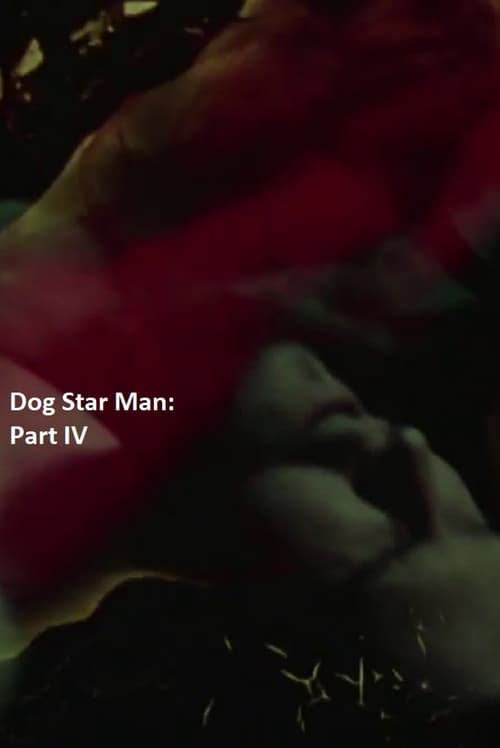
Dog Star Man: Part IV
1964 · Stan Brakhage
When you're curious and open rather than tired — for a night of adventurous viewing when you want cinema as pure sensation, not narrative. Firmly on the challenge end, and best approached as part of the full cycle.
What it's about
The closing movement of Stan Brakhage's silent four-part cycle about a woodsman climbing a Colorado mountain to fell a tree. In roughly six minutes, the man lies on the slope while images pour past — a birth, a nursing mother, fire, farm buildings, a stained-glass saint, the sun — before he tumbles downhill and returns to his axe.
The experience
An overwhelming rush of superimposed, hand-worked images at maximum density — less watched than weathered, closer to a vision or a dream than a story. Six minutes that ask for total surrender and can leave you dazed.
The craft
Brakhage shot, painted, scratched, and layered the 16mm film himself, stacking superimpositions until single frames carry multiple images at once — the densest passage of the whole cycle. It's completely silent by design, and the flood of color and texture rewards a real projection or the biggest, sharpest screen you can manage.
Why it matters
The Dog Star Man cycle is a cornerstone of American avant-garde film, and its handmade, layered technique shaped generations of experimental filmmakers and echoes in music video and title-sequence design.
Snapshot
Dog Star Man: Part IV is the closing movement of the four-part cycle Stan Brakhage assembled between 1961 and 1964, preceded by Prelude: Dog Star Man (1961) and Parts I–III. Running roughly six minutes — catalog timings for the individual parts vary slightly between distributors — it completes a silent, 16mm color work whose total length is generally given as about seventy-five minutes. The nominal action could not be simpler: a woodsman and his dog climb a Colorado mountain to fell a tree. Part IV finds the man supine on the slope, cuts through birth, nursing, fire, farm buildings, a stump, a stained-glass saint, a crawling infant, and the sun, sends the man tumbling downhill, and returns him to the labor of the axe.
What makes the part distinctive is not its imagery but its density. Where Part I moves largely in a single strand, the cycle accumulates superimposed layers as it proceeds, and Part IV runs four rolls at once. At twenty-four frames per second, this yields a torrent of simultaneous image-events that no viewer can resolve into a stable picture plane. That the layers were discrete strands and not in-camera accidents is demonstrated by Brakhage's companion work The Art of Vision (1965), which unpacks Dog Star Man into its constituent rolls and their permutations across roughly four and a quarter hours. Part IV is the cycle at maximum compression; The Art of Vision is the same material at maximum extension.
TMDB's genre tag of "Drama" is a database artifact rather than a description. The film has no dialogue, no scenes in the conventional sense, and no dramatic causality.
Industry & production
There is no industry here in any ordinary sense. Dog Star Man was made outside every institution of American film production: no studio, no producer, no crew, no distributor advance, no exhibition contract. Brakhage shot it in and around the mountains of Colorado, where he and his wife Jane were living in a cabin at high altitude under conditions of genuine hardship — for stretches without reliable utilities, on income patched together from occasional commissioned and industrial work, lecture fees, and small sales. The precise budget is not documented, and no credible figure exists; the costs were raw stock, processing, and the laboratory printing required to combine the superimposed rolls. Brakhage worked substantially in reversal stock, which yields a camera original directly and avoids a negative stage, an economy that mattered at this scale.
The distribution infrastructure that carried the film into the world was itself newly built. The Film-Makers' Cooperative, founded in New York in 1962 out of the orbit of Jonas Mekas and the New American Cinema Group's 1960 manifesto, operated on a non-juried, filmmaker-controlled basis with rental income weighted to the maker. Canyon Cinema served a comparable function on the West Coast. Screenings happened at the Film-Makers' Cinematheque, at museums, on campuses, and at European experimental festivals such as Knokke-le-Zoute. Audiences were counted in dozens and hundreds.
Institutional recognition came before commercial recognition and largely replaced it. Brakhage received Film Culture's fourth Independent Film Award in 1962, and his manifesto-anthology Metaphors on Vision was published by Film Culture in 1963 under P. Adams Sitney's editorship — meaning the film's theoretical apparatus reached print while the cycle was still being shot. Dog Star Man was later included in Anthology Film Archives' Essential Cinema repertory and added to the Library of Congress's National Film Registry in 1992. Criterion's By Brakhage: An Anthology (2003) gave the complete cycle its first broad home-video circulation.
Technology
The tool that shapes almost everything about this film is the spring-wound Bolex H16, a 16mm camera small enough to hold in one hand, throw, swing, or strap to a body. Its constraints are legible in the finished work: a wind of the spring motor yields something on the order of twenty to thirty seconds at sound speed, and a 100-foot daylight spool runs under three minutes, so the natural unit of Brakhage's shooting is a short burst rather than a long take. Its affordances matter equally — a variable frame-rate control, a single-frame release for animation and pixillation, and a rewind mechanism permitting re-exposure of film already run through the gate.
Color reversal stock (Kodachrome and Ektachrome families) gave saturated, contrasty results with a distinctive palette, and Brakhage worked against and through the stock's limits rather than for correct exposure. He shot into the sun, underexposed deliberately, used negative and solarized material, and treated the emulsion as a physical surface — painting on it, scratching it, applying dyes and chemicals by hand. Optical printing and laboratory compositing enabled the layered strands, though Brakhage's relationship with commercial labs was chronically adversarial, since what he wanted routinely read to a technician as error.
The cycle also absorbs imagery not shot by Brakhage: astronomical footage of the sun's surface and microphotography of cellular and vascular material appear in the Prelude and echo through the later parts, including Part IV's solar imagery. This is scientific instrumentation pressed into mythic service — the telescope and the microscope as two more lenses in a film about lenses.
Technique
Cinematography
Brakhage is his own cinematographer, and the camera behaves less like an observing instrument than like a body. It swings, whips, tilts wildly, loses focus and does not recover it, jams itself against skin and bark, and in Part IV it falls and rolls with the man. Framing is frequently unreadable by design: extreme close-ups that abolish scale cues, so that a patch of skin, a mountainside, and a stained-glass fragment become formally interchangeable. Handheld motion is not corrected but amplified, and the "unstable" image is the film's argument, not its flaw. The lens is regularly compromised on purpose — breathed on, smeared, filtered, refracted — pursuing what Metaphors on Vision famously calls an eye "unruled by man-made laws of perspective, an eye unprejudiced by compositional logic."
Superimposition is a cinematographic strategy as much as an editorial one. With four layers, no image is ever alone; every element is simultaneously figure and ground for the others, and the frame becomes a field of competing transparencies closer to Abstract Expressionist all-over painting than to photographic depiction.
Editing
The editing is done by hand at a rewind bench, splice by splice, at frame-level granularity. Shots of one, two, and three frames are common; rhythm is built out of pulse and interval rather than out of action and reaction. Continuity is not merely absent but actively refused: there are no establishing shots, no eyelines, no spatial contract. Instead, images recur and rhyme — sun and nipple, mountain and stump, fire and blood — so that coherence accrues associatively, in the manner of a poetic sequence.
Because Part IV runs four strands, its editing is polyphonic in a literal sense: four independent rhythmic lines proceed simultaneously, each with its own cutting pattern, and the composite pulse is their interference. The Art of Vision, by separating and recombining those lines, effectively publishes the score.
Mise-en-scène / staging
The staging is documentary in its materials and mythic in its arrangement. The mountainside, the cabin, the farm buildings, the tree, the fire, the domestic interior, and the family are all real and near at hand; the film travels no further than a filmmaker without money could travel. What transforms them is scale-collapse and juxtaposition. The stained-glass saint imports an iconographic register — the sacred image as a manufactured, backlit thing — set beside a lactating breast and a newborn, so that Christian iconography and biological fact are made to comment on each other without a word of commentary.
Sound
The cycle is silent, and this is a positive aesthetic commitment rather than a budgetary accident, though it was also cheaper. Brakhage argued across his writing that a soundtrack imposes a temporal order alien to visual thinking, pulling the eye onto music's rhythmic grid. Silence forces the viewer to accept the film's own cutting as the only meter available. He made sound films occasionally — Blue Moses (1962) is the conspicuous contemporary exception — but the great mid-career works are mute, and he was insistent that they be projected without accompaniment.
Performance
Brakhage himself plays the Dog Star Man; his dog Sirius appears as the animal companion whose name supplies the title's astronomical pun. Jane Brakhage and one of the Brakhage children appear in the birth and nursing material — the specific identification of the infant is not consistently documented across sources, and it should not be asserted. The performance mode is entirely non-theatrical: labor, exhaustion, falling, climbing, swinging an axe. The body is filmed as matter under strain rather than as a character with intentions. Arguably the primary performer is the camera operator, whose exertion is inscribed directly in the image.
Narrative & dramatic mode
The film retains a narrative armature so thin it functions as a trellis: man and dog ascend a mountain; man falls; man rises; man cuts a tree. Everything else is vertical elaboration. There is no psychology, no conflict between agents, no resolution in any dramatic sense. Sitney's category of the mythopoeic film — the avant-garde work that constructs a cosmogony rather than telling a story — was formulated with Dog Star Man as its central American instance, and it remains the most useful description. Part IV's dramatic mode is closest to a creation myth compressed into six minutes: birth, nourishment, fire, sun, fall, and work, in an order that reads as ritual rather than plot.
Genre & cycle
Dog Star Man belongs to no genre and to a very particular kind of cycle: the long-form avant-garde work built in movements, whose parts are separately screenable but cumulatively transformed. Its immediate companions in that ambition are Kenneth Anger's Magick Lantern Cycle, Gregory Markopoulos's serial projects, Jonas Mekas's diary films, and — later, and in explicit reaction — Hollis Frampton's serial and encyclopedic works. Brakhage's own The Art of Vision is the cycle's most radical extension, a work that exists only because Dog Star Man's superimpositions were compositional decisions with alternatives.
Authorship & method
Authorship here is nearly total and nearly solitary: Brakhage shot, edited, performed, financed, and theorized the film. There is no composer because there is no score, no screenwriter because there is no script, no editor because the splices are his. This concentration is precisely what made him the exemplary figure for a "personal cinema" and, later, precisely what has been reconsidered.
The most substantial reconsideration concerns Jane Brakhage (later Jane Wodening). She was present throughout, appears in the films, and by her own subsequent accounts contributed labor, footage, and creative input to the domestic works of this period without corresponding credit; scholarship since the 1990s has taken that reappraisal seriously. Named collaborators otherwise are few. Brakhage's intellectual circle mattered more than any production team: the Black Mountain and San Francisco poets — Robert Duncan, Michael McClure, Charles Olson among them — whose ideas about breath, measure, and the long poem shaped his sense of film rhythm, and Joseph Cornell, with whom he had worked in the 1950s. P. Adams Sitney functioned as editor and, in effect, theorist-in-residence for the project's public reception.
Movement / national cinema
The film sits at the center of the American postwar avant-garde, the second generation after Maya Deren, and within the loose insurgency that Mekas branded the New American Cinema and the press called underground film. Brakhage's position within it was geographically eccentric — he worked from the Rockies, not from Manhattan lofts — and that distance is visible: where the New York underground of 1963–64 was urban, camp, and social (Jack Smith, Warhol, Ron Rice), Dog Star Man is solitary, landscape-based, and unironic.
Its deeper national lineage is American Romanticism: Emerson, Thoreau, and Whitman recast as a man with an axe on a mountain, plus the Abstract Expressionist conviction that the mark of the artist's body is the content of the work. Marie Menken's free handheld camera was, by Brakhage's own acknowledgment, a direct liberating influence.
Era / period
1961–64 was the hinge decade for the American avant-garde: the Film-Makers' Cooperative in 1962, the co-op distribution model, Film Culture's critical platform, the obscenity prosecutions of 1964 that made underground cinema briefly newsworthy, and the beginnings of an academic apparatus that would install these films in university curricula within a decade. Simultaneously the studio system was disintegrating and 16mm was becoming genuinely portable, which is the technical precondition for a body of work made by one person on foot.
Themes
Vision itself is the primary subject — not what is seen but the act and physiology of seeing, including closed-eye and hypnagogic imagery, the pressure-phosphenes and after-images the film repeatedly approximates. Around that center: birth and generation, rendered without euphemism through the newborn, the nursing breast, and the crawling child; the correspondence of macrocosm and microcosm, with solar prominences and cellular matter treated as the same event at different magnifications; the seasonal cycle, which critics following Sitney have mapped onto the four parts beginning in winter; labor and the body's exhaustion; and a sacred register that borrows Christian iconography — the stained-glass saint — without adopting doctrine. The fall and the rise, the stump and the sun, the axe returning at the close: the film's shape is renewal through effort.
Reception, canon & influence
Contemporary reception was small in volume and intense in kind. There were no mainstream reviews of consequence, no box office, and no general release; the readily available critical record for the individual parts on first exhibition is genuinely thin, and any account of a broad 1964 reception would be invention. What existed instead was advocacy within a subculture — Mekas's Village Voice column and Film Culture, co-op catalogs, campus screenings — followed a decade later by scholarly canonization. Sitney's Visionary Film (1974) is the decisive text; subsequent studies by Fred Camper, R. Bruce Elder, Marjorie Keller and others built out the reading of Brakhage as heir to Pound, Stein, and Olson.
Backward, the film absorbs: Eisenstein's montage as rhythmic rather than dialectical instrument; Deren's ritual-poetic structure; Menken's handheld freedom; Cornell's collage sensibility; Abstract Expressionist gesture; and the Romantic long poem.
Forward, its influence runs along two divergent lines. The first is affirmative — hand-processed, painted, and superimposed filmmaking as a continuing practice, visible in Phil Solomon, Nathaniel Dorsky, Jennifer Reeves and others, and sustained institutionally by Brakhage's long teaching career at the School of the Art Institute of Chicago and the University of Colorado. The second is oppositional: the structural filmmakers of the later 1960s and 1970s — Frampton, Sharits, Snow, and the British materialists — defined themselves substantially against Brakhage's romantic subjectivity, which is a form of influence measured in resistance. A third, pointed response came from Carolee Schneemann, whose Fuses addressed the sexual body from a position deliberately other than the male visionary's, and feminist criticism has continued to interrogate both the films' representation of birth and Jane Brakhage's uncredited role.
Beyond the avant-garde, the cosmic-to-cellular montage that Dog Star Man pioneered has become a recognizable idiom, and critics have repeatedly invoked Brakhage in discussing later mainstream films that attempt the same leap of scale — a comparison worth noting as reception history rather than as documented lineage. Part IV, the cycle's densest six minutes, remains the clearest single demonstration of what the whole project claimed: that a film can be looked at the way a painting is looked at, and that the eye, properly provoked, will build the myth itself.
A Deleuzian reading
Halfway through Part IV the woodsman loses his footing on the mountainside and goes down.
The full Deleuzian reading of Dog Star Man: Part IV →
Reception
In 1964 Part IV completed a cycle that the underground-film world (Film Culture, Jonas Mekas's circle) had already crowned a masterpiece, while mainstream audiences found it baffling. The full Dog Star Man cycle is now settled avant-garde canon — it entered the U.S. National Film Registry in 1992.
How Dog Star Man: Part IV was received, from release to now →
How to watch Dog Star Man: Part IV: what to notice on a first viewing
- Watch the camera fall and tumble with the man. When the woodsman loses his footing, the camera goes down too, losing focus and finding only smears of sky and ground, with no steady shot afterward. Brakhage used the camera as a limb, not an instrument, so the fall happens to the image itself.
- Count how few frames some shots seem to last. Brakhage cut the film by hand at one, two, and three frames at a time, so the rhythm hits you as pulse rather than as readable shots. You are watching in a unit smaller than a shot, the single frame, rather than a story.
- Notice extreme close-ups that erase any sense of scale. A patch of skin, a mountainside, and a shard of stained glass are all shot so close that you cannot tell how big any of them actually is. Losing scale is how the film makes a body, a mountain, and a window equally interchangeable.
- Listen for the total absence of any soundtrack. The film is silent by design, not by budget, so nothing outside the cutting itself sets your sense of rhythm or time. With no music pulling you along, the cutting alone has to be the only meter you follow.
- Watch images of birth, fire, and the sun recur. A newborn, a nursing breast, a fire, and the sun keep reappearing among shots of a mountainside and a stained-glass saint, without any of them being explained. These images rhyme with each other instead of following one another, so meaning builds by echo, not by plot.
The whole guide to watching Dog Star Man: Part IV, with the keys for a rewatch →
Influences: the films it descends from and the films it influenced
- Ballet Mécanique (1924) — Establishes the two devices Part IV runs simultaneously — prismatic/mirrored lens attachments that fracture a single object into kaleidoscopic multiples, and cutting governed by descending frame-counts so the rhythm accelerates independently of what is depicted.
- October: Ten Days That Shook the World (1928) — Brakhage takes Eisenstein's metric and overtonal montage — shot durations cut to a handful of frames so pulse rather than proposition carries the passage — and discards the dialectical thesis, keeping the cutting rate as a purely plastic instrument.
- L'Hippocampe (The Seahorse) (1934) — Legitimizes laboratory microcinematography as expressive material rather than illustration, the precedent for Part IV splicing cellular and solar-observatory footage as pure texture inside a poetic rhythm instead of as evidence.
- A Colour Box (1935) — The first sustained application of dye and stencil directly onto the film strip with no camera involved, treating emulsion as a paintable surface — the technical ancestor of Part IV's hand-painted frames burning through the photographed layers.
- Rose Hobart (1936) — Cornell — with whom Brakhage worked in the 1950s — models the collage method of re-cutting existing footage and passing the whole strip through a single color filter, teaching the treatment of found imagery and overall tinting as compositional acts.
- Meshes of the Afternoon (1943) — Supplies the ritual-poetic armature: continuity built from matched movement across spatially impossible cuts, and the filmmaker performing her own protagonist — the model for Brakhage playing the woodsman himself with no theatrical apparatus.
- Visual Variations on Noguchi (1945) — Menken swings the handheld camera as a drawing implement — pans and whips too fast to describe the sculpture they pass over — freeing the Bolex from the tripod and giving Brakhage the gestural camera-as-hand that Part IV depends on.
- Inauguration of the Pleasure Dome (1954) — Constructs myth through stacked superimpositions and chained dissolves rather than plot, demonstrating that layered imagery alone can carry ritual meaning — the procedure Brakhage pushes to four simultaneous layers on the optical printer.
- Anticipation of the Night (1958) — Brakhage's own break with drama: first-person handheld Bolex standing in for a subjectivity, swung light sources and defocused lens smears as the primary imagery, and the abandonment of script, actors, and sound that Part IV inherits wholesale.
- Ray Gun Virus (1966) — Takes Brakhage's frame-level splicing literally and strips everything else away: single-frame color fields alternating at projection speed, converting the pulse Part IV uses for lyric effect into a systematic, pre-planned structure that repudiates its romantic subjectivity.
- Hours for Jerome (1982) — Continues the silent-by-design lyric assembled from handheld 16mm fragments and light-play, extending Brakhage's premise that a film should be looked at as a painting is — Dorsky slows the montage rate and projects at 18fps to hold each image.
- The Secret Garden (1988) — Attacks the emulsion chemically — corroding, bleaching and re-photographing on the optical printer until the grain itself becomes the subject — carrying forward the hand-processing branch of Brakhage's practice as a deliberate craft inheritance.
- Light Work Mood Disorder (2007) — Hand-paints and inks 16mm frame by frame and stacks the painted strips against photographed material in multiple superimposition, reproducing Part IV's exact stratification of gesture over image on contemporary stock.
- Cosmic Ray (1961) — Splices found footage and countdown leader at single-frame intervals so the cut itself flickers, arriving independently at the frame-as-unit editing Brakhage practices — though Conner binds his to a Ray Charles track where Brakhage insists on silence.
- Mothlight (1963) — The contemporaneous limit case of the same workflow: moth wings and plant matter pressed between splicing tape and run through the optical printer, proving the emulsion surface — not the lens — is where the image can be authored.
- Peyote Queen (1965) — Engraves and inks the emulsion directly with surgical instruments over found stock, an independent parallel to Brakhage's scratched and painted frames that treats the film strip as an etching plate.
- Castro Street (1966) — Builds its images from in-camera bi-pack superimposition, running color over black-and-white and positive over negative passes through the same gate — the layering problem Brakhage solves in the printer, solved instead at the moment of shooting.
- Fuses (1967) — Adopts Brakhage's full material vocabulary — baked, bleached, painted and collaged emulsion under handheld superimposition — and turns it against the premise of the solitary male visionary, filming her own sexual body as co-subject rather than muse.
Similar films
- The Act of Seeing with One's Own Eyes (1972) — shared sensibility
- Moonage Daydream (2022) — shared sensibility
- Grizzly Man (2005) — shared sensibility
- Baraka (1992) — shared sensibility
- On the Silver Globe (1989) — shared sensibility
- 2001: A Space Odyssey (1968) — shared sensibility
- Wavelength (1967) — shared sensibility
- Koyaanisqatsi (1983) — shared sensibility