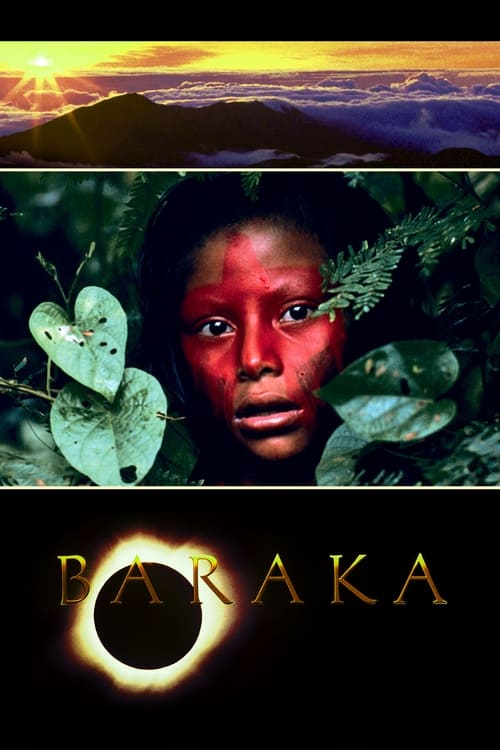
Baraka
1992 · Ron Fricke
For when you want to turn off the noise and just watch — a film for decompressing, marveling, or resetting your sense of scale. Equally good as a late-night trance or the ultimate showcase night for a big TV and good sound.
What it's about
A wordless journey around the planet — no dialogue, no narration, no captions — moving between untouched landscapes, ancient rituals, roaring factories, teeming cities, and sites of human devastation. Its title is a Sufi word for blessing or the breath of life, and that's the organizing idea: sacred and mechanized worlds placed side by side, with the connections left for you to draw.
The experience
Overwhelming in the best way — meditative one minute, thunderous the next, closer to a piece of music or a moving meditation than a conventional film. It can leave you awed, unsettled, and unusually quiet afterward.
The craft
Shot around the world in 70mm by Ron Fricke, who also built his own time-lapse camera systems, it delivers some of the most staggering pure photography ever put on film — rivers of city traffic, temple ceremonies, volcanic landscapes. The score does the storytelling that words would normally do; this is the definition of a film that rewards the biggest screen and best speakers you can find.
Why it matters
The fullest flowering of the wordless global-documentary form Fricke helped invent, it became a reference point for visual filmmaking and a perennial demo piece for image and sound quality.
Snapshot
Baraka is a feature-length non-narrative documentary assembled entirely from wordless images and music — no dialogue, no voiceover, no on-screen text beyond its title and end credits. Directed and photographed by Ron Fricke, it moves across the globe in a loosely symphonic structure, cutting between untouched landscapes, ancient ritual, industrial modernity, and human devastation. The film's title is an Arabic and Sufi word variously rendered as "blessing," "breath," or the essential animating force of life, and that gloss functions as the picture's thesis: it proposes to photograph the sacred and the mechanized side by side and let the viewer draw the connective tissue. Shot in 70mm and released in 1992, it stands as the fullest realization of the "Qatsi" tradition Fricke had helped invent a decade earlier as cinematographer of Koyaanisqatsi (1982). It is best understood not as reportage but as a contemplative essay film — a work whose meaning is generated almost entirely through juxtaposition and rhythm rather than argument.
Industry & production
Baraka was produced by Mark Magidson, who partnered with Fricke as the film's driving commercial and logistical force; the two would go on to a long collaboration, most notably the 2011 companion piece Samsara. The production is widely reported to have filmed in roughly two dozen countries across six continents over a shooting period of about fourteen months, a scale that made it an unusually ambitious independent undertaking for a film with no stars, no script, and no conventional distribution hook. Locations frequently cited include Angkor Wat in Cambodia, the burning and bathing ghats along the Ganges, the Kaaba at Mecca, the Auschwitz-Birkenau and Tuol Sleng (S-21) sites of genocide, Japanese snow monkeys in hot springs, and numerous churches, temples, and mosques.
The economics of such a film were always precarious: a wordless, large-format documentary sits outside the theatrical categories that studios and most distributors are built to sell. Baraka circulated through the specialty and art-house circuit and found its durable audience on home video and, later, high-definition disc, where its imagery could be appreciated as reference-grade demonstration material. Precise budget and box-office figures are not something I can state reliably, and I will not invent them; the honest characterization is that the film was a niche release whose reputation grew steadily over decades rather than an immediate commercial event.
Technology
Technologically, Baraka is inseparable from its format. It was photographed on 65mm negative and presented in 70mm using the Todd-AO widescreen system, giving it a resolution and tonal latitude far beyond standard 35mm production. Fricke, a self-taught engineer as much as a cinematographer, is central here: for his large-format short Chronos (1985) he had developed custom motion-controlled time-lapse equipment, and Baraka extends that toolkit. Its signature effect is the marriage of time-lapse exposure with camera movement — a computer-controlled system that could pan or track the camera incrementally across long exposures, so that clouds streak, crowds flow like liquid, and stars wheel while the frame itself is also moving. This was demanding, bespoke technology, built to solve problems no off-the-shelf motion-picture camera addressed.
The film's second major technological chapter came long after release. In 2008 Baraka was restored by scanning the original 65mm negative at 8K resolution — reported at the time as one of the first, if not the first, feature to be digitally scanned at that resolution — for a high-definition Blu-ray master. The restoration is significant beyond the disc itself: it demonstrated that a 1992 large-format negative held detail far in excess of the delivery formats then available, and it became a benchmark reference in discussions of archival scanning resolution.
Technique
Cinematography
The cinematography is the film's authorship. Fricke composes in a hieratic, frontal, often perfectly symmetrical style — architecture and ritual framed head-on, horizons leveled, the camera treated as a contemplative instrument rather than a participant. The palette exploits 70mm's dynamic range: deep shadow detail in temple interiors, saturated skies, and fine textural rendering of skin, stone, and smoke. Movement is deliberate and mechanized rather than handheld; where the camera moves, it usually glides on cranes, tracks, or the motion-control rig. Aerial photography recurs, offering the "global vision" the film advertises. The recurring device of the human face held in near-portrait stillness — subjects looking back into the lens — is a deliberate counterweight to the sweeping landscapes, insisting on individual presence within the planetary scale.
Editing
Baraka is edited by Fricke, Magidson, and David E. Aubrey, and its editing is where meaning is manufactured. With no narration to guide interpretation, the cut carries the entire argumentative burden through association, graphic match, and tempo. The film characteristically builds from stillness and slowness toward accelerated montage: its central movement is a famous sequence linking the human commute, mass production, and industrial poultry processing into a single rhythmic crescendo, edited to music so that people moving through subway turnstiles rhyme visually with chicks moving along conveyor belts. Elsewhere the editing works by graphic rhyme — the geometry of a mosque courtyard against the geometry of a computer chip, ritual repetition against mechanical repetition. This is montage in the Soviet inheritance, meaning produced between shots rather than within them.
Mise-en-scène / staging
As a documentary, Baraka stages little in the fiction sense, but it is intensely composed. Fricke selects and frames pre-existing realities — a whirling dervish, a tattooed tribal face, a garbage-picker at a smoldering dump — with the deliberation of a still photographer, and the "staging" lies in placement of the camera, choice of lens, and duration of the hold. The film's mise-en-scène is fundamentally about scale relationships: the small human figure against the immense temple, the individual against the crowd, the crowd against the machine.
Sound
There is no synchronous dialogue and no commentary. The soundtrack is a designed weave of music, ambient recordings, and effect, with the score anchored by composer Michael Stearns and drawing on a range of world and contemporary artists. Sound in Baraka is not illustrative but structural — it sets the tempo the editing follows, and the transitions between contemplative drones and rhythmic, percussive passages map directly onto the film's emotional architecture. Ambient sound (chant, water, industrial noise) is layered so that even without speech the film feels grounded in the acoustic reality of its places.
Performance
There are no actors and no performances in the dramatic sense. What the film offers instead is the presence of real people — monks, laborers, worshippers, children — many of whom hold the camera's gaze directly. These direct-address portraits function as the film's emotional performances: unscripted, but charged by the duration of the look and the dignity of the framing.
Narrative & dramatic mode
Baraka has no story, no characters, and no conflict in the conventional sense. Its dramatic mode is thematic and musical: it is organized like a symphony or a tone poem, in movements that modulate mood and tempo rather than advance a plot. The implicit arc runs from creation and unspoiled nature, through the flowering of human ritual and belief, into industrial acceleration and its catastrophes (war, genocide, ecological ruin), and toward a return to the contemplative and the cosmic. Meaning is cumulative and associative; the viewer is positioned as an interpreter assembling a thesis about the human relationship to the planet and the sacred, rather than a follower of events.
Genre & cycle
The film belongs to the tradition of non-narrative, "pure cinema" documentary, and more specifically to the strand launched by Koyaanisqatsi. It descends from the 1920s "city symphony" — Walter Ruttmann's Berlin: Symphony of a Great City and Dziga Vertov's Man with a Movie Camera — which similarly built meaning from rhythmic montage of everyday life without narration. Within Fricke and Magidson's own output it forms the middle term of an informal trilogy of tone: Chronos (1985) as prototype, Baraka (1992) as the mature statement, and Samsara (2011) as the large-format sequel. It also sits alongside the IMAX/large-format nature-and-culture documentary cycle, though it is more essayistic and darker in vision than most museum-format spectacle.
Authorship & method
Baraka is an unusually singular authorial work for a documentary because so many of its crafts converge in one person. Ron Fricke directs, operates the camera, and co-edits, and he is also the engineer behind its time-lapse and motion-control technology — an auteur defined by the image rather than the word. His method, carried over from his work on Koyaanisqatsi, is to treat cinematography, editing, and music as inseparable instruments of a single non-verbal composition. Mark Magidson produced and co-edited, functioning as Fricke's essential collaborator and the pragmatic engine of a globe-spanning shoot; the two form a genuine creative partnership rather than a director-and-financier arrangement. David E. Aubrey shares the editing credit. The score is led by composer Michael Stearns, whose ambient and electronic sensibility shaped the film's meditative register, incorporating contributions from a range of world-music and contemporary artists. There is no writer in the conventional sense — the "screenplay" is the shot list and the edit — which is itself a statement about the film's authorship.
An important lineage point: Fricke's aesthetic was forged as director of photography on Godfrey Reggio's Koyaanisqatsi, and Baraka can be read as Fricke stepping into the director's chair to pursue the same non-narrative vision on his own terms and at larger format. The two men subsequently pursued parallel careers within the same tradition.
Movement / national cinema
Though global in subject, Baraka is a product of American independent, avant-garde-adjacent documentary practice. It carries no national-cinema affiliation in the usual sense; its lineage is aesthetic — the international city-symphony movement of the silent era filtered through American experimental and large-format filmmaking of the 1980s. It is transnational in ambition and deliberately resists the nation-state as an organizing category, presenting humanity and the planet as its subject rather than any single culture.
Era / period
Baraka arrives at a specific historical moment: the early 1990s, at the close of the Cold War and on the cusp of accelerated globalization and the digital era. Its anxieties — mass production, urban density, environmental degradation, the memory of twentieth-century genocide — are the anxieties of late-twentieth-century modernity, and its inclusion of Auschwitz and the Cambodian killing fields places it explicitly in the shadow of that century's atrocities. Technologically it belongs to the last flowering of large-format photochemical filmmaking before digital acquisition, which lends it, in retrospect, the character of a summation of an analog craft.
Themes
The film's governing theme is the relationship between the sacred and the mechanized — between forms of human meaning-making (religion, ritual, craft, community) and the accelerating systems (industry, commerce, war) that both flow from and threaten them. Repetition is a master motif: prayer beads and assembly lines, pilgrims circling the Kaaba and commuters cycling through turnstiles, the film insistently rhyming spiritual and industrial repetition to ask whether they are opposites or reflections. Adjacent themes include the fragility of the natural world; the continuity between ancient ruins and living faith; the moral weight of historical atrocity; and the smallness of the individual against cosmic and geological time — a scale the time-lapse and aerial photography make literally visible.
Reception, canon & influence
Critically, Baraka was received as a work of extraordinary visual beauty and contemplative seriousness, admired precisely for its refusal of narration and argument, and it accumulated a strong reputation among critics and cinephiles over the years following release; I should note that a comprehensive contemporaneous critical ledger is thinner than for a mainstream release, given its specialty distribution. Its canonization owes much to the home-video and, especially, the 8K-restored Blu-ray era, when it became a touchstone "reference disc" cited endlessly in discussions of image quality — a somewhat unusual route to lasting status, in which technical prestige and aesthetic ambition reinforced each other.
Its influences run backward to the silent city symphonies (Ruttmann, Vertov) and, most directly, to Koyaanisqatsi and the collaboration between Godfrey Reggio and Philip Glass, whose fusion of montage and music Baraka extends into large format and global scope. Looking forward, its legacy is most concretely visible in Samsara (2011), Fricke and Magidson's own sequel-in-spirit, and more diffusely in the visual vocabulary of subsequent non-narrative and large-format documentary, ambient "slow cinema," and even the montage grammar of advertising and music video, which absorbed its rhyming juxtapositions and time-lapse spectacle. Its role as an early 8K restoration also gives it a small but real place in the technical history of digital film archiving. Within the atlas of influence, Baraka functions as a node where the 1920s avant-garde, the 1980s Qatsi films, and the large-format documentary all converge and pass forward.
A Deleuzian reading
Commuters crowd a subway turnstile.
The full Deleuzian reading of Baraka →
Reception
A modest arthouse curio in 1992, it was fully canonized by its 2008 restoration — Roger Ebert added it to his Great Movies and hailed the Blu-ray as the best-looking disc he'd ever seen, turning it into the reference demo for home theaters everywhere.
How Baraka was received, from release to now →
How to watch Baraka: what to notice on a first viewing
- Watch for perfectly symmetrical, head-on shots of architecture. Fricke composes temples, ruins, and ritual space frontally and levels the horizon, treating the camera as a contemplative instrument rather than a participant. The formality of the framing gives ordinary places the weight of something sacred before you know their context.
- Notice the deep shadow and saturated color in temple interiors and skies. The 70mm photography holds fine texture in skin, stone, and smoke alongside rich shadow detail, a range the film uses across wildly different places. The consistent visual richness ties together locations that have nothing else in common.
- Listen for how the music sets the pace, not the pictures. The score by Michael Stearns moves between contemplative drones and rhythmic, percussive passages, and the editing follows that tempo rather than the other way around. Sound is doing the structural work a narrator would normally do in a documentary like this.
- Watch for a face that looks straight back into the camera. Monks, laborers, and children are filmed in near-portrait stillness, holding the lens directly, counterweighting the film's sweeping landscapes with individual presence. A single held gaze keeps the planetary scope from swallowing the people in it.
- Watch for two very different images cut together by shape alone. The editing works by graphic rhyme, a mosque courtyard's geometry set against a computer chip's, ritual repetition against mechanical repetition. The film argues entirely through what it places next to what, with no narration at all.
The whole guide to watching Baraka, with the keys for a rewatch →
Influences: the films it descends from and the films it influenced
- Koyaanisqatsi (1982) — Fricke shot and co-edited it as DP, forging the time-lapse-montage-to-Philip-Glass-score lockstep that Baraka inherits wholesale and enlarges to 70mm.
- Powaqqatsi (1988) — Introduced the slow-motion, dignified frontal portraiture of manual labor across the developing world that Baraka's global human-face passages directly replicate.
- Chronos (1985) — Fricke's own 70mm IMAX solo debut, where he engineered the computerized motion-control time-lapse camera rig later reused to shoot Baraka.
- Man with a Movie Camera (1929) — Supplies the Soviet-montage grammar of rhyming human and mechanical motion through associative cutting that Baraka's factory/city sequences openly quote.
- Berlin: Symphony of a Great City (1927) — The city-symphony template of organizing non-narrative footage by musical rhythm and daily cycle rather than plot underlies Baraka's symphonic four-movement shape.
- Rien que les heures (1926) — Pioneered the wordless day-in-a-city structure and cross-class juxtaposition-by-cut that Baraka extends from one city to the whole planet.
- Regen (1929) — Its purely observational, dialogue-free lyric built entirely from graphic and tonal matches models Baraka's structural-not-illustrative editing logic.
- Samsara (2011) — Fricke and Magidson's explicit sequel-in-spirit, shot on 65mm with the identical motion-control time-lapse rig and symmetrical-portrait method refined from Baraka.
- Naqoyqatsi (2002) — Closes the Qatsi trilogy by pushing Baraka's montage-and-Glass model into digital manipulation, extending the same non-verbal image-as-argument tradition.
- Manufactured Landscapes (2006) — Adopts Baraka's slow, contemplative wide framing of industrial scale and human labor as spectacle, letting the image argue without narration.
- Watermark (2013) — Extends Baraka's aerial and symmetrical-frontal survey of humanity's mark on the earth, cutting global water sites into an associative, dialogue-light montage.
- Home (2009) — Builds a feature almost entirely from the sweeping aerial photography that Baraka helped establish as the default idiom of the planetary-scale eco-documentary.
- The Tree of Life (2011) — Absorbs Baraka's non-narrative cosmic-montage register — time-lapse nature imagery scored as structural music — into a fiction feature's associative editing.
- Voyage of Time (2016) — A wordless (in its IMAX cut) time-lapse symphony of natural process that operationalizes Baraka's premise that edited image plus score can carry a film alone.
- Leviathan (2012) — Inherits Baraka's no-dialogue, no-voiceover immersion but radicalizes it, replacing serene composition with sensory-ethnographic camera placement while keeping sound structural, not illustrative.
- The Fall (2006) — Non-narrative cinematography assembled entirely from real global locations shot on large format establishes the practical, no-CGI, travel-the-world aesthetic that The Fall's 20-plus-country location shoot extends into narrative.
- Sans Soleil (1983) — Shares the globe-spanning associative-montage essay form, though Marker keeps the voiceover Baraka strips away — a sibling that defines Baraka's chosen silence by contrast.
- Anima Mundi (1992) — Reggio and Glass's same-year wordless biodiversity montage runs parallel to Baraka, both distilling the Qatsi image-music method into a compact meditative reel.
- For All Mankind (1989) — Fricke (cinematographer on Koyaanisqatsi) extends the non-narrative visual essay with ambient score into a global survey — sharing For All Mankind's image-score discourse and structural refusal of narration, though substituting new large-format photography for found footage.
- Lessons of Darkness (1992) — Produced the same year in 70mm: sustained aerial and ground-level photography of sacred and industrial landscapes stripped of narration and political context, with music as the primary structural logic — the same aesthetic program pursued simultaneously from within the non-fiction landscape film tradition.
- Microcosmos (1996) — Sibling in the wordless immersive nature feature, using 70mm image and continuous music instead of narration to make the observed world feel vast — the same rhetoric of awe without explanation.
Similar films
- Samsara (2011) — influence & lineage · same viewing thread
- Sans Soleil (1983) — influence & lineage
- Man with a Movie Camera (1929) — influence & lineage · same viewing thread
- Koyaanisqatsi (1983) — same viewing thread
- Fata Morgana (1972) — shared sensibility
- The Gospel According to St. Matthew (1965) — shared sensibility
- Lessons of Darkness (1992) — shared sensibility
- The Sacrifice (1986) — shared sensibility
All the films related to Baraka →
Watch it with: curated runs of related films
- Cinema Without Words — Watch these as one run of pure image and music — the city symphony reborn, from Vertov's roaming cameras to 70mm temples, disaster zones, and Apollo footage, each the whole world edited into rhythm without a line of dialogue.