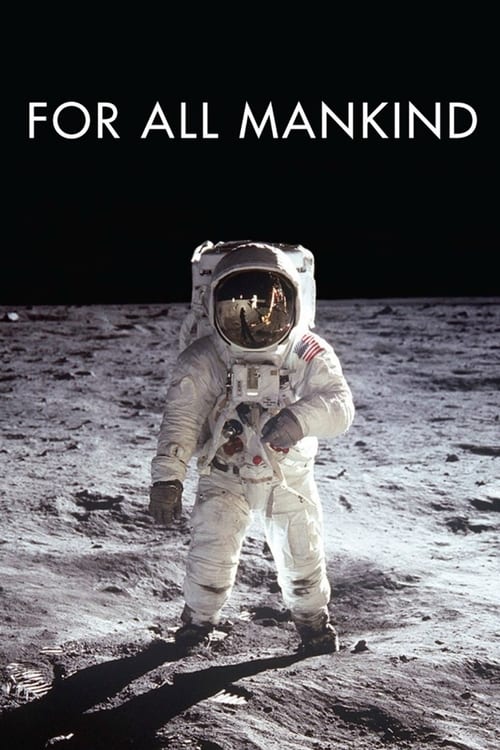
For All Mankind
1989 · Al Reinert
For a late night when you want wonder without plot — something beautiful to sink into when you're feeling contemplative, or need your sense of scale reset. Pure comfort for the cosmically curious.
What it's about
The Apollo moon missions, told entirely through NASA's own footage and the voices of the astronauts who flew them. Rather than following one crew, it weaves twelve missions into a single composite voyage — launch, the long drift to the Moon, the landing, the walk, the return — as one journey humanity took together.
The experience
Serene, floating, almost dreamlike — closer to a meditation than a history lesson. Brian Eno's ambient score and the astronauts' unhurried voices make eighty minutes feel like leaving Earth yourself.
The craft
Every frame is real NASA footage, cut not for chronology but for feeling — a poem assembled from an archive. Brian Eno's score is legendary in its own right, and the pairing of weightless imagery with ambient music has been echoed ever since. Watch it on the biggest screen you have, lights off, sound up.
Why it matters
An Oscar-nominated landmark of archival filmmaking that showed documentary could be lyrical rather than journalistic, and it fixed the emotional memory of Apollo — what it felt like, not just what happened.
Snapshot
Al Reinert's For All Mankind is a seventy-nine-minute lyrical documentary assembled entirely from NASA footage of the Apollo lunar program, released to mark the twentieth anniversary of the first moon landing. It does not follow a single mission or a named crew. Instead, Reinert constructs a composite voyage — launch, transit, landing, EVA, re-entry — that distills twelve missions and twenty-four astronauts into a single, archetypal journey. The result is less journalism than elegy: an immersive, nearly abstract meditation on what it felt like to leave Earth. Brian Eno's ambient score and the unhurried cadences of anonymous astronaut voices fold the archival record into something closer to interior experience than historical chronicle. The film premiered at the 1989 Cannes Film Festival and received an Academy Award nomination for Best Documentary Feature. It is widely regarded as one of the finest nonfiction films of its decade, and its influence on subsequent space cinema is well-documented.
Industry & production
Reinert was a Houston-based journalist with deep ties to the NASA community when he first secured access to the agency's film archives in the late 1970s. The project would occupy nearly a decade of his working life. NASA had accumulated an extraordinary record of its own Apollo operations — camera systems were carried on virtually every mission, mounted in the spacecraft interiors, worn by astronauts, and planted on the lunar surface — yet the bulk of this material had never been theatrically shaped. Reinert reviewed what is commonly cited as several million feet of film; the exact figure varies in accounts, and precise archival tallies are difficult to confirm. What is clear is that the resulting picture was drawn from the full breadth of Apollo, from early missions establishing procedures to the later scientific expeditions of Apollos 15 through 17.
The film's route to distribution was modest. It was initially released through small distributors and performed in a limited number of theatrical engagements rather than a wide commercial rollout. Its festival profile, particularly its Cannes premiere, gave it critical visibility that its box-office numbers — never reported publicly in ways this record can confirm — would not have provided. Home video and subsequent television broadcast extended its reach considerably. By the time of the thirtieth anniversary of Apollo 11 in 1999, and especially by the fiftieth in 2019, the film had been repositioned as an essential document.
Technology
The technological story of For All Mankind is largely NASA's story. The footage Reinert inherited was shot across a range of film gauges and imaging systems. Crews carried 16mm Maurer cameras for interior and continuous documentation; surface EVA footage was captured on modified 16mm cameras attached to the lunar module descent stage. Still photography — the iconic Hasselblad images — occasionally appears as quasi-cinematic material, integrated without the photographic-pan treatment that would later become standard in documentary practice; here stills are held still, their planetary quietude a formal choice. Mission television transmissions of variable quality supplement the film record. Transfer and restoration work to bring this heterogeneous footage to a presentable theatrical standard was a significant undertaking, though the specific technical pipeline Reinert and his collaborators used is not exhaustively documented in public sources.
Eno's score was composed and recorded separately and laid against the picture, a process closer to the creation of a musical tone poem than to the conventional spotting-and-scoring of nonfiction film. The sound mix also integrates actual mission audio — astronaut-to-Houston communications, instrument readings, the specific static of space radio — as an ambient layer rather than as expository testimony.
Technique
Cinematography
Reinert held no camera himself; the cinematographic credit belongs, in an unusual sense, to the astronauts and the NASA engineers and technicians who designed, mounted, and operated the cameras. What Reinert exercised was a curatorial cinematographic intelligence — selecting shots for compositional quality, for the quality of Earth-light falling through a porthole, for the specific duration of a floating pencil in weightlessness, for the geometry of a bootprint. The footage has an accidental formalism: the extreme backlight of deep space, the blown-out whites of the lunar surface against a sky that registers as pure black, the floating dust motes and condensation that accumulate on lenses not designed for aesthetic scrutiny. Reinert treats this material as if a single, extraordinarily gifted if unknowing cinematographer had shot it, trusting the visual record to carry more than documentation.
The range of focal lengths is constrained by the equipment available; most interior shots are slightly wide, creating the slight spatial distortion of a confined chamber, while surface telephoto work compresses the barren distances between a suited figure and the horizon in ways that emphasize isolation.
Editing
The editing performs the film's central intellectual act: the construction of a fictional composite mission from real events that occurred across years and multiple crews. This means an astronaut seen in close-up preparing for a lunar surface walk on one mission is implicitly continuous with a crewmate planting a flag footage drawn from another. The device is acknowledged in the film's framing, but it proceeds without apologetic interruption; viewers are trusted to accept the poetic license. The editorial rhythm is predominantly slow, favoring duration over montage-driven momentum. Certain sequences — the passage through the terminator as the spacecraft crosses from lunar day to lunar night, the long receding view of Earth — are held until they become meditative rather than illustrative. Specific editorial credits and the precise division of labor among the editing team are not fully documented in the public record this account can confirm.
Mise-en-scène / staging
The concept of staging is inverted here. Reinert could not direct action. What he could arrange was the sequencing of events-already-happened so that they enacted a dramatic structure — approach, threshold, immersion, return — without staging a single frame. The "mise-en-scène" is a retrospective one, constructed in the cutting room from pro-filmic events that preceded any directorial intention. The film thus poses a theoretical question it does not explicitly address: whether directorial authorship in nonfiction can be entirely post-hoc. Within the found record, the "staging" that matters most is the accidental: the astronaut who floats into center frame, the moment a colleague's reflection appears in a visor, the way the lunar soil behaves under a boot.
Sound
Brian Eno's contribution is, alongside the editorial concept, the film's most consequential formal decision. Eno had by 1989 a well-established body of ambient work — Ambient 1: Music for Airports (1978), the Apollo: Atmospheres and Soundtracks album (1983, created originally for a different space documentary, For All Mankind having a different compositional genesis) — that positioned him as the logical collaborator for this material. The score Eno produced functions not as emotional underlining but as environment: it suggests scale, stillness, the absence of atmospheric mediation. The score does not swell at arrivals or darken at risk; it persists, varying only gently, and this monotonal quality amplifies rather than interprets the imagery.
The decision to embed the astronauts' radio communications within the sound design without providing identifying titles or explanatory context is equally significant. Voices speak; Houston responds; technical vocabulary accumulates without a guide. The effect distances the viewer from easy comprehension and installs them within an experience of partial audibility — the position of the listening public during the actual missions.
Performance
Documentary in the usual sense has no performance register, but For All Mankind makes a specific formal claim by declining to use talking-head interviews. Astronauts are heard — their voices compositing a collective narrator — but never seen addressing a camera in a studio context. The men we see are men at work: suiting up, calibrating instruments, moving across a surface in the ungainly but practiced gait of a pressure suit. The "performance" is the performance of competence: the economy of gesture trained into people who understand that in their environment, unnecessary motion is dangerous. Reinert reads this restraint aesthetically, framing the astronauts not as heroes exhibiting emotion but as technical beings absorbed in the execution of an unprecedented task.
Narrative & dramatic mode
For All Mankind adopts the structure of the journey — departure, voyage, arrival, sojourn, return — as its organizing mode, but evacuates the journey of individual dramatic stakes. There is no character in the conventional sense, no antagonist, no crisis whose resolution the film awaits. The composite-mission conceit removes the specificity of named crewmembers and thereby generalizes the experience: this is not what Neil Armstrong felt, but what a human being feels, in the hypothetical or archetypal. The film leans toward what might be called a phenomenological mode: it is interested in the texture of the experience — the sound of re-entry heat, the look of Earthrise, the weight of silence — more than in its political or technological meaning.
This is a significant departure from the dominant narrative mode of space documentation in the broadcast era, which tended toward the procedural, the heroic individual, and the national-achievement frame. Reinert's approach is closer to the poetic documentary tradition than to network news coverage of the missions, though it emerged from the same archival reservoir.
Genre & cycle
For All Mankind belongs to the tradition of the lyrical or essay documentary, a mode with roots in the city symphonies of the European avant-garde (Dziga Vertov, Walter Ruttmann), the New Deal documentary films of Pare Lorentz (The River, 1938), and the photo-essay traditions associated with Edward Steichen and the Family of Man exhibition. Within American nonfiction film of the late 1980s, it stands apart from the observational verité tradition (Fredrick Wiseman) and the reflexive first-person mode then gaining momentum (Michael Moore's Roger & Me was released the same year). It is not an expository documentary in Bill Nichols's taxonomy; it operates closer to the poetic mode.
Its more immediate generic context is the space documentary as it had evolved through NASA's own public affairs output, newsreel coverage, and network broadcast specials. In this company, Reinert's film represents a radical aestheticization: it turns institutional archive into personal film.
Authorship & method
Al Reinert's authorial profile is unusual: For All Mankind is his feature debut and remains, effectively, his primary filmmaking work, though he has written for screen and television subsequently. His method was archival and curatorial in the first instance — the years spent reviewing footage — and then structurally architectural: deciding what shape the found material should be made to assume. His journalism background, with its attention to testimony and to the human detail inside institutional events, inflected both his access to astronaut voices and his instinct to center felt experience over official narrative.
Brian Eno's role as composer-collaborator was decisive. The Apollo: Atmospheres and Soundtracks album, though initially created for a different project, had already established an aesthetic idiom precisely suited to this material, and the collaboration extended that idiom into a feature-length work. Eno's status as a major figure in ambient and art music lent the film credibility in contexts where documentary film was not always taken seriously as a sonic art.
The film's editorial collaborators — whose specific contributions are not fully itemized in widely available sources — shaped the composite-mission structure and the rhythm of individual sequences. The thinness of the public record here is worth acknowledging; the division of creative labor in a project of this scope and production duration is often under-documented in nonfiction film history.
Movement / national cinema
For All Mankind is an American film, but it belongs to no American documentary movement in any strict sense. Its aesthetic debts are to the European lyrical documentary and ambient music; its subject is American institutional achievement; its reception was strongest in art-house and festival contexts that were internationally mixed. It does not fit comfortably within the New American Documentary movements of the 1970s and 1980s, being neither politically adversarial nor produced through the independent distribution networks associated with that work. It is, in some respects, a film outside movements — a one-off object whose affinities are cross-national and cross-disciplinary.
Era / period
Released in 1989, the film arrives in the late Cold War and in the context of a renewed public nostalgia for the Apollo program, twenty years on. The space shuttle program was then the operational successor to Apollo, and the Challenger disaster of 1986 had reopened national conversation about the costs and meanings of human spaceflight. For All Mankind does not address the shuttle program or the Challenger disaster, but it was received in their shadow, and its elegiac quality registered partly as mourning for a scale of ambition that the shuttle era had not recaptured.
Themes
The film's central thematic preoccupation is with threshold experience: what it means to leave the atmosphere, to see the Earth as an object rather than a ground, to stand on another body. Related to this is the theme of the human being as instrument — competent, trained, small within a vast physical situation — and the paradox of collective endeavor made visible only through the individual body in a suit. The Earth's fragility as a visual object, its vivid blue against black space, carries an implicit environmental resonance that the film does not lecture about but persistently images. The composite-narrator strategy makes the experience structurally universal: this is cast as something humanity did, not only something Americans did, though the institutional apparatus that made it possible was entirely American.
There is also a theological or quasi-mystical register that the film neither explains nor rejects. Several astronaut testimonies speak in terms of awe, of the inadequacy of language, of a changed relation to existence after return. The film holds these moments without commentary, allowing them to stand as testimony to an experience the film can only approach.
Reception, canon & influence
For All Mankind was critically well received on release, most prominently through its Cannes premiere and its subsequent Academy Award nomination, though it did not win. Critics identified its formal ambition — particularly the decision to use Eno and to forgo conventional interview structure — as marks of a serious aesthetic intelligence. The film's theatrical run was limited, and its reputation built over years through ancillary release, broadcast, and word of mouth within documentary and avant-garde film communities.
Looking backward, the film's influences are legible in its form. The lyrical documentary tradition from which it draws runs from Vertov through Lorentz through Chris Marker, and the film's interest in duration and in the aesthetics of found footage has affinities with the structural film practices of the 1970s. Brian Eno's existing body of ambient work was a direct resource; the Apollo album had already mapped the sonic territory Reinert needed.
Looking forward, the film's influence on subsequent space documentary and on NASA-related dramatizations is well-attested. Ron Howard has publicly cited For All Mankind as a direct influence on Apollo 13 (1995), particularly in its approach to the visual texture of spaceflight; the production of that film drew on materials and perspectives that Reinert's archival work had helped make visible. The film's model of the lyrical, composite-voice space documentary can be traced in In the Shadow of the Moon (2007), which, while using talking-head interviews, shared its interest in felt astronaut testimony and in the ineffability of the experience. Damien Chazelle's First Man (2018) — a fiction film — drew on the aesthetic grammar of interior, claustrophobic spaceflight footage that Reinert's archival choices had helped establish as the authentic look of the program.
Within documentary film, For All Mankind is a frequently cited example of the poetic mode taken to an unusual level of formal rigor. Its archive-as-primary-text approach, its score-as-environment rather than score-as-punctuation, and its refusal of explanatory voiceover have influenced subsequent nonfiction filmmakers working with institutional or historical archives. It remains in active circulation, and the fiftieth anniversary of Apollo 11 in 2019 renewed scholarly and journalistic attention to the film as the defining cinematic account of what the program looked and felt like from the inside.
A Deleuzian reading
A pencil floats in the cabin and turns over, slowly, going nowhere.
The full Deleuzian reading of For All Mankind →
Reception
A quiet 1989 release that won both the Grand Jury Prize and Audience Award for documentary at Sundance, it was slowly canonized via the Criterion Collection and is now the benchmark every space documentary — Apollo 11 included — gets measured against.
How For All Mankind was received, from release to now →
Influences: the films it descends from and the films it influenced
- Man with a Movie Camera (1929) — Reinert inherits Vertov's kino-eye principle — that actualist footage rhythmically edited without narration or intertitles constructs phenomenological truth — applying it to NASA's archive to make the composite mission feel lived rather than documented.
- Night and Fog (1955) — Resnais and composer Hanns Eisler established that an archival lyrical documentary can subordinate its score entirely to tonal atmosphere rather than narrative punctuation — the structural template Reinert replicates with Eno's Apollo album.
- 2001: A Space Odyssey (1968) — Kubrick's decision to score extended space sequences with pre-existing classical music as environmental ground rather than commissioned underscore established the formal precedent for treating score as spatial environment that Reinert applies to Eno in depicting the actual missions Kubrick had imagined.
- Moonwalk One (1970) — Kamecke's film first assembled NASA's own 16mm mission footage into feature-length cinema, establishing the archival grammar Reinert inherits and radicalizes by stripping Kamecke's conventional explanatory voiceover entirely.
- Fata Morgana (1971) — Herzog assembled observational Sahara footage with ambient and classical music into a non-narrative lyrical triptych that resists explanation — the European essay-documentary model Reinert draws on when he refuses to let astronauts explain what they experienced.
- Koyaanisqatsi (1982) — Reggio proved non-narrative documentary could sustain feature length through image-score density alone — Philip Glass's minimalist score functioning as environmental ground, not punctuation — the direct formal model for Reinert's decision to let Eno's Apollo album carry the film's phenomenological argument.
- Sans Soleil (1983) — Marker's essay-film practice of treating found and archival footage as material for phenomenological meditation rather than historical illustration is the intellectual tradition For All Mankind inhabits, even as Reinert strips Marker's voiceover and relocates the meditation into ambient score and duration alone.
- Apollo 13 (1995) — Howard (who publicly cited For All Mankind) adopted Reinert's visual grammar of cramped, heterogeneous-gauge mission interiors as the authentic texture of spaceflight — translating archival aesthetics into a studio production through deliberate stock variation and handheld-influenced camera movement.
- In the Shadow of the Moon (2007) — Sington takes For All Mankind's organizing question — what the lunar experience felt like from inside, and why language fails it — and rebuilds it with talking-head testimony, the film's phenomenological structure directly descended from Reinert's composite-voice model though restoring the individual faces it had refused.
- Gravity (2013) — Cuarón and Lubezki's extended long-take immersion technique makes weightlessness a continuous duration the audience inhabits rather than observes — applying the phenomenological-duration principle Reinert established with archival footage to CGI-enabled fiction.
- First Man (2018) — Chazelle and cinematographer Linus Sandgren shot mission interiors on 16mm and Super 8 to replicate the cramped, grain-heavy aesthetic Reinert's archival editing had established as the authentic visual language of the Apollo program, extending that archival grammar into fiction.
- Apollo 11 (2019) — Miller applies Reinert's archive-as-primary-text method to newly discovered 65mm NASA materials — no narration, no interviews, no expository structure — the most direct formal descendant of For All Mankind, extending its model to pristine large-format materials unavailable in 1989.
- Baraka (1992) — Fricke (cinematographer on Koyaanisqatsi) extends the non-narrative visual essay with ambient score into a global survey — sharing For All Mankind's image-score discourse and structural refusal of narration, though substituting new large-format photography for found footage.
- Lessons of Darkness (1992) — Herzog assembles aerial footage of the burning Kuwaiti oil fields with Wagner as environmental ground — no narration, meditative duration, footage treated as evidence of the technological sublime — applying the same lyrical-documentary mode as For All Mankind to apocalyptic rather than ecstatic material.
Similar films
- Baraka (1992) — influence & lineage · same viewing thread
- First Man (2018) — influence & lineage
- 2001: A Space Odyssey (1968) — influence & lineage
- Apollo 13 (1995) — influence & lineage
- Gravity (2013) — influence & lineage
- Man with a Movie Camera (1929) — influence & lineage · same viewing thread
- Samsara (2011) — same viewing thread · often watched together
- Koyaanisqatsi (1983) — same viewing thread · often watched together
All the films related to For All Mankind →
Watch it with: curated runs of related films
- Cinema Without Words — Watch these as one run of pure image and music — the city symphony reborn, from Vertov's roaming cameras to 70mm temples, disaster zones, and Apollo footage, each the whole world edited into rhythm without a line of dialogue.