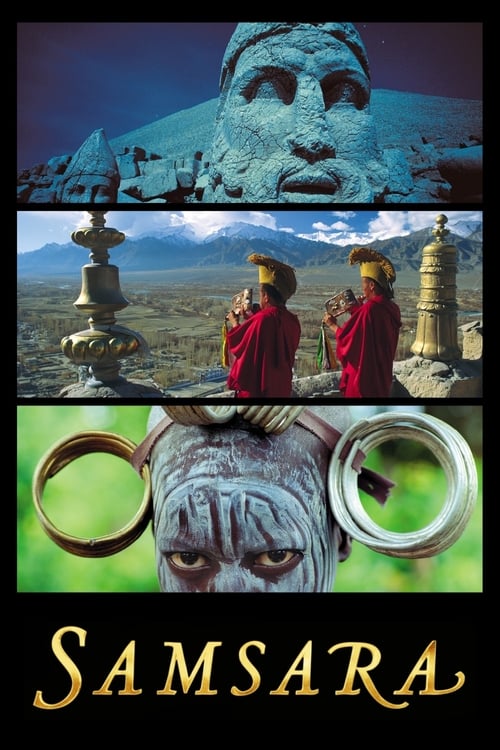
Samsara
2011 · Ron Fricke
For when you want to turn the lights off, put your phone in another room, and let a film wash over you — a meditative trip around the planet rather than a story.
What it's about
No plot, no dialogue, no narrator — just the world itself, filmed over five years in twenty-five countries on 70mm. Sacred rituals, disaster zones, factory floors, deserts, temples, and cities flow into one another in a wordless meditation on the wheel of birth, death, and rebirth that gives the film its name.
The experience
Hypnotic and immersive — you sink into pure image and music, and the film does its arguing through juxtaposition: a temple cut against an assembly line, a landscape against a skyline. Some passages are serene, some genuinely confronting.
The craft
Ron Fricke shot it himself on 70mm film, and the images are among the most stunning ever put in a documentary — this is the definition of a film that demands the biggest screen and best sound you can find. The editing builds meaning purely through rhythm and rhyme between shots, ritual against industry, nature against construction.
Why it matters
The capstone of Fricke's wordless world-documentary triptych begun with Chronos and Baraka, and a touchstone for the whole tradition of non-narrative visual filmmaking — the film people reach for to show what cinema can do without a single word.
Snapshot
Samsara is a wordless, non-narrative documentary assembled from images captured over roughly five years across some twenty-five countries and five continents, and shot on 70mm film. Directed and photographed by Ron Fricke and produced and co-edited by his longtime partner Mark Magidson, it is the third panel in an unofficial triptych of "world" tone poems that began with Fricke's IMAX short Chronos (1985) and continued with Baraka (1992). The film has no dialogue, no narration, no on-screen text, and no protagonist. Its organizing principle is instead the Sanskrit concept named in the title — saṃsāra, the ever-turning wheel of birth, death, and rebirth — which Fricke and Magidson render as a montage that rhymes sacred ritual against industrial process, natural landscape against human construction, the geological against the momentary. It premiered at the Toronto International Film Festival in September 2011 and received a staggered international release across 2012, distributed in the United States by Oscilloscope Laboratories. It stands as one of the last major theatrical works composed on large-format photochemical film before digital acquisition became near-universal.
Industry & production
Samsara was produced outside the conventional studio and even the conventional documentary-financing system. Fricke and Magidson operated as a small, self-directed unit — Magidson's Magidson Films — carrying forward the working model they had established on Baraka two decades earlier. The production's defining constraint was time rather than a large crew: the roughly five-year shooting window reflects both the logistics of reaching remote locations on five continents and the deliberate, laborious nature of Fricke's time-lapse and precisely composed photography, which cannot be rushed. Crews on the ground were kept minimal, which suited both the budgetary reality of an independently financed film and the contemplative, unobtrusive stance the material required.
The commercial logic of the film is unusual. With no stars, no story, and no spoken language, Samsara was positioned less as a documentary in the reportorial sense than as an immersive theatrical experience, marketed to arthouse and repertory audiences and, later, to the home-cinema and audiophile market where its imagery and sound design could be shown off. Precise budget and box-office figures are not something I can responsibly cite here; the film's economics belong to the specialized world of large-format independent cinema, where returns come slowly through long theatrical tails, festival exposure, and premium home-video sales rather than opening weekends.
Technology
The film's headline technology is its acquisition format: it was shot on 65mm negative in the large-format tradition (the Todd-AO 70mm lineage), yielding a negative area far larger than standard 35mm and a correspondingly enormous resolution and tonal latitude. Because very few venues could still project 70mm by the early 2010s, the 65mm footage was scanned and finished digitally at high resolution and distributed primarily as a Digital Cinema Package — a hybrid workflow characteristic of its moment, marrying photochemical capture to a digital intermediate and digital projection.
Equally important is Fricke's custom time-lapse apparatus. Since Chronos and Baraka, Fricke had designed and refined his own computer-controlled motion-control systems that move the camera incrementally during long time-lapse exposures, so that clouds, crowds, and stars streak past a camera that is itself slowly tracking or panning. This produces the signature effect of these films: time compressed while space glides, the frame alive with motion in two different temporal registers at once. The 65mm frame gives that effect a clarity and depth that smaller formats cannot match.
Technique
Cinematography
Fricke is the rare director who is also his own master cinematographer, and Samsara is above all a photographic achievement. The visual grammar is built on symmetry, frontality, and stillness. Human subjects are frequently framed head-on, centered, looking directly into the lens in held portrait shots — a device that confers dignity and confronts the viewer, collapsing the distance between spectator and stranger. Landscapes and architecture are composed with an almost devotional attention to line, scale, and geometry. The time-lapse sequences, by contrast, unleash motion: pilgrims circling the Kaaba in a vast human vortex, traffic and cloud shadows racing across cities, stars wheeling over desert ruins. The 70mm capture renders all of it with immense depth of field and resolution, so that a single frame holds detail from foreground to distant horizon.
Editing
The edit, credited to Fricke and Magidson, is the film's true authorial argument, because with no narration or plot the meaning lives entirely in juxtaposition. Samsara proceeds associatively, cutting on visual and conceptual rhyme rather than chronology or geography — a Tibetan sand mandala answered later by its own ceremonial destruction; the manufacture, consumption, and disposal of goods traced across continents; human faces set against the faces of statues and the "faces" of machines. The mandala functions as the film's structural signature and thesis, its patient creation and deliberate sweeping-away literalizing the cyclical idea the whole film pursues. Rhythm is calibrated to the music and to breath, alternating long meditative holds with accelerating montage.
Mise-en-scène / staging
As a documentary, Samsara largely finds rather than stages its images, but several sequences are clearly performative or composed for the camera — most famously the interlude in which the French performance artist Olivier de Sagazan, seated at an office desk, smears clay and paint over his own face in a violent, self-obliterating transformation. Such passages sit at the boundary between documentary observation and constructed tableau, and Fricke stages them with the same symmetry and directness he brings to found subjects, so the seams rarely show.
Sound
There is no synchronous dialogue and no voice-over. The soundtrack is instead a fused bed of score, ambient sound, and music-driven design composed by Michael Stearns, Lisa Gerrard, and Marcello De Francisci. Stearns, who scored Baraka, again supplies drifting ambient and electronic textures; Gerrard brings her distinctive wordless, glossolalic vocals; De Francisci contributes and co-shapes the whole. The result is closer to a continuous musical score with integrated field recordings than to conventional documentary sound, and it carries much of the film's emotional through-line in the absence of language.
Performance
There are no actors and no characters in the ordinary sense. "Performance" in Samsara means the presence of ordinary and extraordinary people before Fricke's lens — Buddhist monks, factory laborers, a family, prisoners, dancers, worshippers — whose stillness or activity the camera holds. The direct-address portraits ask subjects simply to be seen. The de Sagazan sequence is the exception that proves the rule: a deliberate, expressive human performance dropped into a film otherwise built from observed reality.
Narrative & dramatic mode
Samsara is resolutely non-narrative. It has no plot, no dramatic conflict resolved over time, and no individuated arc. Its mode is the tone poem or visual symphony: meaning accrues thematically and rhythmically rather than causally. If it has a "drama," it is the tension the montage keeps staging — between the sacred and the industrial, the handmade and the mass-produced, creation and destruction, the individual face and the anonymous crowd. The viewer is positioned as an active meaning-maker, invited to draw the connections the cuts imply rather than to follow a story being told.
Genre & cycle
The film belongs to a specific and thinly populated genre: the large-format, non-narrative documentary tone poem. Its most direct lineage runs through Godfrey Reggio's Koyaanisqatsi (1982) — on which Fricke served as cinematographer and co-editor — and its "Qatsi" sequels, and through Fricke's own Chronos and Baraka. Further back it descends from the 1920s "city symphony" tradition (Walther Ruttmann's Berlin: Symphony of a Great City, Dziga Vertov's Man with a Movie Camera) and from the IMAX/large-format nature and travel documentary. Within Fricke's cycle, Samsara is explicitly the companion piece to Baraka: same director-photographer, same producer-collaborator, same globe-spanning method, same 70mm ambition, made twenty years on with matured technology.
Authorship & method
Samsara is very nearly a two-person authorship. Ron Fricke directed, photographed, and co-edited; his sensibility — the symmetry, the time-lapse, the reverence for the human face — is the film's defining signature, formed during his foundational work as the cinematographer of Koyaanisqatsi and carried through Chronos and Baraka. Mark Magidson, who produced, co-edited, and co-conceived the film with Fricke, is the essential second author: the editing partnership is where the material's associative meaning is actually built, and Magidson's role reaches back to Baraka as well. On the music side, Michael Stearns, Lisa Gerrard, and Marcello De Francisci function almost as co-authors of the film's affect, since in a wordless film the score does the work that dialogue and narration would otherwise do. There is no screenwriter in the conventional sense; the "writing" is the shot list and the edit. The method — long years of patient, self-financed, small-crew shooting on the most demanding available format, then a lengthy associative assembly — is itself the authorial statement.
Movement / national cinema
The film resists national categorization by design. It is nominally an American independent production, but its subject is deliberately transnational, refusing to privilege any one culture or to name any location on screen. It is best understood as part of an international avant-garde and non-narrative documentary tendency rather than any nation's cinema — a lineage of experimental, montage-driven, image-first filmmaking that runs from Vertov and Ruttmann through the American structural and IMAX traditions to Reggio and Fricke. Its "movement" is a small transhistorical family of films devoted to the world as spectacle and moral meditation.
Era / period
Samsara is very much a work of the 2010–2012 hinge moment in film technology and culture. Technologically it sits on the cusp between photochemical and digital cinema: it may be among the last major films originated on 65mm before digital acquisition all but ended the practice, yet it was finished and distributed digitally. Culturally it arrives amid a heightened awareness of globalization, mass production, consumption, and environmental strain — anxieties its montage of factories, waste, weaponry, and ritual speaks to directly. It is also a product of the festival-and-arthouse ecosystem of its era, launching from Toronto into a specialized theatrical and premium-home-video release.
Themes
The governing theme is the cyclical nature of existence — creation, destruction, and renewal — announced by the title and literalized by the sand mandala that is painstakingly made and then swept away. Around that spine the film gathers a cluster of preoccupations: the interdependence of the sacred and the industrial; the machinery of global consumption, from manufacture through consumption to waste and death; the tension between the handmade and the mass-produced; the dignity and anonymity of the human face within vast systems; and the smallness of human time against geological and cosmic time, made visible by the time-lapse. Crucially, the film advances these ideas without argument or narration — it withholds captions and commentary so that its ethical and spiritual reflections emerge as felt correspondences rather than stated theses, leaving interpretation deliberately open.
Reception, canon & influence
Critically, Samsara was widely received as a work of extraordinary photographic beauty, praised above all for the richness of its 70mm imagery, the immersive sound, and the power of its portrait sequences; the recurring reservation among critics was the familiar objection to this genre — that its sublime images can tip toward the decorative or the glib, aestheticizing suffering and consumption without the friction of argument. I would rather flag that critical debate in general terms than attribute specific verdicts or quotations I cannot verify precisely.
Looking backward, the film's influences are clear and largely internal to Fricke's own career: Koyaanisqatsi and the Reggio "Qatsi" films that Fricke helped shape; his own Chronos and Baraka; and behind them the city-symphony and large-format documentary traditions. The visual devices — time-lapse motion control, symmetrical composition, direct-address portraiture, montage-by-rhyme — are refinements of techniques Fricke had been developing since the early 1980s.
Looking forward, Samsara's legacy is felt less in prestige narrative cinema than in the visual vocabulary of ambient, immersive, and observational image-making. Its aesthetic — the drifting time-lapse, the wordless global montage, the meditative held frame — has been widely absorbed into large-format cinema, high-end nature and travel documentary, gallery and installation work, advertising, and the ambient video culture of the streaming and large-screen era. As the capstone of the Chronos–Baraka–Samsara line, it also stands as a kind of summation and possible endpoint of the 70mm non-narrative tone poem: a form defined by a very small number of practitioners, of whom Fricke is the most complete, arriving just as the photochemical technology that made it sublime was passing out of general use.
Reception
Critics in 2012 split between calling it a transcendent 70mm meditation and dismissing it as a gorgeous coffee-table travelogue; a decade-plus on, it's settled into beloved status as the go-to 'put this on the biggest, best screen you can find' film of the streaming/4K era.
How Samsara was received, from release to now →
Influences: the films it descends from and the films it influenced
- Koyaanisqatsi (1982) — Fricke shot and co-edited it, codifying the motion-control time-lapse cinematography and the wordless image-and-score montage grammar that Samsara later refines.
- Chronos (1985) — Fricke's first solo large-format film, where he engineered the custom computer-controlled time-lapse camera mount and slit-scan rigs he would reuse to shoot Samsara.
- Baraka (1992) — The direct 70mm Todd-AO predecessor with Magidson, establishing the held direct-address portrait and the pilgrimage-structured global montage Samsara essentially remakes.
- Powaqqatsi (1988) — Extended the Qatsi form to Global South labor and ritual, modeling the sacred-versus-industrial juxtaposition and the slowed, reverent framing of manual work Samsara inherits.
- Man with a Movie Camera (1929) — Foundational associative montage-by-rhyme, building meaning through graphic matches and cross-cut activity rather than narration — the editing logic underlying Samsara's assembly.
- Berlin: Symphony of a Great City (1927) — The city-symphony template: a day-cycle of the industrial metropolis edited to musical rhythm, the 'symphony' structure of movement Fricke's tradition descends from.
- Olympia (1938) — Pioneered the performative tableau and idealized, symmetrical framing of the human body as sculptural spectacle, a compositional debt visible in Samsara's frontal portraiture.
- Ballet Mécanique (1924) — Rhythmic editing of machine parts and human gesture into abstract visual rhyme, an early instance of the mechanized-body montage Samsara stages in its factory sequences.
- Lessons of Darkness (1992) — Shot in 70mm with sustained aerial photography across 25 countries, chapter-structured without narration, using the equivalence between sacred and industrial landscapes — abattoirs alongside temples — as visual argument, extending Lessons of Darkness's principle that juxtaposition alone constitutes the film's thesis.
- Watermark (2013) — Aerial and locked-off large-format compositions of water infrastructure and industry assembled as a near-wordless visual argument, directly downstream of Samsara's global montage.
- Voyage of Time (2016) — A feature non-narrative tone poem using time-lapse and macro/micro juxtaposition to stage cosmic time, extending the associative-montage cosmology of the Qatsi–Baraka–Samsara line.
- Home (2009) — A feature-length aerial large-format ecological survey built on the sacred-versus-industrial contrast and drifting global montage Samsara canonized for the streaming era.
- Ashes and Snow (2005) — Gallery-installation large-format tableaux of humans and animals held in painterly, performative stillness, extending Fricke's staged portrait-tableau mode into immersive exhibition.
- Planet Earth (2006) — Mainstreamed the motion-control time-lapse and stabilized aerial tracking into ambient large-screen nature imagery, the immersive documentary vocabulary Samsara helped seed.
- Anthropocene: The Human Epoch (2018) — A large-format survey of planetary-scale industrial transformation rendered as sublime spectacle, carrying Samsara's sacred/industrial juxtaposition into the photochemical-to-digital era.
- Naqoyqatsi (2002) — The Qatsi trilogy's capstone, a contemporaneous continuation of the same wordless-image-plus-Philip-Glass-score tone-poem method Fricke helped originate.
- The Tree of Life (2011) — Imports the Fricke/Trumbull cosmic time-lapse sublime into narrative cinema — its creation sequence is essentially the Qatsi macro/micro juxtaposition grammar embedded in a family drama.
- Manufactured Landscapes (2006) — Frames Edward Burtynsky's industrial-scale sites in slow, symmetrical large-format compositions of the sublime, sharing Samsara's sacred/industrial dialectic and static contemplative held frame.
- Leviathan (2012) — A wordless, immersive sensory-ethnography that likewise abandons narration and lets sound and image alone carry meaning, inverting Fricke's composed sublime toward the chaotic.
- Microcosmos (1996) — Extends the wordless image-and-score essay film with 65mm precision and time-lapse, sustaining the Microcosmos-adjacent belief that meticulously lit, non-narrated imagery can structure a feature.
Similar films
- Baraka (1992) — influence & lineage · same viewing thread
- Koyaanisqatsi (1983) — same viewing thread · often watched together
- Man with a Movie Camera (1929) — influence & lineage · same viewing thread
- Pather Panchali (1955) — often watched together
- The Turin Horse (2011) — often watched together
- Andrei Rublev (1966) — often watched together
- Sans Soleil (1983) — shared sensibility
- The Oldest Person in the World (2026) — shared sensibility
All the films related to Samsara →
Watch it with: curated runs of related films
- Cinema Without Words — Watch these as one run of pure image and music — the city symphony reborn, from Vertov's roaming cameras to 70mm temples, disaster zones, and Apollo footage, each the whole world edited into rhythm without a line of dialogue.