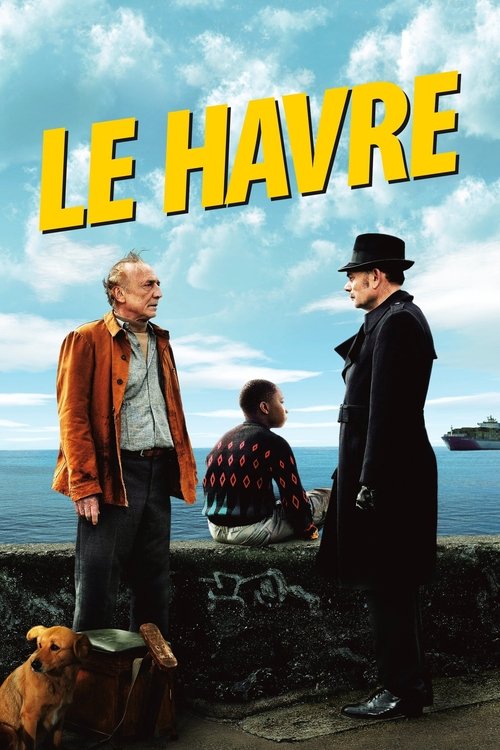
Le Havre
2011 · Aki Kaurismäki
Un-retired to make Fallen Leaves, and the internet decided the deadpan Finn was its favorite romantic — a genuine late-career Letterboxd canonization event.
For when the news has worn you down and you want to believe in people again — a gentle, funny, big-hearted film that comforts without ever going soft in the head.
What it's about
An elderly shoeshiner in the port city of Le Havre, scraping by while his wife lies ill in hospital, discovers a young African refugee hiding from the police near the docks. He takes the boy in, and his whole hard-up neighborhood — the baker, the grocer, the barkeeper — quietly closes ranks to shield him from deportation, while a trench-coated inspector circles closer.
The experience
Deadpan and tender at once: the faces barely move, the dialogue is dry as toast, and yet an enormous warmth keeps rising off the screen. It moves at an unhurried, storybook pace and leaves you feeling that ordinary decency might actually be enough.
The craft
Kaurismäki shoots poverty in rich, saturated color — blues, reds, and lamplight that make a cramped kitchen look like a painting — and stages every scene with still, precise framing where a single gesture lands like a punchline. Where most films about migration reach for grim handheld realism, this one deliberately plays it as a fairy tale, and the tension between the harsh subject and the warm style is the whole effect.
Why it matters
It became one of the defining humane responses to Europe's migration debate in cinema, widely embraced on the festival circuit and a late-career landmark that introduced many viewers to Kaurismäki's deadpan world.
Snapshot
Le Havre is Aki Kaurismäki's fairy tale about a deportation. A shoeshiner in the Normandy port city — Marcel Marx, the failed bohemian first met in Kaurismäki's La Vie de Bohème (1992), now twenty years older and shining shoes outside the railway station — finds a Gabonese boy, Idrissa, hiding in the water off the quay after a shipping container full of African migrants is opened by police. Marcel takes him in. His neighborhood — baker, grocer, barkeeper, all of them broke — closes ranks around the boy while Marcel's wife Arletty is hospitalized with an illness her doctor calls hopeless. A trench-coated inspector named Monet knows exactly what is happening and declines to act on it.
The film was made at a moment when the European art film's default register for migration was documentary-inflected naturalism: handheld, grim, procedural. Kaurismäki went the other way entirely. He shot on 35mm in saturated primaries, staged in near-static frames, wrote dialogue no living person speaks, and ended on two miracles delivered without a flicker of irony. The result is one of the most legible political films of its decade precisely because it refuses to argue: it simply shows a form of solidarity that the world does not currently supply, and lets the gap do the work. It premiered in competition at Cannes in 2011 and became, with The Man Without a Past (2002), Kaurismäki's most widely seen film.
Industry & production
Le Havre is a Finnish–French–German co-production, financed through the mid-budget European art-cinema apparatus that Kaurismäki has used since the 1990s: his own Helsinki company Sputnik Oy as lead producer, with Pyramide Productions in France and Pandora Film in Germany, supported by national film funds and the pan-European co-production instruments that make a Finnish auteur's French-language feature financially possible in the first place. Kaurismäki produces his own work; that self-financing posture, maintained since he and his brother Mika founded Villealfa in the early 1980s, is the structural precondition for everything idiosyncratic about the films — the short schedules, the small crews, the refusal of coverage, the absence of a producer's notes.
The shoot took place in Le Havre itself and in the Calais region. Le Havre is a pointed choice of location for reasons beyond the migration story: bombed nearly flat in 1944, the city was rebuilt by Auguste Perret in reinforced concrete and inscribed as a UNESCO World Heritage site in 2005 for exactly that modernist reconstruction. Kaurismäki largely ignores it. He shoots the surviving older fabric — the Saint-François quarter, bars, a bakery, low brick streets near the water — producing a city that reads as mid-century working-class France rather than as the architectural landmark it is officially celebrated for being.
Cannes gave the film the FIPRESCI prize in 2011; the Palme d'Or that year went to Malick's The Tree of Life. It subsequently took the Prix Louis-Delluc for the year's French film, and was Finland's submission to the Academy's foreign-language category, reaching the shortlist but not the final five. Janus Films handled US theatrical distribution and the Criterion Collection issued it on disc in 2012 — a canonisation-by-label that has shaped its afterlife in American cinephile culture.
Technology
The film's technology is, deliberately, a statement of position. It was shot photochemically on 35mm in 1.85:1 at the precise historical moment when European exhibition was converting wholesale to digital projection and most of Kaurismäki's contemporaries had abandoned film capture. Kaurismäki stayed on 35mm through The Other Side of Hope (2017). There are no digital effects, no visible stabilization, no compositing; the image is what stood in front of the lens.
The color, likewise, is built in the world rather than in a grade. Timo Salminen's method with Kaurismäki — consistent across nearly thirty years — is to construct the palette through art direction and hard, gelled, directional light: deep saturated blues and greens on walls, a red door, a yellow lamp, black shadow with no fill. Faces are lit from a single hard source; the tungsten warmth of practicals is allowed to sit against cold exteriors. This is a pre-digital-intermediate aesthetic sensibility even where post-production tools were available, and it accounts for the film's peculiar density of color, which resembles 1950s Technicolor more than 2011 arthouse.
The same anachronism governs the props. Rotary telephones, a jukebox, period cars, sit-up radios, tin advertising signage: the material culture is decades out of date, punctured only occasionally by a mobile phone or a police computer that reminds you the deportation machinery is contemporary. The technology of the story is modern; the technology of the world is not.
Technique
Cinematography
Salminen's camera is almost immobile. Scenes are built from a small number of long-ish static setups — frontal medium shots, clean singles, occasional two-shots that hold both actors in profile — with reframing rather than movement. When the camera does track or pan it registers as an event. Compositions are frontal and centered to the point of formality; characters are often placed against flat planes of color that abstract the space behind them. The framing is close to the vocabulary of silent comedy and of Ozu: the spectator is given a stage and asked to watch it, not led through it.
Depth is shallow and lighting is high-contrast, which flattens the image and pushes it toward graphic design. Salminen also uses a recurring device of the doorway and window frame — Idrissa glimpsed through a hatch, Marcel framed in a bar door — which visually rhymes shelter with confinement.
Editing
Timo Linnasalo, Kaurismäki's regular editor, cuts on an economy so severe it becomes a joke in its own right. Scenes begin after their beginnings and end before their ends; establishing material is routinely skipped; a journey to Calais and back is compressed to a handful of shots. There is almost no shot/reverse-shot acceleration, no cutting for emphasis, no montage. Reaction shots are held a beat past comfort, which is where much of the film's humor and nearly all of its pathos live. The overall effect is of a narrative stripped to its load-bearing members — roughly ninety minutes carrying a plot that a conventional treatment would run at two hours.
Mise-en-scène / staging
Kaurismäki stages like a theater director working in tableaux. Actors enter, take a position, deliver, and hold; blocking is minimal and gestures are single and complete — a hand set on a table, a glass lifted, a hat removed. Interiors are dressed to the last object and lit so that the objects read as objects. The bar, the bakery, the hospital room and Marcel's kitchen are each given a fixed geometry that the film returns to unchanged, so that the neighborhood becomes a set of stations rather than a continuous space.
Sound
The soundtrack is sparse and hard-edged: harbor noise, foghorns, trains, doors, footsteps on stone, long stretches of near-silence under dialogue. There is no non-diegetic underscoring in the conventional sense. Music arrives instead as records and performances — French chanson, blues, rockabilly, dropped in whole and allowed to play — culminating in the benefit concert given by Little Bob (Roberto Piazza), the veteran Le Havre rock singer, playing himself. That concert is the film's one sustained release of energy, and it is also its plot mechanism: the money that buys Idrissa's passage.
Performance
The house style is deadpan: level delivery, minimal inflection, no visible interiority. André Wilms — a French stage and screen actor known to a wide audience from La Vie est un long fleuve tranquille (1988) — plays Marcel as a man of unbreakable courtesy, formal in speech even when destitute. Kati Outinen, Kaurismäki's longest-serving lead and a Cannes best-actress winner for The Man Without a Past, plays Arletty in a register of near-total stillness, so that the smallest softening of the face carries the weight a lesser film would give to a monologue. Jean-Pierre Darroussin — an actor indelibly associated with Robert Guédiguian's Marseille films of working-class solidarity, a resonance that is surely deliberate — plays Inspector Monet as an implacable functionary whose moral turn is conveyed almost entirely through what he does not say.
The supporting bench is a cinephile's register: Pierre Étaix, the great French comic filmmaker and Tati collaborator, as the doctor; Jean-Pierre Léaud, the New Wave's own boy, cast devastatingly against type as the neighborhood informer; Elina Salo and Evelyne Didi as the shopkeepers. Blondin Miguel, a non-professional, plays Idrissa with a watchful reserve that matches the adults' flatness rather than contrasting with it. The dog Laika, from the line of Kaurismäki's own dogs that have appeared throughout his filmography, took the Palm Dog at Cannes.
Narrative & dramatic mode
The structure is a folk tale in three movements: a threat arrives, a community conceals it, an authority relents. Two rescue plots run in parallel — Idrissa must reach his mother in London, Arletty must survive an untreatable illness — and the film resolves both by miracle. Idrissa is smuggled aboard a boat; Arletty walks out of the hospital cured, and a cherry tree blossoms in the yard.
This is the film's most consequential formal decision. Kaurismäki has been explicit that he was writing a fairy tale, not a report, and the ending is not a lapse into sentiment but a declared genre. The dramatic mode is closer to Chaplin and to Miracle in Milan than to social realism: the world of the film is manifestly not the world, and the pleasure of the ending is inseparable from the knowledge that no such ending is on offer outside the cinema. The utopia functions as indictment.
Dialogue is aphoristic and unidiomatic — the French carries the syntax and formality of Kaurismäki's Finnish, a quality nearly every critic noticed — which keeps the characters permanently slightly abstracted from naturalism. Nobody explains their motives. Nobody has a backstory beyond one line.
Genre & cycle
It sits at the intersection of three cycles. First, the European migration film of the 2000s–2010s: Winterbottom's In This World (2002), Frears's Dirty Pretty Things (2002), and especially Philippe Lioret's Welcome (2009), which is also set at Calais and also concerns an older Frenchman helping a young man reach England — the direct point of comparison, and the naturalist treatment against which Le Havre's stylization is best measured. Second, the deadpan comedy of Kaurismäki's own devising. Third, the tradition of the working-class fable: poetic realism inverted, its fatalism replaced by grace.
Authorship & method
Kaurismäki writes, directs and produces; he works fast, with small crews, few takes, and a company of returning collaborators. Timo Salminen has photographed nearly every film since Crime and Punishment (1983); Linnasalo has cut most of them; Wouter Zoon designed Le Havre's sets. There is no composer — Kaurismäki curates records instead, a practice as consistent and as authorial as any score.
The method's core principle is subtraction: remove psychology, remove exposition, remove camera movement, remove inflection, and what remains — gesture, color, silence, kindness — carries more than it otherwise could. His politics are equally unfussy and have been acted on: he declined to attend the 2003 Academy Awards over the invasion of Iraq, and had earlier withdrawn from the New York Film Festival when Abbas Kiarostami was denied a US visa.
Le Havre was announced as the first of a projected trilogy of port-city films. The other two were never made in that form; The Other Side of Hope (2017), a Helsinki-set story of a Syrian asylum seeker, became its companion piece instead.
Movement / national cinema
Kaurismäki is the central figure of modern Finnish cinema's international presence, and Le Havre belongs to a national cinema that has always worked through co-production and export. His filmography breaks roughly into the "proletariat" films (Shadows in Paradise, 1986; Ariel, 1988; The Match Factory Girl, 1990), the later Finland trilogy (Drifting Clouds, 1996; The Man Without a Past, 2002; Lights in the Dusk, 2006), and a set of films made abroad and in other languages — I Hired a Contract Killer (1990, London), La Vie de Bohème (1992, Paris), and Le Havre. The French films are not tourism: they are a Finnish sensibility installed inside French cinema's own iconography, which is why the homages land.
Era / period
The film premiered in May 2011, in the middle of the eurozone crisis, under a French presidency conducting a highly visible campaign of deportations and camp clearances, and in the same season as the Arab Spring crossings that were bringing thousands of people to Lampedusa. Calais at the time was already a decade past the closure of the Sangatte center and well into the permanent informal-camp condition that would later be known worldwide as the Jungle. The film thus predates the 2015 emergency by four years, which is a large part of why it has aged into looking prescient rather than topical: the machinery it depicts was already fully assembled, just not yet front-page news across Europe.
Themes
The governing theme is hospitality as a practice of the poor. Every person who helps Idrissa is themselves precarious; the film's implicit accounting is that solidarity flows sideways, among people with nothing, and not downward from institutions. Against that, the informer — played by the New Wave's emblem — represents the ordinary, unremarkable civic impulse to report.
Secondary strands: the dignity of manual labor, insisted on through Marcel's shoeshine box and the film's attention to hands and tools; the moral neutrality-then-defection of the state, embodied in Monet; illness and mortality as the private counterpart to the public emergency; and anachronism itself as an argument — the film's stubbornly obsolete world is a proposal that something was lost, socially as well as visually, and might be worth wanting back.
Reception, canon & influence
Critical reception was warm to the point of unanimity; Le Havre was among the best-reviewed films of 2011 internationally, took the FIPRESCI prize at Cannes and the Prix Louis-Delluc, gathered European Film Award attention, reached the Academy's foreign-language shortlist as Finland's entry, and was quickly given a Criterion edition. The most common critical reservation concerned the ending's double miracle — whether the fable license covers a cured cancer as readily as a successful escape — and that debate remains the standing critical question about the film.
Backward, the lineage is unusually explicit. Poetic realism is signposted by name: Arletty is the star of Hôtel du Nord and Les Enfants du paradis, and Le Havre is the setting of Carné's Quai des brumes, so the film's port, fog and doomed lovers arrive pre-quoted. Inspector Monet carries the name of the painter raised in Le Havre whose Impression, soleil levant depicts its harbor. Bresson underwrites the flat delivery, the attention to hands and objects, and the moral seriousness; Ozu underwrites the frontal, static frame; Vigo, Becker and Melville supply the quays, the working-class romance and the trench coat; Chaplin and De Sica supply the sentimental-utopian ending. Casting Étaix and Léaud writes French film history into the ensemble directly.
Forward, the influence is easier to describe as consolidation than as lineage. Le Havre did not spawn imitators so much as it legitimized an alternative register for the migration film — anti-naturalist, comic, frankly utopian — at a moment when the subject was hardening into a single documentary idiom. Its clearest descendant is Kaurismäki's own The Other Side of Hope (2017), which reworks the same material with the fable's optimism substantially withdrawn, and beyond that Fallen Leaves (2023), which returned him to Cannes prize-winning prominence with the style intact. The wider deadpan-humanist current it belongs to — Jarmusch, a long-standing friend and fellow traveler; Roy Andersson, a parallel rather than a debtor — was already established, but Le Havre is the film most often reached for when that sensibility is asked to prove it can address a live political emergency without abandoning its form. Tracing specific stylistic borrowings by younger filmmakers is where the record is genuinely thin; the honest claim is that its influence has so far been one of permission rather than of imitation.
A Deleuzian reading
A boy stands in the water at the end of a quay.
The full Deleuzian reading of Le Havre →
Reception
A Cannes 2011 darling — it won the FIPRESCI critics' prize and plenty thought it deserved the Palme that went to The Tree of Life — Le Havre has only grown since, looking prescient once Europe's refugee crisis made its gentle fairy tale feel urgent rather than quaint.
How Le Havre was received, from release to now →
How to watch Le Havre: what to notice on a first viewing
- Watch scenes held in static, frontal, centered compositions throughout. Salminen builds the film from a small number of long, unmoving setups, so that any track or pan registers as a real event. The camera's stillness makes you watch what's arranged inside the shot, not follow the shot itself.
- Notice the deep saturated reds, blues, and yellows throughout Le Havre. Salminen and Kaurismaki build color through art direction and hard gelled light, a red door or yellow lamp against deep blue walls and black shadow. A static film this plain in its blocking never goes inert because the color carries the charge.
- Watch Idrissa and Marcel framed through doorways and windows repeatedly. Salminen recurrently frames the boy glimpsed through a hatch and Marcel standing in a bar door, rhyming shelter with confinement across the film. The same shape holds two opposite meanings, safety and being trapped, depending on who's in it.
- Listen for harbor foghorns, trains, and footsteps under long silences. There's no non-diegetic score. Music arrives instead as records and live performances, so the harbor's own noise carries most scenes. The soundtrack stays as plain and unadorned as the static, frontal camera.
The whole guide to watching Le Havre, with the keys for a rewatch →
Influences: the films it descends from and the films it influenced
- Le Quai des brumes (1938) — Carné and Prévert's Le Havre is the film's pre-built set — fog, dockside bar, a fugitive sheltered by fixed local types — and Kaurismäki reuses its principle of a port rendered as an enclosed studio stage rather than a location, down to Marcel's trench coat.
- Hôtel du Nord (1938) — Supplies both the naming of Outinen's Arletty and the structural device Le Havre runs on: a lodging-house block whose baker, greengrocer and barkeep operate as a chorus of shopkeepers who conspire collectively to hide one person from the police.
- L'Atalante (1934) — Vigo's method of shooting quayside labor as lyrical material — hands, water, junk-objects invested with feeling — plus the precedent for resolving a beloved's absence/illness by an openly non-realist gesture rather than by plot.
- Le Trou (1960) — Becker's scoreless, gestural procedural — the escape filmed as manual craft in unhurried shots of hands on objects, faces held in silent reaction — underwrites the smuggling logistics and the held reaction shots; Étaix's character is named Dr. Becker.
- Pickpocket (1959) — The 'model' rather than the actor: level, unstressed line delivery with the gaze off the addressee, cutaways isolating hands passing objects, and a closing grace the narrative has not earned — the exact permission Kaurismäki draws on for the double miracle.
- Late Spring (1949) — The tripod-locked low frontal camera, actors addressing a point just off-lens, and interiors composed through successive door apertures — Le Havre's doorway framing and absolute refusal of camera movement are Ozu's grammar transposed to a Normandy shoemaker's kitchen.
- The Kid (1921) — The poor man concealing a child from state officials, staged as gags in a static wide with the comic beat carried by a held, unmoving reaction — and the license to end in frank sentimental utopia without irony.
- Miracle in Milan (1951) — Zavattini's move of loading a scrupulously neorealist setup — shanty poverty, police, deportation — and then discharging it with a declared miracle in the last reel is the structural precedent for Le Havre's cured cancer and successful crossing.
- Bob le flambeur (1956) — Melville's costume-as-ethics — trench coat and hat worn as moral uniform — and the policeman whose professional duty is quietly overridden by loyalty to the man he is pursuing, which is precisely Inspector Monet's last gesture at the quay.
- Yoyo (1965) — Étaix, cast in Le Havre as the doctor, built his gags inside a locked-off wide with silent-comedy timing and no verbal underlining; that composed-gag-in-a-fixed-frame is the comic engine Kaurismäki runs beneath the deadpan.
- The 400 Blows (1959) — Léaud's Doinel — the boy fleeing authority toward the sea — is deliberately inverted by casting the same actor as the neighborhood informer, so the film's coastal ending reads as arrival where Truffaut's was a dead stop.
- Kitchen Stories (2003) — Sustains the frontal-symmetry, color-blocked, terse-dialogue deadpan that Kitchen Stories helped keep in international art-house circulation through the following decade.
- The Other Side of Hope (2017) — The declared companion piece — same Salminen photography and Linnasalo cutting, same restaurant-as-refuge and forged-papers plumbing — with the fable license withdrawn: the asylum seeker is knifed rather than blessed.
- Fallen Leaves (2023) — Carries the toolkit forward intact: primary-coloured painted interiors on 35mm, anachronistic props (landline, transistor radio) fixing no decade, karaoke-bar source music replacing score, and dialogue written as aphorism.
- The Happiest Day in the Life of Olli Mäki (2016) — The Finnish continuation of the photochemical, undemonstrative register — 16mm black-and-white, period props handled as objects rather than signals, performances stripped of inflection, and elliptical cutting that skips the climactic event.
- It Must Be Heaven (2019) — Takes Le Havre's proof that displacement can be staged as comedy: a near-mute deadpan protagonist observing symmetrical, locked-frame silent gags, with the bureaucracy of borders played for absurdist composition instead of documentary urgency.
- Drifting Clouds (1996) — The direct rehearsal of the form: Outinen and Salminen, saturated primaries against gray civic misery, no composer but jukebox records, and an unemployment story rescued by a communal miracle in the final reel.
- Stranger Than Paradise (1984) — The shared deadpan grammar — one static setup per scene held well past the joke, under-reaction as the performance register, and a soundtrack of found records used diegetically rather than scored.
- Songs from the Second Floor (2000) — A parallel rather than a debt: scene-as-single-composed-shot, deep-focus frontal tableau with a locked camera, and a rigorously drained-then-accented color design achieved in-camera through set painting.
- The Man Without a Past (2002) — Extends the identical ethic of hospitality toward outsiders using the same fixed-camera tableaux and warm Sirkian color, transposing the shantytown-community model onto a refugee narrative.
Similar films
- The Other Side of Hope (2017) — influence & lineage
- Fallen Leaves (2023) — influence & lineage
- Little French Fish (2020) — shared sensibility
- The Man Without a Past (2002) — shared sensibility
- Shoplifters (2018) — shared sensibility
- Souleymane's Story (2024) — shared sensibility
- Little Amélie or the Character of Rain (2025) — shared sensibility
- The Kid with a Bike (2011) — shared sensibility