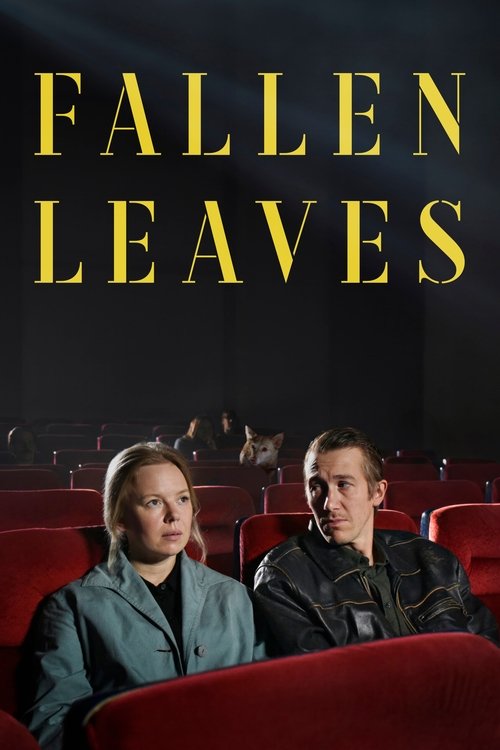
Fallen Leaves
2023 · Aki Kaurismäki
Un-retired to make Fallen Leaves, and the internet decided the deadpan Finn was its favorite romantic — a genuine late-career Letterboxd canonization event.
For a cozy night when you want to fall in love without an ounce of schmaltz — comfort viewing for people allergic to sentimentality. Also ideal when you need proof that kindness still photographs well.
What it's about
In a stylized, out-of-time Helsinki, two lonely working-class people find each other in a karaoke bar: Ansa, a supermarket shelf-stocker fired for pocketing expired food, and Holappa, a sandblaster whose drinking keeps costing him jobs. What follows is a courtship of small gestures repeatedly derailed by bad luck — a lost phone number, a wrong address, a movie date, a stray dog — while radio news of the war in Ukraine drones in the background.
The experience
Deadpan, tender, and quietly hilarious — barely anyone cracks a smile on screen, yet the film radiates warmth. At 81 minutes it's a small, perfect thing that leaves you unaccountably hopeful.
Performances
Alma Pöysti and Jussi Vatanen are pitch-perfect at Kaurismäki's signature register — faces nearly motionless, feelings enormous — making two taciturn people's tiny gestures land like grand declarations.
The craft
Kaurismäki's minimalism is honed to a gleam: flat, saturated colors, immaculately composed rooms, jukebox and karaoke songs doing the emotional talking, not a wasted shot anywhere. The film is full of loving nods to cinema itself, including a movie-theater date that doubles as a thesis on why we watch.
Why it matters
Winner of the Jury Prize at Cannes 2023 and one of the most beloved art films of its year, it marked Kaurismäki's triumphant return from a announced retirement and introduced his deadpan romanticism to a new generation.
Snapshot
Fallen Leaves (Finnish: Kuolleet lehdet, literally "Dead Leaves") is an 81-minute Finnish romance told in the deadpan minimalist idiom that Aki Kaurismäki has refined over four decades. Two lonely working-class people in a stylized, anachronistic Helsinki — Ansa (Alma Pöysti), a supermarket shelf-stocker later fired for taking expired food, and Holappa (Jussi Vatanen), a sandblaster whose drinking keeps costing him work — meet by chance in a karaoke bar and inch toward each other through a comedy of missed connections: a lost phone number, a misremembered address, a movie date, a stray dog. The film premiered in competition at the 2023 Cannes Film Festival, where it won the Jury Prize, and became one of the most widely acclaimed art films of its year. It also marked Kaurismäki's return after he had publicly suggested he was done directing following The Other Side of Hope (2017). Characteristically brief, wry, and tender, it distills a career-long project — dignifying the overlooked — into a compact modern fairy tale.
Industry & production
Fallen Leaves is a product of Kaurismäki's own long-standing production infrastructure. His company Sputnik has produced his features since the late 1980s, and the film was mounted as a European art-cinema coproduction of the kind that has sustained his work — Finnish backing supplemented by German partners, with the sales and festival strategy oriented toward Cannes and the international specialty market. The precise financing breakdown is not something I can detail reliably here, so I will not invent figures; what is well established is that this is a modestly budgeted, tightly controlled auteur production rather than a studio undertaking.
The most significant industrial fact surrounding the film is its status as a comeback. After The Other Side of Hope, Kaurismäki had spoken of retirement, and the arrival of a new feature was itself news. Cannes selection and the Jury Prize gave the film immediate international distribution momentum; it was picked up by arthouse distributors across many territories (MUBI handled it in a number of markets, including the United States and United Kingdom). Finland selected it as its submission for the Academy Award for Best International Feature Film, and it appeared on a large number of critics' year-end lists, cementing its commercial life as a festival-driven prestige release.
Technology
Kaurismäki is one of world cinema's most committed holdouts for photochemical film, and Fallen Leaves was shot on 35mm, as has been his near-invariable practice. This is not nostalgia for its own sake but a technical foundation of the film's look: the grain, the density of saturated color, and the particular way film stock renders his blocks of red, green, and blue are integral to the image. In an era of near-total digital capture, the choice is a deliberate material stance, and it aligns with his broader aversion to contemporary technological texture. The film's mise-en-scène is likewise anti-technological — the world is furnished with rotary phones, old radios, jukeboxes, and vintage cars — so that the one insistently contemporary technology, the radio broadcasting news of Russia's invasion of Ukraine, lands as a deliberate intrusion of the present into an otherwise timeless frame. The projection format for its festival and theatrical life reflected the same celluloid orientation where venues allowed.
Technique
Cinematography
The photography is credited to Timo Salminen, Kaurismäki's cinematographer on the overwhelming majority of his features since the 1980s and one of the defining collaborators of his style. Salminen died in December 2022, which places Fallen Leaves among his final works with the director — a poignant coda to one of the most consistent director–cinematographer partnerships in European cinema. The visual signature is unmistakable: frontal, frequently static compositions; carefully bounded frames in which figures are arranged with an almost pictorial stillness; and a palette built from saturated primary and secondary colors set against muted or dark surrounds. Lighting is controlled and often theatrical, isolating faces and objects with a clarity that recalls both classical Hollywood studio craft and painterly still life. The camera rarely calls attention to itself through movement; meaning is generated by framing, color, and the patient hold on a face or a gesture.
Editing
The cutting is spare and unhurried in the Kaurismäki manner — scenes are pared to essentials, transitions are clean, and the rhythm favors held shots and pointed pauses over coverage-driven flow. Kaurismäki has historically been deeply involved in shaping his films' final form, and Fallen Leaves shows the same economy: at 81 minutes it wastes nothing, and its comedy depends on precise timing, the beat of silence before a laconic line, the cut that arrives a moment later than expected. I won't assert a specific editing credit I can't confirm; what is clear is that the film's compression is a defining formal achievement.
Mise-en-scène / staging
This is the heart of Kaurismäki's method. Interiors are dressed as color-blocked stage sets — a kitchen, a bar, a bedsit — with props chosen for graphic and emotional weight rather than realism. Time period is deliberately unfixed: the décor, clothing, and cars suggest the mid-twentieth century even as the Ukraine broadcasts and other cues anchor the story firmly in 2022–23. Characters are staged with formal restraint, often facing forward or arranged in balanced tableaux, and the human warmth emerges precisely against this stylized stillness. Recurring Kaurismäki motifs recur here — the karaoke/bar milieu, the workplace, the modest home, cinema itself as a place of refuge (the couple's date is to a movie theater whose lobby is decorated with posters honoring canonical directors, and the feature on screen is Jim Jarmusch's zombie comedy The Dead Don't Die).
Sound
Sound design is quiet and precise, foregrounding source music and ambient detail rather than a conventional orchestral score. Music is diegetic and pointed: the karaoke bar, jukebox selections, and a performance by the Finnish duo Maustetytöt place popular song at the emotional center. The film's very title gestures at "Les Feuilles mortes" ("Autumn Leaves," the Prévert–Kosma standard), and Kaurismäki's soundtrack characteristically braids melancholy popular music into the drama so that songs carry feeling the characters won't articulate aloud. Against all this, the recurring radio news of the war supplies a stark, unmusical counterpoint.
Performance
Performance in Kaurismäki is famously anti-theatrical: actors underplay to the point of near-immobility, delivering lines flatly and withholding overt expression, in a register descended from Robert Bresson's "models." Alma Pöysti's Ansa and Jussi Vatanen's Holappa embody this beautifully — their restraint makes small movements (a glance, a half-smile, the naming of a dog) enormously expressive. Pöysti's performance in particular drew wide praise for the way it locates deep feeling within the deadpan mask. The result is comedy and pathos generated by what is not shown, a discipline the whole ensemble sustains.
Narrative & dramatic mode
The dramatic mode is the modern fable or fairy tale rendered in a minor, ironic key. The plot engine is the classic comedy-of-obstacles: boy meets girl, boy loses girl's number, address is mistaken, drinking intervenes, an accident delays the reunion. These are the mechanics of screwball romance and old melodrama, but Kaurismäki plays them with such austerity and understatement that they read as both funny and quietly devastating. The tone holds sentimentality at bay through deadpan irony while never becoming cynical; the film believes in its lovers' happiness even as it acknowledges every social force arrayed against it. The narrative is elliptical and compressed, trusting the audience to supply connective tissue, and it resolves in a gently hopeful register — an ending that consciously echoes the redemptive close of Chaplin's tramp films (underscored by the stray dog Ansa adopts and names Chaplin).
Genre & cycle
The film sits at the intersection of romance, comedy, and social drama, and within Kaurismäki's oeuvre it belongs explicitly to his working-class cycle. Kaurismäki himself framed it as a fourth entry extending his so-called "Proletariat trilogy" of the 1980s — Shadows in Paradise (1986), Ariel (1988), and The Match Factory Girl (1990) — returning after decades to the world of shift workers, precarious jobs, and modest lives. As romance it revives the beleaguered-lovers tradition; as comedy it works in a dry, tableau-based deadpan far from mainstream romantic comedy; and as a labor film it extends a documentary-inflected concern with contemporary work — zero-hours precarity, arbitrary firing, workplace danger — that runs throughout his career.
Authorship & method
Fallen Leaves is an unusually pure expression of a single, fully formed authorial system. Kaurismäki writes and directs, exerts tight control over design and music, and shapes each film to a personal template: short running times, static color-blocked compositions, laconic dialogue, underplayed performance, popular song, and an unwavering sympathy for society's losers rendered without pity. His long-term collaborators are central to this. Cinematographer Timo Salminen was his indispensable visual partner across most of his filmography, and this film stands as one of their last works together. Rather than a conventional composer, Kaurismäki builds his soundtracks from curated songs and source music, and here the inclusion of Maustetytöt continues his habit of foregrounding contemporary and vintage popular music as emotional text. The casting reflects both continuity and renewal: Kaurismäki has long worked with a repertory sensibility, and the pairing of Pöysti and Vatanen supplied fresh faces perfectly attuned to his register. Where specific below-the-line credits (such as the editor) are not something I can state with certainty, I flag that rather than guess.
Movement / national cinema
Kaurismäki is the preeminent figure of modern Finnish art cinema and, more broadly, a totemic auteur of European minimalism. His work has effectively defined an international image of Finnish film — melancholic, dryly funny, formally rigorous — and has done more than any other body of work to put Finnish cinema on the festival map. Stylistically he descends from a lineage that crosses national cinemas: Bresson's French minimalism, the humanist stillness of Yasujirō Ozu, French poetic realism (Carné, Becker) and the crime-film classicism of Jean-Pierre Melville, Italian neorealism's attention to the working poor, and the melodramatic social critique of Rainer Werner Fassbinder. Silent comedy — Chaplin above all, but also Keaton — is another deep root, visible in the film's tramp-like sweetness and the dog's name. Fallen Leaves thus belongs less to a contemporary movement than to a self-contained authorial tradition that Kaurismäki has built by synthesizing these influences.
Era / period
The film is a 2020s work that deliberately scrambles its own periodicity. Its production design evokes a mid-twentieth-century Finland of jukeboxes, rotary phones, and vintage automobiles, yet it is unambiguously anchored in the present by radio bulletins reporting Russia's 2022 invasion of Ukraine — the film's clearest historical timestamp and its most direct engagement with the political moment of its making. That collision of the timeless and the topical is the point: it universalizes the lovers' story while insisting that their small lives unfold under the shadow of contemporary catastrophe and precarity. It arrives, too, at a particular moment in Kaurismäki's own timeline — a late-career return after presumed retirement — which lends it the quality of a summation.
Themes
The governing themes are loneliness and the possibility of connection against it; the dignity of the working poor; and love as a modest, hard-won grace. Precarious labor is treated concretely — arbitrary dismissal, unsafe workplaces, insecure income — and functions as the social ground against which the romance struggles. Alcoholism is a central obstacle: Holappa's drinking is both a personal affliction and a symptom of the loneliness the film anatomizes, and Ansa's refusal to accept it becomes a moral fulcrum. Cinema and popular song recur as sources of solace and self-recognition. War and its distant menace haunt the edges of the story via the radio, connecting private hardship to public violence. And running through all of it is Kaurismäki's abiding faith in solidarity and kindness among the marginalized — the stray dog, the coworkers, the bartender — as the true wealth available to people the economy has discarded.
Reception, canon & influence
Critically, Fallen Leaves was among the most warmly received films of 2023. Its Cannes Jury Prize signaled establishment esteem, and reviews widely praised its emotional generosity, its compression, and Pöysti's performance; it recurred on many year-end top-ten lists and drew renewed attention to Kaurismäki as a living master. Finland's selection of it as its international-feature Oscar submission underscored its national standing.
Its influences run backward into the deep tradition sketched above — Bresson and Ozu in form, poetic realism and Fassbinder in mood, silent comedy and Chaplin in spirit — and, more intimately, back into Kaurismäki's own 1980s working-class films, which the picture consciously revisits and extends. The film is unusually candid about this lineage, wearing its cinephilia openly: the movie-theater sequence, with its homage-laden lobby and the screening of Jarmusch's The Dead Don't Die, stages Kaurismäki's love of cinema (and his personal friendship with Jarmusch's world of deadpan American independent film) as part of the text itself.
Its forward influence is best understood as consolidation rather than the founding of something new: Fallen Leaves reaffirmed the enduring viability of slow, minimalist, humane art cinema at a moment dominated by maximalist spectacle, and it renewed critical and popular appetite for Kaurismäki's model. For younger filmmakers drawn to restraint, deadpan tone, and empathy for ordinary lives, it stands as a fresh, accessible demonstration of that approach's continuing power. As the film is recent, its long-term legacy is still forming, and I won't overstate a shaping influence that history has not yet had time to register; what is already clear is that it will be read as a definitive late statement from one of European cinema's essential auteurs.
A Deleuzian reading
A radio is on in a small Helsinki kitchen, reporting the Russian invasion of Ukraine.
The full Deleuzian reading of Fallen Leaves →
Reception
It premiered at Cannes 2023 as Kaurismäki's surprise return from self-declared retirement and won the Jury Prize; there was no reappraisal needed — it was greeted instantly as a late masterpiece and topped year-end lists (Cahiers du Cinéma named it the best film of 2023).
How Fallen Leaves was received, from release to now →
How to watch Fallen Leaves: what to notice on a first viewing
- Notice how often characters face the camera straight on. Kaurismäki stages interiors like color-blocked stage sets, figures held in careful, frontal, almost pictorial stillness rather than caught in motion. Every room looks composed before anyone speaks, like a painting waiting for you to notice the people in it.
- Notice blocks of red, green, and blue against otherwise muted rooms. Salminen's palette isolates saturated primary colors, a coat, a jukebox, a door, against dark or muted surrounds rather than a naturalistic wash. The color doesn't decorate the mood. It carries it directly, the way a held note carries a feeling.
- Listen for the radio reporting the war in the background. News bulletins about Russia's invasion of Ukraine play in the kitchen and elsewhere, heard but never shown, with no footage and no map to place it. The war never becomes a place you can point to. It only ever arrives as sound with nowhere to go.
- Watch how little expression crosses Ansa's face. Alma Pöysti underplays almost to stillness, so a glance or a half-smile carries the weight a bigger performance would spend on a whole scene. Nothing crosses that face, and somehow everything is still on it.
- Notice how many small mishaps keep the two apart. A lost phone number, a wrong address, missed timing: the film stacks small, ordinary obstacles rather than one dramatic one. None of these problems is something a person can fight. They just have to be outlasted.
The whole guide to watching Fallen Leaves, with the keys for a rewatch →
Influences: the films it descends from and the films it influenced
- Pickpocket (1959) — Supplies the 'model' approach to acting that Kaurismäki adopts wholesale — non-professional-register, affectless flat delivery and neutral faces, with emotion displaced onto hands, objects and framing rather than expression.
- Tokyo Story (1953) — Source of the frontal, static, low-placed camera and near-axis compositions, plus the 'pillow shot' cutaways to empty spaces and objects that pace Kaurismäki's scenes between dialogue.
- City Lights (1931) — Model for silent-comedy pathos: a working-poor romance carried by gesture, timing and dignity, wringing tenderness from destitution without dialogue underlining or sentimentality.
- Ali: Fear Eats the Soul (1974) — Stages a Sirkian melodrama of social outcasts in composed, doorway-framed static tableaux that hold characters at a deliberate emotional distance — the frame-within-frame distancing Kaurismäki inherits.
- Le Jour se lève (1939) — French poetic-realist template of a doomed proletarian romance rendered in stylized, studio-lit interiors with a mood of tender fatalism among the working poor.
- Diary of a Country Priest (1951) — Demonstrates the spare, elliptical compression — cutting to essentials and withholding dramatic climax — that shapes Kaurismäki's short-running-time editing and refusal of emotional emphasis.
- Shadows in Paradise (1986) — The Proletariat-trilogy blueprint Fallen Leaves consciously revisits: a halting romance between two working losers built from laconic dialogue, static color-blocked frames and jukebox source music.
- The Match Factory Girl (1990) — Kaurismäki's most austere self-template — a near-wordless factory heroine shot in locked-off frontal tableaux — establishing the deadpan-underplaying/minimal-dialogue register the later film extends.
- Drifting Clouds (1996) — Introduces the unemployment-melodrama subject and Timo Salminen's saturated primary-colored interiors that Fallen Leaves reprises almost as a companion piece.
- The Man Without a Past (2002) — The most direct antecedent: a deadpan romance among the destitute lit in Salminen's saturated primaries, with popular source songs functioning as emotional text — the exact system Fallen Leaves refines.
- Le Havre (2011) — Perfects the deadpan humanist fable mode — a color-blocked storybook set, frontal Salminen lighting and scrambled 'timeless' periodicity — that Fallen Leaves carries forward.
- The Other Side of Hope (2017) — The direct continuation: identical locked-off frontal grammar and spare dry mix, with a radio war bulletin (Ukraine replacing the Syrian television news) as the sole intrusion of actual history into the constructed Finland — but the romance this film withheld is restored.
- Stranger Than Paradise (1984) — Parallel deadpan minimalism built on single-take static frontal shots and affectless performers — the American branch of the same tradition, and Jarmusch is the friend whose film screens inside Fallen Leaves.
- The Dead Don't Die (2019) — Literally screened within Fallen Leaves as an intertext; shares the deadpan flat-affect delivery and comic understatement, embedding Kaurismäki's kinship with American deadpan cinema in the text itself.
- Songs from the Second Floor (2000) — Extends the same craft via wide, locked-off static tableaux and meticulously art-directed color-blocked frames populated by blank-faced performers — deadpan staging as composition.
- Divine Intervention (2002) — Deadpan frontal-tableau comedy of the dispossessed, using held static wide shots, minimal speech and precise staging to find absurd tenderness in ordinary lives.
- The Grand Budapest Hotel (2014) — Shares the frontal, centered, planimetric compositions and bold color-blocked production design — the same tableau-and-primary-palette formalism deployed toward a very different tone.
Similar films
- Shadows in Paradise (1986) — influence & lineage
- The Man Without a Past (2002) — influence & lineage
- Le Havre (2011) — influence & lineage
- Lost in Starlight (2025) — same viewing thread
- Falling in Love Like in Movies (2023) — same viewing thread
- The Love That Remains (2025) — same viewing thread
- Ariel (1988) — shared sensibility
- The Other Side of Hope (2017) — shared sensibility
All the films related to Fallen Leaves →
Watch it with: curated runs of related films
- Love Among the Lonely — Watch these when you want love written for grown-ups — drifting, grieving, self-destructing people who find or keep each other with no fanfare — and want to feel a deadpan Helsinki karaoke bar and a warm Jakarta romance answer each other.