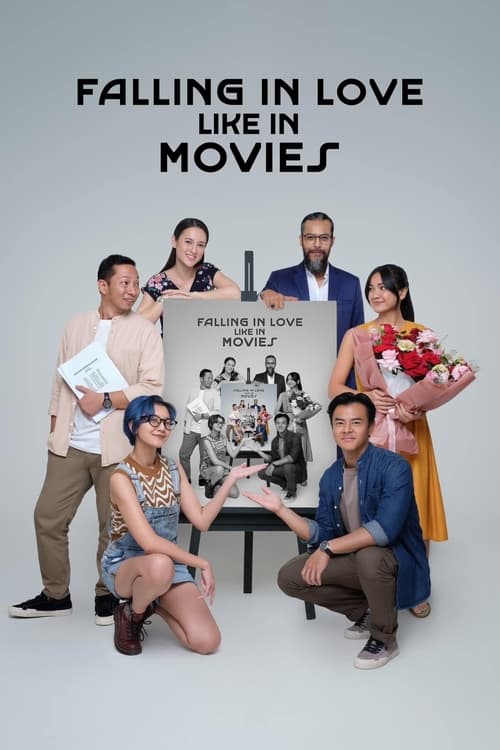
Falling in Love Like in Movies
2023 · Yandy Laurens
For a date night when you want a romance with a brain, or a solo evening when you want to laugh and then get quietly wrecked. Comforting in shape, surprising in depth.
What it's about
Bagus, a screenwriter, reunites with Hana, his high-school friend and old crush, who is still grieving her late husband. He decides to win her over the only way he knows how: by pitching a black-and-white romance about his own courtship of her — and the film you're watching keeps folding into the film he's writing, scenes revised before your eyes as he begins to actually understand her grief.
The experience
Witty and inventive at first — fourth-wall breaks, arguments with producers, scenes rewritten mid-stream — and then unexpectedly moving, as the games give way to a real meditation on mourning and how long love is supposed to wait. It's the rare clever film that gets warmer the cleverer it gets.
Performances
Ringgo Agus Rahman and Nirina Zubir carry the film's tricky tonal balance — he all hopeful scheming, she holding a grief the script keeps having to make room for.
The craft
Yandy Laurens shoots in elegant monochrome and builds the whole film as a story arguing with its own storyteller — every structural trick serves the question of whether life should imitate the movies at all. The screenplay's nested revisions are precision-engineered but never cold. A film about filmmaking that plays like a love letter.
Why it matters
It swept Indonesia's Citra Awards and established Laurens as one of the most formally playful new voices in Southeast Asian cinema.
A screenwriter pitches a black-and-white romance about his own real-life attempt to court a widowed high-school friend — and the film we're watching keeps folding into the film he's writing, scenes revised before our eyes as his understanding of her grief deepens. Yandy Laurens, who cut his teeth in Indonesian television and short-form work, emerged here as one of the most formally playful voices in Southeast Asian cinema, and the film swept Indonesia's Citra Awards. The metafiction is Kaufman-adjacent but never cold: every structural game — the monochrome frame, the interruptions, the arguments with producers about how love stories are supposed to end — serves a tender inquiry into whether life should imitate movies at all, or whether mourning has its own unfilmable tempo. Ringgo Agus Rahman and Nirina Zubir play the leads with a lived-in wariness that keeps sentimentality at bay. Its central question is disarmingly practical: what does it mean to write a happy ending for someone who hasn't finished grieving the last one?
Reception
A word-of-mouth darling on release in late 2023, it was fully canonized a year later when it swept the 2024 Festival Film Indonesia with seven Citra Awards — including Best Picture, Best Original Screenplay, and all four acting prizes — going from indie-flavoured rom-com to instant modern Indonesian classic.
How Falling in Love Like in Movies was received, from release to now →
Influences: the films it descends from and the films it influenced
- 8½ (1963) — Establishes the blocked-creator film where imagined, remembered, and real scenes interleave seamlessly, the template for diegetic slippage between the movie being made and the life around its maker.
- Persona (1966) — Its severe monochrome and the literal burning/rupturing of the film strip pioneer the diegetic-interruption device in which the medium announces its own artifice mid-scene.
- Day for Night (1973) — The affectionate procedural that cuts between a fiction and the crew manufacturing it — the load-bearing film-within-a-film architecture.
- Providence (1977) — A dying novelist drafts and re-drafts fiction peopled by his own family, staging recursive-revision in real time as living relatives bleed into the invented scenes.
- Annie Hall (1977) — Direct address plus the retroactive re-staging of a failed romance — the narrator literally rewrites a scene to get the ending he wanted.
- The Purple Rose of Cairo (1985) — A monochrome film-within-a-film whose character steps off the screen, dramatizing life-imitating-art and the yearning to author a happier ending than reality allows.
- Adaptation (2002) — The Kaufman screenplay that depicts its own agonized writing, turning recursive-revision into structure — the direct Charlie Kaufman debt named in the facets.
- Eternal Sunshine of the Spotless Mind (2004) — Reconstructs a lost love through collapsing, nonlinear memory-spaces, modeling grief-driven revision of a relationship's narrative.
- Synecdoche, New York (2008) — Recursive theater-within-life in which the artwork swallows and mirrors its maker's mourning, pushing life-imitating-art into infinite regress.
- Aftersun (2022) — Processes grief by re-watching diegetic camcorder footage, letting the recorded image interrupt and puncture the present — diegetic-interruption in service of mourning.
- Sore: A Wife from the Future (2025) — Perfects Laurens's dialogue-driven, self-aware romantic craft where feeling outranks plot mechanics — the toolkit Sore applies to a time-loop conceit.
- Reprise (2006) — Uses conditional voice-over to narrate alternate futures for its writer-characters, rewriting outcomes in the same breath as it depicts them.
- Stranger Than Fiction (2006) — A man discovers his life is being authored and the plot pivots on choosing a happy versus tragic ending — 'writing a happy ending' made literal mechanism.
- Frances Ha (2012) — Contemporary black-and-white shot for intimacy rather than nostalgia, paired with an unglamorous, lived-in performance register.
- A Ghost Story (2017) — Renders widowhood and mourning through a single spare formal conceit and elongated duration rather than dialogue or plot.
- The Souvenir (2019) — An autobiographical filmmaker reconstructs a lost love through restrained, observational performance, making art directly out of the act of mourning.
Similar films
- Sore: A Wife from the Future (2025) — same viewing thread
- Fallen Leaves (2023) — same viewing thread
- The Love That Remains (2025) — same viewing thread
- Lost in Starlight (2025) — same viewing thread
- We Live in Time (2024) — often watched together
- All We Imagine as Light (2024) — often watched together
- Even If This Love Disappears Tonight (2025) — shared sensibility
- Past Lives (2023) — shared sensibility
All the films related to Falling in Love Like in Movies →
Watch it with: curated runs of related films
- Love Among the Lonely — Watch these when you want love written for grown-ups — drifting, grieving, self-destructing people who find or keep each other with no fanfare — and want to feel a deadpan Helsinki karaoke bar and a warm Jakarta romance answer each other.