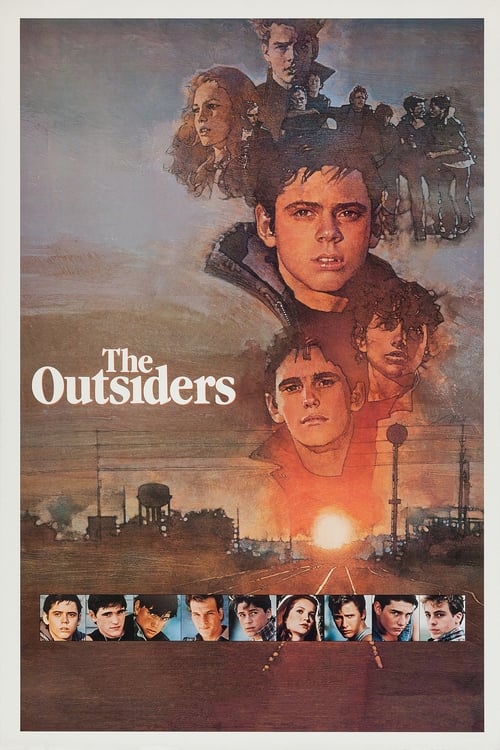
The Outsiders
1983 · Francis Ford Coppola
Megalopolis is the decade's great folly narrative: self-funded with $120M of wine money, chaotic Cannes premiere, a pulled trailer with AI-fabricated critic quotes, on-set conduct allegations, and a defiant "I don't care" tour. The conversation is about the mythology of the last mogul-auteur.
For when you need to feel something — a nostalgic, big-hearted night, whether you're revisiting the book you loved in school or want a coming-of-age story that wears its heart entirely on its sleeve. Comfort viewing that still stings.
What it's about
In 1960s Tulsa, the working-class Greasers and the rich-kid Socs are locked in a class war that keeps spilling into violence. Ponyboy Curtis, a sensitive teenager raised by his brothers and his gang, gets caught in a deadly encounter with his friend Johnny, and the two go on the run. It's a story about loyalty, class, and how fast the world forces boys to grow up.
The experience
Openly romantic and emotionally huge — Coppola shoots teenage life like a grand old Hollywood epic, all golden sunsets and swelling feeling, so the friendships and losses hit with operatic force. It's earnest in a way that sneaks past your defenses and can absolutely make you cry.
Performances
The young cast is a time capsule of stars on the launch pad — C. Thomas Howell, Matt Dillon, Ralph Macchio, Patrick Swayze, Rob Lowe, Emilio Estevez, Tom Cruise, and Diane Lane — with Dillon's swagger and Macchio's wounded gentleness standing out.
The craft
Coppola deliberately styled a slim young-adult novel as a lush, classical Hollywood picture — painterly widescreen compositions, dramatic skies, and a sweeping romantic score that treats teenage grief as seriously as any epic. The gap between the modest story and the grand treatment is the whole point, and it looks gorgeous on a big screen.
Why it matters
It introduced an entire generation of 1980s stars in a single film and remains the definitive screen version of S. E. Hinton's beloved novel — a rite of passage passed down through classrooms and living rooms alike.
Snapshot
The Outsiders is Francis Ford Coppola's lush, deliberately operatic adaptation of S. E. Hinton's 1967 young-adult novel, a film that takes a slim, plainspoken book beloved by American schoolchildren and refracts it through the grand romantic grammar of classical Hollywood. Set in mid-1960s Tulsa, Oklahoma, it dramatizes the entrenched class war between the working-class "Greasers" and the affluent "Socs" (Socials) through the eyes of Ponyboy Curtis, a sensitive teenager whose loyalty to his brothers and his gang collides with violence, flight, and grief. The picture is best remembered today for two reasons that pull against each other: the astonishing concentration of young talent it assembled — C. Thomas Howell, Matt Dillon, Ralph Macchio, Patrick Swayze, Rob Lowe, Emilio Estevez, Tom Cruise, and Diane Lane, most at or near the start of major careers — and Coppola's decision to film a gritty story of juvenile delinquency in the saturated, sunset-drenched idiom of Gone with the Wind. It arrived at a low point in Coppola's fortunes, immediately after the commercial catastrophe of One from the Heart (1982), and it carried the additional novelty of having been instigated by a schoolteacher and her students. Critically divisive on release and modest in its initial reception, the film has since become a durable cult object and a foundational text in the mythology of 1980s American youth cinema.
Industry & production
The film's origin story is unusually well documented and genuinely charming. In 1980, Jo Ellen Misakian, a librarian at the Lone Star School near Fresno, California, organized her students to write to Coppola petitioning him to adapt The Outsiders, the novel they had been reading; the letter, with its accompanying student signatures, reached Coppola's office and caught his attention. Coppola's producer Fred Roos pursued the rights, and the project moved forward under the auspices of Coppola's American Zoetrope.
The timing was fraught. Coppola had just sunk himself and his studio into One from the Heart, an experimental, technologically ambitious musical whose costs ballooned and whose box-office failure was severe enough to threaten Zoetrope's solvency. The Outsiders — a comparatively contained literary adaptation with a built-in, school-age readership — represented in part a return to firmer commercial ground. Coppola and his collaborators shot the film on location in and around Tulsa, the city of Hinton's novel, in 1982. Hinton herself, a Tulsa native, was closely involved as a consultant and on-set presence and appears in a brief cameo as a nurse; she and Coppola formed a working rapport substantial enough that the two would immediately collaborate again. In one of the more remarkable production decisions of the era, Coppola shot a second Hinton adaptation, Rumble Fish, back-to-back with The Outsiders using overlapping cast and crew — a black-and-white, expressionist art film that functions as the stylistic shadow-twin to The Outsiders' Technicolor romanticism.
The screenplay is credited to Kathleen Knutsen Rowell, working closely from Hinton's text, with Coppola's uncredited shaping evident in the finished film's structure and tone. Warner Bros. distributed the picture, which opened in March 1983. Its most consequential legacy, in pure industry terms, was as a casting event: the ensemble Coppola assembled would, within a few years, populate the center of Hollywood's youth market, and the film is routinely cited as a launching pad for what the press would soon label the "Brat Pack."
Technology
The Outsiders is, in its theatrical form, a conventionally produced 35mm color feature, and its interest lies not in technical novelty but in the expressive deployment of established photochemical tools. Coppola and cinematographer Stephen H. Burum pursued a heightened, almost archaic color rendering meant to evoke the dye-saturated palette of 1950s Hollywood melodrama, and the film's "technology" is best understood as the conscious revival of an older studio aesthetic — painted skies, golden hour light, and a glossy, theatrical surface — rather than the pursuit of anything new.
The one genuinely significant technical episode in the film's history came later. In 2005, Coppola returned to the material and produced a substantially re-edited version, The Outsiders: The Complete Novel, restoring roughly twenty-odd minutes of footage and, notably, replacing much of the original orchestral score with period rock-and-roll and rhythm-and-blues recordings. The 2005 version's reconstruction — drawing on preserved elements to re-cut and re-score a film more than two decades after its release — is the most technologically and editorially noteworthy fact in the film's lifecycle, and it has complicated the historical record, since the work now exists in two materially different cuts with different running times, music, and emphases.
Technique
Cinematography
Stephen H. Burum's cinematography is the film's most discussed and most divisive element. Working in close concert with Coppola's conception, Burum photographed this story of poor teenagers in the visual language of grand romantic spectacle: amber and crimson sunsets, silhouetted figures against burning skies, and a warm, idealized glow that aestheticizes the Greasers' hardscrabble world. The reference points Coppola invoked belong to classical Hollywood — the sweeping, sentimental epic — and the imagery repeatedly pushes toward the painterly and the iconic rather than the documentary. The celebrated sunset that Johnny and Ponyboy watch from the abandoned church, the moment that prompts the recitation of Robert Frost, is the apotheosis of this approach: nature rendered as luminous artifice. To admirers, the style elevates an adolescent story into mythic register; to detractors, it overwhelms the material's plainness with kitsch. Either way, the look is the film's signature, and it stands in stark, deliberate contrast to the stark monochrome and tilted, smoke-filled expressionism Burum and Coppola pursued simultaneously in Rumble Fish.
Editing
The original 1983 cut, edited by Anne Goursaud, is notably compact — running only around ninety minutes — and the picture's early reception was shaped by a sense that the novel had been compressed, with certain characters and subplots thinned to keep the narrative moving toward its emotional climaxes. The editing favors the story's set-pieces — the fountain killing, the church fire, the rumble, the deaths — and the rhythm is built around these peaks. Coppola's 2005 re-edit was an explicit corrective to this compression: by reinstating excised footage, particularly material at the beginning and end and scenes fleshing out the brothers' relationships, The Complete Novel restores a fuller, more novelistic shape and alters the balance of the whole. The coexistence of the two cuts makes the editing one of the film's genuinely live critical questions rather than a settled fact.
Mise-en-scène / staging
Coppola stages the film as a series of charged tableaux organized around the sociology of its two gangs. The Greasers' world — the Curtis brothers' modest house, the drive-in, the lot, the corner store, the railyards — is dressed with period specificity but lit and composed for romantic effect, while the Socs are coded through cars, clothes, and the manicured spaces of privilege. The fountain where Johnny kills Bob, the burning country church, and the climactic rumble staged in rain and mud are the film's principal stages, each composed for maximum operatic impact. Costuming and physical type do heavy characterizing work: the Greasers' denim, leather, and pomaded hair against the Socs' clean-cut affluence, the casting of distinctly charismatic young actors so that the gang reads as a kind of romantic brotherhood. The recurring motif of the sunset, and of "staying gold," is woven into the staging as a visual refrain.
Sound
The original score is by Carmine Coppola, the director's father, who supplies a sweeping, lushly orchestral accompaniment entirely consistent with the film's classical-Hollywood ambitions — music that frequently underlines the romantic and tragic registers rather than the grit. The film's best-known musical element is the theme song "Stay Gold," composed by Carmine Coppola with lyrics by Dennis Lambert and performed by Stevie Wonder, which ties the film's central Frostian motif into a soaring pop ballad over the action. The 2005 re-edit significantly revised the soundtrack, swapping out much of the orchestral scoring for period recordings to ground the film more firmly in its early-1960s moment — a change that meaningfully alters the film's emotional texture and is among the most-debated aspects of the two-version legacy.
Performance
The performances are the film's enduring fascination, in part because of what their players would go on to become. Matt Dillon, already an established teen presence, gives the most fully realized turn as Dallas "Dally" Winston, the gang's hardened, doomed tough; his charisma anchors the film. C. Thomas Howell carries the picture as the sensitive narrator Ponyboy, and Ralph Macchio brings a fragile gentleness to Johnny, the abused boy whose conscience drives the tragedy. Patrick Swayze plays the eldest Curtis brother, Darrel, with watchful gravity; Rob Lowe is the warm middle brother Sodapop; Emilio Estevez and Tom Cruise round out the gang as Two-Bit and Steve; and Diane Lane provides the film's principal female role as Cherry Valance, the Soc girl who bridges the two worlds. The ensemble playing is youthful and earnest, occasionally raw, and pitched to match the film's heightened emotional key. The collective effect — a roster of soon-to-be stars caught at the threshold — gives the performances a documentary fascination that has only grown with hindsight.
Narrative & dramatic mode
The film's dramatic mode is romantic tragedy filtered through the coming-of-age tale. Narrated retrospectively by Ponyboy (the film frames itself as his written account), it follows a classic structure of innocence, transgression, flight, and loss. The inciting violence — Johnny's killing of the Soc Bob to save Ponyboy from drowning in a fountain — propels the two boys into hiding in a rural church, where the idyll of their exile is shattered first by the heroism of rescuing children from a fire and then by Johnny's fatal injury and death, which in turn precipitates Dally's self-destructive end at the hands of the police. The mode is elegiac and sentimental in the serious sense: the film is preoccupied with the impossibility of preserving innocence, a theme it states almost explicitly through Johnny's dying invocation of Robert Frost's poem "Nothing Gold Can Stay" and the refrain "Stay gold, Ponyboy." The narration's literary self-consciousness — a boy turning his grief into writing — frames the whole as an act of memory and mourning rather than straightforward action drama.
Genre & cycle
The Outsiders sits at the intersection of several traditions. It is a juvenile-delinquency picture in a lineage running back to Rebel Without a Cause (1955) and The Wild One (1953) — films Coppola's evokes both in subject and in its romanticization of troubled, sensitive young men — and it is simultaneously a literary coming-of-age adaptation. Within its own moment, it belongs to and helped catalyze the wave of 1980s teen-centered films that would define the decade's youth market, even as its operatic style sets it apart from the more naturalistic or comedic teen pictures that followed. Its paired production with Rumble Fish situates both films within Coppola's personal cycle of Hinton adaptations, two halves of a diptych exploring adolescent masculinity in contrasting visual keys. The gang-brotherhood structure and the class-war framing also link it to a broader American tradition of stories about youth tribes divided by money and territory, of which West Side Story is the most obvious antecedent.
Authorship & method
The Outsiders is a characteristic Coppola project in its ambition and its risk-taking, even as it is often regarded as minor within his canon. Coppola's method here was deliberately to apply a "big" classical style to "small," intimate material — to treat a young-adult novel with the visual and musical grandeur of an epic — and that gamble defines the film's authorship. His decision to shoot two films back-to-back, to involve the novelist directly, and later to return and re-cut the picture wholesale all reflect his lifelong tendency to treat films as living, revisable works and to pursue auteurist control even on commissioned material.
The key collaborators give the film its texture. Cinematographer Stephen H. Burum, on a major early feature in a long career that would include further work with Coppola and Brian De Palma, executed the romantic visual scheme. Carmine Coppola's orchestral score and the Stevie Wonder theme set the original emotional tone, a genuine family collaboration of the kind that recurs across Coppola's work. Editor Anne Goursaud shaped the compact theatrical version. Screenwriter Kathleen Knutsen Rowell adapted Hinton's text, and Hinton's own intimate involvement — as consultant, on-set guide, and cameo player — makes her something close to a co-author of the film's fidelity to its source.
Movement / national cinema
The film is a product of American studio filmmaking at a transitional moment, and its most meaningful "movement" affiliation is to the New Hollywood generation of which Coppola was a leading figure. By 1983 that generation's heyday was passing, and The Outsiders can be read as a New Hollywood auteur applying his prestige and craft to a youth-market property — a meeting of 1970s authorship with the emerging 1980s teen-film economy. It is wholly an American national cinema artifact, rooted in a specifically American landscape (the class geography of a midwestern city) and an American literary tradition of adolescent narration, and its evocation of classical Hollywood style is itself a gesture of national-cinematic memory.
Era / period
The film depicts the mid-1960s — the period of Hinton's novel, written when she was a teenager herself — and its production design, cars, costume, and music aim to reconstruct that moment, though the original orchestral scoring pulls against strict period realism in a way the 2005 re-score sought to correct. As a 1983 release, it is equally an artifact of the early-1980s American film industry: made in the wake of Coppola's financial crisis, shaped by the rising commercial importance of the teen audience, and standing at the threshold of the decade's youth-movie boom. The class anxieties it dramatizes — the resentment of the have-nots toward the privileged, the sense of a social order rigged against working-class kids — are framed as timeless adolescent experience but resonate across both its 1960s setting and its 1980s production context.
Themes
At its center the film is about the loss of innocence and the impossibility of "staying gold" — the Frostian conviction that the most precious things are the most transient, made literal in the deaths of Johnny and Dally and in Ponyboy's passage from boyhood into grieving knowledge. Class division is the film's social engine: the rigid, violent boundary between Greasers and Socs, and the recognition (voiced through Cherry's friendship with Ponyboy and the discovery that the privileged Socs have troubles of their own) that the line between the groups is both brutally real and partly illusory. Brotherhood and chosen family are central — the Curtis brothers holding together after their parents' death, the gang as a surrogate kinship — as is a tender, unusually unguarded vision of adolescent male sensitivity, in which boys read poetry, watch sunsets, and weep. Running beneath all of it is mortality and its premature arrival in young lives, and the redemptive idea that experience, however devastating, can be transmuted into art through the act of writing that frames the story.
Reception, canon & influence
On its 1983 release, The Outsiders met a mixed critical response. Reviewers were divided over Coppola's operatic treatment: some admired the sincerity and visual grandeur he brought to the material, while others found the heightened style overwrought and at odds with the novel's plainspoken intimacy, and a number felt the compressed theatrical cut shortchanged Hinton's characters. Commercially it performed respectably without becoming a major hit, and within Coppola's body of work it was generally received as a lesser, if interesting, effort. (Precise contemporary box-office and award details should be confirmed against the record rather than asserted here.)
The influences on the film run backward to the juvenile-delinquency dramas of the 1950s — Rebel Without a Cause above all — and to the classical Hollywood romantic epic whose color and sweep Coppola consciously emulated; its literary spine is Hinton's novel and, explicitly, Robert Frost's "Nothing Gold Can Stay." Its influence forward is considerable and somewhat paradoxical. As a launching pad it is hard to overstate: the film gathered, in a single ensemble, a remarkable share of the actors who would define 1980s and 1990s Hollywood youth and stardom, and it is routinely invoked in the origin narrative of the "Brat Pack." Among young readers and viewers it became a beloved companion piece to a novel already fixed in American school curricula, giving it a durable second life in classrooms and a strong cult following. Its paired production with Rumble Fish established an unusual model of the auteur diptych. And Coppola's 2005 reconstruction, The Outsiders: The Complete Novel, secured the film a renewed critical conversation and a more generous reassessment, cementing its place — initially uncertain — within both the Coppola canon and the larger history of the American teen film.
A Deleuzian reading
Two boys sit in the doorway of an abandoned country church at first light, watching the sky go gray, then gold, then a burning amber no Tulsa morning ever actually wore.
The full Deleuzian reading of The Outsiders →
Reception
Critics in 1983 shrugged it off as overwrought, minor Coppola after the Apocalypse Now era; it's since been embraced as a generational touchstone, with that cast now looking like one of the most stacked 'before they were famous' ensembles ever assembled.
How The Outsiders was received, from release to now →
Influences: the films it descends from and the films it influenced
- Rebel Without a Cause (1955) — Ray's CinemaScope-color treatment of sensitive juvenile delinquents as tragic figures — the wounded-boy close-up and color-coded teen melodrama — is the template Coppola consciously enlarges to operatic scale.
- American Graffiti (1973) — Coppola, Graffiti's protector-producer, returns to the same 1950s-teen Americana with cars-as-stage iconography and an ensemble of soon-famous unknowns, directly downstream of Graffiti's casting and milieu.
- The Virgin Suicides (1999) — Inherits the Coppola idiom of hazy golden-hour nostalgia, retrospective collective narration, and a literary 'lost innocence' frame around doomed adolescents — the lineage passed to the next-generation auteur.
- East of Eden (1955) — Kazan's lush color adaptation of a literary novel built around a brooding, inarticulate young outsider (and Dean's Method tenderness) models the prestige-melodrama register Coppola applies to Hinton.
- Splendor in the Grass (1961) — Supplies the doomed-young-love-and-lost-innocence structure capped by a recited poem (Wordsworth), the exact framing device Coppola adopts with Frost's 'Nothing Gold Can Stay.'
- Gone with the Wind (1939) — The saturated three-strip Technicolor sunset silhouette and romantic-epic sweep is the classical 'big' visual grammar Coppola deliberately grafts onto 'small' intimate material.
- West Side Story (1961) — Establishes the operatic, balletic staging of warring street gangs as romantic tragedy — the choreographed rumble and stylized tableau Coppola echoes in his Greasers-vs-Socs set pieces.
- Days of Heaven (1978) — Almendros's magic-hour photography — figures backlit against amber skies — is the golden-hour idiom Stephen Burum reaches for in the sunset and church-fire imagery.
- The Night of the Hunter (1955) — Its expressionist, fairy-tale tableaux of imperiled children supply the heightened pictorial mode Burum and Coppola push toward in the film's painterly compositions.
- Tex (1982) — The immediately preceding S.E. Hinton adaptation, also starring Matt Dillon, that proved her Tulsa juvenile-outsider material could anchor a sincere youth feature — the bridge Coppola crosses into the Hinton diptych.
- Rumble Fish (1983) — The shot-back-to-back companion Hinton adaptation — same author, same Burum cinematographer, same Tulsa milieu — inverting this film's warm color into stylized monochrome as the diptych's other half.
- The Godfather (1972) — Carries the Coppola family-collaboration method — Carmine Coppola's orchestral scoring and operatic, tableau-driven staging — that Coppola transplants onto teenage material here.
- The Untouchables (1987) — Extends Burum's painterly, classically-composed widescreen photography from this early feature into the De Palma partnership, carrying forward the same grand pictorial scheme.
- The Breakfast Club (1985) — Builds its star ensemble directly from this film's casting pool, inheriting the 'Brat Pack' template of treating a tight teen ensemble as serious dramatic protagonists.
- St. Elmo's Fire (1985) — Consolidates the Brat Pack as a marketable repertory company — Estevez, Lowe and company — first gathered in Coppola's ensemble, extending the youth-stardom launch model.
Similar films
- Stand by Me (1986) — influence & lineage
- Rumble Fish (1983) — influence & lineage
- The Godfather (1972) — influence & lineage
- My Own Private Idaho (1991) — influence & lineage
- The Breakfast Club (1985) — influence & lineage
- Boyz n the Hood (1991) — shared sensibility
- Easy Rider (1969) — shared sensibility
- Dazed and Confused (1993) — shared sensibility