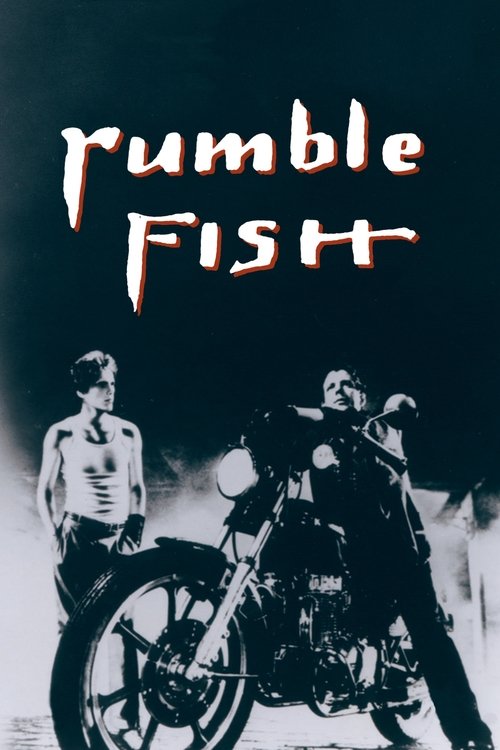
Rumble Fish
1983 · Francis Ford Coppola
Megalopolis is the decade's great folly narrative: self-funded with $120M of wine money, chaotic Cannes premiere, a pulled trailer with AI-fabricated critic quotes, on-set conduct allegations, and a defiant "I don't care" tour. The conversation is about the mythology of the last mogul-auteur.
For a late night when you want atmosphere over plot — something beautiful, melancholy, and a little strange to sink into, ideally in the dark with the sound up. More art-house reverie than Friday-night crowd-pleaser.
What it's about
In a smoky, dead-end Tulsa, a not-too-bright street tough named Rusty James dreams of reviving the gang wars his legendary older brother once ruled. Then the brother — a burnt-out, near-mythic figure known as the Motorcycle Boy — drifts back into town, and Rusty James has to reckon with the gap between the legend he worships and the exhausted man in front of him. It's a story about hero worship, brothers, and a kid chasing a past that never really existed.
The experience
Dreamlike and moody rather than plot-driven — clouds race in time-lapse, clocks tick everywhere, smoke drifts through every frame, and a restless percussion score keeps your pulse slightly elevated. It feels less like watching a teen delinquent story than being inside one kid's romantic, doomed head.
Performances
Matt Dillon gives Rusty James a swaggering, wounded puppy-dog energy, and Mickey Rourke is quietly mesmerizing as the Motorcycle Boy — soft-spoken, detached, carrying the weight of a legend he never asked for.
The craft
Coppola shot it as an expressionist black-and-white art film wearing a teen-movie jacket: distorted wide-angle streets, time-lapse skies bleeding between scenes, and one piercing use of color reserved for the Siamese fighting fish of the title. Stewart Copeland's clock-obsessed percussion score works like a second nervous system. Gorgeous on a big screen — this is a film you feel through your eyes and ears.
Why it matters
A commercial flop that became a cult touchstone, it's now prized as one of Coppola's boldest swings — proof of a studio-era master spending his capital on pure style — and a formative object for generations of visually ambitious filmmakers.
Snapshot
Shot back-to-back with The Outsiders in the summer of 1982, Rumble Fish is the more radical of Francis Ford Coppola's two S.E. Hinton adaptations — an expressionist, black-and-white art film delivered in a genre chassis of teen delinquency. Where The Outsiders traded in earnest melodrama, Rumble Fish pursues formal rupture: distorted wide-angle perspectives, time-lapse skies that bleed between scenes, a percussive Stewart Copeland score that functions as a second nervous system, and a selective deployment of color reserved exclusively for the Siamese fighting fish of the title. Coppola has described his intention in terms of making an experimental art film aimed at a young audience — something akin to what the French New Wave had accomplished for European youth cinema, but rooted in the mythologized Americana of Hinton's Tulsa, Oklahoma. The film failed commercially on release but accrued a substantial critical and cult reputation over the following decades, now regarded as one of the period's most formally adventurous studio-adjacent productions.
Industry & Production
By 1983, Coppola's Zoetrope Studios had collapsed financially under the catastrophic losses of One from the Heart (1982), and Rumble Fish was produced under an arrangement with Universal Pictures that gave Coppola creative latitude in exchange for modest budgets. The two Hinton films were packaged together; The Outsiders was conceived as the commercial venture intended to subsidize Rumble Fish, the more personal experiment. Coppola brought much of the same Tulsa crew and several actors across both productions — Matt Dillon, Diane Lane, and Emilio Estevez appear in both — and the rapid double-production schedule meant Rumble Fish was shot under time and resource constraints that may paradoxically have sharpened its formal economy.
S.E. Hinton, who had befriended Coppola during The Outsiders, co-wrote the screenplay. She also appears briefly on screen, as she had in the earlier film. The novel, published in 1975, was Hinton's most elliptical and formally unconventional YA work, organized around a near-mythological older brother figure and narrated from a perspective of bewildered inadequacy — qualities that attracted Coppola's interest in transposing its mood rather than its plot mechanics.
The casting assembled an unusual concentration of talent on the cusp of major careers. Matt Dillon, already the closest thing teen cinema had to a star following Tex and The Outsiders, plays Rusty James. Mickey Rourke, at the height of his pre-9½ Weeks prestige, plays the Motorcycle Boy with an eerie, otherworldly stillness. Diane Lane plays Patty, Rusty James's girlfriend. Dennis Hopper — whose own career was in one of its periodic troughs — plays their alcoholic father with considerable restraint. Nicolas Cage (who had already changed his surname from Coppola to avoid nepotism associations, his uncle being the director) plays Smokey. Tom Waits appears in a small but atmospheric role as Benny, a pool hall owner. Laurence Fishburne, then still billed as Larry Fishburne following Apocalypse Now, has a supporting part.
Technology
The decision to shoot in black and white was grounded in the film's central conceit: the Motorcycle Boy is colorblind (and, the film gradually reveals, partially deaf), and the monochrome image is understood as the world filtered through his deficient perception. Cinematographer Stephen H. Burum — working with Coppola for the first time — executed this concept in high-contrast, expressionistically lit 35mm, using wide-angle lenses that warp perspective and compress space in ways that externalize the psychological instability of Rusty James's point of view.
The selective color of the rumble fish is achieved through relatively conventional optical printing techniques of the period rather than digital compositing (which did not exist in its contemporary form). The effect, isolating the vivid iridescent reds and blues of the Siamese fighting fish against a gray world, is both narratively legible — these are the only things the Motorcycle Boy truly sees, the only life-force worth attending to — and formally striking. The fish become a chromatic anomaly that the eye goes to immediately, a kind of punctuation in the visual grammar of the film.
Time-lapse photography of clouds racing across the Tulsa sky appears as a repeated structural device — clouds boil and streak through scenes, compressing duration and creating a visual rhetoric of time's acceleration and indifference. The technique has been linked to influences from Akira Kurosawa's cloud photography, though the specific genealogy of this choice within Coppola's thinking is not extensively documented.
Technique
Cinematography
Burum's work here is the fulcrum around which the film's ambitions turn. The high-contrast black-and-white draws heavily on German Expressionist photography — the deep shadows, the raked light, the distorted perspectives that Franz Kafka or Fritz Lang might recognize — while the restless, mobile camera (craning, tracking, sometimes lurching) situates the visual language somewhere between Expressionist stasis and New Wave restlessness. Wide-angle lenses throughout create a subtle but persistent spatial wrongness: faces loom into close-up, backgrounds recede unnaturally, the world never quite sits still in its geometry. The overall effect is less naturalist documentation than visual argument — this is a film about a young man who cannot see clearly, filmed so that we cannot see clearly either.
Editing
Barry Malkin, a longtime Coppola collaborator, edited the film. The cutting is associative rather than strictly continuity-driven: scene transitions are sudden, time is compressed or elided without announcement, and the film does not bother to explain temporal gaps that a more conventional narrative would chart. This fragmentary quality mirrors Rusty James's addled consciousness — he is, by the film's own admission, not the sharpest observer of his own life — and aligns the editing's rhythm with Copeland's score, which functions percussively rather than melodically.
Mise-en-scène / Staging
Coppola stages Rumble Fish against Tulsa locations — industrial districts, back alleys, pool halls, a pet store — that feel both specific and archetypal. The setting is nominally contemporary but the film avoids period markers carefully, producing a timeless quality more akin to myth than sociology. Clock imagery is pervasive: large clocks appear in the frame repeatedly, sometimes ostentatiously, anchoring the film's obsession with time's passage and the impossibility of recapturing the past. The gang-fight choreography deliberately echoes stylized theatrical movement rather than realistic street violence; Coppola frames brawls with the geometry of ballet, an aesthetic choice that distances the film from the gritty realism that the genre nominally invites.
The Motorcycle Boy is staged throughout at a slight remove — he is rarely fully integrated into the social geometry of a scene but positioned at its edge, watching, a figure who has already departed even when present. Rourke's stillness makes this work; he occupies space differently than the other actors.
Sound
Stewart Copeland's score is one of the most distinctive of the decade. Copeland — then the drummer of The Police, working here on one of his earliest major film scores — built the soundtrack around percussion and industrial textures, with skins, metal, and rhythm displacing the melodic orchestrations that would be conventional in genre films of this kind. The score has a tribal, urgent quality that creates tension without sentimentality and keeps the film's emotional register unstable and slightly threatening. It functions not as mood underscoring but as an additional argument running alongside the images — sometimes in ironic counterpoint, sometimes in direct amplification.
Diegetic sound is also deployed with care: the Motorcycle Boy's partial deafness is made palpable at moments through sudden audio attenuation, pulling the soundtrack into a muffled, distant register that is then abruptly restored.
Performance
Rourke's performance as the Motorcycle Boy is the film's great achievement in acting — a man who has been so mythologized by others that he has become a kind of ghost inhabiting his own legend. He speaks in a flat, almost cadenced monotone and barely reacts to the world around him, yet the performance is not empty but densely interior. Dillon, asked to carry the film's narrative consciousness in a less glamorous role, delivers an honest and somewhat overlooked performance as a boy defined by what he cannot become. Hopper's alcoholic father is underplayed in ways that feel true and difficult. The younger actors — Cage, Lane, Fishburne — are variable in their integration with the film's heightened stylistic world, though Cage in particular plays his character's social ambition with a coiled alertness that prefigures later career notes.
Narrative & Dramatic Mode
The film's narrative is deceptively simple: Rusty James drifts through Tulsa's remnant gang culture, gets into fights, loses his girlfriend, and orbits the gravitational field of his older brother until the Motorcycle Boy's attempt to free the rumble fish from a pet store and carry them to the river ends in his death at a police officer's hands. What gives the film its dramatic weight is less plot than mode: it operates as elegy from the beginning, mourning something — a way of life, a fraternal ideal, a kind of romantic possibility — that has already passed. The Motorcycle Boy has already been to California, already seen the Pacific, already found the horizon empty, and returned with nothing to offer except the myth of his absence. This is a film about the impossibility of mythology while inside it.
Genre & Cycle
Rumble Fish sits within the early-1980s cycle of teen films — The Outsiders, Tex, Bad Boys, and soon The Breakfast Club and Brat Pack cinema — but it refuses that cycle's terms. It treats the delinquent youth genre as Godard treated the crime film: as a set of conventions to be absorbed, distorted, and made to carry a different philosophical payload. The film's relationship to genre is essentially ironic in the technical sense — it is aware of what the conventions expect and declines to satisfy those expectations while still working within their framework.
Authorship & Method
Coppola in this period was simultaneously one of the most commercially visible and most embattled directors in American cinema, and Rumble Fish represents the experimental, uncommercial pole of his practice. He has spoken of the film's inspiration in French New Wave cinema — Godard and Truffaut, particularly — as well as in the tradition of European art cinema more broadly. The decision to shoot in black and white, the use of expressionist stylization, the de-emphasis of conventional narrative satisfaction: all of these place Rumble Fish in a lineage that runs through Bergman, Antonioni, and the nouvelle vague rather than through classical Hollywood.
Stephen H. Burum's contribution as cinematographer was formative; his capacity to execute Coppola's expressionist aspirations within production realities is central to the film's existence as it is. Burum subsequently became a major figure as Brian De Palma's regular cinematographer, shooting The Untouchables, Casualties of War, and Mission: Impossible, among others. Copeland's score was widely noted as a significant achievement in film composition outside the orchestral mainstream. S.E. Hinton's co-authorship of the screenplay means the film retains a fidelity to the novel's texture and interior logic that pure adaptation might have lost.
Movement / National Cinema
Rumble Fish is American independent cinema of the early 1980s at its most European in aspiration — a film that uses American genre materials, American locations, and American studio infrastructure to pursue an aesthetic project more legible in the context of the French New Wave or German New Cinema than of Hollywood genre production. It belongs to the broader phenomenon of post-Easy Rider auteurist studio filmmaking, now in its last phase before the blockbuster hegemony of the mid-1980s fully closed off such experiments within the studio system.
Era / Period
The film belongs to the early 1980s moment when the consequences of New Hollywood's collapse were still being negotiated — when directors of Coppola's generation retained enough residual authority to pursue formal experiment within studio-adjacent arrangements, but were operating under increasing financial and commercial pressure. Rumble Fish is in some sense a last gasp of that negotiation: a film that could not have been made a few years later as the decade's commercial consolidation tightened.
Themes
The film's central thematic concern is the impossibility of living up to a myth — and more broadly, the way myth distorts the young. Rusty James cannot see himself except through the legend of his brother; the Motorcycle Boy cannot see himself except through the mythology others have made of him. Both are trapped, like the rumble fish in the pet store, in an enclosed world where fighting serves only to confirm the walls. The rumble fish fight their own reflections — a figure for selves so unmoored that even the self appears as an enemy.
Time and its irreversibility pervade the film: the clocks, the time-lapse clouds, the sense that the gang culture Rusty James wants to revive has already ended, that he is performing an elegy for a world that has already passed. Freedom and entrapment, colorblindness as both literal condition and metaphor for cultural myopia, the corrosive romance of masculine legend, the failure of fathers — these run through the film without the neat resolution that genre convention would provide.
Reception, Canon & Influence
Influences on the film: The debts are multiple and worn openly. German Expressionism — the visual language of Nosferatu, The Cabinet of Dr. Caligari, M — is apparent in the high-contrast photography, the distorted spaces, and the atmospheric use of shadow. The French New Wave, especially Godard, informs the fragmentary editing, the associative rather than causal narrative logic, and the treatment of genre as raw material for formal experiment. Kurosawa's cloud photography is a cited reference for the time-lapse sequences. Albert Camus's existentialism — the absurdist hero, the man defined by what he cannot choose — hovers over the Motorcycle Boy. The film also draws on the silent cinema tradition: Coppola has discussed the influence of purely visual storytelling on his compositional approach here.
Critical reception: On release in October 1983, Rumble Fish received a divided critical response. Reviewers who responded to its formal ambition — its obvious seriousness of purpose and its willingness to pursue an art-cinema register in disregard of commercial norms — praised it as one of Coppola's most personal works. Others found it pretentious, its style unearned, its narrative too thin to bear the weight of its formal apparatus. It performed poorly at the box office, confirming the commercial logic that had assigned it the secondary role in the double Hinton production.
The film appeared in competition at the Venice Film Festival, where it received attention without the decisive breakthrough recognition that might have stabilized its critical standing. Over the following decade it developed a cult following, particularly among viewers who encountered it on home video — a format that suited its compressed, intense visual texture.
Legacy: Rumble Fish has been increasingly recognized as a significant formal experiment within American cinema, a film that demonstrates what the youth genre could bear when subjected to genuine formal intelligence. Its influence is difficult to trace with precision — it did not spawn immediate imitators — but it can be felt in the arthouse teen films of the late 1980s and 1990s: Gus Van Sant's Drugstore Cowboy and My Own Private Idaho share its willingness to use formal distortion as a register of damaged consciousness, and its approach to the delinquent genre as a vehicle for existentialist themes anticipates several strands of independent American filmmaking. Stewart Copeland's score influenced subsequent approaches to film percussion and non-orchestral scoring. Mickey Rourke's performance has been revisited repeatedly in discussions of the actor's brief apex period. The rumble fish themselves — colored against a black-and-white world — have become one of the decade's most frequently reproduced single visual ideas.
A Deleuzian reading
Start with the fish.
The full Deleuzian reading of Rumble Fish →
Reception
Booed at the New York Film Festival and dumped by Universal in 1983, it barely made a dent at the box office — but decades on it's been reappraised as one of Coppola's most personal films, complete with a Criterion edition and a devoted cult.
How Rumble Fish was received, from release to now →
Influences: the films it descends from and the films it influenced
- M (1931) — Burum's high-contrast chiaroscuro directly inherits Lang's Expressionist shadow-architecture — raked light, pooled darkness, and spatial distortion used as moral and psychological geography rather than neutral staging.
- The 400 Blows (1959) — Establishes the formal template for deploying teen delinquency as vehicle for cinematic experimentation rather than genre sentiment; the alienated-adolescent POV as license for stylistic rupture rather than melodramatic resolution.
- Breathless (1960) — Malkin's associative editing — cutting across temporal gaps without bridging shots — adopts Godard's jump-cut grammar of collapsing narrative time, a New Wave inheritance Coppola explicitly cited as the film's formal ambition.
- Wild Strawberries (1957) — Deploys clock imagery as expressive vehicle for time-anxiety and the impossibility of return; Rumble Fish's recurring clock-face motif and elegy mode for vanished experience share this Bergmanian formal vocabulary directly.
- Rashomon (1950) — Time-lapse cloud photography deployed between scenes as a structural atmospheric device; the dossier directly links this technique to Kurosawa's cloud-photography work as the source Coppola drew on for the recurring time-lapse sky sequences.
- Rebel Without a Cause (1955) — Supplies the genre vocabulary — sensitive male protagonist, fatal surrogate-sibling bond, failed paternal figure — that Rumble Fish consciously mythologizes and formally distorts through Expressionist wide-angle cinematography.
- Shadows (1958) — High-contrast black-and-white street photography paired with performance centered on interior psychological withholding rather than emotive display, directly prefiguring Mickey Rourke's Motorcycle Boy stillness.
- Mean Streets (1973) — Establishes the grammar of treating street-gang youth culture as mythic material through diegetically integrated popular music and wide-angle photography of claustrophobic male spaces, which Rumble Fish absorbs and formalizes into pure Expressionism.
- The Warriors (1979) — Pushes gang life fully into expressionist abstraction — hard-sourced smoke-and-shadow rumbles staged as ritual, Stewart Copeland's percussion score keeping time as a metronome for the cutting.
- Stranger Than Paradise (1984) — Extends the black-and-white associative-ellipsis grammar — unexplained temporal gaps, minimal camera movement, refusal of continuity bridging — into a sustained feature strategy, treating Rumble Fish's formal ruptures as a baseline rather than a departure.
- Drugstore Cowboy (1989) — Adopts time-lapse photography as a structural device within an outlaw-youth narrative, and uses associative editing that compresses duration without melodramatic bridging in ways that trace directly to the Coppola/Malkin ellipsis model.
- Pi (1998) — High-contrast black-and-white cinematography as psychological externalization of a disturbed male protagonist's perception, paired with a percussive electronic score used as neurological pressure rather than emotional illustration — inheriting Rumble Fish's dual strategy of image-distortion and industrial sound.
- Eraserhead (1977) — Deploys percussive industrial sound design — mechanical rhythm, ambient drone, non-musical noise — as direct psychological externalization of a disturbed male protagonist's inner state, working from identical logic to Stewart Copeland's score.
- Raging Bull (1980) — Michael Chapman's high-contrast black-and-white with selective color punctuation (blood on the canvas), combined with fight choreography rendered through wide-angle lens distortion as expressionist spectacle — a near-exact formal parallel reached from different generic material.
- One from the Heart (1982) — Tom Waits's score blurs diegetic and non-diegetic registers, integrating musical performance into narrative fabric; Copeland's percussion in Rumble Fish applies the same logic, making sound both environmental atmosphere and subjective psychological pressure.
- The Outsiders (1983) — Shot back-to-back with overlapping cast, crew, and source author; the deliberate formal divergence — earnest melodrama vs. Expressionist rupture — constitutes Rumble Fish's identity as the experimental negative of The Outsiders, each defined by what the other chose not to do.
- Four Days in September (1997) — Showcases Stewart Copeland's percussive, ostinato-driven scoring method — the same rhythmic, propulsive underscoring he applies to Barreto's mounting tension.
Similar films
- The Outsiders (1983) — influence & lineage
- Raging Bull (1980) — influence & lineage
- The Godfather (1972) — shared sensibility
- Nickel Boys (2024) — shared sensibility
- GoodFellas (1990) — shared sensibility
- Boyz n the Hood (1991) — shared sensibility
- Scarface (1983) — shared sensibility
- Rocco and His Brothers (1960) — shared sensibility