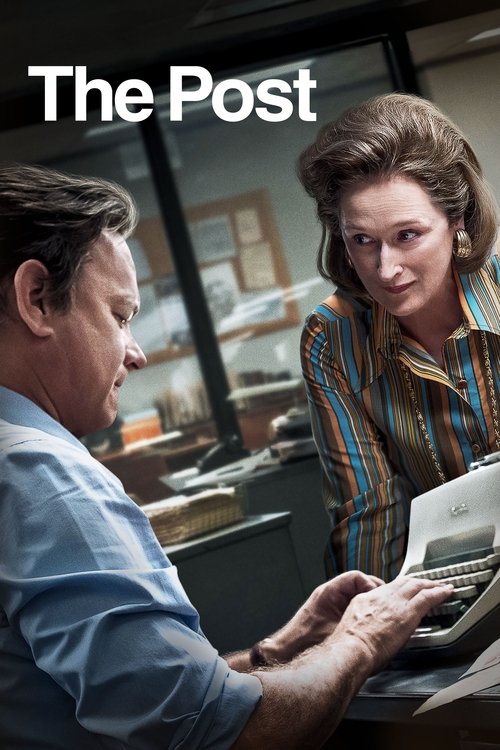
The Post
2017 · Steven Spielberg
For when you want a smart, grown-up crowd-pleaser that makes you believe institutions can still do the right thing — comfort food for people who like their comfort with stakes. Great when the news has you cynical and you need the antidote.
What it's about
Washington, 1971. A leaked government study lands in the hands of the press, proving that four presidents lied to the country about the Vietnam War — and the Washington Post has days to decide whether to print it. The paper's publisher, Katharine Graham, a widow who inherited the job and has spent her life deferring to the men around her, must choose between her lawyers, her board, and the Nixon administration on one side and her hard-charging editor Ben Bradlee on the other.
The experience
It moves like a thriller even though the weapons are phone calls, typesetting, and boardroom votes — a steady, clock-ticking build toward one decision. Watching Graham find her voice under that pressure is quietly stirring; you leave energized rather than lectured.
Performances
Meryl Streep plays Graham's hesitancy as a lifetime of habit, so every small assertion of will registers like a plot twist; Tom Hanks gives Bradlee a gruff, restless appetite that keeps the newsroom scenes crackling.
The craft
Spielberg shot the whole thing in under a year and the urgency shows in the best way: long roving takes through the newsroom, phones cradled between shoulders, the camera lingering lovingly on hot-lead type and thundering printing presses. The mechanics of physically making a newspaper become the film's action sequences.
Why it matters
Released in the thick of the 'fake news' era, it landed as a deliberate rallying cry for press freedom and earned a Best Picture nomination — a case of an old-fashioned newspaper picture arriving exactly when its argument felt urgent again.
Snapshot
The Post is Steven Spielberg's compact, urgent dramatization of the Washington Post's 1971 decision to publish the Pentagon Papers, the leaked Defense Department study that exposed decades of governmental deception about the Vietnam War. The film narrows an enormous historical episode to a few feverish days and to a single moral crucible: whether publisher Katharine Graham (Meryl Streep), newly thrust into command of a family-owned paper she never expected to run, will defy her lawyers, her board, and the Nixon administration to print. Tom Hanks plays executive editor Ben Bradlee as the engine of newsroom appetite, but the film's true center is Graham's passage from deference to authority. Made and released with unusual speed — conceived, shot, and delivered inside a single year — The Post is at once a classical newspaper procedural and a transparently topical intervention, produced as the American press entered open conflict with the Trump administration. It functions as both period reconstruction and present-tense argument about the First Amendment, and it carries Spielberg's late-career conviction that institutional courage is a collective, often reluctant, achievement.
Industry & production
The Post is notable above all for its velocity. The screenplay by Liz Hannah, a then-unproven writer whose spec script circulated in 2016, attracted Spielberg's attention, and the project moved into production with a speed extraordinary for a director of his stature. Spielberg shot the film in spring 2017 — interrupting and reordering his own slate, with Ready Player One in post-production — and Twentieth Century Fox (with Amblin, Participant Media, and DreamWorks among the producing entities) released it in December 2017 to qualify for that year's awards season. The compressed schedule was itself a statement: Spielberg has described feeling the story could not wait, given the political moment, and the production's tempo became part of its public meaning.
The casting of Streep and Hanks united, for the first time on screen, two of the most decorated American screen actors of their generation under Spielberg's direction — a marquee pairing that signaled the film's prestige ambitions and its appeal to a mid-budget adult audience increasingly rare in studio filmmaking. The film was a co-financing and distribution arrangement typical of late-2010s prestige drama, leaning on Participant Media's issue-oriented production identity. The Post received Academy Award nominations for Best Picture and Best Actress (Streep); its relatively modest awards haul, against high expectations, reflected a crowded field and perhaps the sense that the film's craftsmanship outpaced its surprise. Commercially it performed respectably for an adult drama, though specific grosses should be checked against the trade record rather than asserted here.
Technology
The Post was photographed on 35mm film by Janusz Kamiński, consistent with Spielberg's long-standing preference for a photochemical image and his resistance to fully digital capture during this period. The choice is integral to the film's texture: the grain, latitude, and color response of celluloid reinforce the early-1970s setting without recourse to heavy digital pastiche. Production design reconstructed the analog machinery of newspaper production as a near-fetishistic subject — Linotype hot-metal typesetting, the casting of lead slugs, the thunderous rotary presses, the pneumatic tubes and teletype. The film treats this industrial apparatus as a character, lingering on the physical transformation of words into print, an emphasis that doubles as elegy for a vanished material culture of journalism. Digital effects exist but are deliberately invisible, used for period set extension and crowd augmentation rather than spectacle. The film's technological argument is implicit: that the freedom of the press was once embodied in tons of churning machinery that could not be quietly switched off.
Technique
Cinematography
Kamiński's photography favors mobile, fluid camerawork — long Steadicam and dolly moves that thread through the newsroom and through Graham's domestic spaces — punctuated by the diffused, blooming backlight that has become his signature with Spielberg. Interiors are warm and lamplit; the Post newsroom is rendered as a humane, cluttered organism. Kamiński frequently stages conversations in deep space with foreground and background action, allowing Spielberg to choreograph ensembles in continuous takes. A recurring strategy isolates Graham within crowds of men — framing her at the edge or center of rooms full of dark suits — so that the composition itself dramatizes her singularity and her gradual claiming of authority. The visual register is classical and legible rather than showy, subordinating style to the clarity of the procedural and the reading of faces.
Editing
Cut by Spielberg's veteran collaborator Michael Kahn together with Sarah Broshar, the film sustains a propulsive forward drive across what is, dramatically, a series of phone calls, meetings, and deliberations. The editing generates suspense from the mundane — a courier ferrying documents, a decision relayed over crossed telephone lines, a deadline counting down — by intercutting parallel locations so that scattered participants seem to converge on a single irreversible moment. The climactic publish-or-not sequence, with Graham reaching her decision while multiple parties listen on the line, is a model of tension built entirely from talk and reaction. Kahn's long association with Spielberg shows in the unobtrusive rhythm, which never calls attention to itself yet keeps a fundamentally talky film taut.
Mise-en-scène / staging
Spielberg stages the film as a study in rooms and thresholds: boardrooms, the newsroom floor, Graham's elegant Georgetown home where Washington's powerful socialize across the lines they are supposed to police. The staging repeatedly contrasts the masculine, transactional world of editors and executives with the social and domestic spheres Graham inhabits, then collapses the distinction as she carries her decision into the male preserve. Spielberg uses blocking to track shifts in power — who stands, who sits, who is permitted to speak — and choreographs ensemble scenes so the stakes register physically. The newsroom is dressed and populated to feel lived-in and procedural, the period detail dense but rarely ostentatious.
Sound
John Williams's score is comparatively restrained, supplying momentum and gravity without the leitmotif grandeur of his adventure work; it underscores the procedural rhythm and swells at the moral turning points. The film's sound design foregrounds the mechanical clamor of the press hall and the percussive clatter of typewriters and teletype, building an acoustic environment in which journalism is audibly labor. Overlapping dialogue in the newsroom scenes creates a documentary density, while the hush of Graham's deliberations isolates her voice at the decisive moments.
Performance
Streep's Graham is the film's principal achievement: a performance of accumulating nerve, built from hesitation, half-finished sentences, and the gradual steadying of a woman accustomed to deferring. Streep externalizes an interior transformation, letting confidence arrive in increments rather than in a single epiphany, and the film's emotional architecture rests on this calibration. Hanks plays Bradlee with brusque, profane energy, a counterweight of certainty against Graham's doubt — though the role is more a fixed pole than an arc. The deep ensemble — including Bob Odenkirk as reporter Ben Bagdikian, Bruce Greenwood as Robert McNamara, Tracy Letts, Bradley Whitford, Sarah Paulson, and others — supplies the procedural texture, with several actors drawn from theatrical and prestige-television backgrounds whose verbal facility suits the dialogue-driven mode.
Narrative & dramatic mode
The film operates in the register of the moral-procedural drama: it externalizes ethical stakes through institutional process, deriving suspense from deliberation rather than physical action. Hannah and Josh Singer's screenplay braids two arcs — the journalistic chase for the documents and the corporate-personal crisis of Graham's authority, complicated by the paper's imminent public stock offering and her friendships with the very officials implicated. The structure is classically Aristotelian and tightly time-bound, with a clear escalation toward a single irrevocable choice and a coda that gestures forward to Watergate. The dramatic mode privileges talk, and the film makes a virtue of conversation as action; its tension is the tension of consequence weighed aloud. If there is a structural limitation, it is that the outcome is historically foreknown, so the film must generate stakes from character and conviction rather than uncertainty of result.
Genre & cycle
The Post belongs to the venerable American genre of the newspaper picture, and more specifically to the post-Watergate lineage of the journalism-as-democratic-heroism film. Its most obvious forebear is All the President's Men (1976), whose story it precedes and toward which it explicitly points in its final scene — The Post functions almost as a prequel, ending at the threshold of the Watergate break-in. It also sits within a 2010s cycle of journalism dramas reaffirming the press's civic function, most prominently Spotlight (2015), co-written by Singer, whose involvement links the two films directly. Within Spielberg's own filmography it joins a strand of historical-institutional dramas — Lincoln, Bridge of Spies, Munich — preoccupied with conscience operating inside systems of power and law.
Authorship & method
The Post is a near-pure expression of Spielberg's late style and of his repertory method. The film reunites the director's core craft collaborators: cinematographer Janusz Kamiński, who has shot every Spielberg feature since Schindler's List; composer John Williams, his decades-long musical partner; and editors Michael Kahn and Sarah Broshar. This continuity of personnel underwrites the film's classical fluency and accounts for its assured tempo despite the breakneck schedule. The screenplay marries Hannah's original conception with the journalistic-procedural expertise of Singer, fresh from Spotlight, producing a script attentive both to the mechanics of reporting and to the human drama of decision. Spielberg's authorial signature is legible in the film's humanism, its faith in institutions redeemed by individual courage, its warm chiaroscuro light, and its conviction that history turns on private moments of nerve. The film also reflects his willingness, in his seventies, to deploy his full machinery in service of a deliberately topical statement, treating filmmaking as a form of civic intervention.
Movement / national cinema
The film is a product of mainstream American studio filmmaking in its prestige-drama mode — the increasingly endangered middle-budget adult picture made by an established auteur within the Hollywood system. It does not belong to any avant-garde or national movement; rather it exemplifies the classical Hollywood tradition's persistence into the late 2010s, when such films were sustained largely by the reputations of figures like Spielberg, Streep, and Hanks. Its aesthetic lineage runs through the 1970s American cinema it depicts and emulates, particularly the sober, location-rooted realism of New Hollywood journalism films.
Era / period
The Post is doubly periodized. Diegetically it reconstructs 1971, immersing the viewer in the analog newsroom and the political atmosphere of the Nixon era and the late Vietnam War. Extra-diegetically it is unmistakably a film of 2017, made in direct response to a moment of acute conflict between the American presidency and the press, when phrases like "fake news" and "enemy of the people" had entered official rhetoric. Spielberg has been candid that the contemporary parallel motivated the film's urgency and accelerated production. The film thus reads its historical subject through the lens of the present, and its account of governmental hostility to the Fourth Estate is calibrated to resonate as commentary on the Trump administration without ever naming it.
Themes
The film's governing themes are press freedom and the constitutional check journalism provides on state power; its dramatic engine is the testing of that principle against personal cost, social loyalty, and financial risk. Equally central is a theme of female authority and self-actualization: Graham's arc from a publisher who inherited her position by familial accident — her husband's death, after her father had passed the company to him rather than to her — to a leader who exercises decisive power in a room of men who underestimate her. The film foregrounds the gendered condition of that authority, repeatedly showing Graham among male advisors who speak over and around her, and locates her heroism precisely in claiming a voice. Other threads include the corrupting intimacy between Washington's press and its powerful — Graham's friendship with McNamara, Bradlee's with the Kennedys — and the question of whether such proximity can survive the duty to publish. Underlying all of it is a Spielbergian faith that institutions are redeemed by individuals who, at the decisive moment, choose conscience over comfort.
Reception, canon & influence
Critical reception was broadly admiring, with particular praise for Streep's performance and for Spielberg's craftsmanship, even as some reviewers found the film's topicality heavy-handed and its outcome dramatically foreordained. It earned Academy Award nominations for Best Picture and Best Actress, and it was widely received as a polished, intelligent, and unmistakably timely piece of mainstream filmmaking — a film whose virtues were those of classical execution rather than formal risk.
Looking backward, The Post draws on a clear set of influences: most directly All the President's Men, whose newsroom realism and democratic mythology it inherits and toward which it deliberately points; the broader 1970s tradition of American political cinema; and, through Singer, the procedural rigor of Spotlight. The Pentagon Papers episode itself had been dramatized before in various forms, but Spielberg's film distinctively reframes it around Graham rather than around the leaker Daniel Ellsberg or the New York Times, which broke the story first and whose role the film acknowledges while centering the Post's subsequent, riskier decision.
Looking forward, the film's influence is best understood as part of a wave of late-2010s works reasserting the value of a free press during a period of perceived threat. Its forward legacy is less a matter of stylistic imitation than of its participation in a cultural argument; as a craft object it consolidated rather than redirected the journalism-film genre. Its most durable contribution may be its portrait of Katharine Graham, which, alongside her own celebrated memoir, helped fix her in public memory as a figure of institutional courage. Whether The Post endures in the canon at the level of its 1976 predecessor remains, given its recency, genuinely uncertain — the longer critical verdict is still forming.
A Deleuzian reading
The decision arrives as a voice on a crossed line.
The full Deleuzian reading of The Post →
Reception
Landed in December 2017 as an urgent, of-the-moment statement — a Best Picture nominee greeted as Spielberg's answer to the Trump era's press-freedom battles. Once the moment passed, it settled into 'solid mid-tier Spielberg' territory, more respected than loved.
How The Post was received, from release to now →
Influences: the films it descends from and the films it influenced
- All the President's Men (1976) — The Post functions as a deliberate prequel-companion, inheriting Pakula's deep-focus newsroom tableaux of reporters working phones, the docu-procedural fetish for the mechanics of verification, and literally ending on the Watergate break-in that opens Pakula's film.
- Citizen Kane (1941) — Source of the newspaper-picture's deep-space staging in ceilinged rooms, where Spielberg and Kaminski compose decisions in layered foreground-to-background depth and frame the press baron against cavernous interiors.
- His Girl Friday (1940) — Template for the overlapping, talked-over newsroom ensemble at screwball tempo that The Post revives in its clattering scenes of reporters and editors shouting across desks.
- Schindler's List (1993) — Origin point of the Kaminski-Spielberg method The Post runs on: hard diffused backlight blowing out windows into white, smoky chiaroscuro interiors, and reactive handheld coverage (deployed here in the linotype and pressroom sequences).
- Lincoln (2012) — Defines the late-Spielberg chamber-history mode The Post extends: dialogue-driven institutional procedure, Williams' restrained underscore, Kahn's patient cutting, and Kaminski's window-lit, lamp-pooled interiors where history turns on talk.
- Bridge of Spies (2015) — Immediate stylistic predecessor — a moral-procedural about an ordinary professional's principled stand, shot in cool diffused Kaminski light with the same staging through doorways and thresholds that marks Graham's deliberations.
- Spotlight (2015) — Direct method transfer through co-writer Josh Singer, who carried over the unglamorous, step-by-step reporting procedure and ensemble newsroom realism that give The Post its journalistic texture.
- Network (1976) — Model for the corporate-versus-newsroom institutional drama, supplying the boardroom and the IPO-pressure subplot as dramatic arena where business interests menace editorial independence.
- The Insider (1999) — Ancestor in dramatizing the legal-corporate jeopardy of publishing — the editorial conscience weighing institutional risk against the public's right to know, structured as a suspense procedural rather than an action plot.
- The Parallax View (1974) — Supplies the 1970s political-paranoia grammar — the lone investigator dwarfed by institutional architecture and conspiratorial unease — that The Post invokes nostalgically in its period texture.
- Kill the Messenger (2014) — Extends the post-Watergate procedural lineage — the newsroom weighing publication against state pressure — as the optimistic counterweight to this film's pessimism.
- The Report (2019) — Extends the same government-secrecy procedural: a dogged insider assembling a suppressed record against official obstruction, told through dense talk and document-driven suspense in the late-2010s press-and-power wave The Post helped crest.
- She Said (2022) — Most direct descendant — female-led journalism procedural centered on NYT reporters' methodical verification, foregrounding female authority in the newsroom that The Post placed at its center, in an even more austere register.
- Dark Waters (2019) — Carries forward the moral-procedural of individual courage against a powerful institution, building tension from paperwork, depositions, and the slow accretion of evidence rather than spectacle.
- Official Secrets (2019) — Descendant whistleblower-and-press procedural about the legal peril of publishing leaked classified material, dramatizing the editorial decision to print against threat of prosecution.
- Good Night, and Good Luck (2005) — Sibling in the journalism-as-civic-courage mode: press freedom staged against state power inside smoke-filled newsroom interiors with documentary restraint and a foreknown historical outcome.
- The Trial of the Chicago 7 (2020) — Sibling civic-history drama working the same foreknown-outcome structure and overlapping, rhetorically dense dialogue, treating a courtroom/era of dissent as a present-tense argument about institutions.
- Hidden Figures (2016) — Runs the same play of staging a woman's competence spatially — Streep repeatedly framed as the sole figure entering rooms of seated men — and dramatizes obsolete technology (linotype, hot metal) as loving process cinema the way Hidden Figures dramatizes FORTRAN punch cards.
Similar films
- All the President's Men (1976) — influence & lineage
- Lincoln (2012) — influence & lineage
- Spotlight (2015) — influence & lineage
- Bridge of Spies (2015) — influence & lineage
- The Report (2019) — influence & lineage
- Schindler's List (1993) — influence & lineage
- The Insider (1999) — influence & lineage
- Forrest Gump (1994) — shared sensibility