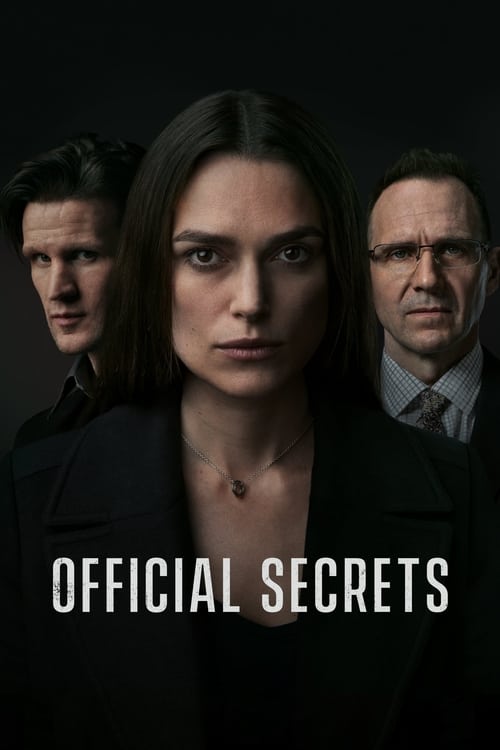
Official Secrets
2019 · Gavin Hood
For when you want a smart, grown-up thriller that makes you quietly furious — engrossing but not stressful, the kind of true story you'll want to read up on afterward.
What it's about
In early 2003, a translator at Britain's GCHQ opens an email asking her agency to help spy on UN Security Council delegations — dirt-gathering meant to strong-arm smaller nations into voting for the Iraq War. She leaks it to a newspaper, and the film follows what that single act costs her: the mole hunt inside the agency, the journalists fighting to verify the memo, and the lawyers preparing to defend her against the Official Secrets Act. It's a true story about an ordinary employee who decided her conscience outranked her security clearance.
The experience
Quiet, coiled, and steadily gripping — the tension comes from hushed offices, ringing phones, and the dread of a knock at the door rather than chases or guns. It builds a slow-burn moral anger that stays with you after the credits.
Performances
Keira Knightley plays Katharine Gun with a restrained, trembling resolve — an ordinary person terrified by her own courage — and Ralph Fiennes brings dry gravity to the lawyer who takes her case.
The craft
Gavin Hood directs it like a procedural in three interlocking parts — intelligence agency, newsroom, courtroom — and keeps the fact-based machinery clean and legible. The pleasure is in the detail: how a leak actually travels, how a newspaper verifies a document, how a legal defense gets built. It plays perfectly well at home; the fireworks are all in the escalating stakes.
Why it matters
It revived one of the buried scandals of the Iraq War era for a new audience and stands with the strongest of the 2000s-war-on-terror reckoning films — proof the whistleblower drama still had urgent stories left to tell.
Snapshot
A political thriller and legal procedural grounded in documented fact, Official Secrets reconstructs the story of Katharine Gun, a GCHQ Mandarin translator who, in January 2003, leaked a classified NSA memorandum to a journalist at The Observer. The memo, authored by NSA official Frank Koza, requested British intelligence assistance in mounting a surveillance operation against the delegations of six "swing vote" members of the UN Security Council — Chile, Mexico, Pakistan, Bulgaria, Cameroon, Guinea, and Angola — with the explicit aim of gathering material that could be used to pressure their ambassadors into endorsing a second UN resolution authorizing the invasion of Iraq. Gun's disclosure, and the story that briefly penetrated the pre-war media environment, represents one of the most audacious acts of institutional dissent in modern British intelligence history. Hood's film is deliberately unshowy in its rendering of that dissent: a portrait of a woman who did something extraordinary while living an ordinary life, and who then waited years to learn whether her conscience would cost her everything.
Industry & production
The film was produced by BBC Films, Raindog Films, and Entertainment One, with US distribution handled by Bleecker Street — a configuration typical of prestige British co-productions that need American partners to secure international theatrical release. The project originated in Gregory Bernstein and Sara Bernstein's adaptation of The Spy Who Tried to Stop a War, the 2008 account by journalists Marcia and Thomas Mitchell that first reconstructed Gun's story in book form. Hood joined as both co-writer and director, deepening the screenplay's focus on the overlapping institutional machineries — GCHQ, The Observer's newsroom, the Crown Prosecution Service, and the chambers of the human rights barrister Ben Emmerson QC — through which Gun's leak traveled, was authenticated, was published, and eventually became the subject of a prosecution under the Official Secrets Act 1989.
The casting was notable for assembling a particularly strong ensemble around Keira Knightley's lead: Matt Smith as Gun's Turkish-Kurdish husband Yasar (the spelling used in the film), Rhys Ifans as Observer reporter Martin Bright, Matthew Goode as the paper's foreign correspondent Ewen MacAskill, and Ralph Fiennes in the compressed but pivotal role of Emmerson. The film's modest scale — relative to Hood's studio-era work — reflects a deliberate return to the kind of materially specific, politically engaged British drama that BBC Films has long enabled, at budgets that require narrative efficiency rather than spectacle.
Technology
Official Secrets was photographed digitally by Florian Hoffmeister, whose European-trained eye tends toward controlled, institutional palettes that read as photographic precision without the artificiality of heavily graded prestige television. The film does not announce its digital origins through mobility or low-light expressionism; instead, Hoffmeister uses the format's latitude to sustain a consistent cool-to-neutral color temperature that codes the world of intelligence and legal procedure as clean-surfaced, impersonal, and slightly airless. The locations — Cheltenham (GCHQ's home city), London legal chambers, newsroom interiors — are integrated into the visual scheme as spaces defined by fluorescent overhead lighting and the particular institutional green-gray of government buildings. This is a film that looks the way a classified document reads: orderly, drained of affect, quietly alarming.
Technique
Cinematography
Hoffmeister's approach is fundamentally one of observation rather than dramatization. The camera placement is predominantly at human height, favoring medium shots and medium close-ups that place Gun within her environment rather than isolating her as a heroic figure against it. There is almost no handheld urgency of the kind that political thrillers frequently deploy to signal tension. Instead, Hoffmeister and Hood opt for a kind of steady, watchful restraint: the audience is positioned as the intelligence apparatus itself — observing, recording, not yet interpreting. When the frame does tighten on Knightley's face, it is earned by the scene's dramatic logic rather than imposed editorially. The nighttime sequences — Gun learning of the NSA memo's publication, the long waiting period before charges are filed — are rendered in the kind of grainy ambient light that suggests both domestic normalcy and the abrupt chill of potential arrest.
Editing
Megan Gill's editing manages the film's most structurally demanding task: intercutting between three largely separate procedural worlds — the intelligence bureaucracy, the newspaper's verification process, and the legal defense — without allowing any strand to atrophy into exposition. The rhythm is deliberate, unhurried by thriller-genre standards, which is itself a tonal argument: the machinery of government, of journalism, and of law all move at their own institutional tempos, and compression would falsify the experience Gun and those around her actually lived. Gill's cuts across the three strands are most effective in the film's middle section, where the proximity of the publication date, the verification impasse, and Gun's growing realization that she cannot remain anonymous creates a structural tension the editing channels rather than manufactures.
Mise-en-scène / staging
Hood and Hoffmeister work extensively with real and dressed practical locations to anchor the film's claim to factual legitimacy. The GCHQ workspace, with its rows of terminals and the subdued cooperative hum of a large surveillance operation, is staged to suggest an unremarkable professional environment — exactly the mundane setting from which Gun's act of conscience becomes legible as extraordinary. The film's most deliberately staged moment is the scene in which Gun reads the Koza memo at her workstation: the flat overhead light, the quiet of surrounding colleagues, the stillness before the decision — Hood holds this staging without scoring it, allowing the physical ordinariness of the space to do the work. In contrast, the newsroom sequences carry a warmer, more kinetically cluttered quality: the visual texture of an organization in controlled chaos, working against deadline.
Sound
The sound design is calibrated to match the visual scheme's institutional quietude. There is no score over the scene in which Gun reads the memo, a silence that registers as an ethical as well as aesthetic choice. Paul Hepker contributes a score that functions largely as emotional underliner in the film's legal sequences, avoiding the swelling orchestral cues that political thrillers frequently use to launder ambiguous facts into reassuring moral legibility. The ambient sound of GCHQ's open-plan offices — the white noise of computer banks, the muffled conversations of translators — establishes a texture of monitored, semi-public privacy that gives Gun's act a specific spatial register: she was not working alone, in secret, at night, but in plain sight, in a room full of colleagues, which is part of what makes her decision both more and less explicable.
Performance
Keira Knightley's work here is widely regarded as among the most sustained of her career in dramatic film. She plays Gun with a quality of compressed certainty: the decision is not dramatized as anguish (the film wisely refuses the expected scene of internal conflict before the leak) but as something almost pre-cognitive, a moral reflex whose consequences only become fully visible afterward. Knightley is particularly effective in the scenes of waiting — the months between leak and arrest, between charge and prosecution — where she conveys a woman who has accepted a cost she cannot fully calculate. The scene in which Gun admits the leak to her supervisors is played without defensiveness or self-pity, at an emotional register that conveys the specificity of British institutional restraint under pressure. Ralph Fiennes brings an intellectual sharpness to Emmerson's legal strategy that the film needs: the defense pivoting on the illegality of the war itself is an argument that sounds abstract on paper and requires an actor of Fiennes's precision to make it feel contingent and real.
Narrative & dramatic mode
The film operates as parallel-strand procedural, a mode it shares with its closest genre antecedents in the investigative journalism film. The three procedural arcs — Gun's path from transmission to arrest, The Observer's path from receipt to publication, Emmerson's construction of the necessity defense — are never fully synchronous in time but are edited to produce a cumulative pressure that substitutes for conventional thriller plotting. Hood's key structural decision is to delay the prosecution and its resolution until the film's final act, which means Official Secrets spends much of its runtime in a mode of suspended institutional consequence: something enormous has happened, and the response of the state is measured, slow, and more frightening for its methodical deliberateness than any sudden confrontation could be. The film ends with a coda that is unusually direct in its political address: text and archival material that names the falsehoods used to justify the invasion. This is a rare moment where Hood steps outside the procedural mode and makes an explicit moral argument.
Genre & cycle
Official Secrets belongs to an identifiable cycle of Anglophone institutional procedural films that gathered momentum in the decade following the 2008 financial crisis and the 2013 Snowden revelations: films that dramatize the collision of individual conscience with state and corporate power and center that collision on documented, verifiable facts. The cycle includes Spotlight (2015), The Post (2017), Oliver Stone's Snowden (2016), and The Report (2019, which appeared the same year). The shared formal signature of the cycle is a rejection of thriller aesthetics in favor of procedural realism: these films trust the documented facts to generate dramatic tension without manufactured suspense sequences. Official Secrets sits closest to The Report in its focus on a single whistleblower navigating institutional exposure, and closest to The Post in its concern with press freedom and the decision to publish under government pressure.
Within British cinema specifically, the film connects to a tradition of fact-based political drama that BBC Films and Channel 4 have sustained across decades: from Peter Watkins's The War Game (1965) through the docudramas of Ken Loach and Mike Leigh's politically charged realism to the more mainstream prestige productions of the 2000s. Hood is not operating in the social-realist register of Loach, but the institutional specificity and the moral seriousness belong to the same national tradition.
Authorship & method
Gavin Hood's career describes a notable arc from local political urgency to studio commerce and back. His debut Tsotsi (2005), a Johannesburg-set adaptation of Athol Fugard's novel, won the Academy Award for Best International Feature Film and established Hood as a filmmaker drawn to morally consequential situations rendered with unaffected naturalism. Rendition (2007), his Hollywood debut, addressed CIA extraordinary rendition with an earnestness that critics found admirable but dramatically inert; the lesson Hood appears to have absorbed was that political material requires procedural specificity rather than emotional generalization. The studio period — X-Men Origins: Wolverine (2009), Ender's Game (2013) — represents a commercial interlude that Hood has spoken of with some ambivalence in interview. Eye in the Sky (2015), a UK production examining the ethics of drone strikes in real time, marked the return to political-ethical subject matter and demonstrated a surer dramatic hand: the procedural constraint of a single operation compressed into near-real-time gave the moral argument a formal container that Rendition lacked.
Official Secrets extends the Eye in the Sky method: a specific, documented chain of events in which institutional procedure is both the subject and the formal model. Hood co-wrote the screenplay with Gregory and Sara Bernstein, deepening what was already a strong structural foundation. His directorial signature across the film is primarily a signature of restraint: the refusal of scoring and cutting choices that would convert documented ambiguity into cinematic simplicity.
Hoffmeister as cinematographer brings a European precision compatible with Hood's control. The collaboration is functionally closer to the British prestige television tradition than to Hollywood cinematography conventions, which suits material whose authority depends on its apparent factual fidelity.
Movement / national cinema
The film occupies a liminal position in national cinema terms: financed with British public-broadcasting money, shot in Britain, depicting British institutions and a specifically British political crisis, but directed by a South African filmmaker and distributed in the United States through an independent American company. This structure is characteristic of the BBC Films co-production model, which functions as a mechanism for sustaining the kind of politically serious, formally restrained drama that neither pure American studio production nor purely market-dependent British production reliably generates. The film's sensibility — its particular combination of legal proceduralism, journalistic due-diligence as drama, and moral seriousness without sentimentality — is recognizably British in tone, whatever Hood's origins. The institutional settings, the legal-professional culture of the defense team, and the specific register of British civil-service understatement under pressure all locate Official Secrets within a national tradition even as its director is an outsider to it.
Era / period
The film is set between January 2003 and March 2004, a period it reconstructs with care for the specific texture of that political moment: Tony Blair's government, the dodgy dossier controversy, Hans Blix's inspections, Colin Powell's UN presentation, the failure of the anti-war movement to prevent the invasion, and the long post-invasion delay before the prosecution of Gun was abandoned. It was made and released in 2019, when the questions it raised had been given renewed urgency by the Brexit referendum and its aftermath — a period of heightened public skepticism about government honesty and institutional integrity. Hood does not make the Brexit parallel explicit, but the film's implicit argument — that democratic governments routinely deceive their populations about the legal and moral basis of major decisions, and that those who expose this deception face prosecution while those responsible face none — needed no updating to feel current. The 2019 release date places it within a broader moment of institutional anxiety in British public life that served as an involuntary amplifier of its themes.
Themes
At its center, the film is about the relationship between institutional loyalty and moral obligation — the degree to which an employee of the secret state can be said to have duties that supersede her obligations to the institution that employs her. Gun's act is framed not as rebellion but as the opposite: an act of fidelity to the values the institution nominally serves. The defense's necessity argument — that her disclosure was lawful because the war it sought to prevent was itself unlawful — enacts this paradox in legal form. The film is also about the differential costs of conscience: Katharine Gun risked prosecution, career, and (briefly) her husband's deportation; the officials who authorized the surveillance operation, the politicians who commissioned the dodgy dossier, and the governments that invaded a country on false pretenses faced no equivalent accountability. This asymmetry is the film's sharpest political argument, and Hood makes it with accumulative rather than rhetorical force, letting the documented facts carry the weight.
Marriage as the site where political abstraction becomes personal reality is developed through the subplot of Yasar Gun's precarious immigration status, which the British government appeared to use as implicit leverage during the investigation. The film uses this thread to ground the geopolitical in the domestic without melodramatizing the relationship itself.
Reception, canon & influence
Official Secrets received broadly positive critical notices on its release, with Knightley's performance consistently cited as the film's primary achievement. The procedural restraint that some critics found admirable was for others a source of mild disappointment: the film was praised for its honesty and fidelity to documented events and faulted, by some, for the same qualities — a sense that its formal integrity precluded the kind of dramatic propulsion the genre can deliver. The specific box-office performance is not well documented in the scholarly record and should not be estimated here; the film was released by a US independent distributor into a specialized market, and its reach was substantially extended through streaming and broadcast distribution via BBC and ITV channels.
The film's backward influences are clearly legible. All the President's Men (1976, Alan J. Pakula) established the template of the investigative journalism procedural as prestige drama, and Official Secrets follows its structural logic — the verification process as narrative — closely. Michael Mann's The Insider (1999) is the most direct antecedent for the whistleblower-under-institutional-pressure strand: a corporate scientist rather than a government translator, but the same pattern of a single individual absorbing the weight of a system's response to exposure. Spotlight (2015) is a more proximate formal influence, establishing the ensemble newsroom procedural as viable prestige drama in the contemporary market. Hood's own Eye in the Sky provided the directorial preparation: the discovery that moral-ethical material embedded in procedural constraint can generate its own form of dramatic intensity.
The question of the film's forward influence — what it shaped — is genuinely difficult to assess at this proximity. Official Secrets arrived in a market already processing multiple whistleblower and surveillance-state narratives (The Report, Citizenfour, Snowden) and did not clearly redirect the cycle's trajectory. Its most durable contribution may be to the biographical record of the Gun case itself: the film significantly expanded public awareness of an episode that, despite its gravity, had largely receded from mainstream memory. Katharine Gun herself has spoken positively of the film's fidelity to the facts of her situation, and in a genre where dramatization frequently distorts the documented record for narrative convenience, that fidelity constitutes an argument of its own — that the facts, rendered with care and without ornament, are sufficient.
A Deleuzian reading
Start with the screen inside the screen.
The full Deleuzian reading of Official Secrets →
Reception
Warmly reviewed at Sundance 2019 as a solid, old-fashioned political thriller, it made barely a ripple at the box office — and has since settled into 'quietly one of Keira Knightley's best, why did nobody see this?' territory.
How Official Secrets was received, from release to now →
Influences: the films it descends from and the films it influenced
- Z (1969) — Costa-Gavras's closing text-card sequence — naming implicated officials, listing punitive outcomes, documenting continuing injustices — establishes the political-coda device that Official Secrets inherits to convert its dramatic narrative into an act of documentary witness, the on-screen aftermath titles reframing the drama as evidentiary record.
- All the President's Men (1976) — Pakula establishes the investigative procedural grammar in which the verification process itself — source confirmation, document cross-referencing, institutional obstruction — is the primary narrative engine rather than backstory or character drama, a template Official Secrets applies directly to the Observer's parallel investigation into the leaked GCHQ memo.
- Silkwood (1983) — Nichols uses practical domestic and industrial workplace locations without aesthetic mediation, establishing the grammar whereby a protagonist's unremarkable working environment argues for her credibility before dialogue is required — the visual logic of ordinary-person authenticity that Official Secrets applies to Katharine Gun's GCHQ corridors and family home.
- In the Name of the Father (1993) — Sheridan's performance direction extracts compressed interiority under sustained legal-institutional pressure — Day-Lewis holding psychological disintegration without melodramatic externalization — establishing the British realist acting grammar that Official Secrets relies on in Knightley's performance as Gun across the GCHQ-to-Old Bailey arc.
- The Insider (1999) — Mann maps the full institutional-response system — legal, corporate, media — through simultaneous parallel strands that converge on a single whistleblower, establishing the structural template Official Secrets applies to its three-strand architecture: Gun's prosecution, the Observer's legal battle over publication, and the GCHQ intelligence operation itself.
- United 93 (2006) — Greengrass's handheld observational-restraint digital cinematography — maintaining documentary proximity to institutional interiors without aesthetic aggression — establishes the grammar of credibility-through-restraint that Official Secrets inherits for its GCHQ open-plan offices, newsroom interiors, and legal chambers.
- Michael Clayton (2007) — Gilroy renders institutional space in a cool-neutral digital palette so tonally desaturated that ethical weight must be carried entirely by performance compression rather than visual affect — the moral-landscape grammar Official Secrets applies to its government-office and law-firm environments, where the color temperature itself argues the case.
- State of Play (2009) — Macdonald's parallel-strand intercutting between the newspaper investigation and the parliamentary exposure maps the institutional geography — journalism, government, intelligence apparatus — as a formal diagram of power, establishing the British variant of the investigative procedural that Official Secrets inherits for the Observer/GCHQ/legal axis.
- Citizenfour (2014) — Poitras's documentary grammar of diegetic silence and institutional ambient sound — corridors, keyboards, air-conditioning hum as acoustic texture of surveillance-state exposure — establishes the sound-design vocabulary that Official Secrets absorbs into its fictional rendering, treating the institutional soundscape as a moral environment rather than background.
- Spotlight (2015) — McCarthy's ensemble newsroom procedural with deliberately unhurried rhythm — dramatic tension generated by the accumulation of mundane procedure (phone calls, archive requests, source verification) rather than thriller mechanics — is the immediate formal template for Official Secrets' Observer subplot and its insistence that the verification process is itself the drama.
- Eye in the Sky (2015) — Hood's own formal discovery that moral-ethical material embedded in procedural constraint — near-real-time institutional decision chains as the structural container — generates dramatic intensity without melodrama is the directorial method he carries directly into Official Secrets, replacing the drone-strike operation with the GCHQ-to-trial chain of procedure.
- The Post (2017) — Spielberg structures the Pentagon Papers narrative along the same parallel institutional axis as Official Secrets — the classified-material possessor and the newspaper's editorial decision to publish intercutting as two strands of the same ethical crisis — generating dramatic tension through competing institutional obligations rather than any action sequence.
- The Courier (2020) — Cooke extends the British prestige procedural grammar — practical Cold War institutional locations, compressed interiority under escalating state-apparatus pressure, cool-neutral observational palette — into the intelligence-operative register, inheriting the formal restraint that Official Secrets and its cycle consolidates as the dominant mode for British institutional conscience-drama.
- She Said (2022) — Schrader inherits the ensemble investigative journalism procedural — parallel source-verification strands, deliberately unhurried rhythm, institutional ambient sound design as the texture of bureaucratic obstruction — that Spotlight established and Official Secrets refined, extending the cycle's formal vocabulary into the #MeToo institutional-exposure narrative.
- The Report (2019) — Burns deploys parallel-strand intercutting between present Senate-committee procedure and documented past events (CIA interrogation program), the same structural device Official Secrets uses to hold the Gun prosecution and the GCHQ/NSA intelligence operation in simultaneous frame, both films formalizing political argument through procedural intercutting rather than dramatic confrontation.
- Dark Waters (2019) — Haynes applies the same observational-restraint cinematography and cool-neutral palette as moral stance — institutional and rural space rendered tonally as landscapes of evasion, ethical weight carried by compressed performance interiority (Ruffalo) — in direct formal parallel to Official Secrets' handling of state surveillance, both films treating desaturation as an argument about power.
Similar films
- Eye in the Sky (2015) — influence & lineage · same viewing thread
- The Report (2019) — influence & lineage · same viewing thread
- The Post (2017) — influence & lineage
- The Insider (1999) — influence & lineage
- A House of Dynamite (2025) — same viewing thread
- Zero Dark Thirty (2012) — same viewing thread
- Black Bag (2025) — shared sensibility
- The Berlin File (2013) — shared sensibility
All the films related to Official Secrets →
Watch it with: curated runs of related films
- Inside the Security State — A run of modern espionage and national-security thrillers — globe-trotting spycraft, submarine brinkmanship, and the paper trail behind the black sites — where operatives and investigators race secretive institutions and catastrophic clocks.