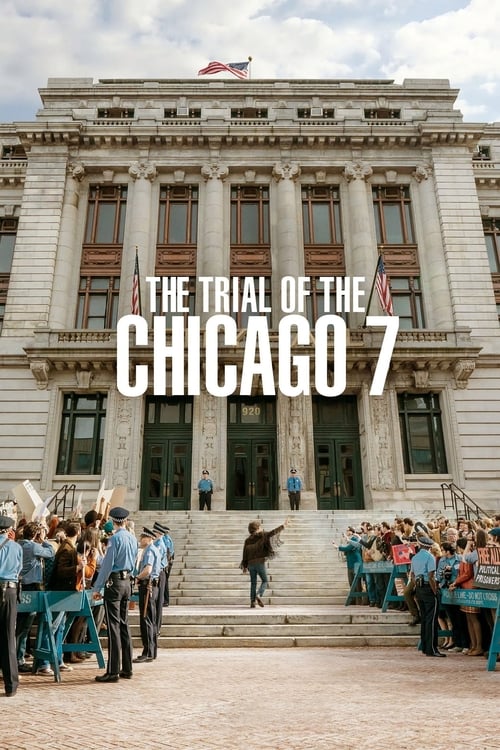
The Trial of the Chicago 7
2020 · Aaron Sorkin
For when you want to be fired up — a smart, crowd-pleasing watch that goes down easy on a weeknight but still gives you something to argue about at dinner.
What it's about
After anti-war protests at the 1968 Democratic Convention in Chicago end in a bloody clash with police, the new administration puts eight activists on trial for conspiracy — hippie pranksters, earnest pacifists, student organizers, and a Black Panther leader who barely knows the others. The courtroom becomes a circus presided over by an openly hostile judge, while flashbacks replay what actually happened in the streets. The question the film keeps asking: was the trial about a riot, or about silencing dissent?
The experience
Fast, talky, and surprisingly funny for a film about an injustice — the dialogue crackles, the cutting between courtroom and street keeps the pulse up, and a few moments land like a punch. It's outrage delivered as entertainment.
Performances
A stacked ensemble: Sacha Baron Cohen is the revelation as Abbie Hoffman, turning the class clown into the film's conscience, Mark Rylance grounds it as defense attorney William Kunstler, and Frank Langella makes the judge infuriating without ever winking. Eddie Redmayne and Yahya Abdul-Mateen II give the anger its two very different temperatures.
The craft
This is Aaron Sorkin's writing at full velocity — overlapping arguments, setups that pay off an hour later, speeches you'll want to quote. The editing is the secret weapon, braiding testimony, flashback, and real archival footage so the trial and the riot answer each other. It plays great at home; the pleasure is in the words.
Why it matters
Landing on Netflix in the protest-charged fall of 2020, it hit as a period piece that read like the news, and picked up a raft of Oscar nominations. It cemented Sorkin's move from screenwriter to director.
Snapshot
The Trial of the Chicago 7 is Aaron Sorkin's dramatization of the 1969–70 federal conspiracy trial that followed the protests at the 1968 Democratic National Convention in Chicago. It is Sorkin's second feature as director, after Molly's Game (2017), and a return to the courtroom-and-rhetoric territory that made his name as a screenwriter. The film braids two timeframes: the orderly catastrophe of the trial itself, presided over by Judge Julius Hoffman, and flashbacks to the convention week, when demonstrations organized by an ideologically fractious coalition collided with Mayor Richard J. Daley's police. Its ensemble — Yippies, old-left pacifists, student organizers, and a Black Panther charged alongside men he barely knew — lets Sorkin stage his recurring argument about whether American institutions can be reformed from within or must be confronted from the street. Released into the charged climate of 2020, amid a presidential election and nationwide protests over policing, the film arrived as a deliberately resonant period piece, debuting on Netflix after the pandemic upended its theatrical plans. It earned six Academy Award nominations.
Industry & production
The project has one of the longer development histories in recent studio memory. Sorkin wrote an early draft in the mid-2000s, and for years the film was associated with Steven Spielberg and DreamWorks, with Spielberg attached to direct. The 2007–08 Writers Guild strike, budget concerns, and the broader disruption of the era stalled it, and over the following decade the package drifted through various configurations and reported directors before Sorkin — by then a first-time director with Molly's Game behind him — took the chair himself. Sorkin has spoken in interviews about Spielberg encouraging him to direct; the precise contractual history of the project's many turnarounds is not something I can reconstruct with confidence, and I won't invent it.
The finished film was produced for a theatrical release, with Paramount Pictures positioned to distribute. The COVID-19 pandemic and the collapse of the 2020 theatrical calendar led to the film being sold to Netflix, which gave it a brief awards-qualifying theatrical window before streaming it from October 16, 2020. This shift — from prestige theatrical to streaming premiere — is itself part of the film's industrial story, typical of how 2020 redrew distribution for adult-skewing dramas.
The ensemble cast is the production's marquee asset: Eddie Redmayne as Tom Hayden, Sacha Baron Cohen as Abbie Hoffman, Jeremy Strong as Jerry Rubin, Yahya Abdul-Mateen II as Bobby Seale, Mark Rylance as defense attorney William Kunstler, Frank Langella as Judge Julius Hoffman, Joseph Gordon-Levitt as prosecutor Richard Schultz, Michael Keaton as former Attorney General Ramsey Clark, John Carroll Lynch as David Dellinger, Alex Sharp as Rennie Davis, and Kelvin Harrison Jr. as Fred Hampton, with Noah Robbins and Daniel Flaherty as the lesser-known defendants Lee Weiner and John Froines. The cast assembled a Screen Actors Guild Award for Outstanding Performance by a Cast — a signal of how the film was understood, foremost, as an actors' showcase.
Technology
This is conventional, high-end digital studio filmmaking rather than a technically experimental work. It was shot digitally by Phedon Papamichael — consistent with mainstream prestige drama of the period — and finished through a standard digital-intermediate pipeline that allowed the trial and convention timelines to be tonally distinguished in the grade. The most technologically inflected gesture in the film is its incorporation of archival-style and re-created period documentary footage, blended with newly shot material to evoke 1968 television and newsreel imagery. The seams between staged footage and the period look are handled in post; I won't claim specific formats or finishing details beyond what is reliably established.
Technique
Cinematography
Papamichael's photography draws a clear line between the film's two registers. The courtroom is shot in a controlled, classical idiom — measured coverage, warm wood-paneled interiors, faces isolated in clean singles for the rhetorical duels that are the film's engine. The convention flashbacks are looser and more kinetic, with handheld camerawork, grain, and a desaturated palette that reaches toward the texture of 1968 news footage. This stylistic bifurcation is the film's primary visual strategy: stability and ritual inside the court, escalating disorder in the streets, the two cut against each other so the verbal account of the violence and its image keep colliding.
Editing
Editing is arguably the film's defining technical element, and Alan Baumgarten's work earned an Oscar nomination. The opening sequence is a rapid montage that introduces each faction — Hayden and Davis's SDS, Hoffman and Rubin's Yippies, Dellinger's pacifists, Seale's Panthers — cross-cutting their preparations to lay out the coalition's internal contradictions before the trial begins. Throughout, Baumgarten intercuts courtroom testimony with flashback, often using the act of testimony as the bridge into the event being described, then cutting back to puncture or complicate the official account. The film's late movement — the reading of the names of the American war dead — is built as an editorial crescendo, and the picture's rhythm overall is propulsive in a way that suits Sorkin's dialogue.
Mise-en-scène / staging
The courtroom is the film's central stage, and Sorkin treats it theatrically: a fixed set of players, a presiding authority figure, and a procession of witnesses, with blocking organized around who is allowed to speak and who is silenced. The trial's most indelible real event — Bobby Seale bound and gagged at the defense table after demanding to represent himself — is staged as the film's moral nadir, the literalization of a courtroom that will not hear a Black defendant. Against the proscenium order of the court, the convention scenes are staged as expanding chaos, crowds and police lines and tear gas, the geography deliberately harder to read.
Sound
Daniel Pemberton's score works in two modes that track the film's timelines: driving, percussive cues for momentum and a more plaintive register for the human cost underneath the procedural sparring. Pemberton co-wrote the end-credits song "Hear My Voice" with Celeste, which received an Academy Award nomination for Best Original Song. The convention sequences lean on the sound design of crowds, chants, and confrontation, and on the period soundtrack texture of late-1960s protest culture, though I won't enumerate specific needle-drops I can't verify.
Performance
Performance is where the film concentrates its energy. Sacha Baron Cohen's Abbie Hoffman — sardonic, theatrical, the trial's resident provocateur — drew the most attention and an Oscar nomination for Best Supporting Actor; the role lets Sorkin voice the film's wit and its argument about political theater. Mark Rylance's Kunstler grounds the picture as the lawyer trying to win a case his clients keep treating as a stage. Frank Langella plays Judge Hoffman as imperious, error-prone authority. Jeremy Strong's Rubin and Eddie Redmayne's Hayden embody the Yippie/New Left divide that the script repeatedly stages as personal friction. Yahya Abdul-Mateen II's Seale carries the film's sharpest indictment, a man tried for a conspiracy he had no part in planning. The SAG ensemble win reflects the film's evident priority.
Narrative & dramatic mode
The film is a courtroom drama threaded with flashback, structured so that the trial functions as both plot and frame: testimony triggers the dramatization of the events under dispute, and the gap between official narrative and depicted event becomes the source of dramatic irony. Sorkin's mode is fundamentally rhetorical — the film advances through argument, cross-examination, and verbal sparring, with character revealed through how each man speaks and what he is willing to say. It is also, structurally, an ensemble film organized around an ideological spectrum, using the forced proximity of the defendants to dramatize the disagreements within the American left. The dramatic arc bends toward a cathartic final gesture rather than strict procedural realism: the film compresses, rearranges, and heightens the historical record in service of a clear emotional and political climax, a liberty consistent with Sorkin's body of work and with the docudrama tradition generally.
Genre & cycle
The Trial of the Chicago 7 sits at the intersection of the courtroom drama, the historical/biographical docudrama, and the "issue picture" — the socially engaged prestige film aimed at awards season and adult audiences. It belongs to a cycle of late-2010s/early-2020s American films revisiting the long 1960s and the history of protest and civil rights as commentary on the present (a lineage that includes Spike Lee's BlacKkKlansman and other reckonings with that decade). Within the courtroom genre it is a talk-driven, ensemble variant rather than a mystery or whodunit: the facts of what happened are largely settled, and the drama lies in interpretation, authority, and justice. Its release pattern — Netflix streaming with an awards-qualifying theatrical run — also marks it as a product of the moment when prestige drama migrated to streaming.
Authorship & method
The film is unmistakably an Aaron Sorkin work, and its authorship is best understood through his recurring concerns and methods. As writer-director he carries forward the hallmarks established across A Few Good Men, The American President, The West Wing, The Social Network, Steve Jobs, and Molly's Game: densely verbal, idealistic-yet-combative dialogue; institutions as arenas of moral testing; the courtroom or hearing as a privileged setting for truth-seeking; and a faith in the well-made speech. His direction here is in service of the text — coverage and pacing built to deliver dialogue — and as a relatively new director he leans on strong department heads.
Chief among those collaborators: cinematographer Phedon Papamichael, a frequent Alexander Payne collaborator (Nebraska, The Descendants) whose work bridges naturalism and classicism; editor Alan Baumgarten, who shapes the film's intercut structure and earned an Oscar nomination; and composer Daniel Pemberton, known for stylistically eclectic, rhythm-forward scores. The casting — assembling a deep bench of character actors and rising stars — is itself an authorial choice that defines the film's ensemble character. Sorkin's method as a historical dramatist is openly interpretive: he treats the record as raw material to be shaped toward argument and catharsis, and the film should be read as a Sorkin essay on protest and institutions as much as a reconstruction of 1969.
Movement / national cinema
This is mainstream American studio cinema — a Hollywood prestige drama in the liberal, talk-centered tradition rather than a work aligned with any formal movement. If it has a lineage, it is the American social-problem film and the courtroom drama as vehicles for civic argument, a tradition stretching back through Hollywood's mid-century message pictures. It is not part of an avant-garde or a national-cinema movement in any meaningful sense; its "movement," such as it is, is the contemporary cycle of socially conscious awards-season filmmaking funded and distributed by major studios and streamers.
Era / period
The film operates across two eras at once. Its subject is the long 1960s at its point of greatest rupture — the 1968 convention, the Vietnam War, the fracturing of the New Left, the rise of the counterculture, the assassinations of King and Robert Kennedy that frame the period's despair, and the early Nixon administration's prosecution of dissent. The trial dramatizes the legal weaponization of the anti-riot provisions of the 1968 Civil Rights Act against protest organizers. But the film is also a product of its own moment: made and released in 2020, against an American backdrop of mass protest over policing and a contentious election, it was clearly intended to speak to the present. The film foregrounds these resonances — the question of who is permitted to protest, and how the state responds — making the period setting a lens on the era of its release.
Themes
The film's central theme is dissent and the state's response to it: the line between protest and "riot," and who gets to draw it. Closely related is the question of institutional legitimacy — whether the courtroom is a venue for justice or an instrument of power, dramatized through Judge Hoffman's conduct and the treatment of Bobby Seale. A second axis is the argument within the left itself, embodied in the Hayden–Hoffman tension: incremental, electoral reform versus cultural revolution and confrontation, "winning" within the system versus refusing its terms. Race threads through all of it, most sharply in Seale's story and in the killing of Fred Hampton, which the film invokes to mark the difference in stakes between the white defendants and the Black radical tried beside them. Underneath runs Sorkin's perennial idealism — the belief that speech, testimony, and the naming of the dead can still move a conscience — held in tension with the film's evidence that the trial was rigged from the start.
Reception, canon & influence
Critically, the film was generally well received as a polished, well-acted, and timely entertainment, with praise concentrated on the ensemble and on Sorkin's facility for dramatic dialogue. The most common critical reservation was the obverse of that strength: that Sorkin's tidy speechmaking, dramatic compressions, and feel-good climax smoothed the messier and grimmer historical reality, and that the film's liberalism was more comforting than challenging. This split — admiration for craft and performance, skepticism about historical and political tidiness — is the characteristic response to Sorkin's docudramas, and it shaped this film's reception as well.
In awards terms the film was a significant contender. It received six Academy Award nominations, including Best Picture, Best Original Screenplay (Sorkin), Best Supporting Actor (Sacha Baron Cohen), Best Cinematography (Papamichael), Best Film Editing (Baumgarten), and Best Original Song ("Hear My Voice"); it did not convert these into wins. It won the Screen Actors Guild Award for Outstanding Performance by a Cast and figured in the Golden Globe and other guild and critics' races of the 2020–21 season.
The influences on the film run backward to the documentary and dramatic record of the trial and the convention — the historical transcripts and the era's news footage that the film restages — and to Sorkin's own established mode of courtroom and political drama. Its forward influence is harder to assess so close to release, and I won't overstate it: as a high-profile streaming-era prestige drama released in a politically charged year, it became a reference point in the ongoing conversation about protest and state power, and a prominent example of the 1960s-revisited cycle. Whether it leaves a durable mark on the courtroom genre or on docudrama craft is a judgment the record is still too thin to make with confidence.
A Deleuzian reading
A man is tied to his chair, a cloth knotted across his mouth.
The full Deleuzian reading of The Trial of the Chicago 7 →
Reception
Landed in October 2020 as the timeliest movie in America — protests in the streets, an election weeks away — and rode that wave to six Oscar nominations. It's since settled into 'awards-season artifact' status: the heat cooled fast once the moment passed, and it's now discussed more as peak Sorkin-does-history than as a keeper.
How The Trial of the Chicago 7 was received, from release to now →
Influences: the films it descends from and the films it influenced
- A Few Good Men (1992) — Sorkin's own source play and screenplay established his signature courtroom climax — a cross-examination that breaks a witness through escalating rhetorical pressure toward a cathartic outburst — the set-piece grammar he reruns in the trial's confrontations.
- The Social Network (2010) — Sorkin's screenplay pioneered the deposition-frame structure he reuses here: present-tense legal testimony intercut with dramatized flashbacks of the contested events, the courtroom adjudicating a past we keep cutting back to.
- Molly's Game (2017) — Sorkin's directorial debut set his director's grammar — voiceover-driven flashback, a legal jeopardy frame, and rapid montage exposition delivering dense backstory — which Chicago 7 extends to an ensemble.
- 12 Angry Men (1957) — The chamber-piece template of a deep bench of distinct character actors confined to one deliberative space, where blocking and reaction-cutting among the ensemble do the dramatic work.
- Judgment at Nuremberg (1961) — The prestige issue-picture model of restaging a real historic trial as a moral referendum, climaxing in grandstanding speeches pitched past the bench toward the contemporary audience.
- Inherit the Wind (1960) — Dramatizes a real trial (Scopes) into theatrical combat between rhetorical titans, openly fictionalizing the record toward present-day argument — the interpretive docudrama license Sorkin takes with the transcripts.
- Z (1969) — The kinetic political docudrama that uses handheld urgency and tight cross-cutting between trial, investigation, and street violence to indict the state, closing on factual title cards as Chicago 7 does.
- Medium Cool (1969) — Shot inside the actual 1968 Chicago DNC riots, fusing documentary footage of police violence with staged fiction — the literal event and the kind of street-versus-courtroom intercutting Chicago 7 reconstructs.
- JFK (1991) — The courtroom-anchored docudrama that intercuts trial testimony with reconstructed and archival footage and deliberately mixes film stocks and textures — a precedent for the stylistic bifurcation between trial and flashback.
- All the President's Men (1976) — The procedural-realism mode of the political-institutional docudrama, mining dialogue and the documentary record for suspense within the same long-1960s Nixon-era reckoning.
- Anatomy of a Murder (1959) — Establishes the procedural courtroom realism — objections, sidebars, the judge's rulings, and trial mechanics dramatized as suspense — that underlies the speeches and supplies the genre's working grammar.
- Reds (1981) — The historical-political ensemble docudrama that intercuts staged period drama with documentary 'witness' testimony, blending record and reconstruction in service of a leftist-dissent narrative.
- On the Basis of Sex (2018) — Carries the issue-picture courtroom biopic forward, building to a rhetorical appellate-argument climax in which legal speech is staged as the decisive act of social change.
- Steve Jobs (2015) — Shares Sorkin's method of compressing biography into staged verbal duels and a tripartite real-time-confrontation architecture, treating argument rather than action as the engine of scenes.
- Mangrove (2020) — Released the same year, it dramatizes a real political trial (the Mangrove Nine) as a clash of testimony in which defendants weaponize the proceedings — the identical protest-on-trial premise rendered with grittier observation.
- Judas and the Black Messiah (2021) — Extends the period-protest docudrama into the same milieu — Fred Hampton, the Panthers, and the state's repression of dissent (Hampton appears in Chicago 7) — with a more confrontational politics than Sorkin's reconciliatory mode.
- Argentina 1985 (2022) — Contemporary restaging of a politically charged trial that intercuts courtroom testimony with archival and recreated footage of the events under judgment, dramatizing a nation litigating its own recent history.
- Oppenheimer (2023) — Sorkin's courtroom pressure-chamber procedural intercutting the 1968 Convention riots with 1969–70 trial testimony deploys the same genre apparatus as Oppenheimer's 1954 hearing: institutional legal procedure as the vehicle for retroactive political persecution of ideological threats to state power.
- Brexit: The Uncivil War (2019) — Carries forward the Sorkin/Social Network engine — rapid political cross-talk and a procedural courtroom frame — that powers Brexit's talk-heavy momentum.
- The Post (2017) — Sibling civic-history drama working the same foreknown-outcome structure and overlapping, rhetorically dense dialogue, treating a courtroom/era of dissent as a present-tense argument about institutions.
Similar films
- Molly's Game (2017) — influence & lineage · often watched together
- Judas and the Black Messiah (2021) — influence & lineage
- A Few Good Men (1992) — influence & lineage
- The Social Network (2010) — influence & lineage
- 12 Angry Men (1957) — influence & lineage
- Judgment at Nuremberg (1961) — influence & lineage
- Z (1969) — influence & lineage
- Medium Cool (1969) — influence & lineage
All the films related to The Trial of the Chicago 7 →
Watch it with: curated runs of related films
- Great Men, Grand Reckonings — A run of prestige true stories about singular, obsessive men chasing an epochal achievement — the bomb, the moon, the checkered flag, a nation — and reckoning with what it cost them and everyone around them.