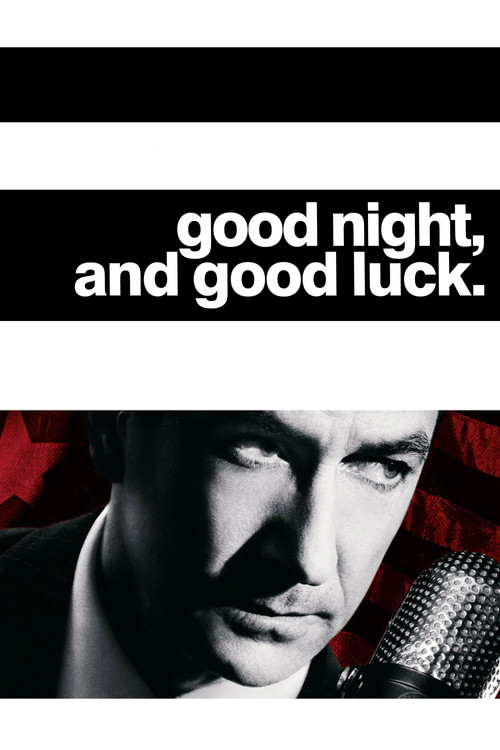
Good Night, and Good Luck.
2005 · George Clooney
When you want something smart and gripping that leaves you thinking about journalism, courage, and the news you consume — a film to argue about afterward. Challenge over comfort, but an easy, absorbing watch.
What it's about
In the 1950s, at the height of America's Red Scare, CBS newsman Edward R. Murrow and his producer Fred Friendly decide to use their program See It Now to challenge Senator Joseph McCarthy's anti-communist crusade — knowing the senator destroys careers by accusation alone. The film stays almost entirely inside the newsroom, following the reporters, executives, and sponsors as the pressure mounts with each broadcast.
The experience
Taut, smoky, and hushed — it plays like a chamber thriller where the weapons are words and airtime. At a lean running time it moves fast, and the tension of people risking everything on a live broadcast never lets up.
Performances
David Strathairn's Murrow is a marvel of stillness and moral gravity, delivering the anchorman's real broadcasts nearly verbatim with a cigarette permanently in hand — a performance that earned him an Oscar nomination and defines the film.
The craft
George Clooney shoots in luminous black and white and makes one bold, brilliant choice: no actor plays McCarthy — only real archival footage of the senator, so the film's villain indicts himself in his own words. Live jazz interludes and the dense haze of newsroom smoke give it a texture you can almost breathe.
Why it matters
It landed in 2005 as a pointed statement about media courage and government overreach, earned six Oscar nominations, and established Clooney as a serious director of conscience-driven drama.
Snapshot
A monochrome political drama compressed almost entirely within a single set—the CBS newsroom and broadcast studio at 485 Madison Avenue—Good Night, and Good Luck. reconstructs the eighteen-month campaign Edward R. Murrow and producer Fred Friendly waged on the CBS television program See It Now to expose the methods of Senator Joseph McCarthy during the height of the Red Scare. Directed by George Clooney from a screenplay he co-wrote with Grant Heslov, the film is distinguished by three interlocking choices that define its aesthetic and argumentative character: it was shot in black and white on a $7.5-million budget; it cast David Strathairn as Murrow while refusing to cast any actor as McCarthy, using only authentic Senate hearing and television footage of the senator instead; and it frames the entire drama within Murrow's prescient 1958 address to the Radio-Television News Directors Association, in which he warned that television was being squandered as an instrument of enlightenment. The result is one of the more formally rigorous American political films of the early twenty-first century.
Industry & Production
Good Night, and Good Luck. was produced through Section Eight Productions, the shingle George Clooney co-founded with Steven Soderbergh in 2000, which had already backed Soderbergh's Traffic (2000) and Solaris (2002) and Clooney's debut feature Confessions of a Dangerous Mind (2002). Section Eight operated as a mid-budget prestige arm, cultivating the kind of director-driven, politically inflected work that the major studios increasingly retreated from during the post-merger consolidation of the early 2000s. Warner Independent Pictures acquired distribution rights in North America, placing the film in the boutique specialty-releases pipeline then typical of politically ambitious smaller films.
The screenplay went through extensive historical research. Clooney and Heslov drew on primary sources including Murrow's broadcast transcripts, Fred Friendly's memoir Due to Circumstances Beyond Our Control (1967), and contemporaneous press accounts. Crucially, they used McCarthy's actual words and images throughout rather than a scripted version of the senator, a decision with both aesthetic and legal dimensions: it made the film's antagonist genuinely historical and unreconstructable, while sidestepping the dramatic risk of a performer who might be accused of caricature or of softening the record.
Production took place over approximately thirty-eight days, shot almost entirely on a single reconstructed studio set designed by production designer Jim Bissell. The decision to confine the action so tightly was both a budget constraint and a dramaturgical choice: Murrow's world was the newsroom and the broadcast booth, and the claustrophobia of that environment—heavy with smoke, fluorescent light, and the hum of technical apparatus—became the film's dominant spatial grammar. Nearly every principal character smokes throughout, a historically accurate period detail that accumulates into something aesthetically overwhelming, giving the interiors a perpetual haze.
The film premiered at the Venice International Film Festival in September 2005, where Clooney and Heslov received the Osella award for Best Screenplay. It opened in limited release in the United States in October 2005 before expanding, ultimately earning approximately $54 million worldwide against its modest budget—a substantial return for a black-and-white political drama with no action, no stars deployed in genre roles, and a subject audience testing might have flagged as schoolbook.
Technology
The choice to photograph the film in black and white was not cosmetic nostalgia but an argument about texture and historical authenticity. Because the actual McCarthy hearings and the CBS broadcasts of the early 1950s existed only in black-and-white kinescope recordings—the standard method of preserving live television before videotape—shooting in monochrome allowed archival footage to be cut into the drama with minimal perceptual disruption. Had the film been shot in color, the McCarthy sequences would register as a different ontological category of image, calling constant attention to their documentary nature; in black and white, they integrate into the narrative fabric with relative seamlessness, a technical choice inseparable from the film's central conceptual gambit.
The production used 35mm film rather than digital acquisition. Cinematographer Robert Elswit, who had been Clooney's DP on Confessions of a Dangerous Mind and whose primary collaborative relationship was with Paul Thomas Anderson, worked from the visual grammar of early television news and the kinescope recordings themselves. The grain structure, contrast ratios, and lighting temperatures were calibrated to echo the look of cathode-ray imagery without fully simulating it—the film does not pretend to be archival footage, but it lives in the same visual neighborhood.
Technique
Cinematography
Elswit's work here is among the most restrained in his career, which is itself known for formal intelligence rather than bravura. The newsroom is lit in high-contrast black and white that emphasizes the geometry of desks, broadcast equipment, and tobacco smoke against deep shadows. The cameras maintain a largely observational register: medium shots and close-ups dominate, with relatively few wide establishing frames—the effect is of a film that refuses to aestheticize its historical setting from a comfortable distance. Faces are lit with the kind of directional, pooled light that evokes the photographs of the period rather than Hollywood studio glamour.
Where the film becomes visually distinctive is in the broadcast sequences, when Murrow delivers his editorial addresses directly to camera. These are shot with a directness that borders on discomfort—Strathairn's face filling the frame, held for extended duration—echoing the peculiar intimacy of early television journalism, a medium that had not yet developed the mediating conventions of distance and visual busyness that later characterized broadcast news.
Editing
Stephen Mirrione, who edited both Traffic (for which he won an Academy Award) and the later Clooney-produced Syriana (2005), cuts Good Night, and Good Luck. with a journalistic compactness. The film runs approximately ninety-three minutes, and Mirrione's editing conveys the velocity of institutional decision-making without sacrificing coherence. Transitions between archival McCarthy footage and dramatic scenes are handled with deliberate bluntness—hard cuts rather than dissolves—which preserves the ontological distinction between historical document and dramatic reconstruction even as the monochrome palette minimizes visual difference.
The framing structure is notable: the film opens in 1958, in mid-speech, and closes by completing that speech. The Murrow RTNDA address thus surrounds the drama as a kind of retrospective annotation, a device that creates continuous dramatic irony—we hear Murrow predicting exactly the trajectory that American television will follow—and compresses the film's argument into a sealed rhetorical form.
Mise-en-scène / Staging
Clooney stages the newsroom as a pressure vessel. The CBS set is populated with secondary characters who are always present but rarely foregrounded—journalists at their desks, technicians managing equipment, secretaries—so that the principal drama between Murrow, Friendly, and the institutional forces arrayed against them plays out in a space that feels continuously inhabited and monitored. Authority relationships are legible in blocking: Frank Langella's CBS president William Paley commands physical space; Murrow is most himself when seated at the broadcast desk.
The most formally striking staging choice is the decision to position the jazz performances of Dianne Reeves as apparently diegetic events, presented as if occurring within the studio. Reeves and her ensemble appear intermittently throughout the film—playing standards including "TV Is the Thing This Year" and "One for My Baby"—in what is formally an ambiguous space between diegetic entertainment and non-diegetic commentary. These sequences are never motivated by plot and function more like a Brechtian alienation effect, interrupting the naturalistic institutional drama with an acknowledgment that we are watching a constructed artifact about a particular historical moment.
Sound
The sound design is deliberately spare. In broadcast sequences, the faint electronic room tone of early television equipment—monitors, audio feeds, the slight compression of the kinescope recordings—grounds the scenes in period technology. The dialogue is mixed with unusual dryness, foregrounding the spoken word in a film that is, fundamentally, about the power and responsibility of spoken language delivered through electronic media.
Reeves's jazz functions as the film's primary sonic texture outside of dialogue. The arrangements draw from the cool jazz idiom of the early 1950s, and the performances are presented with minimal post-production processing, preserving the acoustic character of live performance. The music neither underscores emotional beats nor acts as a conventional score but exists as a parallel channel, commenting on the action at an oblique angle.
Performance
David Strathairn received an Academy Award nomination for Best Actor for his work as Murrow, and the performance is the film's gravitational center. Strathairn's Murrow is inhabited from the inside rather than impersonated from the outside: the posture, the deliberate cadence of speech, the way Murrow drew on a cigarette before addressing the camera. The performance is calibrated to historical record—recordings of Murrow's broadcasts are widely available—while making room for interior life that the archival footage cannot supply.
George Clooney plays Fred Friendly with characteristic restraint, functioning less as a co-protagonist than as the institutional environment through which Murrow operates. Robert Downey Jr. and Patricia Clarkson play Joe and Shirley Wershba, two CBS journalists who were secretly married in violation of company policy—a subplot that introduces the personal cost of institutional conformity without overloading the main narrative. Frank Langella's Paley is rendered with genuine ambiguity: a man who understands what Murrow is doing and why, respects it, and withdraws support anyway.
Narrative & Dramatic Mode
The film operates primarily in a procedural mode—the journalism procedural being one of American cinema's most durable and morally legible forms—but it pushes against that mode's usual satisfactions. There is no scene of private deliberation in which Murrow resolves his doubts; no dramatic reversal that threatens failure before the triumph; no private antagonist to receive the moral weight of the narrative. McCarthy is never written or performed, only documented. The film's tension derives almost entirely from institutional mechanics: what Paley will permit, what the sponsors will accept, what the legal department will clear.
The framing device of the 1958 address introduces an elegiac dimension. By the time Murrow delivers that speech, See It Now has been canceled, Murrow's influence at CBS is waning, and the senator he exposed has been censured and is dying. The film's apparent victory—the Army-McCarthy hearings, McCarthy's collapse—is contextualized by an immediate future in which television took precisely the path Murrow feared, toward entertainment, triviality, and the avoidance of difficulty. This retrospective irony distinguishes the film from straightforward political hagiography.
Genre & Cycle
Good Night, and Good Luck. belongs to the journalism procedural, a genre with robust precedents in American cinema: His Girl Friday (1940), All the President's Men (1976), Absence of Malice (1981), The Insider (1999). It shares with All the President's Men in particular a commitment to process over personality—the mechanics of institutional journalism rendered with specificity—and an implicit argument that journalism, practiced with rigor and courage, constitutes a form of civic action.
The film was also part of a loose cycle of politically inflected American films released between 2004 and 2006, including Syriana (Heslov produced, Clooney executive-produced), Munich (2005), Jarhead (2005), and United 93 (2006), that engaged the post-9/11 political environment through historical and contemporary lenses. The film's allegorical pressure—the parallel between McCarthyism and the post-9/11 culture of political conformity, the failure of media institutions to challenge executive power in the lead-up to the Iraq War—was explicit in virtually every interview Clooney gave during the promotional campaign, though the film itself maintains a studied historical fidelity that allows the allegory to operate without collapsing into didacticism.
Authorship & Method
George Clooney's directorial career is marked by a consistent interest in the relationship between institutional power, individual conscience, and mass communication. Confessions of a Dangerous Mind (2002) examined the paranoid mythology surrounding American popular entertainment; Good Night, and Good Luck. scrutinized television journalism; Leatherheads (2008) looked at the commercialization of professional sport; The Monuments Men (2014) returned to questions of cultural authority and institutional responsibility. Within this pattern, Good Night, and Good Luck. is the most formally rigorous, its restraint matching its subject—a man defined by discipline of thought and language.
Clooney's collaboration with Grant Heslov, who served as both co-writer and producer here and later as co-producer on Argo (2012), represents one of the more productive partnerships in recent American prestige filmmaking. Heslov's background as an actor gave him a performer's eye for what dialogue will carry; his partnership with Clooney ensured that the film's political seriousness did not override its understanding of how people actually behave within institutions.
Robert Elswit's cinematography brought a technical sophistication to the black-and-white aesthetic that distinguished it from mere retro affect. His Oscar nomination recognized a body of work on the film that is as much conceptual as purely optical: every choice about contrast, grain, and focal length was in service of an argument about how this material should be seen.
Stephen Mirrione's editing integrated archival and dramatic footage without calling attention to itself, a technically demanding task that required precise calibration of contrast, grain, and pacing so that the tonal shift between documentary and fiction reads as intentional without being jarring.
Movement / National Cinema
The film sits within the tradition of American political cinema that includes Costa-Gavras's influence on Hollywood (though Good Night, and Good Luck. is less operatic than Costa-Gavras), the liberal procedural dramas of the 1970s New Hollywood, and the prestige political filmmaking that has been Hollywood's primary mode for engaging civic history since the 1990s. Its black-and-white aesthetic links it visually to the documentary tradition and to the neo-noir strain of 1990s American independent film, though its sensibility is more restrained than either.
The film was produced within the studio system's specialty distribution infrastructure—a mode of production that allowed director-driven political work to reach art-house and specialty audiences without the commercial compromises of wide release. This infrastructure largely collapsed in the decade following the film's release as the major studios divested their specialty divisions.
Era / Period
The film depicts the period from late 1953 to spring 1954, centered on the See It Now broadcasts of October 1953 ("The Case of Milo Radulovich"), March 1954 ("A Report on Senator Joseph R. McCarthy"), and the Army-McCarthy hearings of April–June 1954. It was made and released in 2005, at the height of a period of intense public debate about media complicity with governmental power, the erosion of civil liberties under the PATRIOT Act, and the collapse of journalistic scrutiny in the lead-up to the Iraq War. The film's period setting allowed it to make its arguments about contemporary media with historical insulation, a strategy with deep precedents in American political filmmaking.
Themes
The film's central concern is the relationship between institutional journalism and democratic accountability—specifically, the conditions under which journalists will use the platform they command to challenge rather than ratify the exercise of power. Murrow's broadcasts are presented not merely as acts of individual courage but as institutional risks: every cigarette break in the corridor between Murrow and Paley is a negotiation about what the network can bear, who the sponsors are, what the legal exposure is.
Fear as an instrument of social control runs through every scene. McCarthy's power, the film insists, derived not from evidence but from the ambient terror his accusations generated—a terror that required only the possibility of accusation to suppress dissent. Don Hollenbeck's subplot (Ray Wise), a CBS journalist whose career was destroyed by accusations and who eventually took his own life, literalizes this theme without melodramatic excess.
The film also engages the specific technology of television as a double-edged instrument—Murrow's belief that it could be a tool of enlightenment is present throughout, but so is the awareness that the same medium that enabled the broadcasts could just as easily amplify demagoguery, as McCarthy's early exploitation of the hearings demonstrated.
Reception, Canon & Influence
Influences on the film: All the President's Men (Alan J. Pakula, 1976) is the most legible precursor—the journalism procedural organized around institutional mechanics rather than individual heroism, the commitment to fidelity of process as a form of moral argument. Paddy Chayefsky's Network (1976) clearly informs the film's understanding of the relationship between broadcast journalism and commercial imperatives. Citizen Kane's (1941) monochrome aesthetic and its study of a media figure's moral trajectory provide a visual and thematic genealogy, though Clooney's film is far more compressed and less formally baroque. The Italian political cinema of the late 1960s and early 1970s—particularly Costa-Gavras's Z (1969)—underwrites the film's sense that political drama can operate through restraint and procedural rigor rather than melodramatic escalation.
Critical reception: The film received six Academy Award nominations: Best Picture, Best Director, Best Actor (Strathairn), Best Cinematography, Best Original Screenplay, and Best Art Direction. It did not win in any category. Critical reception was overwhelmingly positive, with particular attention to Strathairn's performance and to the elegance of the framing conceit. Some critics noted that the film, by confining itself to a single institutional environment and refusing to dramatize McCarthy's inner life, risked a certain narrowness—that it told only the story of Murrow's courage rather than examining the broader cultural conditions that produced McCarthyism. This criticism is legitimate and the film does not entirely escape it, though its brevity and formal discipline read now as virtues rather than limitations.
The Venice Film Festival Osella for Best Screenplay recognized the writing's formal achievement: the way Clooney and Heslov constructed an argument using only documented speech, actual archival footage, and a tightly circumscribed dramatic world.
Legacy: The film's most direct successors in the journalism procedural are Spotlight (Tom McCarthy, 2015) and The Post (Spielberg, 2017), both of which share its interest in the institutional conditions for acts of journalistic courage, its procedural fidelity, and its implicit argument that journalism functions as a form of democratic self-defense. The decision to use archival rather than dramatized antagonist footage has not become a widely adopted formal strategy—its specific conditions (the existence of high-quality footage, the public domain status of Senate hearings) are not easily replicated—but it has been discussed extensively in film scholarship as a solution to the problem of how dramatic reconstruction relates to historical record.
The film has acquired additional resonance in subsequent years as debates about media capture, the normalization of political intimidation, and the failure of journalistic institutions to resist executive pressure have recurred in American public life. Murrow's 1958 RTNDA address, quoted at length at the film's opening and close, circulates widely online as a statement of principle about the responsibilities of broadcast media that its original audience could not have anticipated would remain so urgently applicable.
A Deleuzian reading
The image you keep is two faces that never share a room.
The full Deleuzian reading of Good Night, and Good Luck. →
Reception
A critical darling in 2005 — six Oscar nominations, including Best Picture and Director — that famously went home empty-handed, it has only grown in stature since, routinely dusted off as 'more relevant than ever' with each new press-freedom crisis and widely held up as the film Clooney the director never topped.
How Good Night, and Good Luck. was received, from release to now →
Influences: the films it descends from and the films it influenced
- Sweet Smell of Success (1957) — James Wong Howe's extreme-ratio black-and-white lighting of smoke-filled media workspaces, combined with the Chico Hamilton Quintet's cool jazz score as ironic moral commentary on power, is the direct visual and sonic template Elswit and Clooney adapted for the CBS newsroom.
- Citizen Kane (1941) — The 'News on the March' newsreel-within-narrative establishes the technique of integrating archival-style footage into dramatic structure as an ontological argument; Welles also originates the retrospective investigative frame that Clooney deploys through Murrow's 1958 address as bookend.
- Judgment at Nuremberg (1961) — Kramer's decision to screen authentic concentration-camp documentary footage during the courtroom proceedings—cutting between audience reaction and unedited historical image—establishes the ethical and aesthetic grammar for integrating archival material into performed drama that Clooney adopts with the McCarthy kinescopes.
- 12 Angry Men (1957) — Lumet proves that American procedural drama can sustain feature length entirely through single-set confinement—one room, no location relief—using only performance geometry and hard-cut editing, the formal template Clooney applies to the CBS newsroom.
- All the President's Men (1976) — Pakula and William Goldman codify the journalism-procedural genre's formal conventions: the newsroom as dominant and nearly exclusive staging environment, dialogue stripped of conventional dramatic scoring, and investigative process itself—not confrontation—as the primary action.
- Network (1976) — Lumet and Paddy Chayefsky establish the anchor's direct-to-camera broadcast address as the pivot point of a media-accountability narrative, and model how institutional sabotage of journalistic integrity—not external censorship—functions as the dramatic subject.
- The Manchurian Candidate (1962) — Frankenheimer renders McCarthyite political paranoia in high-contrast black-and-white as formal expression of ideological destabilization, and establishes the principle that a demagogue's actual television performances can be incorporated into dramatic narrative without reconstruction.
- Medium Cool (1969) — Wexler cuts live documentary footage—the 1968 DNC riot—directly into staged dramatic scenes, establishing that the ontological boundary between performed and archival image can function as a subject in itself rather than a technical problem to be concealed.
- Point of Order (1964) — De Antonio assembled the kinescope Army-McCarthy hearing footage that Clooney integrates verbatim, demonstrating that McCarthy's own unedited television performances constitute sufficient antagonist without any dramatic reconstruction.
- Broadcast News (1987) — Builds tension entirely from diegetic newsroom and control-room procedure, inheriting Broadcast News's fascination with the mechanics of putting a broadcast on air.
- Confessions of a Dangerous Mind (2002) — The Clooney/Mirrione partnership turned to format-conscious period-media recreation, now stripped to classical, restrained composition.
- The Man Who Wasn't There (2001) — Robert Elswit shoots a 1950s period piece originated on color negative and rendered as expressive black-and-white — the exact technical lineage (color-stock-to-monochrome) this film helped legitimize.
- Frost/Nixon (2008) — Howard directly inherits the historical-inhabitation mode and retrospective framing, centering the broadcast interview as the arena where political accountability is partially sought and partially won—the same dramaturgy as Murrow's confrontation with McCarthy conducted through the television apparatus.
- Zodiac (2007) — Fincher extends the journalism-procedural template by integrating archival evidence—crime-scene photographs, police documents—as narrative data cut into dramatic scenes, and adopts retrospective irony as structural principle: the investigation is known to fail before the first frame.
- Spotlight (2015) — McCarthy inherits institutional ambiguity as the journalism procedural's central dramatic engine: the drama is not individual heroism but evidence accumulating inside institutional spaces, with investigative process replacing confrontational affect—the same formal restraint Clooney applies to the Murrow campaign.
- Truth (2015) — Vanderbilt transposes Clooney's exact institutional setting—CBS News—and retrospective framing into the Rather/Mapes controversy, using the same institutional ambiguity about editorial courage and the same dry procedural dialogue stripped of conventional dramatic scoring.
- The Report (2019) — Burns's film is the most direct formal descendant: a document-driven government investigation procedural with retrospective framing through a witness's testimony, post-9/11 political allegory, and the identical institutional-ambiguity dramaturgy—courage under political pressure inside a bureaucratic space—that structures Clooney's film.
- The Trial of the Chicago 7 (2020) — Sorkin integrates actual historical testimony into scripted dramatic scenes, uses retrospective irony through the known verdict, and deploys Brechtian theatrical framing—the courtroom as media spectacle—in the same post-9/11-era political allegory register, with anachronistic dialogue functioning as alienation device rather than period reconstruction.
- Kill the Messenger (2014) — Uses period newsroom and broadcast hardware as moral atmosphere — the analog-media texture and reporter-as-institutional-conscience register the film echoes.
- September 5 (2024) — Confines a media-ethics drama to studio and control room while integrating period archival broadcast footage with staged action, the same archival-staged-integration technique and monochrome apparatus fidelity.
- Capote (2005) — Miller deploys the same historical-inhabitation performance mode—Hoffman channeling Capote's voice and physical affect without impersonation—and structures the film so the subject's known biography and recorded words function as retrospective irony against the performed scenes; both films released the same year in the same post-9/11 political-allegory register.
- The Post (2017) — Sibling in the journalism-as-civic-courage mode: press freedom staged against state power inside smoke-filled newsroom interiors with documentary restraint and a foreknown historical outcome.
- Milk (2008) — A period-reconstructed activist drama that splices real archival footage of its antagonist directly into staged scenes, the same archive-in-narrative, media-as-activism method.
Similar films
- Network (1976) — influence & lineage
- Spotlight (2015) — influence & lineage
- Capote (2005) — influence & lineage
- Medium Cool (1969) — influence & lineage
- All the President's Men (1976) — influence & lineage
- The Insider (1999) — shared sensibility
- Foreign Correspondent (1940) — shared sensibility
- Primary (1960) — shared sensibility