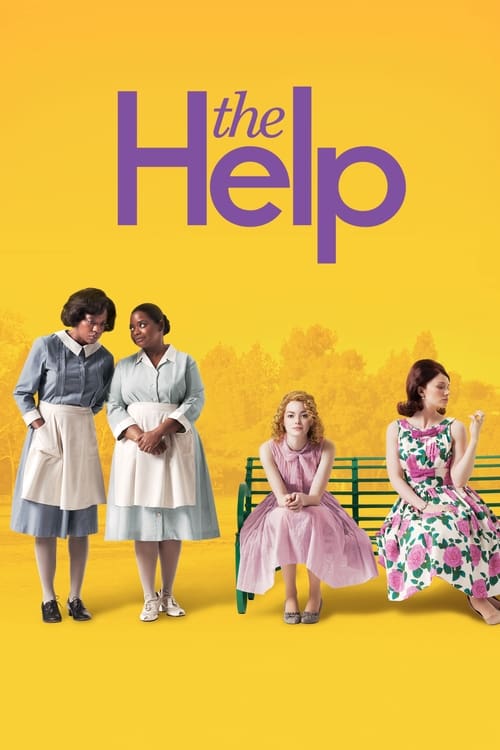
The Help
2011 · Tate Taylor
For a stirring, accessible night in when you want to laugh, cry, and cheer — comfort-viewing built around hard history. Watch it with someone; it's the kind of film that starts conversations, including about its own framing.
What it's about
Jackson, Mississippi, 1963. An aspiring young white journalist comes home from college and persuades the Black maids who work for her social circle to tell her — at genuine risk to their jobs and safety — what their lives raising white families are really like. The film follows two of those women above all: Aibileen, grieving and dignified, and Minny, whose sharp tongue keeps costing her employment.
The experience
A big, warm, crowd-pleasing period drama — funny, tearful, and easy to fall into, even as the injustice at its center stings. It goes down smoothly by design; whether that smoothness is a virtue or the problem is the argument the film still generates.
Performances
This is why the film endures: Viola Davis's stillness turns a compromised script into something wounded and exact, and Octavia Spencer won the Oscar for comic timing with fury underneath. Jessica Chastain, in her breakout year, is disarming as the town's ostracized outsider.
The craft
Tate Taylor's adaptation of Kathryn Stockett's bestseller is classical Hollywood storytelling — sun-drenched Southern period detail, an ensemble structure that hands each actress an aria, and a tone that swings from kitchen comedy to real menace without dropping the audience.
Why it matters
A word-of-mouth phenomenon that ran all summer, made Davis and Spencer central to the American screen, and later became a genuine case study — with Davis herself among the critics — in how Hollywood routes civil-rights history through a white protagonist's awakening.
Jackson, Mississippi, 1963: an aspiring white journalist persuades the Black maids of her social circle to tell her, at real risk to themselves, what their working lives are actually like. Tate Taylor's adaptation of Kathryn Stockett's bestseller became one of the defining middlebrow hits of its decade — a word-of-mouth phenomenon that ran all summer and put Viola Davis and Octavia Spencer (who won the Oscar) at the center of the American screen. Its standing has only grown more contested since: critics, and eventually Davis herself, questioned a civil-rights story routed through a white heroine's awakening, and the film now doubles as a case study in how Hollywood metabolizes history. What survives the argument is the acting — Davis's stillness, which turns a compromised script into something wounded and exact; Spencer's timing; Jessica Chastain, in her breakout year, as a ostracized housewife played without condescension. Taylor, a Jackson native who grew up with Stockett, shoots the period in warm, magazine-bright color, sharpening the dissonance between the surfaces and what the maids carry through them.
Reception
A sleeper smash in 2011 — a $25M crowd-pleaser that made over $200M and won Octavia Spencer an Oscar — it's since become the textbook example of the 'white savior' movie, a shift crystallized in June 2020 when it topped Netflix's charts during the George Floyd protests and drew a wave of backlash for being the film people reached for.
How The Help was received, from release to now →
Influences: the films it descends from and the films it influenced
- Gone with the Wind (1939) — Sets the template of the Southern-house melodrama in warm Technicolor and the loyal-Black-domestic archetype whose Best Supporting Actress win for Hattie McDaniel is the exact prize-lineage Octavia Spencer's Minny echoes.
- To Kill a Mockingbird (1962) — Adapts a Southern civil-rights novel through a sympathetic white witness's moral point of view — the white-heroine framing device Skeeter reproduces to make racial injustice legible to a mainstream audience.
- The Color Purple (1985) — Establishes the period-Southern melodrama of Black women's domestic suffering shot in golden, magazine-lit interiors and structured as a showcase ensemble of female performances.
- Places in the Heart (1984) — Renders Depression-era interracial labor in warm harvest-gold cinematography with a genteel surface calm laid over social violence — the same staging/surface-dissonance The Help uses.
- Driving Miss Daisy (1989) — Builds middlebrow Oscar-prestige on the intimate Black-servant/white-employer dyad, the crowd-pleasing and contested comfort of that relationship The Help directly inherits.
- Steel Magnolias (1989) — Provides the Southern ensemble-of-women weepie that alternates comedy and grief across communal set-pieces (beauty parlor / kitchen table) — the same tonal architecture.
- The Long Walk Home (1990) — Pairs a Black maid and her white employer in early-'60s Montgomery, the maid's-eye civil-rights domestic drama The Help most literally descends from.
- Fried Green Tomatoes (1991) — Adapts a Southern women's novel (Fannie Flagg) as a dual-timeline story of a female community wrapped in nostalgic Deep-South warmth — the literary-adaptation-of-Southern-women template.
- Mississippi Burning (1988) — Inherits the white-mediator-into-Black-Mississippi-suffering structure and became the next-generation lightning rod in the same representation-ethics debate Mississippi Burning ignited.
- The Butler (2013) — Reframes the civil-rights decades through a Black domestic servant's witnessing, an ensemble-prestige answer that relocates the point-of-view The Help was criticized for centering on whites.
- Hidden Figures (2016) — Reuses Octavia Spencer and the warmly-lit uplift-through-workplace-triumph structure to dramatize Black women's segregated labor for a broad prestige audience.
- Mudbound (2017) — Takes the Southern racial-labor period drama and redistributes voice-over narration across Black and white characters, correcting the single-frame POV.
- Green Book (2018) — Extends the Oscar-winning cross-racial civil-rights-era dyad and its contested white-savior comfort — the most direct heir to The Help's disputed prestige legacy.
- The Secret Life of Bees (2008) — Adapts a Sue Monk Kidd civil-rights-era Southern novel around a household of Black women who shelter a white girl — the same source-genre and domestic ensemble, contemporaneous.
- Get on Up (2014) — Taylor's follow-up Mississippi-rooted period piece, deploying the same director's stock company (Viola Davis, Octavia Spencer) and warm regional texture — the authorship/collaborator method carried forward.
- Selma (2014) — A civil-rights prestige film that pointedly re-centers Black agency and leadership, the formal corrective to The Help's white-heroine frame.
- Ma (2019) — Taylor's reunion with Octavia Spencer, carrying the director-star collaborator method built on The Help into genre territory.
Similar films
- Mudbound (2017) — influence & lineage · same viewing thread
- Selma (2014) — influence & lineage · same viewing thread
- The Butler (2013) — influence & lineage · same viewing thread
- The Color Purple (1985) — influence & lineage · same viewing thread
- Gone with the Wind (1939) — influence & lineage · same viewing thread
- To Kill a Mockingbird (1962) — influence & lineage · same viewing thread
- Hidden Figures (2016) — influence & lineage
- Green Book (2018) — influence & lineage
All the films related to The Help →
Watch it with: curated runs of related films
- Heat and Reckoning in the American South — A run of Southern dramas where family, race, and old money simmer under the same unbearable heat — watch them together to trace the region from the plantation myth through the civil-rights march.