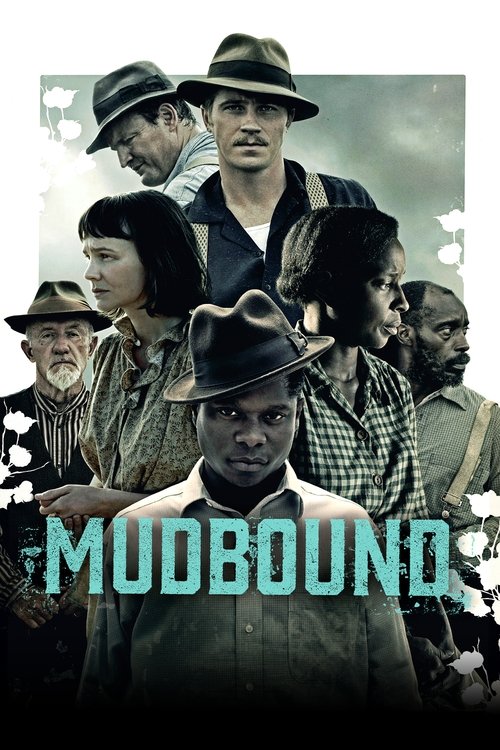
Mudbound
2017 · Dee Rees
For when you want serious, substantial American drama — a film to sit with and talk about after, not a comfort watch. Reach for it when you're ready to be moved and challenged in equal measure.
What it's about
In the 1940s Mississippi Delta, two families — one Black, one white — work the same unforgiving farmland, bound together by land, debt, and the brutal racial order that governs every exchange between them. When a son from each family comes home from World War II, the friendship they strike up as fellow veterans becomes intolerable to the world around them. It's a story of two wars: the one abroad and the one waiting at home.
The experience
Heavy, immersive, and slow-building — mud, weather, and lamplight thicken every frame, and the dread accumulates like a storm you can see coming. It's a hard, moving watch that treats its violence with gravity, never as spectacle.
Performances
Mary J. Blige, nearly unrecognizable and profoundly still, earned Oscar nominations for both her performance and an original song; the ensemble around her — including Jason Mitchell and Garrett Hedlund as the two returning soldiers — is uniformly strong.
The craft
Dee Rees builds the film as a chorus, passing narration between characters so no single family owns the story. Rachel Morrison shoots the Delta in weather and natural lamplight — sodden fields, interiors thick with shadow — work that made her the first woman ever nominated for the cinematography Oscar. It's a dark, textured image that rewards a good screen.
Why it matters
A landmark for Netflix's prestige-film era and for representation behind the camera, with Rees and Morrison both breaking ground; it stands among the defining American films about the Jim Crow South and the Black veteran's homecoming.
Two families — one Black, one white — work the same unforgiving Mississippi Delta mud in the 1940s, bound by land, debt, and the Jim Crow order that governs every exchange between them; when a son from each returns from World War II, their friendship becomes intolerable to the world around them. Dee Rees, adapting Hillary Jordan's novel, builds the film as a chorus: multiple narrators pass the story between them, and the shifting voiceover becomes a democratic form in itself, insisting that no one family owns this history. Rachel Morrison shoots the Delta in weather and lamplight, all sodden fields and interiors thick with shadow, and her work made her the first woman ever nominated for the cinematography Oscar. Mary J. Blige, nearly unrecognizable and profoundly still, earned two nominations of her own. Released by Netflix in 2017, when streaming prestige was still a contested idea, it argued the case better than any film before it. Rees's epic sweep never loses the granular texture of labor — the film understands that in the Delta, the mud itself is a character with a memory.
A Deleuzian reading
Pull a boot out of Delta mud and the ground gives it back slowly, with a sound, and keeps a little of it.
The full Deleuzian reading of Mudbound →
Reception
A Sundance 2017 sensation that Netflix bought for $12.5M — then, despite four Oscar nominations, it barely got a theatrical footprint, and the years since have turned it into the go-to example of a great film a streamer let slip through the culture. Now it's routinely named among the most underrated American films of the 2010s.
How Mudbound was received, from release to now →
Influences: the films it descends from and the films it influenced
- Days of Heaven (1978) — Néstor Almendros and Haskell Wexler's magic-hour, available-light photography of agrarian toil narrated by a plain-spoken outsider voice is the exact register Morrison and Rees adopt for the Delta fields.
- The Thin Red Line (1998) — Its structure of layered, competing first-person soldier voiceovers—interior monologues that hand off across characters—is the direct model for Mudbound's rotating narrators braiding around the returning WWII vets.
- Killer of Sheep (1977) — Burnett's neorealist, natural-light observation of Black working bodies and unglamorized labor established the LA Rebellion mode of stillness-as-dignity that Rees extends to the sharecropping South.
- Daughters of the Dust (1991) — Arthur Jafa's painterly natural-light exposure specifically calibrated to render dark skin in a Southern landscape is the cinematographic problem Morrison inherits and solves for the muddy Delta light.
- Sounder (1972) — A restrained, unmelodramatic portrait of a Black sharecropping family bound to a landlord's land and debt—the same economic architecture Mudbound builds the Jackson family's fate on.
- Barry Lyndon (1975) — John Alcott's insistence on shooting period interiors at the film stock's low-light limit, refusing artificial fill, is the available-light purism Morrison pushes further on digital sensors.
- The Color Purple (1985) — A literary adaptation that turns a Black woman's epic of the rural South into a multi-decade period drama, modeling the prestige-adaptation lane Rees works from Hillary Jordan's novel.
- Pariah (2011) — Rees's own debut, where Bradford Young's saturated low-light rendering of Black faces taught her the naturalistic-light authorship she carries into Mudbound with Morrison.
- The Assassination of Jesse James by the Coward Robert Ford (2007) — Roger Deakins's elegiac available-light Americana wedded to literary third-person voiceover narration is the period-lyric mode Rees channels for the Delta.
- Eve's Bayou (1997) — Builds on Eve's Bayou's multi-voice Southern memory structure — overlapping first-person voiceovers each recalling the same land and events — and its Black-woman-shot painterly Southern imagery (DP Rachel Morrison).
- The Help (2011) — Takes the Southern racial-labor period drama and redistributes voice-over narration across Black and white characters, correcting the single-frame POV.
- If Beale Street Could Talk (2018) — A Baldwin adaptation that fuses a Black literary source with drifting first-person voiceover and held, still close-ups—the same marriage of narration and stillness Mudbound performs.
- Fruitvale Station (2013) — Shot by Rachel Morrison in the same handheld, available-light documentary register—her intimate naturalism on Black lives is the throughline connecting it directly to Mudbound.
- Black Panther (2018) — Morrison's very next film, where the same DP's Oscar-nominated command of skin tone and natural-source lighting proves the technical method she first fully realized on Mudbound.
- 12 Years a Slave (2013) — Sean Bobbitt's available-light, long-held stillness over Southern period atrocity shares Mudbound's refusal to cut away and its performance of endurance through composure.
- Selma (2014) — Bradford Young photographs the civil-rights South with the same underexposed, sun-through-haze naturalism, the sibling grammar for filming Black skin in Southern light that Morrison practices.
- Moonlight (2016) — James Laxton's expressive natural-light exposure of dark skin and the film's chaptered, handed-off structure parallel Mudbound's multiple-narrator form arriving the same festival moment.
- Roma (2018) — A Netflix-financed, black-and-white-toned period drama of domestic labor built on available-light naturalism and stillness, sharing Mudbound's streaming-prestige and formal patience.
- Winter's Bone (2010) — Its available-light, near-documentary realism of rural poverty organized around land, kinship, and inescapable debt is the same aesthetic and thematic engine Mudbound runs on.
- A Thousand and One (2023) — A time-spanning, multi-strand epic shot by Rachel Morrison on grainy naturalist stock that treats interwoven Black and white American lives across years.
- The Butler (2013) — Extends voiceover chaptering into rotating first-person narration across two families, running the dual-track structure through parallel domestic labor and land ownership rather than through parallel political milestones.
Similar films
- Selma (2014) — influence & lineage · same viewing thread
- Moonlight (2016) — influence & lineage
- 12 Years a Slave (2013) — influence & lineage
- Daughters of the Dust (1991) — influence & lineage
- If Beale Street Could Talk (2018) — influence & lineage
- The Color Purple (1985) — influence & lineage · same viewing thread
- The Help (2011) — same viewing thread
- Eve's Bayou (1997) — same viewing thread
All the films related to Mudbound →
Watch it with: curated runs of related films
- Heat and Reckoning in the American South — A run of Southern dramas where family, race, and old money simmer under the same unbearable heat — watch them together to trace the region from the plantation myth through the civil-rights march.