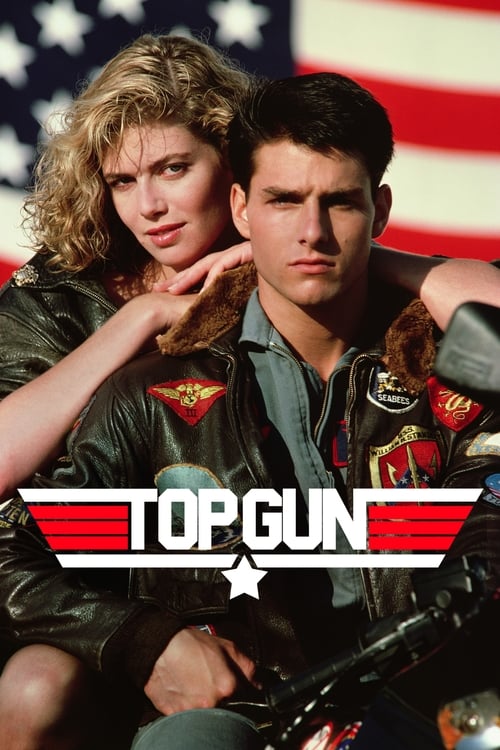
Top Gun
1986 · Tony Scott
For when you want to switch your brain off and feel invincible — a crowd-pleasing, quotable ride for a Friday night, best enjoyed loud and without irony. Comfort food, full throttle.
What it's about
Hotshot Navy pilot Pete 'Maverick' Mitchell and his loyal backseater Goose get their shot at the elite fighter-weapons school known as Top Gun, where the best fliers in the fleet compete to be number one. Between supersonic training duels, a rivalry with the icy Iceman, and a romance with a civilian instructor, Maverick's talent keeps colliding with his recklessness — until events force him to face what his bravado is covering for.
The experience
Pure sun-bleached adrenaline: roaring jets, locker-room swagger, a synth-and-power-ballad soundtrack, and a pace that never lets the story get in the way of the spectacle. It's gleefully unsubtle and enormously fun, with a streak of real grief underneath the gloss.
Performances
This is the film that made Tom Cruise a global star — the cockiness, the grin, the need for speed — and Val Kilmer's Iceman gives him a perfectly chilly foil.
The craft
Tony Scott shoots the whole thing like a gorgeous commercial: golden-hour silhouettes, gleaming steel, aerial footage of real F-14s that still thrills. The music is half the movie — turn it up; this one demands good speakers and rewards the biggest screen you can find.
Why it matters
It crystallized the high-concept 1980s blockbuster, defined the Simpson–Bruckheimer style that dominated action cinema for a decade, and famously sent Navy recruitment soaring.
Snapshot
Top Gun is the film that crystallized the high-concept Hollywood blockbuster of the 1980s: a sleek, sun-bleached, rock-scored recruitment fantasy about a gifted, reckless Navy fighter pilot learning discipline, grief, and humility. Produced by Don Simpson and Jerry Bruckheimer at the peak of their partnership and directed by the British commercials-and-promos stylist Tony Scott, it took a slim narrative armature—cocky flyer, dead best friend, demanding instructors, a romance—and wrapped it in advertising gloss, aerial spectacle, and a synthesizer-and-power-ballad soundtrack. It made Tom Cruise a global star, became (by most accounts) the top domestic grosser of its year, and established a commercial and aesthetic template—the "Simpson-Bruckheimer movie"—that dominated mainstream action filmmaking for a decade. Critically divisive on release, it has since been canonized less as a great film than as a cultural object of unusual gravity: a movie whose surfaces, songs, and silhouettes became permanent fixtures of pop memory.
Industry & production
Top Gun originated not in a pitch but in journalism. Producers Simpson and Bruckheimer optioned the subject after a 1983 California magazine article by Ehud Yonay, "Top Guns," about the U.S. Navy Fighter Weapons School at Naval Air Station Miramar near San Diego. The producers, then on a run at Paramount, recognized in the real "Topgun" school the raw material for exactly the kind of glossy, youth-skewing, music-driven picture their brand was built on. Jim Cash and Jack Epps Jr. wrote the screenplay.
The choice of Tony Scott as director was telling. Scott had made one stylish, commercially disappointing feature, the vampire film The Hunger (1983), but his real reputation rested on award-winning television commercials (he and his brother Ridley came out of the British advertising world). Simpson and Bruckheimer wanted his image-making, not a dramatist; the production is in many respects an extended, feature-length distillation of commercial craft.
Crucially, the film was made with the cooperation of the U.S. Navy, which provided access to aircraft carriers, F-14 Tomcats, and Miramar itself. This cooperation shaped the film at the level of content—the Navy reviewed the script and the relationship was, in effect, a synergy of entertainment and institutional self-presentation. The film is widely reported to have boosted Navy recruitment, and it became a frequently cited example of military-entertainment collaboration. The production also carried a real cost: stunt and aerial photography pilot Art Scholl died during filming when his aircraft failed to recover from a spin while shooting flight footage. The finished film carries a dedication to him.
Commercially, the picture was an enormous success and, with its chart-dominating soundtrack, became a model of cross-promotion in which film, album, and music videos sold one another.
Technology
The technological centerpiece of Top Gun is its aerial cinematography. Filming legible, dramatic dogfights between real jets traveling at hundreds of miles per hour posed problems that earlier aviation pictures had largely solved through models, process work, or static mounting. The production mounted cameras directly on the F-14s and used a camera aircraft to capture air-to-air footage, working within the punishing constraints of g-forces, fuel limits, the narrow windows of usable light, and the simple difficulty of keeping fast-moving aircraft framed and oriented.
Because aerial combat is spatially confusing—two specks against an empty sky offer no sense of geography—the filmmakers leaned on devices to give the action orientation and grandeur: low sun and backlight, haze and smoke, silhouettes against cloud, and shooting "magic hour" tones. The enemy aircraft, the fictional "MiG-28s," were portrayed by Northrop F-5s, painted black to read as menacing and other. Much of the film's combat legibility was ultimately constructed in the cutting room (see Editing), but the raw spectacle depended on genuine flight footage—part of the film's claim on audiences was that what they were watching was, mostly, real metal in real air.
Technique
Cinematography
Jeffrey L. Kimball's photography is fundamental to the film's identity and to its influence. The ground-level Miramar and romance sequences are saturated, golden, and heavily backlit, with sunlight raking through windows and locker rooms, lens flares, fans turning, and bodies rendered as bronze silhouettes. This is the "look" people remember: a commercial-grade idealization in which sweat, sky, and chrome all gleam. The aesthetic descends directly from advertising and music video, and Kimball and Scott apply it with conviction across both the spectacle and the intimacy, so that a flight deck and a kiss are lit with the same worshipful gloss. The aerial footage, by contrast, trades that controlled studio beauty for the documentary urgency of real flight, and the film's rhythm depends on the alternation between the two registers.
Editing
Cut by Billy Weber and Chris Lebenzon, Top Gun is in many ways an editor's film. The dogfights are assembled from disparate, hard-to-match flight elements into coherent, exciting sequences through rapid, propulsive cutting cued tightly to music. The editing schema—short shots, aggressive momentum, visuals locked to a driving score—imports the grammar of the music video into the action set piece, and the film's combat scenes are as much musical numbers as they are spatial dramas. The cutting also smooths over the inherent illegibility of jet combat: orientation is supplied less by continuous space than by pace, sound, cockpit reaction shots, and on-the-nose dialogue that narrates what we are seeing.
Mise-en-scène / staging
The film's world is built from a small set of charged, repeated spaces: the carrier flight deck, the sun-flooded Miramar classrooms and locker rooms, the neon-and-shadow bar, the hangar, the beach. Staging favors iconography over realism—the volleyball sequence, the motorcycle beside the runway, the leather jacket and aviator sunglasses are costume and blocking organized for poster-image legibility. Production and costume design lean hard on uniforms, insignia, and the gleam of machinery, treating military hardware and bodies alike as objects of fetishistic display. This pictorial, emblematic approach is part of why the film reads so powerfully as a sequence of images even to those who have never seen it whole.
Sound
Sound is arguably Top Gun's most consequential dimension. Harold Faltermeyer's synthesizer score—anchored by the recurring "Top Gun Anthem"—gives the film a sleek electronic pulse, while the soundtrack songs function as structural pillars: Kenny Loggins's "Danger Zone" drives the flight sequences, and Berlin's "Take My Breath Away" (written by Giorgio Moroder and Tom Whitlock) carries the romance and won the Academy Award for Best Original Song. The film's design fuses engine roar, radio chatter, and pop music into a single continuous sensory drive; the songs are not incidental but load-bearing, doing much of the emotional and narrative work that dialogue or staging might carry in a more conventional drama.
Performance
The performances are pitched to the film's iconographic mode. Tom Cruise's Maverick is built on grin, intensity, and physical charisma—a star turn that fixed the Cruise screen persona of the driven, slightly dangerous young man. Anthony Edwards gives Goose warmth and ordinariness that make his death the film's emotional fulcrum; Val Kilmer's Iceman supplies cool antagonism; Tom Skerritt (Viper) and Michael Ironside (Jester) lend instructor gravitas; Kelly McGillis plays the civilian instructor Charlie, the romantic lead; Meg Ryan appears as Goose's wife Carole. The acting register is broad and clean rather than naturalistic, suited to a film that traffics in archetypes—the hotshot, the loyal friend, the rival, the mentor.
Narrative & dramatic mode
The screenplay is a textbook hero's-journey melodrama compressed into a training-school setting. Maverick enters an elite institution, clashes with its discipline and his rivals, courts a forbidden romance, suffers a catastrophic loss (Goose's death in a flat-spin accident), and must overcome guilt and self-doubt to reclaim his nerve before a climactic combat. The structure is deliberately archetypal and economical: character is signaled through tags and call signs, conflict is externalized, and emotional beats are cued by song. This is dramaturgy as efficient delivery system for spectacle and sensation rather than psychological complexity—the "high concept" logic in which premise and image dominate. The film's emotional power, where it lands, comes less from script subtlety than from performance, music, and the sheer conviction of its surfaces.
Genre & cycle
Top Gun sits at the intersection of the military/aviation film, the romance, and the 1980s youth picture, but its defining genre identity is the high-concept blockbuster. It belongs to the cycle of Simpson-Bruckheimer hits—alongside Flashdance (1983) and Beverly Hills Cop (1984) before it—that fused MTV-era aesthetics, soundtrack-driven storytelling, glossy cinematography, and easily pitchable premises. It also revived and reinvented the Hollywood aviation film for a new era, trading the propeller-age romance of earlier war pictures for jet-age, Reagan-era technological glamour, and it stands as a signal entry in the patriotic, militaristic, hardware-celebrating action cinema of the mid-1980s.
Authorship & method
Authorship here is genuinely shared between a director and a producing apparatus. Tony Scott is the film's stylistic author—its look, pace, and gloss are recognizably his commercial sensibility, later developed across Days of Thunder, Crimson Tide, True Romance, and a string of increasingly kinetic action films. But Top Gun is at least as much an auteur-producer film: Don Simpson and Jerry Bruckheimer imposed the high-concept formula, the soundtrack-as-marketing strategy, and the brand identity, and the project is inseparable from their production model.
Among key collaborators: cinematographer Jeffrey L. Kimball, whose backlit, saturated imagery defines the film and who would reteam with Scott; composer Harold Faltermeyer, whose synth score and anthem became the sonic signature; editors Billy Weber and Chris Lebenzon, who built the action's music-video grammar (Lebenzon became a longtime Scott collaborator); and screenwriters Jim Cash and Jack Epps Jr., who supplied the archetypal structure. The method was collaborative and commercial in the fullest sense—craftspeople from advertising, music, and studio filmmaking pooling techniques toward maximum sensory impact.
Movement / national cinema
Top Gun is mainstream American studio cinema at its most commercially streamlined, but it is worth noting the transnational element in its making: Tony Scott, like his brother Ridley, emerged from the British advertising industry, and that "Brit-in-Hollywood" pedigree—craft honed on commercials rather than in film schools or independent cinema—is central to the film's polish. It is not part of any art-cinema movement; rather, it exemplifies a tendency in 1980s Hollywood toward the absorption of advertising and music-video aesthetics into the heart of studio production. Its closest "movement" affiliation is to the high-concept, marketing-led blockbuster as a distinctly Reagan-era American phenomenon.
Era / period
The film is a quintessential artifact of the mid-1980s. Its celebration of military technology, individual heroism, and confident American power resonates with the Reagan-era cultural mood, and it is frequently read as a piece of soft militarism aligned with the period's revived patriotism and Cold War posture (the enemy is unnamed and abstract, a generic adversary flying black jets). Aesthetically it is pure MTV-age: the music-video had become a dominant cultural form by 1986, and Top Gun imports its visual and editorial language wholesale. It also captures a specific moment in Hollywood economics, when the synergy of film, soundtrack album, and cable/music-video promotion could turn a movie into a multi-platform event.
Themes
Beneath the spectacle, the film works a consistent set of themes: the tension between individual brilliance and institutional discipline (Maverick must learn to be a wingman, not a lone gun); masculinity and competition, staged through rivalry, mentorship, and physical display; grief and the recovery of nerve after loss; and the relationship between man and machine, with the aircraft as extension of self and arena of identity. There is also an unmistakable—and much-discussed—homoerotic charge running through its imagery of male bodies, rivalry, and bonding, a reading made famous in popular culture and frequently raised in critical and academic discussion of the film. Around these, the picture organizes a broader celebration of skill, speed, and belonging.
Reception, canon & influence
Critical reception on release was sharply divided. Many serious critics were dismissive, treating the film as glossy, hollow, and ideologically suspect—an advertisement more than a drama—while audiences embraced it overwhelmingly. The gap between critical disdain and commercial triumph became part of the film's identity. It won the Academy Award for Best Original Song for "Take My Breath Away," and its soundtrack was a major commercial force in its own right.
Influences on the film (backward): Top Gun descends from the Hollywood aviation tradition—the camaraderie, romance, and male professionalism of films like Howard Hawks's flying pictures—reworked for the jet age. More immediately, it is shaped by the Simpson-Bruckheimer house style established in Flashdance and Beverly Hills Cop, and by the visual idioms of 1980s television advertising and music video out of which Tony Scott came. Its source was journalistic—Ehud Yonay's magazine article on the real Topgun school—and its sensibility owes as much to commercials and pop music as to prior narrative cinema.
Legacy (forward): The film's influence is large and durable. It consolidated the high-concept, soundtrack-driven blockbuster as Hollywood's dominant commercial mode and confirmed the Simpson-Bruckheimer template that would shape action cinema for years. It cemented Tom Cruise's stardom and the Cruise persona. Its music-video editing and advertising gloss fed into a generation of action filmmaking. It became a touchstone of military-entertainment synergy and a recurring case study in discussions of cinema and recruitment. Its imagery, dialogue, and songs entered the permanent vocabulary of pop culture, and its homoerotic subtext became the subject of one of the most famous comic film-criticism riffs of the 1990s (Quentin Tarantino's monologue in Sleep With Me). Its enduring hold was confirmed decades later by the major critical and commercial success of the legacy sequel Top Gun: Maverick (2022), which revived the property for a new era while self-consciously honoring the original's iconography. Whatever critics first made of it, Top Gun has proven one of the most culturally consequential American films of its decade.
A Deleuzian reading
You remember the silhouettes before you remember the plot.
The full Deleuzian reading of Top Gun →
Reception
A monster hit in 1986 — the year's highest-grossing film — but critics sniffed at it as a feature-length music video and Navy recruitment ad; decades later, the Tony Scott reappraisal and the triumph of Maverick (2022) have recast it as peak-80s pop filmmaking rather than a guilty pleasure.
How Top Gun was received, from release to now →
Influences: the films it descends from and the films it influenced
- Only Angels Have Wings (1939) — Establishes the aviation-professional template Top Gun inherits — male flyers measured by competence and grace under pressure, with romance subordinated to the code of the group and death processed as stoic ritual rather than tragedy.
- The Dawn Patrol (1938) — Codifies the squadron melodrama of rivalry, the lost wingman, and the reckless ace who must accept command responsibility — the exact dramaturgical machinery driving Maverick's arc after Goose's death.
- An Officer and a Gentleman (1982) — Supplies the 1980s military-training-plus-romance formula and the chart-topping love-theme-as-marketing model ("Up Where We Belong") that Top Gun reproduces with "Take My Breath Away."
- Flashdance (1983) — The first Simpson-Bruckheimer high-concept hit: it pioneers the soundtrack-as-marketing strategy and the music-video montage sequence — cutting image to pre-existing pop tracks — that becomes Top Gun's structural grammar.
- Beverly Hills Cop (1984) — Cements the Simpson-Bruckheimer brand identity and brings in Harold Faltermeyer, whose driving synthesizer signature ("Axel F") is the direct sonic precedent for Top Gun's electronic anthem score.
- The Hunger (1983) — Scott's debut feature establishes his commercial-trained aesthetic — backlit smoke, billowing curtains, saturated shafts of light, fan-blown atmosphere — the exact pictorial vocabulary he and Kimball transpose onto the locker rooms and tarmacs of Top Gun.
- Risky Business (1983) — Launches the Tom Cruise star persona — the cocky grin, the underdog charisma, the body-as-icon — that Top Gun weaponizes into the definitive Cruise leading-man image.
- Saturday Night Fever (1977) — Pioneers the synergy of a hit film and a blockbuster soundtrack album sold as a single cultural product, the commercial model Simpson-Bruckheimer industrialize and Top Gun perfects.
- The Right Stuff (1983) — Tony Scott inherits the jet acoustic vocabulary and low-angle aircraft-against-sky compositions but evacuates Kaufman's mythological ambivalence: the sonic boom becomes kinetic pleasure rather than philosophical event, and the lone-rider figure is reabsorbed into institutional triumph rather than structurally excluded from it.
- Midnight Express (1978) — Moroder's synth-driven scoring and a British-commercials visual gloss fully mainstream the electronic-score template traceable to Midnight Express.
- Days of Thunder (1990) — Literally "Top Gun on wheels" — the same Scott/Simpson-Bruckheimer/Cruise team transplants the cocky-prodigy-with-a-mentor structure, hardware-fetish cutting, and anthem scoring from jets to NASCAR stock cars.
- Crimson Tide (1995) — Extends Scott's military-machine aesthetic into the submarine — the same fetishization of hardware ritual, blue-steel light, and tightly-cut command tension, now sharpened into chamber drama.
- Bad Boys (1995) — Bay graduates from the same advertising/music-video pipeline as Scott and inherits the Bruckheimer house style wholesale — hero low-angles against magic-hour skies, lens flares, and edit-to-the-beat action that descends directly from Top Gun's grammar.
- The Rock (1996) — The mature Bruckheimer blockbuster: high-concept logline, glossy backlit heroics, and percussive synth-orchestral scoring (Hans Zimmer/Faltermeyer lineage) all extend the Top Gun production template into the late-90s action canon.
- Pearl Harbor (2001) — Bruckheimer explicitly returns to the aviation-romance-and-camaraderie genre, mounting Top Gun's love-triangle-among-flyers melodrama on a wartime canvas with the same aerial spectacle and pop-ballad marketing hook.
- Behind Enemy Lines (2001) — A music-video director applies Top Gun's MTV-age aerial photography and kinetic cutting to a Navy fighter-pilot survival story, extending the military-entertainment recruitment aesthetic into the post-Cold-War era.
- Top Gun: Maverick (2022) — The legacy sequel self-consciously rebuilds the original's iconography — magic-hour silhouettes, the locker-room and beach staging, Faltermeyer/Zimmer's anthem — while pushing the practical, in-cockpit aerial photography Scott pioneered to a new technical extreme.
- Iron Man (2008) — Fused glossy military-hardware spectacle with needle-drop rock cues laid over flight, the grounded-glossy aerial sound-and-image grammar Iron Man reuses for its flight tests.
- Independence Day (1996) — The hotshot-fighter-pilot grammar and recruitment-poster jet photography adopted wholesale for ID4's aerial dogfights and Will Smith's cocky aviator.
- Transformers (2007) — Establishes the Simpson/Bruckheimer glossy military-recruitment aesthetic — sun-flared low-angle hardware worship and magic-hour silhouettes — that Bay inherited and intensified.
- Remember the Titans (2000) — Defines the Bruckheimer house style — backlit glossy imagery, needle-drop montage sequences, and emotional maximalism engineered for mass accessibility — that shapes Titans' polish and pace.
- Revenge (1990) — The Kimball-Scott-Lebenzon unit's first consolidation: golden-hour silhouette, long-lens compression collapsing foreground and background, and Lebenzon's habit of cutting on movement rather than on dialogue beats — all carried over intact and slowed down.
- Iron Eagle (1986) — Released months before Top Gun, it runs the parallel mid-80s play of pairing fighter-jet aerial spectacle with a propulsive rock soundtrack, confirming the era's jet-and-pop-anthem formula rather than descending from it.
- True Romance (1993) — Famously connected by Tarantino's Sleep With Me riff on Top Gun's homoerotic subtext, Scott here directs Tarantino's script with the same saturated, romantic-glow visual signature, showing the Top Gun style applied outside the blockbuster mode.
Similar films
- Top Gun: Maverick (2022) — influence & lineage
- True Romance (1993) — influence & lineage · often watched together
- Days of Thunder (1990) — influence & lineage
- Pearl Harbor (2001) — influence & lineage
- Vanilla Sky (2001) — often watched together
- Akira (1988) — often watched together
- F1 (2025) — shared sensibility
- Aliens (1986) — shared sensibility