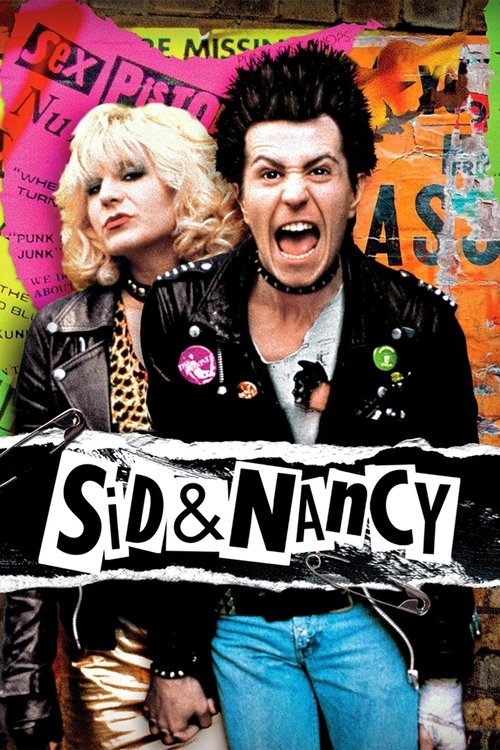
Sid and Nancy
1986 · Alex Cox
For when you want to stare into the abyss with someone — a challenging, feel-bad love story for a night you're up for intensity, not comfort. Not date-night unless your dates run dark.
What it's about
Sid Vicious, the Sex Pistols bassist who could barely play, meets Nancy Spungen, an American groupie as abrasive as he is, and the two fall into a love affair fused to a heroin habit. The film follows them through the Pistols' chaotic 1978 American tour and the band's collapse, then into a New York of methadone clinics and the corridors of the Chelsea Hotel, where the couple hole up as everything else falls away.
The experience
Squalid and tender at once — a doomed romance staged with punk's ugliness intact but shot through with strange, dreamlike beauty. It's abrasive, blackly funny in flashes, and it leaves a bruise.
Performances
Gary Oldman's Sid, in his breakout role, is astonishing — feral, childlike, and pathetic by turns — and Chloe Webb makes Nancy's shriek into something you slowly, unwillingly, start to hear as love.
The craft
Alex Cox refuses both exposé and cautionary tale, treating the most lurid footnote in punk history as amour fou — a squalid fairy tale where grimy realism keeps tipping into stylized reverie. The images (shot by Roger Deakins early in his career) find unexpected grace in the wreckage.
Why it matters
It remains the definitive screen telling of punk's most notorious couple and the film that announced Gary Oldman, setting the template for how movies would treat rock's casualties without sanitizing them.
Snapshot
Alex Cox's second feature takes the most lurid footnote in punk's history — the Sex Pistols bassist who could barely play, his American girlfriend, a heroin habit, and a body in Room 100 of the Chelsea Hotel — and refuses to treat it as either exposé or cautionary tale. What Cox makes instead is a doomed love story in the amour fou tradition, staged in the register of squalid fairy tale. The film follows Sid Vicious (Gary Oldman) and Nancy Spungen (Chloe Webb) from the Pistols' late-period London through the band's disastrous 1978 American tour, into a New York of methadone clinics and residential-hotel corridors, and toward Nancy's death in October 1978 and Sid's own, from an overdose while on bail, the following February.
It is a film that has aged into an odd double status. It remains the most artistically serious narrative feature about British punk, and it is also the film that punk's own survivors — John Lydon most vocally — have most consistently repudiated. Both things follow from the same decision: Cox was not making a documentary reconstruction. He was making a myth, and he knew it.
Industry & production
Sid and Nancy arrived at a specific and short-lived moment in British production. The early-to-mid 1980s saw a cluster of financing structures — Channel Four's film arm, Palace Pictures' distribution-plus-production model, Zenith Productions, and what remained of state support through the National Film Finance Corporation — that briefly made it possible to make idiosyncratic, unpolished British features with a genuine shot at international release. Cox's film was produced through Initial Pictures by Eric Fellner, then near the start of a producing career that would eventually run through Working Title; Zenith was involved in the financing. Palace handled the film in Britain; the Samuel Goldwyn Company released it in the United States. The budget was modest by any standard, and precise figures in the record vary enough that they are better left unstated than guessed at.
Cox came to the project with the leverage of Repo Man (1984), a film that had failed conventionally and then succeeded as a cult object on video and midnight screenings — exactly the kind of track record that makes a young director financeable for one difficult picture. He co-wrote the screenplay with Abbe Wool, working from interviews, court and police records, and the recollections of people who had been around the couple, rather than from a single published source. Notably, the film is not an adaptation of Deborah Spungen's memoir And I Don't Want to Live This Life (1983), though that book was in circulation and shaped the public understanding the film had to push against. Sid's mother, Anne Beverley, is generally reported to have cooperated with the production and to have given Oldman access to material and memory.
A quieter industrial constraint shaped the film's texture: the production could not simply help itself to the Sex Pistols' master recordings. Much of the band's music in the film is therefore performed or re-recorded, with Steve Jones — the Pistols' actual guitarist — participating, and Oldman singing Sid's material himself. What began as a rights problem became an aesthetic asset, forcing the film away from jukebox illustration and toward a soundtrack that is diegetic, ragged, and specific to the actors on screen.
Technology
This is a straightforwardly analog 35mm production, shot spherically and composed for a 1.85:1 frame, in an era before digital intermediates when color was fixed photochemically and a cinematographer's choices about stock, exposure and practical light were effectively irreversible. Roger Deakins exploits that irreversibility rather than hedging against it: much of the film is lit by sources visibly present in the frame — sodium streetlight, neon, bare bulbs, the flat institutional fluorescence of clinics and precinct houses — pushed toward saturation rather than corrected toward neutrality.
The film's most consequential technological afterlife is restorative. Sid and Nancy was an early Criterion title (spine 20), and after a period out of print it returned in a Cox-supervised high-resolution restoration in 2017. That restoration matters critically as well as commercially: for two decades the film was widely known through murky video transfers that flattened Deakins' color into brown, and the restored image makes visible how deliberately stylized — how close to comic-book chroma — the photography always was.
Technique
Cinematography
Sid and Nancy is one of the films on which Roger Deakins became Roger Deakins. His work here is not yet the classical, architecturally clean style of the later Coen and Villeneuve collaborations; it is grainier, more handheld, more willing to blow out a highlight. But the signature control of source light is already fully formed. The London sequences are grimy and cold-blue; New York arrives as a hot, sodium-orange fever. The image the film is remembered by — Sid and Nancy kissing in an alley while garbage rains down around them like confetti, shot in slow motion — works precisely because Deakins had spent the preceding hour photographing filth naturalistically. The romantic gesture is earned by contrast, not by decoration.
Editing
David Martin's cutting is elliptical and deliberately unbalanced. Long, loose, almost documentary-observational passages — arguments, nodding-out, the shapeless duration of addiction — are punctuated by abrupt compressions that skip weeks. The film's chronology is openly unfaithful to the historical record: events are relocated, condensed, and reordered for dramatic rhyme. The editing also carries the film's turns into subjectivity without announcing them, so that the closing sequence — Sid climbing into a yellow cab where Nancy is waiting, children dancing in the street — arrives as a continuation of the film's grammar rather than a rupture in it.
Mise-en-scène / staging
Andrew McAlpine's production design is the film's argument in physical form. Interiors are catalogs of accumulated waste: takeaway cartons, syringes, mattresses on floors, walls that appear to have absorbed the people living against them. Space is consistently too small — corridors, hotel rooms, the backs of vans — so that the couple are staged in near-permanent physical collision. Against this, Cox sets a handful of consciously composed, almost tableau-like images (the alley kiss; the burning car; the final cab) that lift the film out of naturalism at exactly the moments when the story would otherwise become unbearable.
Sound
The score is by Pray for Rain, Cox's regular musical collaborators, with contributions across the soundtrack from Joe Strummer, The Pogues, John Cale, the Circle Jerks and others. The sound design privileges abrasion: overlapping shouted dialogue, feedback, rooms that sound hard and untreated. Two set pieces anchor the film's use of music. Oldman's performance of "My Way" restages the sequence from Julien Temple's The Great Rock 'n' Roll Swindle (1980), ending with Sid firing into the audience — an act of open quotation that acknowledges the film is competing with an existing image of its subject. And the couple's repeated, tuneless singing to each other functions as their only sustainable form of communication.
Performance
Oldman's Sid was a breakout of unusual completeness. Having worked largely in theater and television — his Mike Leigh performance in Meantime (1983) is the key precedent — he arrived without a screen persona to be measured against, and built the role from posture and voice: the loose-jointed slump, the adenoidal drawl, the vacancy that reads alternately as sweetness and as absence. His weight loss for the later scenes is widely reported to have required medical attention. Chloe Webb's Nancy is the harder and, in some respects, the braver performance: a sustained high-register whine, wheedling and abrasive, that gives the audience no easy access to sympathy. Around them, Andrew Schofield's Johnny Rotten and David Hayman's Malcolm McLaren function as satirical sketches rather than portraits, and Cox stocks the margins with his repertory company — Sy Richardson, Xander Berkeley, Miguel Sandoval — alongside a very early screen appearance by Courtney Love, who had auditioned for Nancy.
Narrative & dramatic mode
The film is structured as a romance, not a biography. Its dramatic engine is not the Sex Pistols' collapse but the closed circuit of two people who have made each other into their only available world; the band, the tour, the press and the drug are all pressures on that circuit rather than subjects in themselves. Cox declines the biopic's usual scaffolding: there is no rise, no talent to be validated, no explanatory childhood. Sid cannot play. Nothing is achieved. The narrative advances by attrition.
This is why the film's fidelity problems are structural rather than incidental. Cox is committed to the emotional logic of a folie à deux, which requires that the couple be sealed and mutually sufficient — and that requirement systematically distorts the surrounding historical record, most conspicuously in its handling of Lydon, McLaren, and the actual circumstances of Nancy's death, which the film approaches obliquely and leaves unresolved rather than adjudicating.
Genre & cycle
Sid and Nancy sits at the junction of three cycles. It belongs to the amour fou / doomed-couple-on-the-run tradition running from Gun Crazy (1950) through Pierrot le fou (1965), Bonnie and Clyde (1967) and Badlands (1973) — with the crucial revision that its couple never actually goes anywhere. It belongs to the addiction film, whose immediate ancestors are The Panic in Needle Park (1971) and Christiane F. (1981). And it belongs, awkwardly, to the music biopic, a form it largely refuses: it declines the concert-film payoff, gives its protagonist no artistry to celebrate, and treats the band's mythology as noise.
Authorship & method
Cox's method across his early work is consistent: genre frameworks entered from the side, deadpan absurdism held in the same frame as real squalor, and a repertory of collaborators carried from film to film. Repo Man (1984), Sid and Nancy (1986), Straight to Hell (1987) and Walker (1987) form a tight four-film run, after which Walker's deliberate provocations effectively ended his access to studio financing — making Sid and Nancy his most widely seen film almost by default.
The key collaborations here are Deakins (whose subsequent career — Mountains of the Moon, Barton Fink, and everything after — makes this an important early data point), co-writer Abbe Wool, editor David Martin, designer Andrew McAlpine, and the Pray for Rain / Joe Strummer musical circle that Cox would keep working with. Cox's own subsequent commentary on the film has been notably unsentimental; he has been willing to discuss its fictionalizing and its treatment of heroin with some ambivalence, which is unusual for a director defending a signature work.
Movement / national cinema
The film belongs to the mid-1980s British independent scene — the same financing and sensibility ecology that produced Stephen Frears' My Beautiful Laundrette (1985) and Prick Up Your Ears (1987), and that ran alongside the more avowedly avant-garde work of Derek Jarman. Its specific national contribution is to the small body of British punk cinema: Jarman's Jubilee (1978), Don Letts' The Punk Rock Movie (1978), Rude Boy (1980), Lech Kowalski's D.O.A. (1980) and Temple's Swindle. Nearly all of those are documentary, quasi-documentary or allegorical; Sid and Nancy is the movement's first full narrative feature, and it makes the transatlantic move — London to New York — that the earlier films largely did not.
Era / period
The film is doubly period. Its subject is 1977–79, the moment punk's British phase curdled; its production is 1985–86, near the height of Thatcherite Britain and of Reagan-era America, when punk was recent enough to be contested and distant enough to be mythologized. That eight-year gap is the film's real subject position. It arrives just as punk is beginning to be commodified as heritage, and its refusal of nostalgia — no anthemic soundtrack payoff, no generational triumphalism — is a direct response to that timing.
Themes
The film's governing theme is codependency as a total system: two people for whom the relationship is not a part of life but a replacement for it. Heroin functions less as a subject than as the medium in which that system operates. Around this sit the film's secondary concerns — the manufacture and consumption of celebrity, with McLaren rendered as an impresario of self-destruction; the class texture of British punk, and the gap between its rhetoric of refusal and the actual poverty of its casualties; and, at the close, the persistence of romantic myth against all available evidence, which the final fantasy sequence offers not as consolation but as a diagnosis of what the film has been doing all along.
Reception, canon & influence
Critical reception. The film was received considerably more warmly in the United States than at home. Roger Ebert was among its strongest champions, and American critics broadly responded to Webb and Oldman's performances as a matched pair of extraordinary transformations; Webb in particular collected significant critical honors for the year. British reception was more divided, complicated by proximity to the events and by the objections of participants. John Lydon's repudiation — restated at length in his 1994 autobiography — is the most cited: he has consistently held that the film is inaccurate, that its portrait of Sid is condescending, and that it romanticizes heroin. Members of Nancy Spungen's family have also objected to her characterization. That criticism has been taken up in later scholarship, which has focused on the film's flattening of Nancy into a grating, agency-free antagonist and on the asymmetry between the tenderness extended to Sid and the caricature applied to her.
Influences on the film (backward). Temple's The Great Rock 'n' Roll Swindle is the direct intertext — the film Cox is both drawing on and arguing with, and which he quotes outright in the "My Way" staging. Behind that sit the amour fou lineage (Pierrot le fou, Badlands), the addiction realism of The Panic in Needle Park and Christiane F., and the British social-realist tradition Oldman had come out of via Leigh. Jarman's Jubilee supplies the precedent for treating punk as material for stylization rather than reportage.
Legacy (forward). Three lines run out of the film. First, and most concretely, Gary Oldman's career: Sid and Nancy, immediately followed by Prick Up Your Ears (1987), established the transformation-as-method persona that defined the next three decades of his work. Second, Deakins' emergence — the film sits at the hinge of one of the major cinematographic careers of the following forty years. Third, and most diffusely, the film reset the terms of the music biopic. The cycle that followed — Backbeat (1994), Velvet Goldmine (1998), 24 Hour Party People (2002), Control (2007), and eventually Danny Boyle's Pistol (2022) — inherits from Sid and Nancy the permission to treat music history as unreliable myth rather than as an authorized record, even where direct causal influence is difficult to establish. Its register also anticipates, without directly causing, the strain of romantic-squalid drug cinema that runs through Drugstore Cowboy (1989) and Trainspotting (1996).
The film's canonical position is now secure — sustained by its Criterion presence and its restoration — but it is a contested security. It is simultaneously the definitive screen account of its subject and the account its subject's survivors reject, and the most useful way to read it is as a film that never claimed the first status and has, over time, been vindicated in something like the second.
A Deleuzian reading
Garbage is falling in slow motion.
The full Deleuzian reading of Sid and Nancy →
Reception
Well reviewed in 1986 — Ebert gave it four stars and Gary Oldman was instantly anointed — but punk insiders trashed it, with John Lydon dismissing it as pure fantasy. Forty years on it's a Criterion-canonised cult classic, remembered less as a biopic than as the definitive doomed-romance myth of punk.
How Sid and Nancy was received, from release to now →
How to watch Sid and Nancy: what to notice on a first viewing
- Notice London's cold blue tint versus New York's orange glow. Deakins lights the film almost entirely from visible sources, sodium streetlight, neon, bare bulbs, pushing each city toward its own dominant color. The color scheme tells you where you are emotionally before the story does.
- Notice how cluttered and cramped every room they share is. McAlpine's interiors are catalogs of accumulated waste, cartons, syringes, mattresses on the floor, spaces consistently too small for two people to be apart in. The rooms themselves keep forcing these two bodies into constant physical collision.
- Watch how Oldman builds Sid entirely from posture and voice. A loose-jointed slump and an adenoidal drawl carry the character, a vacancy that reads as sweetness one moment and pure absence the next. You're watching a body do the acting that dialogue usually does in a film like this.
- Listen for how abrasive and untreated the whole mix sounds. Dialogue overlaps, shouted and hard, rooms carry no softening acoustic treatment, and the couple's only steady communication is off-key singing to each other. The sound itself refuses to make this relationship sound comfortable or safe.
- Notice how abruptly the film sometimes skips ahead in time. Long, loose scenes of arguing or nodding out are suddenly punctuated by compressions that jump forward weeks without warning. The editing matches how time actually feels when you're living inside an addiction.
The whole guide to watching Sid and Nancy, with the keys for a rewatch →
Influences: the films it descends from and the films it influenced
- The Great Rock 'n' Roll Swindle (1980) — The direct intertext Cox both quotes and rebuts — the 'My Way' number is restaged off Temple's staircase-and-proscenium framing of Vicious, reversing its ironic distance into pathos.
- Pierrot le fou (1965) — Establishes the amour fou couple as a suicide pact organized by saturated location color-coding and jump-cut ellipsis that skips the mechanics of travel — the template for Deakins' green Chelsea Hotel / amber alley scheme and the film's reordered chronology.
- Badlands (1973) — The device of laying lyrical slow motion and a score-carried romantic interlude directly over squalor and unexplained killing, so the film's beauty is in open contradiction with its facts — Cox's falling-garbage alley kiss is this move exactly.
- The Panic in Needle Park (1971) — Addiction realism built from the junkie couple as the only surviving social unit, shot in unflinching real-time fixing scenes with available location light and no non-diegetic cushioning.
- Christiane F. (1981) — Production design that treats needle squalor as continuous texture — stained walls, litter, derelict interiors dressed to the frame edge — while keeping the rock soundtrack diegetic and star-authenticated rather than scored.
- Jubilee (1978) — The precedent for treating punk as material for stylization rather than reportage: scene figures cast as themselves inside deliberately artificial tableaux, licensing Cox's refusal of documentary fidelity.
- Meantime (1983) — Leigh's rehearsal-built improvisation method gave Oldman the physical vocabulary of the inarticulate — slumped posture, swallowed line readings — worked out in cramped council-flat blocking and carried whole into Sid.
- Performance (1970) — Rock mythology compressed into a claustrophobic chamber piece: a decaying interior treated as color-keyed psychic space, with fractured chronology substituting for causal biography.
- Repo Man (1984) — Cox's own working template — deadpan absurdist bit-players held in the same frame as unstyled real dereliction, with punk-scene music supervision used structurally rather than as period decoration, plus the Pray for Rain / Strummer repertory.
- Prick Up Your Ears (1987) — Consolidates Oldman's transformation-as-method persona a year later on the same structure: a folie à deux ending in killing, with the chronology reordered so the death frames rather than concludes the relationship.
- Barton Fink (1991) — Deakins extends the Chelsea Hotel scheme — a peeling-wallpaper interior lit almost wholly by practical lamps and keyed to one sickly color so the location itself reads as the character's condition.
- Drugstore Cowboy (1989) — Inherits the romantic-squalid register: the drug crew as tender domestic unit, with floating slow-motion inserts and a lyrical score applied over grubby location interiors and no redemptive arc.
- Trainspotting (1996) — Takes the abrasive needle-drop mix and elliptical compression of addiction chronology, pushing the squalor production design past realism into designed stylization — the filthy interior as composed image.
- Backbeat (1994) — Direct method inheritance of the re-recorded-catalog approach — a contemporary alt-rock supergroup cut new versions so performances could be played live on set — attached to the same protagonist choice: the doomed non-musician at the band's edge.
- Velvet Goldmine (1998) — Extends the anti-biopic license to its limit by inventing the songs outright and having actors perform them, refusing the authorized record as a source of authority at all.
- 24 Hour Party People (2002) — Makes explicit what Sid and Nancy practiced — music history staged as unreliable myth, with the surviving participants' objections folded into the film's own text rather than corrected out of it.
- Control (2007) — Actors performing the band's material live on set, staged in Deakins-descended single-source practical light and cramped domestic two-shots that make the flat, not the stage, the site of the collapse.
- The Doors (1991) — Cox's refusal to glamorize the rock couple's mutual self-destruction — maintaining an anti-hagiographic stance through unglamorous 16mm texture, squalid locations, and withholding catharsis even in tragedy — established the generic template The Doors adapts for Morrison and Pamela Courson, where the camera observes destruction without editorializing rescue.
- Love Is the Devil (1998) — The same anti-biopic shape — destructive couple, lover's death, career chronology discarded — realized through color-coded interiors and distorting lenses that render the relationship as pressurized enclosed space.
- Withnail & I (1987) — Contemporaneous portrait of squalid drug-bohemia shot in underlit grime, sharing the British cult cinema of beautiful self-destruction Withnail also inhabits.
- Leaving Las Vegas (1995) — Doomed romance as a mutual non-interference pact, lovers who agree not to halt each other's decline — the same compact Ben and Sera strike.
Similar films
- Repo Man (1984) — influence & lineage
- 24 Hour Party People (2002) — influence & lineage
- Velvet Goldmine (1998) — influence & lineage
- Performance (1970) — influence & lineage
- Trainspotting (1996) — influence & lineage
- Control (2007) — influence & lineage
- Christiane F. (1981) — influence & lineage
- Closer (2004) — same viewing thread
All the films related to Sid and Nancy →
Watch it with: curated runs of related films
- Love as a Wrecking Ball — Watch these when you want desire pushed all the way to self-destruction — affairs and infatuations that leave nothing standing.