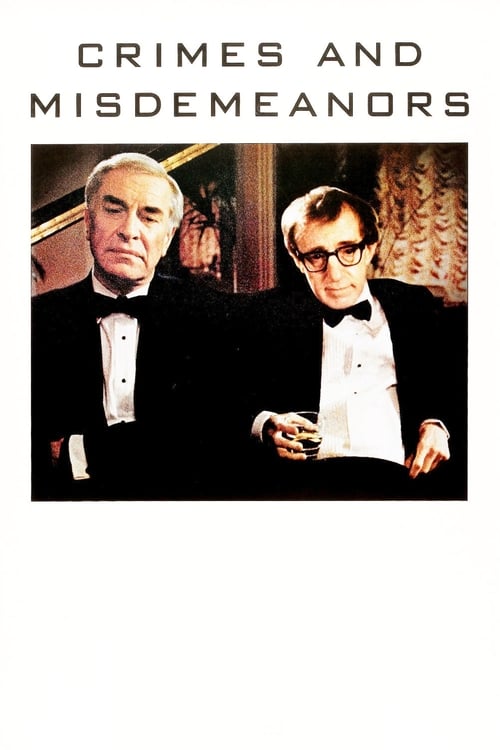
Crimes and Misdemeanors
1989 · Woody Allen
For when you want a film to chew on for days — one that's entertaining enough for a weeknight but dark enough to keep you up after. Reach for it when you're in the mood to think about how people actually live with what they do.
What it's about
Two stories run side by side in well-off New York. In one, a revered ophthalmologist — philanthropist, family man, pillar of his community — is being pushed toward exposure by a mistress who won't be quiet, and finds himself contemplating a way out that no decent man should be able to live with. In the other, a broke, principled documentary filmmaker takes a humiliating job profiling his smug television-mogul brother-in-law, while falling for the producer they're both circling.
The experience
It moves between genuinely funny and genuinely chilling, sometimes within the same scene — the comedy is sharp and the moral questions underneath it are asked with a straight face. It leaves you unsettled in the best way: arguing with the film, and with yourself, on the walk home.
Performances
Martin Landau is extraordinary as the doctor — you watch a respectable man's conscience work in real time behind his eyes. Anjelica Huston brings raw, uncomfortable desperation as the mistress, and Alan Alda is gleefully insufferable as the sitcom mogul who quotes his own aphorisms.
The craft
The structure is the star: a tragedy and a comedy braided together so each sharpens the other, with the two strands touching only at the end. The writing trusts you to connect the moral dots yourself, and the final movement lands with the quiet force of a verdict nobody delivers.
Why it matters
Widely considered one of Woody Allen's most serious and accomplished films, it set the template for the split-register moral drama — comedy and crime sharing one film — and its central question about guilt and consequence still gets argued about.
Snapshot
Crimes and Misdemeanors is Woody Allen's most sustained interrogation of a single question: whether morality can survive the death of God. Two stories run in parallel and touch only at the end. In the "crimes" strand, Judah Rosenthal (Martin Landau), a revered ophthalmologist and philanthropist, is being pushed toward exposure by his unstable mistress Dolores (Anjelica Huston); rather than lose his marriage, reputation, and possibly his freedom over embezzled funds, he lets his mobbed-up brother Jack (Jerry Orbach) arrange her murder — and then discovers he can live with it. In the "misdemeanors" strand, a comic register, the failing documentarian Cliff Stern (Allen) is hired to make a flattering profile of his loathed brother-in-law, the vain sitcom mogul Lester (Alan Alda), while courting the producer Halley Reed (Mia Farrow), whom he loses to Lester. The film's moral gravity is concentrated in a third figure who never drives the plot: the philosopher Louis Levy (Martin S. Bergmann), whose recorded reflections on love and meaning play through Cliff's footage until he abruptly kills himself. The picture is widely regarded as a peak of Allen's "serious" mode and earned Allen Academy Award nominations for Best Director and Best Original Screenplay and Landau a nomination for Best Supporting Actor.
Industry & production
The film was produced and released through Orion Pictures, the studio that distributed the bulk of Allen's 1980s work and gave him the rare arrangement of near-total creative control with modest budgets and no obligation to preview to executives. It sits inside Allen's remarkably consistent one-film-a-year production rhythm of the period, made with a stable repertory crew and a New York shoot. The most consequential production fact about Crimes and Misdemeanors is that Allen substantially reworked it after an initial assembly: as documented in accounts of his working method (notably Eric Lax's reporting), Allen was dissatisfied with the first cut and rewrote and reshot significant portions, altering the Cliff–Halley material and the film's balance of tones. This willingness to treat a finished shoot as a draft — reconvening actors, discarding footage, and re-conceiving relationships in the edit — is characteristic of his practice in these years and helps explain the film's unusually clean interlocking of its two plots. The exact proportion reshot is reported variously and should be treated as approximate rather than precise. The picture premiered as part of the 1989 New York Film Festival, the kind of prestige launch appropriate to Allen's standing as the leading American art-film auteur working within a studio.
Technology
Technologically the film is conservative and deliberately so: 35mm photography, conventional lenses, and no optical or emerging digital effects of note. Its interest lies not in apparatus but in restraint. Allen and his collaborators pursued a naturalistic image built from available-feeling, motivated light rather than the glossier coverage of mainstream late-'80s Hollywood. The score is not a synthesized or original composition but a curated bed of pre-existing music — jazz standards and classical selections — used as needle-drops, a technique Allen favored throughout his career that sidesteps the conventional scoring pipeline entirely. In short, the film's "technology" is essentially that of classical narrative cinema applied with unusual discipline; the innovation is aesthetic, not mechanical.
Technique
Cinematography
The cinematography is by Sven Nykvist, Ingmar Bergman's longtime director of photography, and his presence is one of the film's defining facts. Nykvist brings a warm, low-contrast naturalism — pools of lamplight, faces emerging from and receding into shadow, interiors that feel lived-in rather than lit for display. The visual scheme is thematically pointed: Judah is an eye doctor, sight and blindness are the film's governing metaphor, and Nykvist's chiaroscuro repeatedly stages moral perception as a matter of what is illuminated and what is left dark. Camera movement is restrained and observational; Allen favors long takes and measured reframing over cutting, letting scenes play in extended masters so that performance and space carry the drama. The overall look is closer to European chamber cinema than to American comedy, and the collaboration with Nykvist makes the Bergman inheritance visible on the surface of the image, not merely in the themes.
Editing
Susan E. Morse, Allen's editor across this era, cuts the film with patience. The dominant technique is the sustained take punctuated by minimal coverage, which throws emphasis onto blocking and dialogue rhythm. The larger editorial achievement is structural: the film cross-cuts between two tonally opposed stories — one a tragedy of successful murder, the other a comedy of romantic and professional humiliation — and braids them so that their thematic rhymes accumulate without the seams showing. The recurrent insertion of Cliff's black-and-white documentary footage of Professor Levy functions almost as a chorus, cut into the fiction at intervals to comment on the surrounding action. Given the extensive reshooting, much of the film's coherence was arguably forged in the cutting room, making the editing central rather than transparent.
Mise-en-scène / staging
Production designer Santo Loquasto renders an upper-middle-class Manhattan of book-lined apartments, tasteful restaurants, screening rooms, and the Rosenthals' comfortable house — a world whose surfaces of accomplishment and refinement are precisely what Judah is willing to kill to preserve. The staging repeatedly uses domestic and professional interiors as moral theaters. Allen's blocking tends to keep characters within a single sustained frame during long conversational scenes, so that the drama is spatial as much as verbal. A signature device is Judah's memory and imagination breaking the naturalistic frame — he "walks into" a flashback of his childhood family at a Seder, standing in the present room as his relatives debate God and justice at the table. This literalized intrusion of the past into the present is one of the film's boldest staging strokes and its clearest formal statement of theme.
Sound
Sound is dominated by dialogue and by the compiled music track; there is essentially no conventional dramatic underscore. Schubert and jazz recordings carry emotional weight and irony across scenes, and the absence of a composed score reinforces the film's dry, unconsoled tone — no music swells to tell us how to feel about the murder. Diegetic sound is naturalistic and unshowy. Louis Levy's voice, heard over documentary footage, becomes a crucial aural presence: a disembodied philosophical narration whose calm assurances are retroactively devastated by his suicide, so that the soundtrack itself carries the film's argument about the fragility of constructed meaning.
Performance
The performances mark a deliberate stretching of Allen's ensemble toward drama. Martin Landau gives a career-redefining turn as Judah, moving from panic to calculation to an eerie, unpunished equilibrium; the role recovered his reputation as a serious actor and drew his Oscar nomination. Anjelica Huston plays Dolores as needy, perceptive, and genuinely threatening without becoming a caricature. Alan Alda, cast against his warm public image, is superb as the fatuous, self-adoring Lester, coining aphorisms about comedy ("If it bends, it's funny; if it breaks, it's not funny") while embodying everything Cliff despises and the world rewards. Allen plays Cliff as a familiar version of his neurotic screen persona, but folded into a darker frame; Mia Farrow, Sam Waterston (as the rabbi Ben, going literally blind), and Jerry Orbach fill out an ensemble in which comic and tragic acting styles are held in the same film without collision.
Narrative & dramatic mode
The film's dramatic mode is the moral fable told in a realist key. Its structure is a diptych: two independent plots that never causally intersect until a coda at a wedding, where Judah and Cliff — strangers — sit together and Judah relates the "plot" of a murder as if pitching a movie idea, and Cliff, thinking in fictional terms, insists the killer must confess for the story to have meaning. Judah's reply — that in real life he'd get away with it and go on living comfortably — is the film's thesis delivered as anticlimax. The parallel construction invites the audience to read each strand against the other: the man who commits the gravest crime prospers, while the man guilty of only "misdemeanors" (vanity, self-pity, a doomed infatuation) is punished with defeat. The intercut Levy footage supplies an explicit philosophical commentary track, making the film unusually essayistic in its dramaturgy without abandoning character.
Genre & cycle
Nominally a comedy-drama with a crime plot, the film in practice fuses several modes: the moral-philosophical tragedy of the Judah story, the romantic and satirical comedy of the Cliff story, and an essay-film's discursiveness in the Levy material. It belongs to the cycle of "serious Allen" films — the run in which he pursued the influence of Bergman and Chekhov toward drama proper — that includes Interiors (1978), Another Woman (1988), and, in its comic-serious blend, Hannah and Her Sisters (1986). Within that cycle Crimes and Misdemeanors is the fullest integration of his comic and tragic registers in a single work, and it inaugurates a recurring preoccupation with the perfect, unpunished crime that he would return to years later in Match Point (2005).
Authorship & method
This is an auteur film in the strong sense: written and directed by Allen, drawing on a tight roster of trusted collaborators whose contributions are nonetheless decisive. Nykvist's cinematography imports the visual grammar of European art cinema; Loquasto's design furnishes the bourgeois world under moral pressure; Susan E. Morse's editing braids the twin plots and threads the documentary interludes; and the compiled classical-and-jazz soundtrack substitutes for an original score. Allen's method is well documented: minimal rehearsal, actors given wide latitude, long takes, and — crucially here — a readiness to reshoot and restructure extensively in post-production until the film satisfies him. A distinctive, near-meta touch is the casting of the psychoanalyst and scholar Martin S. Bergmann as Professor Levy, a non-actor whose real intellectual authority lends the character's recorded philosophy its weight. The screenplay is Allen's own, and its literary DNA — Dostoevsky above all — is worn openly.
Movement / national cinema
The film is American independent-minded auteur cinema produced inside a studio arrangement, and it is inseparable from New York: Manhattan is not backdrop but milieu, its professional-class Jewish intellectual world the film's native habitat. At the same time its aesthetic allegiances are explicitly European. Through Nykvist it draws directly on the Swedish art-cinema tradition of Bergman, and its Chekhovian ensemble structure and Dostoevskian moral argument align it with a literary-European sensibility rather than with contemporaneous Hollywood. It thus occupies a characteristic Allen position: an American national cinema of New York that continuously imports and domesticates the concerns of postwar European film.
Era / period
Released in 1989, the film caps a decade in which Allen consolidated his standing as America's foremost art-house auteur and reached the fullest maturity of his "serious" ambitions. It arrives at the close of the Reagan '80s, and its portrait of a prosperous professional who commits murder and is materially rewarded reads, without editorializing, as a comment on a decade's moral bookkeeping — success insulated from consequence. It also belongs to the late stage of the classical Orion Pictures relationship that enabled Allen's autonomy, shortly before that studio's decline. Within his own filmography it stands as a hinge between the 1980s ensemble dramas and the darker moral thrillers to come.
Themes
The film's central theme is the possibility of ethics in a universe that may be godless and indifferent. The eye — the ophthalmologist's trade, the rabbi's blindness, "the eyes of God are on us always" recalled from Judah's childhood — organizes a sustained metaphor about who or what sees our actions, and whether being seen is the only thing that makes them matter. Guilt, and the disquieting discovery that guilt can fade, drives the Judah plot: the film's most unsettling proposition is not that a man murders but that he learns to live with it and is absorbed back into a comfortable life. Against this, the Cliff plot examines a different failure — the punishment of decency, the triumph of the shallow and self-promoting Lester over the sincere but ineffectual Cliff. Faith is tested and found wanting: the one character of genuine belief, Ben, goes blind, while the philosopher who theorized human love's capacity to create meaning kills himself. Love, self-deception, ambition, and the stories people tell to make their lives bearable — Judah literally reframes his crime as a screenplay with a hopeful ending — recur throughout. The film refuses consolation, leaving its arguments unresolved in Levy's closing narration about the small, chosen meanings people impose on an unfeeling world.
Reception, canon & influence
Crimes and Misdemeanors was received as a major work and a high point of Allen's dramatic ambitions, earning him Oscar nominations for Best Director and Best Original Screenplay and Martin Landau a Best Supporting Actor nomination; it is frequently ranked among Allen's finest films and among the essential American moral dramas of its era. (Specific contemporary review quotations and box-office figures are outside what I can verify here and are deliberately omitted.)
Its influences run backward to a clear lineage. Dostoevsky's Crime and Punishment is the obvious literary source, though Allen pointedly inverts its ending — his Raskolnikov is never crushed by conscience and never confesses. Ingmar Bergman is the presiding cinematic spirit, made concrete by Nykvist's camera and by the film's readiness to stage metaphysical debate directly; the Chekhovian country-house tradition of interwoven ensembles informs its structure, and the film's essayistic use of a philosopher's voice reflects Allen's broader engagement with existentialist thought.
Forward, its legacy is most visible within Allen's own oeuvre: the theme of the elegant, unpunished murder returns, reworked into thriller form, in Match Point (2005) and echoes in later films such as Cassandra's Dream and Irrational Man, making Crimes and Misdemeanors the origin point of a recurring Allen preoccupation. More broadly it stands as a touchstone for the intellectually serious moral drama that stages philosophical questions through crime, and it is routinely cited in discussions of cinema and ethics — the film that dramatized, more starkly than most, the terror and the freedom of a world in which the guilty may simply get away with it.
A Deleuzian reading
A well-dressed man stands at the edge of a Seder table and talks to people who are dead.
The full Deleuzian reading of Crimes and Misdemeanors →
Reception
Acclaimed on release — three Oscar nominations, instantly ranked among Allen's best — and its critical standing has held; what's changed is the conversation around it, with the film's story of a man evading consequences now read uneasily against Allen's own reputation.
How Crimes and Misdemeanors was received, from release to now →
Influences: the films it descends from and the films it influenced
- Wild Strawberries (1957) — Provides the frame-breaking flashback template Allen reuses for Judah — the guilty man walks bodily into his own remembered childhood dinner table and addresses the dead, exactly as Isak Borg re-enters his family's past as an unseen adult observer.
- Winter Light (1963) — Establishes the practice of staging theological argument as bald, unscored dialogue — the silence of God debated head-on — which Allen transposes into Judah's rabbi-and-father exchanges and Professor Levy's recorded lectures.
- Cries and Whispers (1972) — Sven Nykvist's Oscar-winning chiaroscuro here — faces and objects surfacing from pooled darkness in lamp-lit interiors — is the exact lighting grammar he imports into Judah's ophthalmology office and Levy sequences.
- The Rules of the Game (1939) — Models the Chekhovian country-house ensemble that braids farce and death across a single moral field, the tonal template for Allen's cross-cut comedy (Cliff) and tragedy (Judah) diptych.
- Interiors (1978) — Launches the serious-Allen cycle by transplanting Bergman's chamber drama into English-language domestic interiors with no comedy and no scored underscore, the mode Crimes later fuses back with comedy.
- Manhattan (1979) — Perfects Allen's compiled-soundtrack method — a pre-existing classical/Gershwin score standing in for any original underscore — the same needle-drop-as-score practice Crimes extends to jazz and Schubert.
- Another Woman (1988) — Allen's first collaboration with Nykvist and the immediate rehearsal for Crimes' look, using eavesdropped-observation staging and cool bourgeois interiors that the very next film reworks.
- Hannah and Her Sisters (1986) — Prototypes the cross-cut parallel-ensemble structure — several household plots interwoven by editing and marked with domestic interiors and needle-drops — that Crimes tightens into a two-strand moral diptych.
- Stardust Memories (1980) — Introduces Allen's essay-film reflex of inserting documentary-style faces and direct philosophical address, later concentrated in Crimes' recorded Professor Levy interludes and non-actor casting of scholar Martin Bergmann.
- Match Point (2005) — Reworks Crimes' central conceit — the elegant, unpunished murder that conscience never crushes — into pure thriller form, keeping the Dostoevskian frame while swapping jazz needle-drops for scratchy opera recordings.
- Cassandra's Dream (2007) — Repeats the guilt-after-murder machinery among ordinary men, testing whether conscience destroys the killer — the direct inverse experiment to Judah's unbroken survival.
- Irrational Man (2015) — Literalizes Levy's philosophy into plot by making a philosophy professor commit a 'perfect' ethical murder narrated in existentialist voiceover, closing the loop Crimes opened between recorded thought and lived crime.
- Husbands and Wives (1992) — Extends the essay-film device from the opposite direction, breaking the frame with pseudo-documentary talking-head confessionals and handheld interviews rather than Levy's serene recorded lecture.
- A Serious Man (2009) — Stages the same ethics-without-God problem as narrative structure — a modern Job petitioning silent rabbis for a moral order that never answers — the Jewish-American counterpart to Judah's unpunished universe.
- Caché (2005) — Shares the sight-and-blindness architecture bound to an unresolved, unpunished bourgeois crime, using surveillance imagery and refused revelation where Allen uses the ophthalmologist's failing patient and literal blindness.
Similar films
- Manhattan (1979) — influence & lineage
- Annie Hall (1977) — shared sensibility
- The Wolf of Wall Street (2013) — shared sensibility
- After the Hunt (2025) — shared sensibility
- Serpico (1973) — shared sensibility
- A Separation (2011) — shared sensibility
- The Insider (1999) — shared sensibility
- The Player (1992) — shared sensibility