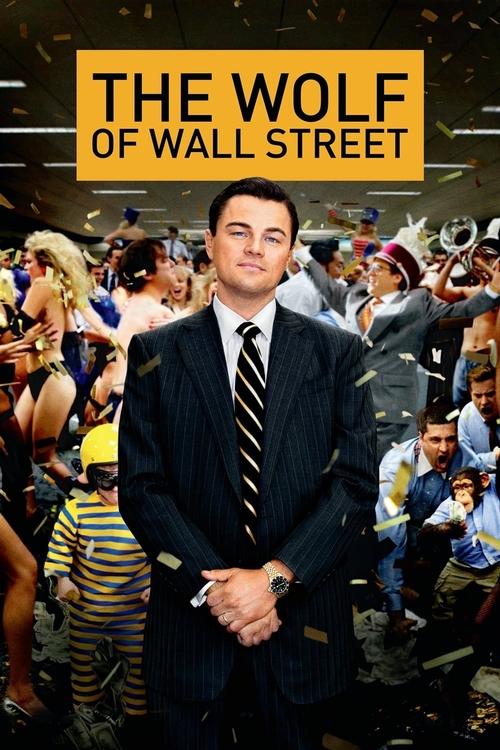
The Wolf of Wall Street
2013 · Martin Scorsese
His "Marvel isn't cinema" comments spawned a years-long culture war about what cinema even is; Killers of the Flower Moon added runtime discourse and questions about centering white perspectives in Osage history. Also beloved as a TikTok dad and Letterboxd's patron saint.
When you want pure adrenaline and outrageous comedy with teeth — a big loud night, not a gentle one. Great with a crowd, and it'll fuel the argument afterward about whether it glorifies what it shows.
What it's about
A young New York stockbroker builds a brokerage on outright fraud and rides it to obscene wealth — mansions, yachts, mountains of drugs, an office culture that runs on greed as a religion. Based on Jordan Belfort's own memoir, it charts the rise, the bacchanal, and the federal investigators slowly closing in. The question isn't whether it can last; it's how much he'll wreck on the way down.
The experience
Three hours that fly like ninety minutes — riotously funny, propulsive, and deliberately exhausting, a party that never lets you off the ride. It seduces you into laughing along, then leaves you queasy about how much fun you had.
Performances
Leonardo DiCaprio gives the most unhinged, physically fearless performance of his career, selling greed as pure charisma; Jonah Hill matches him beat for beat as his grinning enabler, and Matthew McConaughey nearly steals the film in a single lunch scene.
The craft
Scorsese directs at full velocity — whip-pans, freeze-frames, direct-address narration that keeps lying to you — with editing that turns excess itself into the joke and the indictment. The sheer momentum is the point: the filmmaking is as intoxicated as the characters, and it plays best loud and big.
Why it matters
One of the defining films about money culture in the 2010s — endlessly quoted, memed, and misread, its debate over satire versus celebration never settled. It also marked a late-career jolt of pure energy for Scorsese and cemented his partnership with DiCaprio.
Snapshot
Martin Scorsese's three-hour chronicle of stockbroker Jordan Belfort's rise and implosion at the fraudulent brokerage Stratton Oakmont is the most formally aggressive, morally provocative, and physically exhausting film of his late career. It does not punish its protagonist in ways audiences were conditioned to expect from crime cinema, and that refusal is its central argument. Adapted from Belfort's own memoir, the film weaponizes excess against itself — or, depending on one's reading, simply revels in it — and the interpretive contest that followed its release has never been fully resolved. It is a work of radical formal energy applied to the story of radical moral vacancy, and its influence on both prestige cinema and the broader culture of aspirational grotesquerie has been substantial.
Industry & production
Belfort's 2007 memoir had circulated Hollywood for years before DiCaprio's production company, Appian Way Productions, acquired the rights. Terence Winter, who had collaborated with Scorsese on the pilot and early seasons of Boardwalk Empire, wrote the screenplay. The project was financed by Red Granite Pictures, a production company co-founded by Riza Aziz, stepson of Malaysian Prime Minister Najib Razak. Paramount Pictures distributed. The film was made on a reported budget of approximately $100 million — the precise figure has never been officially confirmed — and grossed roughly $392 million worldwide against that cost, constituting a significant commercial success for a 179-minute R-rated adult drama with no action set-pieces in the conventional sense. In a darkly fitting postscript to the film's themes, Red Granite later became a central target of the U.S. Department of Justice's investigation into the 1MDB Malaysian sovereign-wealth-fund scandal; in 2018, the company agreed to pay $60 million to settle civil asset-forfeiture claims, the implication being that funds allegedly stolen from Malaysia had financed a film about financial fraud. The irony was not lost on observers and has since become one of the stranger footnotes in recent Hollywood production history.
The film was shot largely in and around New York and New Jersey. Principal locations included Long Island for the Belfort mansion sequences and Wall Street-adjacent environments for the Stratton Oakmont trading floor, which was built as an elaborate period set evoking the high-pressure, open-plan boiler rooms of the late 1980s and early 1990s. Matthew McConaughey's pivotal scene, shot in a Manhattan restaurant, was among the earliest completed. The production ran long, and Scorsese and Schoonmaker reportedly assembled a first cut well in excess of four hours before arriving at the release version.
Technology
The Wolf of Wall Street was photographed on 35mm film by Rodrigo Prieto, consistent with Scorsese's longstanding preference for photochemical capture. By 2013, the industry had largely migrated to digital acquisition — the film's choice to shoot on celluloid was itself a statement of fidelity to texture and grain. Prieto employed a wide range of lens choices and camera movements, from tight handheld work to wider Steadicam passages, and mixed aspect ratios at points to create a restless, unstable visual field. The production did not rely on significant digital visual effects, instead constructing practical environments — the Stratton Oakmont floor, the yachts, the mansions — that could sustain the long improvisation-heavy takes Scorsese favored. The editing was completed digitally on Avid, which had become Thelma Schoonmaker's standard platform by this period. No single technological innovation defines the film; its technical distinctiveness is a matter of orchestration and intent rather than novelty.
Technique
Cinematography
Rodrigo Prieto's work here constitutes one of the more deliberately anti-beautiful cinematographic choices in prestige American cinema of the decade. The palette is bright, even garish — hot whites, the saturated colors of sunlit wealth — which refuses the moody chiaroscuro of classical crime cinema. Where GoodFellas and Casino occasionally allowed darkness and shadow to imply moral weight, Wolf floods the frame with merciless light. Prieto uses handheld cameras extensively in the crowd and party sequences, generating a sense of barely controlled chaos; Steadicam in the Stratton Oakmont floor scenes sustains longer arcs of performance while preserving kinetic urgency. The direct-address sequences — Belfort turning to the camera to correct or undercut his own narration — demanded camera positions and focal choices that acknowledge the audience as a fourth wall rather than a transparent one.
Editing
Thelma Schoonmaker's editing is among her most formally inventive work with Scorsese. She deploys the fast-cut montage that has characterized their collaboration since Raging Bull, but extends it here into something closer to comedic rhythm — the editing functions as a delivery mechanism for jokes as much as for narrative information. The sequences cataloging Stratton Oakmont's rituals of excess are cut with a propulsive, accumulative logic that is deliberately numbing; the film is, in part, an endurance test that implicates the viewer in the pleasure of watching. Freeze frames punctuate the narration, as they do in GoodFellas, but the Scorsese-Schoonmaker vocabulary is deployed here with a self-consciousness — a slight distance from its own techniques — that reflects the film's ironic register.
Mise-en-scène / staging
The Stratton Oakmont trading floor is the film's great theatrical space. Scorsese stages Belfort's motivational speeches as theatrical performances within performances, the salesforce as crowd and congregation simultaneously. The Quaalude-overdose sequence — in which a severely impaired Belfort crawls across a country-club parking lot, then drives home — is the film's mise-en-scène showpiece: a sustained physical comedy routine that requires DiCaprio to perform without dialogue, dependent entirely on movement and staging. Scorsese shoots it at length, allowing the scene's absurdity to accumulate until it tips into something darker. The film's set design throughout is emphatic: every yacht, every Hamptons interior, every Stratton Oakmont desk encrusted with objects is a prop in an argument about the theater of wealth.
Sound
The film relies almost entirely on pre-existing music, licensed rather than composed for the screen, a practice central to Scorsese's filmmaking since Mean Streets. Robbie Robertson, Scorsese's longtime musical collaborator and former member of The Band, served as music supervisor. The curation moves through period rock and pop — including material by ZZ Top, The Lemonheads, and others — in a manner that encodes each selection as both period signifier and emotional commentary. The voice-over narration by DiCaprio is constant and unreliable, frequently correcting or contradicting the images. The sound design during the Quaalude sequence employs a muted, slowed auditory world that externalizes Belfort's pharmacological impairment. There is no composed orchestral score in any traditional sense; the film refuses that form of emotional guidance.
Performance
DiCaprio's performance as Belfort is the most physically committed work of his career to this point, and arguably the most comedically gifted. His facility with Belfort's rhetorical performance — the speeches are genuine setpieces of oratory — is matched by his willingness to grotesque physical work: the crawl, the chest-thumping ritual borrowed from McConaughey, the rubber-limbed implosions of intoxication. Matthew McConaughey's cameo appearance as mentor Mark Hanna, brief but structurally crucial, features the chest-thumming and humming that the actor had developed as a personal pre-scene ritual; DiCaprio observed it on set, recognized its character value, and the scene was rewritten to incorporate it. Jonah Hill's Donnie Azoff, equipped with prosthetic teeth, provides both comedic foil and moral grotesque. Margot Robbie's film debut as Naomi Lapaglia made immediate and lasting impact — she was cast relatively unknown and left the production a star. Kyle Chandler's FBI agent Denham provides the film's most quietly deflating counterweight.
Narrative & dramatic mode
The film is an exercise in the picaresque rendered at maximum velocity. Its structure is episodic, following Belfort's rise, plateau, and nominal fall through a series of increasingly deranged set-pieces rather than through dramatic causation of the classical kind. The first-person voice-over narration is systematically unreliable: Belfort corrects his own accounts mid-sentence, glosses over inconvenient information, and occasionally turns to address the camera directly to acknowledge the performance of memoir. This double-consciousness — the film is aware that it is adapting a self-serving autobiography by an unrepentant con man — generates its central interpretive problem. The narration seduces; the film is structured to make the seduction pleasurable; and the film's moral architecture, if it has one, lies in the gap between what Belfort claims and what the camera records. Whether that gap constitutes critique or complicity is a question the film declines to resolve.
Genre & cycle
The Wolf of Wall Street belongs to the tradition of the American crime biography — the rise-and-fall narrative whose most celebrated lineage in Scorsese's own filmography runs through GoodFellas and Casino. But it also represents a mutation of that form toward black comedy, even farce, in ways those predecessors did not. The film emerged within a cycle of post-2008 financial-crisis cinema that includes Margin Call (2011), The Big Short (2015), and Billions (television), all of which engage with Wall Street's moral economy; Wolf is the most carnivalesque of these, and the least interested in systemic explanation. It is closer in spirit to the comic excesses of Boogie Nights (1997) than to the procedural exposé. Its most direct generic antecedents are the American outlaw comedy-dramas of the 1970s — the Hal Ashby and Robert Altman mode — retooled through Scorsese's more kinetic sensibility.
Authorship & method
The film consolidates a set of collaborative relationships that have defined Scorsese's cinema for decades. With Thelma Schoonmaker, his editor since Raging Bull, he arrived at a formal approach more overtly comedic than their previous work together. With Rodrigo Prieto, beginning here a relationship that would continue through Silence (2016) and Killers of the Flower Moon (2023), he found a cinematographer capable of the film's deliberately ugly-beautiful visual logic. With Leonardo DiCaprio, who had been his lead since Gangs of New York (2002), he completed the most unguarded film of their five-picture collaboration. Terence Winter's screenplay gave the film its rhetorical energy — Winter's ear for hustler's argot, developed on The Sopranos before his Scorsese work, is operative throughout. Robbie Robertson's presence in the music architecture maintains a through-line to Scorsese's earliest New York films. The film is a late-career work suffused with mastery deployed in the service of apparent recklessness.
Movement / national cinema
The Wolf of Wall Street is a film about and of American capitalism, made within the American studio system by the most canonized figure in American art cinema. Its relationship to any broader cinematic movement is less a matter of allegiance than of synthesis: Scorsese has always operated at the intersection of New Hollywood inheritance and old-Hollywood genre fluency. The film's aggressive energy, its refusal of redemption, and its formal self-consciousness connect it to the New Hollywood tradition Scorsese helped constitute; its sheer commercial ambition and studio framing connect it to mainstream American entertainment. It belongs to no national movement beyond its own national subject.
Era / period
The film is set across roughly the period 1987 to 1995, Belfort's arc at Stratton Oakmont, bracketed by the Black Monday crash and his eventual cooperation with federal prosecutors. The period detail — in costuming, production design, and music — is vivid without being nostalgic; the film is interested in the 1980s and early 1990s as a structure of feeling and a moral climate rather than as an object of period-piece fetishization. That it was released in 2013, five years after the 2008 financial collapse, is a contextual frame the film does not explicitly invoke but which every contemporary viewer inhabited.
Themes
Greed and its pleasures are the film's declared subject, but its deeper engagement is with performance — the performance of wealth, of authority, of masculinity, of sincerity. Belfort is a performer who can only understand the world as an audience. The film asks whether the American Dream is a con perpetrated on the credulous or whether the con is the Dream; it declines to arbitrate. The masculine culture of the trading floor — its rituals, its cruelties, its homoeroticism sublimated into competitive excess — is rendered with both satirical clarity and obvious enjoyment. The inadequacy of institutional consequence (Belfort serves 22 months in federal prison and emerges to a lucrative motivational-speaking career) is the film's darkest joke, delivered in the final shot: the audience at one of Belfort's post-prison seminars, leaning forward, wanting to be told the secret.
Reception, canon & influence
The film received five Academy Award nominations — Best Picture, Best Director, Best Actor (DiCaprio), Best Supporting Actor (Hill), and Best Adapted Screenplay (Winter) — and won none. DiCaprio's loss to Matthew McConaughey (Dallas Buyers Club) was widely contested at the time. The film's critical reception was broadly enthusiastic about its formal achievement and divided over its moral stance; a vocal minority, including Christina McDowell — daughter of a Stratton Oakmont associate and victim of Belfort's schemes — published an open letter arguing that the film's pleasures were irresponsible, a critique that serious critics engaged rather than dismissed.
Looking backward, the film's evident influences include GoodFellas (1990) as the obvious template for criminal-biography narration and formal dynamism; Paul Thomas Anderson's Boogie Nights (1997) for the culture-of-excess picaresque; Barry Lyndon's (1975) epistolary irony applied to a first-person unreliable narrator; and the tradition of oral-history journalism about Wall Street culture. The film's use of direct address and self-correcting narration also recalls the Godardian distanciation techniques Scorsese encountered in his film-school formation.
Its forward legacy is more immediately traceable. Adam McKay's The Big Short (2015) explicitly appropriated the direct-address device and the didactic comedy of excess, credited by McKay in interviews to Wolf's model. Hustlers (2019) applies an analogous picaresque structure to a female criminal ensemble operating in the same post-crash financial atmosphere. Pain & Gain (2013), released the same year, shares the grotesque-comedy-of-American-greed register. The film also exerted significant influence on the culture of aspirational meme content — Belfort as image, the Stratton Oakmont aesthetic, the motivational-speech format — in ways that were both unintended and, from certain angles, damning. The chest-thump, the yacht, the speech: all entered a broader vernacular of performative ambition. Whether the film wanted this is, again, precisely the question it refuses to answer.
A Deleuzian reading
Start with the man who can no longer use his legs.
The full Deleuzian reading of The Wolf of Wall Street →
Reception
Genuinely divisive in 2013 — an Academy member reportedly heckled Scorsese at a screening, and think-pieces raged over whether it endorsed its subject — but it's since settled in as a late-Scorsese classic and one of the decade's most rewatched films.
How The Wolf of Wall Street was received, from release to now →
Influences: the films it descends from and the films it influenced
- GoodFellas (1990) — Wolf directly inherits GoodFellas's criminal-biography apparatus: freeze-frame narration as chapter markers, Schoonmaker's rhythmically accelerating montage, and a picaresque voiceover that simultaneously glamorizes and indicts its narrator.
- Mean Streets (1973) — Scorsese's original template for using pre-cleared rock tracks not as underscore but as environmental texture shaping character performance; Wolf scales this licensed-music-as-world approach to a three-hour picaresque at $100m.
- Raging Bull (1980) — The foundational Scorsese–Schoonmaker editorial collaboration; the rhythmic expressionism and sound-design subjectivity they established here is what Wolf extends—and deliberately vulgarizes—into broad physical comedy.
- Boogie Nights (1997) — Anderson's picaresque traces a decade-long criminal subculture through an ensemble cast scored by licensed pop music in precisely the episodic rise-and-fall structure Wolf borrows for Belfort's 1987–1994 arc.
- Barry Lyndon (1975) — Kubrick's omniscient narrator ironizes a self-deluding protagonist's biography through epistolary distance; Wolf applies this gap—between what the narrator claims and what the camera shows—to Belfort's self-revising first-person voiceover.
- Breathless (1960) — Godard's direct-address fourth-wall breaks and jump-cut editing are the formal precedent Scorsese absorbed in film school; Wolf's self-correcting narrator asides—'actually, let me show you how it really happened'—descend directly from this distanciation device.
- Scarface (1983) — De Palma's criminal-rise-to-grotesque-spectacle picaresque is the formal DNA Wolf inherits and ironizes, replacing De Palma's operatic visual register with comedic vulgarity while preserving the excess-as-self-destruction arc and the immigrant striver's performance of wealth.
- Casino (1995) — Scorsese applies the GoodFellas apparatus—dual voiceover narration, freeze-frames, licensed period music, Schoonmaker cutting—to a Las Vegas excess milieu; Wolf returns to this criminal-biography mode eighteen years later with DiCaprio replacing De Niro and comedy replacing tragedy.
- American Psycho (2000) — Scorsese deploys diegetic period pop music as satirical counterpoint to Reagan-era financial excess — inheriting American Psycho's structural technique of using pop song commentary to render moral horror as dark comedy — while the unreliable narrating Wall Street protagonist reprises the same consumer-masculine satirical subject.
- Blow (2001) — The fullest subsequent development of the confessional crime biography template Blow inhabits: first-person voiceover narrating a decade-spanning rise-and-fall with needle-drop scoring as emotional argument, sustaining a sympathy register for the protagonist through the complete arc of moral collapse — Blow anticipates this mode at lower temperature; Scorsese drives it to maximalist conclusion.
- Wall Street (1987) — Scorsese extends Stone's percussive montage of financial excess to maximalist scale, applying his own rock-track editing grammar to the Faustian stockbroker arc Stone established; Schoonmaker's staccato trading-floor cutting is a direct evolution of Claire Simpson's rhythm, and the charismatic narrator-criminal delivering manifesto-speeches descends from Gekko.
- Catch Me If You Can (2002) — Casts DiCaprio again as a charismatic fraudster narrating his own escalating cons, structured around the dogged federal agent foil — a direct extension of the DiCaprio con-man persona.
- The Big Short (2015) — McKay explicitly credited Wolf's direct-address didactic comedy as his formal model; The Big Short transplants Wolf's fourth-wall narrator-as-explainer device into a non-fiction financial-crisis framework, including characters breaking frame mid-scene to define terms for the audience.
- I, Tonya (2017) — Gillespie's freeze-frame annotations and competing talking-head voiceovers that contradict each other across the same scene are formal descendants of Wolf's self-correcting narrator who rewinds and revises his own account, weaponizing unreliability as the film's primary structural device.
- Hustlers (2019) — Scafaria applies Wolf's criminal-ensemble picaresque structure—oral-history interview framing, sympathetic criminals operating in the post-2008 financial wreckage, a refusal to deliver moral verdict—transposing the same formal sympathy-without-absolution to a female ensemble in the same milieu.
- Babylon (2022) — Chazelle deploys Wolf's fast-cut comedic montage and ensemble grotesque physical performance across a culture-of-excess picaresque; his explicit acknowledgment of Scorsese's excess-comedy register as primary formal reference confirms the inheritance of both the party-sequence handheld approach and the rise-and-fall episodic structure.
- Pain & Gain (2013) — Bay deploys unreliable multi-narrator voiceover presenting real criminals as grotesquely deluded American strivers in a comedy-of-excess register directly parallel to Wolf's; both premiered in 2013 sharing the farce-as-indictment formal stance without delivering the indictment.
- American Hustle (2013) — Russell uses competing unreliable character voiceovers—each narrator revising the same story—and period-licensed pop to drive a criminal picaresque; Wolf's self-correcting narrator and licensed-music world-building appear here in near-simultaneous parallel deployment.
- Spring Breakers (2012) — Korine uses direct-address voiceover to perform aspiration and self-mythologization, granting the narrator the language of desire while the camera supplies the ironic counterargument—the same formal double register Wolf uses to make Belfort's speech both compelling and damning.
- Glengarry Glen Ross (1992) — Inherits the Blake monologue as genre DNA — the predatory sales-motivation sermon and the worship of 'closing' as masculine self-definition — scaled into finance-world bacchanal.
Similar films
- The Big Short (2015) — influence & lineage
- GoodFellas (1990) — influence & lineage
- American Hustle (2013) — influence & lineage
- Casino (1995) — influence & lineage
- Raging Bull (1980) — influence & lineage
- Boogie Nights (1997) — influence & lineage · same viewing thread
- Wall Street (1987) — same viewing thread
- American Psycho (2000) — same viewing thread
All the films related to The Wolf of Wall Street →
Watch it with: curated runs of related films
- The American Male Comes Apart — A run of self-made men — brokers, founders, dealers, drifters — hollowed out by the very thing they chase, each film pressing the same nerve where ambition curdles into alienation and violence.