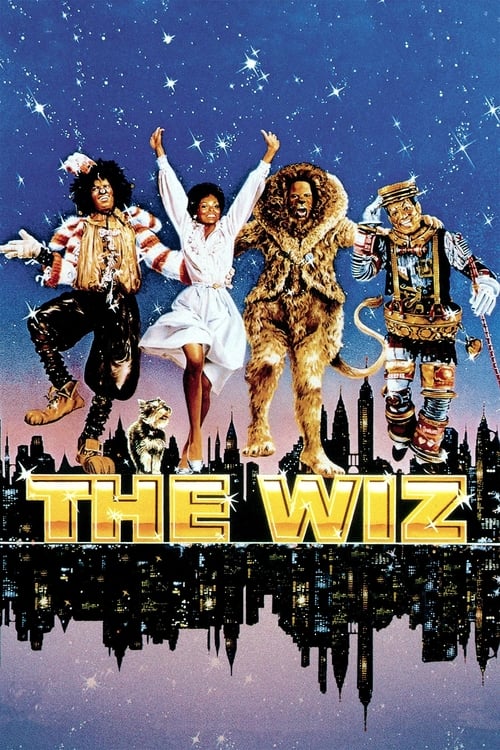
The Wiz
1978 · Sidney Lumet
For a big musical night when you want wonder with soul — or when you need a song about home to hit you square in the chest.
What it's about
A shy Harlem kindergarten teacher who has never ventured south of 125th Street is swept out of her world into Oz — except this Oz is New York City itself, remade into something vast and strange. With a scarecrow, a tin man, and a lion picked up along the way, she eases on down the road toward the Wiz, and toward finding out what home actually means. Diana Ross leads a cast that includes Michael Jackson in his first film role, Richard Pryor, and Lena Horne.
The experience
A huge, strange, soulful spectacle — by turns dazzling, melancholy, and genuinely moving, with funk and gospel numbers that lift the roof. It's uneven and it doesn't care; when it soars, it really soars.
Performances
Michael Jackson is pure joy as the Scarecrow — his first feature role, and his musical numbers are electric — while Diana Ross pours real longing into the finale, and Lena Horne's late appearance is a showstopper.
The craft
One of the most expensive musicals of its era, with staggering production design that transforms real New York landmarks into Oz — subway stations turn menacing, a downtown plaza becomes the Emerald City for a massive disco ballet. Quincy Jones supervised the music, and the songs, especially "Ease On Down the Road" and "Home," are built for good speakers.
Why it matters
A famous flop that cast a long shadow over Black-cast studio musicals — yet it brought Michael Jackson and Quincy Jones together, reshaping pop history, and it has since been embraced as a beloved cultural landmark.
Snapshot
The Wiz is the most expensive and most argued-over Black-cast musical Hollywood ever financed, and one of the strangest films in Sidney Lumet's career. Adapted from the 1975 Broadway hit — William F. Brown's book, Charlie Smalls's songs, seven Tony Awards including Best Musical — it transposes L. Frank Baum's fable into a New York City that has been remade as Oz. Produced by Motown Productions for Universal, it stars Diana Ross as a 24-year-old Harlem kindergarten teacher who has never been south of 125th Street, Michael Jackson in his first feature role as the Scarecrow, Nipsey Russell as the Tin Man, Ted Ross as the Lion, Mabel King as Evillene, Richard Pryor as the Wiz, and Lena Horne as Glinda. It was a commercial disaster and a critical rebuke, and it has since become a durable object of affection and study — partly for its design, partly because the collaboration it accidentally brokered between Quincy Jones and Michael Jackson reshaped popular music within eighteen months of its release.
Industry & production
The film sits at the intersection of two corporate ambitions. Motown Productions, Berry Gordy's film arm, had built a modest run of Diana Ross vehicles — Lady Sings the Blues (1972), Mahogany (1975) — and The Wiz was to be its escalation into major-studio scale, with Rob Cohen, then heading Motown's film division, producing and Universal distributing. Meanwhile the Broadway property was proven: the stage Wiz had opened in 1975 as a genuine phenomenon, and its songs had crossed into radio.
The decisive production choice was casting. On Broadway, Dorothy was Stephanie Mills, a teenager. Ross, then in her thirties, pursued the film role, and her casting forced a wholesale rewrite: Joel Schumacher's screenplay — his work after Sparkle and Car Wash (both 1976), before he turned director — aged Dorothy into an adult schoolteacher and relocated Oz from a generic fantasy space into the boroughs. This is the film's most consequential decision, and nearly every criticism and defense of it descends from there.
Reported budget figures cluster around $24 million, extraordinary for the period and for a musical, with domestic returns falling well short of that; studio accounting from the era is notoriously unreliable, so the precise numbers should be treated as approximate, but the direction is not in dispute. The film lost a great deal of money. Its failure is routinely cited in industry histories as having helped foreclose studio investment in large-scale Black-cast productions for much of the following decade — a claim worth stating carefully, since it functions as an explanation and an alibi, and the causality is more asserted than demonstrated.
Production was New York–based and physically enormous: location shooting across the city plus stage work at the Astoria studio complex in Queens, whose use by the production is generally credited as part of the facility's revival as a working studio. Four Academy Award nominations followed — cinematography, art direction–set decoration, costume design, and adapted song score — with no wins.
Technology
The Wiz is a pre-digital spectacle in the fullest sense: everything on screen was built, lit, dressed, or shot in camera. The Emerald City does not change color through post-production; it changes because several hundred dancers change costume and the lighting shifts with them. The Munchkins are graffiti figures who peel off a playground wall — an effect achieved through design, makeup, and staging rather than compositing. The tornado, the flying monkeys as a motorcycle gang, the celestial finale with Glinda among stars: these draw on the era's optical and matte-work vocabulary, and they show their seams in ways a modern audience reads as either charming or clumsy depending on temperament.
The film was shot on 35mm in anamorphic widescreen, which matters: the scope frame is what allows the World Trade Center plaza sequences to register as mass choreography rather than as coverage of a crowd. It arrived at the moment Dolby Stereo optical prints were becoming standard release practice for musicals, and the picture's sonic ambition — a large orchestra, a disco-era rhythm section, gospel choir — assumes an exhibition environment that could carry it.
Technique
Cinematography
Oswald Morris shot it, and the choice was shrewd. Morris was the British cinematographer most associated with deliberately unnatural color — the diffused, poster-like Moulin Rouge (1952), the desaturated Moby Dick (1956) — and an Oscar winner for Fiddler on the Roof (1971). The Wiz is a film in which color is argument rather than description: each Oz location is keyed to a dominant hue, and the sequence from Harlem's snowbound naturalism through the poison reds of the Poppy Field to the Emerald City's programd green-red-gold is legible as a designed progression rather than a series of looks.
Morris and Lumet favor wide lenses and deep space, particularly on the plaza, where the point is the relation of small figures to vast architecture. The night exteriors are the film's best photography: real New York, hard practical light, black sky, and hundreds of bodies. The weakness is the reverse case — intimate scenes where the same hard, theatrical light flattens faces that the story needs us to read closely.
Editing
Dede Allen cut it, which is a fascinating mismatch. Allen was the editor who had, in Bonnie and Clyde (1967) and in her Lumet collaborations Serpico (1973) and Dog Day Afternoon (1975), pioneered a nervous, elliptical American cutting style — overlapping sound, aggressive fragmentation, rhythm derived from anxiety. The musical is the genre most hostile to that instinct. Dance wants sustained framing and legible bodies; the classical musical's default is the long take that lets you see the whole dancer. The Wiz frequently cuts its numbers into coverage instead, so choreography reads as energy rather than as movement. The result is a film that is often thrilling and rarely danceable on screen — a structural, not incidental, limitation, and the one most responsible for the sense that the picture's scale never quite converts into lift.
Mise-en-scène / staging
This is where the film earns its place. Tony Walton designed both sets and costumes, and his conceit — Oz as a warped New York — is the adaptation's real idea. Munchkinland is a graffiti-covered playground. The Tin Man rusts in a derelict amusement park. The Lion is discovered as one of the stone lions on the steps of the New York Public Library. The Poppy Field becomes a red-lit plaza of streetwalkers. Evillene runs a subterranean sweatshop. Emerald City is the World Trade Center plaza, where fashion is decreed by loudspeaker and an entire population changes color on command. And the subway sequence — animate trash cans, pillars that come alive, a hostile peddler — is nearly a horror set piece, and remains the most frightening thing in any Oz film.
The organizing insight is that a city is already a fantasy landscape to someone afraid of it. Every terror in this Oz is a terror of urban life; every wonder is an urban wonder. Louis Johnson's choreography works this seam, moving between social dance, gospel processional, and the mass-ornament formations the plaza invites.
Sound
Quincy Jones supervised and adapted the score, retaining Smalls's stage songs — "Ease on Down the Road," "Home," "Believe in Yourself," "Don't Nobody Bring Me No Bad News" — alongside "Everybody Rejoice (A Brand New Day)," written for the stage production by a then-young Luther Vandross. Jones added material for the film, including "You Can't Win" for Jackson's Scarecrow. His arrangements pull the material away from Broadway toward the recording studio: bigger, funkier, closer to the R&B and disco charts of 1978 than to pit orchestration. Numbers were prerecorded and performed to playback in the standard manner. The gospel architecture of "Brand New Day" — a liberation anthem sung by workers shedding their coverings — is the score's emotional peak, and it is arranged as a church number, not a showtune.
Performance
Ross gives a genuinely unusual musical-star performance: small, tremulous, withheld, sometimes to the point of opacity. It reads as miscasting if you want Dorothy to be a child and as interpretation if you accept the film's premise that she is an adult in retreat from her own life. Jackson is the film's discovery — weightless, sweet, physically articulate under heavy prosthetics, and the only performer whose musical numbers and acting occupy the same register. Nipsey Russell brings vaudeville rhyme and timing to the Tin Man; Ted Ross and Mabel King carry their stage performances intact, and King's Evillene is a hurricane. Pryor plays the Wiz small and frightened — a failed Atlantic City politician stranded by a balloon — a deliberately anti-comic choice that many critics read as a waste of him. Lena Horne's late-film "Believe in Yourself" is a star turn of the old order, and it is worth noting that Horne was Lumet's mother-in-law at the time.
Narrative & dramatic mode
The film converts a child's quest into an adult allegory of agoraphobia and self-authorship. Dorothy is not homesick; she is home-bound. The journey does not restore her to a place — it makes the place inhabitable by changing her relation to it. "Home," accordingly, is sung not as nostalgia but as a claim about interiority, and "Believe in Yourself" arrives as therapeutic instruction in a decade saturated with self-actualization language. The structure stays faithful to the picaresque of the source — companion accumulation, trials, false authority unmasked, return — but the tonal mode shifts between fable, urban nightmare, and gospel testimony, and the transitions are not always controlled. At roughly two and a quarter hours, it is long for its material, and the middle sags in ways contemporary reviewers were quick to name.
Genre & cycle
The Wiz belongs to the last cohort of studio-scale movie musicals before the form collapsed as a reliable investment — released the same year as Grease and Sgt. Pepper's Lonely Hearts Club Band, just ahead of Hair and All That Jazz (both 1979). It also closes out a specifically 1970s cycle of Black-audience features and Motown's brief run as a film producer. And it belongs to an older, more complicated lineage: the Hollywood all-Black-cast musical, from The Green Pastures (1936) through Cabin in the Sky and Stormy Weather (both 1943) to Carmen Jones (1954) — a tradition of Black recastings of white forms that offered extraordinary showcases inside segregated terms. Lena Horne's presence in the film is a direct line back to that history.
Authorship & method
Lumet is the anomaly here — a director of moral procedurals (12 Angry Men, Serpico, Dog Day Afternoon, Network, later Prince of the City) with no musical experience, taking on a genre that rewards exactly the qualities his cinema lacks: lightness, sustained physical display, artifice held with confidence. What he brings instead is New York, rehearsal discipline (he worked in extended pre-shoot rehearsal, theater-fashion), and a documentary conviction about place. His own writing on craft, in Making Movies (1995), treats production design as where a film's visual thesis gets decided, and The Wiz bears that out: the design is the interpretation.
The collaborators are the story. Walton supplies the concept; Morris supplies the palette; Jones supplies the sound and, incidentally, the future; Allen supplies a cutting sensibility at odds with the genre; Schumacher supplies the premise that makes it all necessary. Charlie Smalls's songs survive every layer of intervention.
Movement / national cinema
This is New York cinema, made in a New York that had just come through fiscal near-collapse in 1975, the 1977 blackout, and a decade of visible decay. The 1970s New York film — The French Connection, Taxi Driver, Lumet's own police pictures — treated the city as evidence of institutional failure. The Wiz does something different with the same material: it takes the decayed city and insists it is also enchanted. The subway is a monster and the World Trade Center is a palace, and both readings are photographed on location. That doubleness is the film's contribution to the New York picture.
Era / period
1978 is post–New Hollywood and mid-blockbuster: Jaws and Star Wars had already reset what studio scale meant, and Saturday Night Fever had just demonstrated that a soundtrack could drive a film's economics. The Wiz was conceived inside that logic — record-company money, chart-facing arrangements, star-as-brand — and failed to deliver on it. Its release also coincides with disco's commercial peak and the crossover economics that made Motown's film ambitions plausible in the first place.
Themes
Fear of the world and the self-knowledge that dissolves it; the city as simultaneous threat and possibility; labor and emancipation, staged literally in Evillene's sweatshop; the fraudulence of authority, with the Wiz as a hollow politician rather than a benign humbug; and, structurally, a Blackness so total in the film's world that it goes unmarked — an Oz where no one is a minority. The film's least discussed theme is professional: Dorothy is a teacher, and her journey is toward the confidence her vocation already implies.
Reception, canon & influence
Contemporary reviews were largely hostile. The recurring objections — Ross too old and too withdrawn for Dorothy, the scale overwhelming the whimsy, the direction unsuited to musical rhythm, the length — were widespread enough to constitute consensus, and the box-office outcome was severe. The four Oscar nominations, all in craft categories, register the split precisely: the design and sound were admired; the film was not.
Its backward debts are dense. It must contend with the 1939 Victor Fleming film, the most-seen American movie of its century, and its strategy is refusal rather than homage — no ruby slippers, no sepia Kansas, a wholly different musical idiom. Beneath that sit Baum's 1900 novel, the 1975 stage show and its Tony-winning company (Ted Ross and Mabel King carried over), the Black musical-theater tradition, gospel form, and the visual culture of graffiti-era New York.
Forward, its most significant legacy is oblique: Michael Jackson and Quincy Jones met on this production, and the working relationship that began there produced Off the Wall (1979), Thriller (1982), and Bad (1987) — arguably the most commercially consequential collaboration in recorded music. Jackson's own later screen work, with its transformations, prosthetics, and dance-through-the-city staging, is legible as an extension of what he learned here. The film's Emerald City fashion sequence anticipates music-video grammar by several years.
The property itself proved far more durable than the film's reception suggested: The Wiz Live! (NBC, 2015) drew a large broadcast audience and cast Stephanie Mills — the original Broadway Dorothy — as Aunt Em, and a Broadway revival opened in 2024. "Ease on Down the Road" has long since detached from both film and show to become a standard. And the film has been reclaimed across generations of Black audiences as a formative text, cherished for exactly the qualities 1978 critics found excessive. Scholarly reassessment has been steady rather than dramatic; the fullest accounts of the production's internal decision-making remain thin, and much of what circulates about who wanted what is anecdote rather than record. What is not in doubt is that a film widely written off as a failure has outlasted most of the year's successes, and that its influence traveled through a channel nobody planned.
A Deleuzian reading
There is a stone lion on the steps of the New York Public Library.
The full Deleuzian reading of The Wiz →
Reception
A notorious 1978 flop — critics savaged it and its huge budget loss was blamed (fairly or not) for cooling Hollywood's investment in Black-led films for years. Decades of TV reruns turned it into a beloved cultural touchstone, especially in Black American households, and it's now warmly reclaimed as a cult classic.
How The Wiz was received, from release to now →
How to watch The Wiz: what to notice on a first viewing
- Watch the crowd in Emerald City change color together. Hundreds of dancers shift costume color on a single loudspeaker cue in the World Trade Center plaza, moving as one continuous mass rather than as individual figures. The city tells this crowd what to feel, and it obeys all at once.
- Notice that every Oz landmark is a real New York place. Tony Walton turns Munchkinland into a graffiti playground, the Lion into a stone library lion, and Emerald City into the World Trade Center plaza, finding Oz rather than inventing it. Every wonder and every terror here already existed on an actual block.
- Listen for the score pulling toward funk and gospel, not showtunes. Quincy Jones arranges Charlie Smalls's stage songs closer to the R&B and disco charts of 1978, with a full church choir arrangement anchoring the film's emotional peak. This score comes from a recording studio, not a Broadway pit, and it sounds like it.
- Watch the subway pillars and trash cans come alive. Ordinary subway fixtures, pillars, trash cans, a peddler, turn hostile with no witch or monster required, staged as the film's most frightening passage. The scariest thing in this Oz is furniture you already recognize from real life.
- Watch how clearly Michael Jackson moves under heavy prosthetics. As the Scarecrow, Jackson's numbers and his acting occupy the same physical register, weightless and precise, in his very first feature film role. You can see, even under makeup, exactly why this performer was about to become huge.
The whole guide to watching The Wiz, with the keys for a rewatch →
Influences: the films it descends from and the films it influenced
- The Wizard of Oz (1939) — Supplies the structural armature The Wiz systematically recodes — the color-threshold arrival reveal, the four-companion road as a chain of numbers, the doubled-casting of home-world figures as Oz figures — with Lumet substituting a Harlem-to-Emerald-City palette shift for the sepia-to-Technicolor cut.
- Cabin in the Sky (1943) — Establishes the all-Black-cast studio musical in which fantasy is achieved by production design and crane-borne camera movement through built sets rather than optical effects — Lumet's dictum that design is the interpretation runs straight through Minnelli.
- Stormy Weather (1943) — The Nicholas Brothers' architectural staircase finale models the number-as-set-piece where choreography is designed against built geometry, the logic behind the Emerald City runway and the Scarecrow's descent staging.
- Carmen Jones (1954) — First to stage an all-Black company in anamorphic widescreen with sustained deep-space blocking rather than proscenium framing — the precedent for Oswald Morris's wide, laterally-loaded compositions of massed Black performers.
- Moulin Rouge (1952) — Oswald Morris's fog filters and colored smoke pumped onto set to bend Technicolor toward Toulouse-Lautrec lithography — the origin of his practice of keying an entire film's palette to a prior visual source, applied here to graffiti-era New York.
- Fiddler on the Roof (1971) — Morris shot it through a brown silk stocking stretched over the lens to enforce a single unified color argument across a musical; The Wiz repeats the method with saturation pushed the opposite direction, and Morris's Oscar nomination here and there marks the continuity.
- Gold Diggers of 1935 (1935) — 'Lullaby of Broadway' invents the overhead mass-ornament number in which dancers stop being individuals and become abstract pattern — the direct grammar of the Emerald City sequence's regimented color-change crowd.
- West Side Story (1961) — Proved that large-ensemble choreography could be executed on actual New York asphalt and cut against real urban geography, licensing 'Ease on Down the Road' as a march across identifiable city sites rather than a soundstage road.
- Sweet Charity (1969) — Introduces the shattering of a single dance into dozens of short, non-matched setups with zooms and freeze-frames — the coverage philosophy that lets a director without musical instincts assemble a number in the cutting room.
- Bonnie and Clyde (1967) — Dede Allen's signature — cutting across the axis, advancing sound ahead of picture, building rhythm from mismatched fragments — is imported wholesale into The Wiz's dance coverage, where she cuts musical numbers like action rather than letting bodies play out.
- Dog Day Afternoon (1975) — The Lumet–Allen working method in full: weeks of theater-style pre-shoot rehearsal, New York locations treated with documentary conviction, and cuts made on performance beats — the same apparatus turned, incongruously, on a fantasy musical three years later.
- Lady Sings the Blues (1972) — Builds the Motown-financed star vehicle around Diana Ross's mic-forward, close-held vocal performance style, establishing both the production apparatus and the intimate-singer register she carries into Dorothy against a spectacle far too large for it.
- Thriller (1983) — Jackson's prosthetic transformation-while-dancing descends directly from Stan Winston's Scarecrow build, which taught him a face could be entirely buried and still carry a number; the Quincy Jones partnership underwriting it was formed on The Wiz's scoring stage.
- Bad (1987) — Stages its entire number in a working New York subway station (Hoyt–Schermerhorn), converting the tunnel from The Wiz's site of horror into a gang-formation dance floor — the same underground-as-expressionist-stage premise, inverted.
- The Color Purple (1985) — Quincy Jones extends the gospel-liberation anthem as structural climax — a choir sequence arranged to deliver narrative release through call-and-response build rather than dialogue — the same architecture as 'Brand New Day' and 'Home.'
- Dreamgirls (2006) — Restores the all-Black-cast studio musical at scale and stages its centerpiece as a sustained, minimally-cut hold on a single singer's escalating gospel attack — the counter-move to Allen's fragmentation, made possible by The Wiz having proved the audience existed.
- Hair (1979) — Released months later with the same wager: Twyla Tharp's mass choreography executed in real, unmodified New York public space — Central Park, Washington Square — the crowd-in-found-location number as the late-70s alternative to the soundstage musical.
- All That Jazz (1979) — Takes fragmented dance coverage to its terminus, cutting numbers into shards synchronized to editing rhythm rather than musical phrase, and shares The Wiz's condition — a studio musical made at the moment the form's economics had already failed.
Similar films
- The Wizard of Oz (1939) — influence & lineage
- Wicked (2024) — shared sensibility
- Wicked: For Good (2025) — shared sensibility
- The Greatest Showman (2017) — shared sensibility
- Michael (2026) — shared sensibility
- Crooklyn (1994) — shared sensibility
- Fantasia (1940) — shared sensibility
- Beetlejuice (1988) — shared sensibility