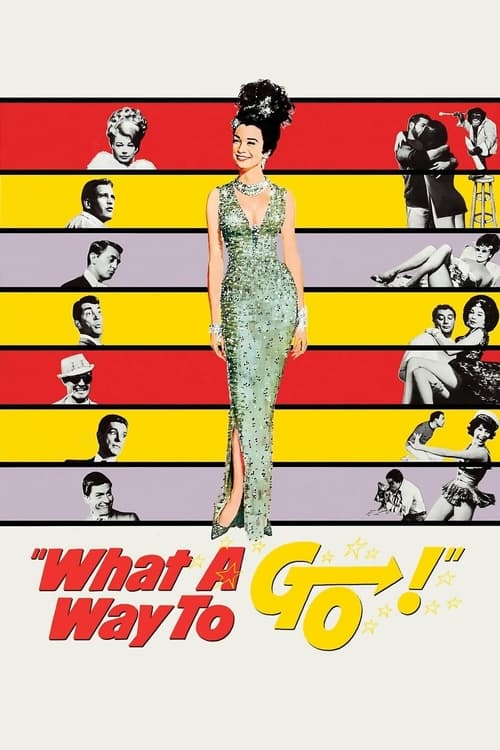
What a Way to Go!
1964 · J. Lee Thompson
For a frothy, no-stakes night when you want old-Hollywood glamour, costume-parade excess, and a body count played entirely for laughs. Pure comfort viewing with a wicked streak.
What it's about
A four-time widow, now grotesquely rich, sits down with a psychiatrist and tries to explain how she got this way — and to give her fortune back to the government. Each of her husbands, she recounts, was a modest man who caught a fatal fever for wealth, struck it big, and died of his own ambition. Every marriage plays out as its own movie-within-the-movie, spoofing a different Hollywood style.
The experience
A big, glossy, giddy dark comedy — death played as running gag, excess played for laughs, with the anthology structure keeping it fizzy from one husband to the next. It's a candy-colored spectacle that never asks you to take any of it seriously.
Performances
Shirley MacLaine carries the whole parade with comic grace, reinventing herself for each marriage, while a murderers' row of leading men — Dick Van Dyke, Paul Newman, Robert Mitchum, Gene Kelly, Dean Martin — each gets a turn as a husband doomed by his own drive.
The craft
The film's best trick is stylistic: each marriage is staged as a parody of a movie idiom — silent slapstick, arty European cinema, glossy studio romance, splashy musical — so it doubles as an affectionate tour of Hollywood's own clichés. Edith Head's outrageous costumes and the widescreen studio gloss make it a genuine eye-candy picture that rewards a big, bright screen.
Why it matters
A late, lavish gasp of the big-studio comedy machine, it's remembered as a showcase for MacLaine at her peak and for its almost absurd concentration of 1960s star power in one cast.
Snapshot
What a Way to Go! is a lavish 20th Century-Fox comedy in which Shirley MacLaine plays Louisa May Foster, a woman whose four husbands each succumb to a fatal appetite for wealth, leaving her a serially bereaved and grotesquely rich widow. The film's organizing conceit is confessional: Louisa recounts her marriages to a psychiatrist (Robert Cummings) while trying, absurdly, to hand her fortune back to the government. Each marriage is dramatized not in a uniform style but as a parody of a distinct movie idiom — silent slapstick, European art cinema, glossy studio romance, and the MGM musical — so that the picture doubles as an anthology of Hollywood self-caricature. Around MacLaine, Fox assembled a marquee of male leads (Dick Van Dyke, Paul Newman, Robert Mitchum, Gene Kelly, plus Dean Martin), draped the whole in Edith Head couture and Leon Shamroy's CinemaScope color, and set it to Nelson Riddle's orchestrations. It is a film best understood as a mid-1960s studio spectacle turned inward — the machinery of glamour deployed to mock the pursuit of glamour and money alike.
Industry & production
The film was produced by Arthur P. Jacobs, the Hollywood publicist-turned-producer for whom it was among the first productions of his APJAC company, released through 20th Century-Fox. Its development sat squarely in the moment when the major studios were answering the erosion of the classical system with high-cost, star-saturated event pictures; What a Way to Go! belongs to that impulse toward opulence-as-selling-point rather than to any economical trend. The screenplay was written by Betty Comden and Adolph Green — the celebrated MGM songwriting-and-scenario team behind Singin' in the Rain and The Band Wagon — working from a story by Gwen Davis, and their background in the musical is legible throughout the film's structure of set-piece pastiche.
Casting was itself the production's headline. Assembling MacLaine opposite Van Dyke, Newman, Mitchum, Kelly, and Martin represented a concentration of star salary and drawing power unusual even for the period, and the film leaned on that roster in its marketing. The production is also remembered for the scale of its wardrobe: Edith Head designed an enormous number of costumes for MacLaine, and the costume budget is frequently cited as one of the most extravagant of its era. Precise dollar figures for that wardrobe and for the film's overall budget circulate in popular accounts, but they should be treated cautiously — the commonly repeated numbers are not consistently documented, so the safer claim is simply that the picture was conceived and sold as a top-tier, high-cost Fox production. Its commercial performance was moderate rather than sensational; the detailed box-office record is thin enough that firm figures are best not asserted.
Technology
What a Way to Go! was made in CinemaScope and color by DeLuxe, the widescreen anamorphic-plus-Fox-color combination that had become the studio's house format for prestige releases. The technological interest of the film, however, is less in a single innovation than in how deliberately it exploits the full apparatus of mid-1960s studio filmmaking as a comic instrument. The wide anamorphic frame and saturated color stock — tools built to sell scale and glamour — are turned toward pastiche, so that the "Lush Budget Production" segment can flaunt exactly the plush Technicolor-romance sheen it is mocking. The parody of European art cinema, by contrast, is rendered in a stripped, monochrome, subtitled register, using the absence of the studio's own color-and-scope machinery as a joke. There is no evidence the film pioneered any process; its sophistication lies in the self-aware manipulation of established Fox production technology.
Technique
Cinematography
The photography is credited to Leon Shamroy, one of the most decorated cinematographers of the studio era and a Fox mainstay associated with the studio's most lavish color and CinemaScope productions. Shamroy's contribution here is the disciplined command of multiple visual registers within a single film. The frame narrative in the psychiatrist's office is clean and contained; the marriage vignettes each demand a different photographic grammar — the flat, iris-and-vignette look of silent comedy; the grainy, subtitled austerity of the "foreign film"; the deep, glazed color and diffusion of the studio-romance fantasy; and the bright, high-key sheen of the musical number. That a single cinematographer modulates so precisely between these idioms is the picture's most substantial craft achievement, and it reflects Shamroy's fluency with the very glamour photography the film is spoofing.
Editing
The editing carries the burden of the film's anthology architecture, cutting between the present-tense confessional framework and four self-contained stylistic worlds, each of which must both function as pastiche and return the viewer cleanly to Louisa's narration. The rhythm therefore shifts by segment — slapstick timing in the silent parody, longueurs and elliptical cutting in the art-film sequence, and the propulsive continuity of a production number in the musical. Attribution of the individual editor should be made with some care; the detailed craft credits for the film are less consistently documented than its star and design credits, and I would rather flag that thinness than assert a name I cannot fully verify.
Mise-en-scène / staging
Design is arguably the film's true subject. The staging is organized around escalation and excess: sets, gowns, and décor grow more absurdly opulent as Louisa's fortunes rise, visualizing the runaway logic of wealth. Edith Head's costumes are not incidental decoration but a structuring element, marking Louisa's transformation across marriages and supplying much of the picture's visual comedy through sheer maximalism. Within each parody segment the staging is keyed to its target style — the pantomimic blocking of silent comedy, the affected minimalism of the art film, the plush interiors of the romance, the choreographed space of the musical. The mise-en-scène thus operates on two levels at once: it must be beautiful enough to please and excessive enough to satirize.
Sound
Sound design follows the same register-switching principle as the image. The silent-comedy segment leans on the convention of image-with-music and gag-scored action; the art-film parody exploits foreign-language dialogue and subtitling as a comic device; the musical sequence foregrounds performed song and dance. Across the whole, Nelson Riddle's scoring provides the connective tissue, adjusting idiom to match each pastiche while maintaining a consistent comic sensibility. The film's use of sound is best read as another axis of parody rather than as a site of technical experiment.
Performance
MacLaine anchors the film, and the role is built to her strengths: she must play both the grounded, sympathetic center of the frame narrative and the shape-shifting heroine of four stylistically incompatible fantasies, adjusting her performance to silent-comedy broadness, art-film affect, romantic gloss, and musical brightness in turn. The male leads function largely as comic types calibrated to their segments — Van Dyke's manic overwork, Newman's bohemian art-machine obsessive, Mitchum's tycoon, and Kelly's performer-turned-star, with Kelly's presence in the musical vignette carrying obvious meta-textual weight given his MGM history. The performances are deliberately pitched to pastiche rather than to naturalism, and their success is measured by how legibly each actor inhabits the style being parodied.
Narrative & dramatic mode
The film's dramatic mode is satirical comedy organized as a framed anthology. The present-tense frame — Louisa's session with her psychiatrist and her doomed attempt to reject her wealth — supplies the through-line and the moral thesis, while the four embedded marriages function as discrete, stylized episodes. This is essentially an episodic, iterative structure: a repeated pattern (husband becomes obsessed with getting rich, husband dies of the obsession, Louisa is richer and more miserable) that accrues meaning through variation. The device recalls the revue or musical-anthology logic that Comden and Green knew intimately, and it privileges tonal invention over sustained psychological development. The dramatic engine is not suspense about whether each husband will die — the title guarantees the outcome — but delight in how each death, and each marriage, will be stylistically rendered.
Genre & cycle
What a Way to Go! sits at the intersection of the star-comedy and the movie-about-movies. It belongs to the mid-century cycle of glossy, big-budget studio comedies built around a marquee cast and lavish production values, and simultaneously to the durable Hollywood tradition of self-referential parody, in which the industry lampoons its own genres. Its four-part pastiche structure aligns it with the sketch or revue film, while its satire of wealth places it within the long line of comedies about money's corrupting pull. It is not a genre innovator so much as a genre anthologist — a film whose novelty is the breadth of idioms it stages under one roof.
Authorship & method
Authorship here is genuinely distributed, and the film resists a straightforward auteurist reading. J. Lee Thompson, the British director, came to the project from a very different register: he was best known for taut, muscular pictures such as The Guns of Navarone (1961) and Cape Fear (1962), and What a Way to Go! represents a marked excursion into lavish comedy. His task was less the imposition of a personal style than the orchestration of many borrowed styles, and the film's coherence is a matter of managed tonal discipline across wildly different segments.
The decisive creative signatures may in fact belong to his collaborators. Comden and Green's screenplay supplies the anthology-of-pastiche architecture that defines the film. Leon Shamroy's cinematography realizes each stylistic world. Edith Head's costume design furnishes the film's central visual argument about escalating excess. Nelson Riddle's music binds the episodes. And producer Arthur P. Jacobs assembled the star package and production scale that made the concept viable. The film is thus best described as a producer-and-designer-driven studio spectacle executed by a versatile director — an authorship of assembly rather than of singular vision.
Movement / national cinema
The film is a product of the American studio system in its late-classical phase, made at 20th Century-Fox and steeped in Hollywood's own history and genres. It does not belong to any movement in the avant-garde or national-cinema sense; on the contrary, its art-film parody segment defines itself against the contemporaneous European art cinema by caricaturing it. If the picture has a "national" character, it is precisely its Hollywood-ness — its reliance on the star system, the anamorphic color spectacle, and the genre memory of the American studio film — even as it enlists a British director in the execution.
Era / period
What a Way to Go! is very much a 1964 studio artifact, made as the classical Hollywood order was straining against television, rising costs, and shifting audiences, and as the majors were betting on high-gloss, star-laden event films. Its confessional psychiatrist framework, its satire of postwar affluence and status anxiety, and its knowing parody of both Hollywood genres and imported art cinema all mark it as a mid-1960s film conscious of its own moment. It arrives just before the more thoroughgoing stylistic upheavals of the later decade, and it can be read as the studio system amusing itself with its own conventions on the eve of their transformation.
Themes
The governing theme is the destructiveness of the pursuit of wealth. In each marriage, love and contentment are available until ambition intervenes; the drive to be rich is literally fatal, and the fortune it produces brings Louisa only isolation and guilt. The film sets material excess against emotional sufficiency, repeatedly suggesting that Louisa was happiest when she and her husband had least. A second, closely braided theme is the artifice of glamour itself: because the film renders its story through cinematic pastiche, its spectacle of gowns, sets, and color becomes a comment on how movies manufacture desire. There is also a running satire of American status and consumption — the equation of worth with wealth — and, in the frame narrative, a gentle mockery of mid-century psychiatry and of the very idea that so much money could be a "problem" to be talked through.
Reception, canon & influence
Contemporary reception was mixed-to-moderate, and the film settled into history as a curiosity rather than a canonical comedy: admired for its cast, its Edith Head wardrobe, and the ambition of its pastiche structure, but often judged uneven across its segments and overlong for its premise. It has never occupied the front rank of either the star-comedy canon or the movie-about-movies tradition, though it retains a following precisely for its excess and its assembly of stars.
Looking backward, the film's influences are wholly internal to Hollywood: it draws directly on the genres it parodies — silent slapstick, the MGM musical (with Gene Kelly's own history a pointed reference), the glossy studio romance — and it defines itself in contrast to the European art cinema then ascendant. Comden and Green's musical-revue sensibility is the connective creative lineage. Looking forward, its legacy is modest and diffuse rather than foundational; it is more a late, luxuriant expression of the studio-parody tradition than the origin of a new one. Its most durable afterlife lies in costume and design history, where MacLaine's Edith Head wardrobe is regularly invoked as a touchstone of 1960s Hollywood extravagance, and in its standing as a case study of the mid-decade all-star studio comedy. Where the historical record on its precise financial and craft particulars is thin, that thinness is itself telling: the film is remembered less for documented milestones than for the sheer spectacle of its conceit.
Reception
Critics in 1964 largely shrugged at it as an overstuffed star parade, but audiences made it a solid hit — and it's since been reclaimed as a glorious camp time capsule, catnip for anyone who loves Edith Head costumes and mid-60s Hollywood excess.
How What a Way to Go! was received, from release to now →
How to watch What a Way to Go!: what to notice on a first viewing
- Notice each marriage is shot in a totally different movie style. One husband's story plays like silent slapstick, another like grainy European art film, another like glossy studio romance, another like an MGM musical number. The film is less about four husbands than about four ways Hollywood tells a love story.
- Watch how much more lavish the sets and gowns get. Edith Head's costumes and the surrounding décor grow more absurdly opulent as Louisa's fortune rises, visualizing the runaway logic of wealth itself. The clothes are keeping score of the money as clearly as any dialogue would.
- Notice the picture's look change completely with each new husband. Cinematographer Leon Shamroy switches between the flat iris look of silent comedy, grainy subtitled austerity, glazed romantic color, and bright musical sheen. One cinematographer is doing the work of four different movies inside a single film.
- Watch MacLaine's acting style change with each marriage's genre. MacLaine adjusts from silent-comedy broadness to art-film affect to romantic gloss to musical brightness, staying the grounded center through all four registers. You are watching one actress prove she can do four different jobs inside the same picture.
- Listen for the music change style with each marriage segment. Nelson Riddle's score adjusts idiom to match each pastiche, from silent-movie gag scoring to foreign-film restraint to full musical performance, while staying tonally consistent. The score is doing the same genre switching as the picture and the costumes.
The whole guide to watching What a Way to Go!, with the keys for a rewatch →
Influences: the films it descends from and the films it influenced
- Singin' in the Rain (1952) — Comden and Green's own screenplay pioneers the movie-about-movies pastiche architecture — self-contained recreations of Hollywood's evolving styles — that they hand directly to What a Way to Go!, whose musical episode also leans on Gene Kelly's dance iconography.
- The Band Wagon (1953) — Comden and Green's revue structure, culminating in the noir 'Girl Hunt Ballet,' models the practice of nesting a complete, hermetically-styled genre world inside a single picture — the exact device WAWTG repeats across silent, musical, and art-film episodes.
- An American in Paris (1951) — Its extended dream-ballet-as-climactic-fantasy and Gene Kelly's choreographic vocabulary are the specific idiom the film's 'MGM musical' segment imitates and gently mocks.
- Ziegfeld Follies (1946) — The MGM revue-anthology of discrete star turns strung on escalating spectacle rather than plot supplies WAWTG's episodic-iterative, star-ensemble-as-structure logic.
- Les Girls (1957) — Its Rashomon-style courtroom framing, in which one woman's serial entanglements are replayed as conflicting stylized flashbacks, is the frame-plus-pastiche method WAWTG adopts wholesale (widow narrates each marriage as a genre).
- Sabrina (1954) — Edith Head's costume-as-narrative-argument — wardrobe marking a heroine's transformation — is the technique WAWTG amplifies into 'costume-as-structure' and escalating sartorial excess.
- Pillow Talk (1959) — The glossy DeLuxe-color star romance built on fashion-as-spectacle and split-screen glamour is precisely the studio-romance register the film parodies in its glamour episodes.
- Breathless (1960) — The nouvelle-vague affectations — jump cuts, handheld informality, Left Bank pretension — are the European art-cinema idiom the film defines itself against and spoofs directly in the Paris-painter episode.
- Movie Movie (1978) — Donen extends the studio-parody tradition into a feature-length double-bill of meticulously reconstructed old-Hollywood genres, the pastiche-anthology conceit made whole.
- Pennies from Heaven (1981) — Deploys immaculate MGM-musical pastiche numbers as ironic counterpoint to a bleak story, weaponizing the fantasy-episode-inside-a-frame device WAWTG uses comically.
- Death Becomes Her (1992) — A dark comedy of glamour and wealth-corruption driven by escalating visual excess and costume, extending WAWTG's 'artifice-of-glamour' satire into the effects era.
- Down with Love (2003) — A scrupulous pastiche of the Doris Day/Rock Hudson CinemaScope romance — its split-screen, saturated color, and fashion-as-spectacle — reviving the exact glossy-romance mode WAWTG parodied.
- Hail, Caesar! (2016) — Structures a movie-about-movies as an anthology of painstakingly recreated studio-genre pastiches (aquatic musical, western, prestige drama), the purest modern heir to WAWTG's genre-per-episode architecture.
- La La Land (2016) — Revives the classical MGM-musical pastiche and the fantasy production number as an emotional idiom, descending from the same reverent-yet-knowing musical mimicry.
- The Artist (2011) — A feature-length silent-film pastiche that extends into standalone form the silent-slapstick episode mode WAWTG staged as one of its parodic worlds.
- It's a Mad, Mad, Mad, Mad World (1963) — A contemporaneous roadshow-scale, all-star ensemble comedy organized around escalating excess, sharing WAWTG's producer-driven bigness as its animating principle.
- The Great Race (1965) — A lavish all-star comedy that pastiches silent-era genre modes with mounting slapstick spectacle and DeLuxe-color extravagance, the same mid-decade studio-parody impulse.
- Sweet Charity (1969) — Reunites Shirley MacLaine with an episodic-iterative structure — a woman's serial romances — each rendered as a self-contained big fantasy production number.
Similar films
- Arsenic and Old Lace (1944) — shared sensibility
- Sunset Boulevard (1950) — shared sensibility
- Double Indemnity (1944) — shared sensibility
- How to Steal a Million (1966) — shared sensibility
- Imitation of Life (1959) — shared sensibility
- Hello, Dolly! (1969) — shared sensibility
- The Thin Man (1934) — shared sensibility
- The Heiress (1949) — shared sensibility