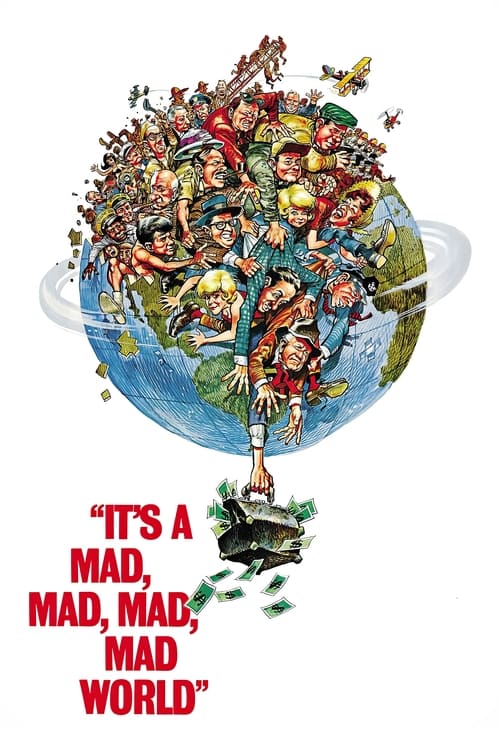
It's a Mad, Mad, Mad, Mad World
1963 · Stanley Kramer
For when you want to laugh at pure spectacle-scale silliness — a long, loud, communal comedy best watched with other people and snacks. Total comfort food, super-sized.
What it's about
A speeding car sails off a desert highway, and with his dying breath the driver tells the strangers who stop to help that $350,000 is buried under a big W in a California park. What follows is an all-out cross-country scramble — by car, plane, bicycle, and anything else with wheels or wings — as ordinary citizens abandon every scruple to get there first, while the police watch the whole stampede with interest.
The experience
Three-plus hours of escalating slapstick mayhem, played at maximum volume by an army of comedians — it's exhausting in the way a demolition derby is exhausting, and frequently very funny. The greed spiral has a cartoon logic that just keeps compounding.
Performances
A who's-who of American comedy — Spencer Tracy anchoring the chaos, plus Milton Berle, Sid Caesar, Ethel Merman, Buddy Hackett, Mickey Rooney, Jonathan Winters, and seemingly every comic then working, with Winters' bull-in-a-china-shop rampaging a highlight.
The craft
Stanley Kramer, of all people the king of earnest message pictures, shot slapstick in Ultra Panavision 70 for curved Cinerama screens — overture, intermission, and all — turning pratfalls into roadshow epic. The stunt work and vehicular chaos are real, huge, and staged across genuine desert landscapes; the wider the screen, the better it plays.
Why it matters
The moment Hollywood tried to save comedy by making it gigantic, it became the model for the star-stuffed ensemble chase comedy and a benchmark that later caper romps are still measured against.
Snapshot
It's a Mad, Mad, Mad, Mad World is the film in which the American comedy tradition tried to buy its own future by making itself enormous. Stanley Kramer — a producer-director whose name in 1963 was synonymous with the earnest social-problem picture (The Defiant Ones, Inherit the Wind, Judgment at Nuremberg) — turned abruptly to slapstick and made it in the largest format the industry then possessed: Ultra Panavision 70, shown in select engagements on the curved Cinerama screen, with an overture, an intermission, and exit music, running over three hours in its roadshow presentation. The premise is a joke about greed reduced to its most mechanical form. A speeding car flies off a mountain road; the dying driver, "Smiler" Grogan (Jimmy Durante), tells the strangers who stop to help him that $350,000 is buried in Santa Rosita State Park "under a big W." The rest is a chase — cars, planes, a bicycle, a fire truck's aerial ladder — in which every character betrays every other and nobody wins.
What makes the film historically significant is less its comic invention than its function as a summation and a hinge. Kramer assembled a cast that reads as an inventory of twentieth-century American comedy: Spencer Tracy as the watching detective, Milton Berle, Sid Caesar, Buddy Hackett, Ethel Merman, Mickey Rooney, Dick Shawn, Phil Silvers, Terry-Thomas, Jonathan Winters, plus a long parade of cameos including Buster Keaton, the Three Stooges, Jerry Lewis, Jack Benny, Edward Everett Horton, Zasu Pitts, and Joe E. Brown. Vaudeville, silent slapstick, radio, burlesque, and early live television are all present in the same frame. The film is simultaneously a monument to that lineage and a demonstration that the lineage could now only be staged at ruinous scale. Its influence runs directly forward into the all-star disaster and ensemble-chase cycles of the following decade, and it remains the reference point whenever a filmmaker decides that a comedy should be logistically impossible.
Industry & production
The picture belongs to the roadshow economy of the late 1950s and early 1960s, when studios responded to television by offering what television could not: enormous screens, reserved seating, printed programs, and running times that made an evening out into an event. United Artists released it; Kramer produced as well as directed, through his own production company, an arrangement that gave him unusual latitude and unusual exposure. The original script came from William and Tania Rose, with additional writing by others during production; the Roses had a facility for the escalating social farce, and Kramer's instinct was to keep escalating past the point where escalation is normally checked.
The scale of the shoot was itself the selling proposition. Production ranged across Southern California locations — desert highway, the Palos Verdes coastline, and Santa Rosita as a fictional stand-in for a Southern California beach city — with sequences requiring aircraft, extensive vehicle destruction, and stunt work of a kind more usually associated with action pictures. Kramer employed a large second-unit and stunt contingent; the film's most famous set pieces (the biplane crashing through a billboard, the collapse of a hardware store's basement, the fire-truck ladder finale) were built as practical, physically executed gags at full scale rather than as miniatures or opticals wherever possible.
The cast list was a production problem as much as a marketing coup. Coordinating a schedule that accommodated Ethel Merman's stage commitments, television performers' series work, and a long roster of one-scene veterans required a shooting plan closer to a revue than a feature. The cameo strategy — Keaton, the Stooges, Benny — was consciously curatorial: Kramer was buying not just faces but comic history, and the audience was expected to recognize the purchase.
The film opened in November 1963 at the Cinerama Dome in Hollywood, a theater built expressly to house it — the geodesic dome on Sunset Boulevard remains the picture's most literal architectural legacy. It was, by the standards of its release, a substantial commercial success, though the roadshow model's economics (fewer seats, higher prices, long runs) make its performance hard to compare directly with wide-release pictures of the period. It was subsequently cut for general release, and the removed footage became one of the more consequential preservation problems in postwar American cinema: the roadshow version was not preserved intact, and decades of restoration work — culminating in the extended reconstruction issued by the Criterion Collection, which combined surviving picture elements with surviving audio for scenes whose images are lost — have assembled an approximation rather than a recovery. The film exists today primarily as a scholarly reconstruction of itself.
Technology
Ultra Panavision 70 is the technical fact around which everything else organizes. The process photographed on 65mm negative with anamorphic elements producing an aspect ratio of roughly 2.76:1 — the widest of the standard large-format systems — and printed to 70mm for exhibition with six-track magnetic stereo sound. Kramer additionally arranged for presentation in Cinerama venues, where a single-lens 70mm print projected onto a deeply curved screen substituted for the original three-strip Cinerama process. This was Cinerama's transitional moment: the three-projector system had proven commercially and technically unsustainable, and single-camera 70mm "Cinerama" was the compromise that kept the brand alive.
The consequences for the film are not incidental. A 2.76:1 frame is nearly three times as wide as it is tall. It resists the standard grammar of close-up and shot-reverse-shot, and rewards lateral action, simultaneity, and the placement of multiple discrete events within a single composition. Kramer and his crew built the picture around this: the frame is a container in which several people can be doing several irreconcilable things at once, which is precisely what the story is about. The film is also an early and conspicuous case of comedy — historically a genre of the close-up, the reaction, the intimate two-shot — being staged as spectacle.
The optical and effects work sits at the seam between practical and photographic. Aerial sequences, process work for driving scenes, and the vertiginous ladder finale combine location stunt photography with rear projection and matte work whose visible seams are, to a modern eye, part of the film's period texture. The soundtrack's six-track magnetic stereo allowed Ernest Gold's score and the dense layering of shouted dialogue to occupy separate spatial positions — a capability the mixing exploits during the multi-vehicle sequences.
Technique
Cinematography
Ernest Laszlo shot the film, and his work here should be read against his other Kramer collaborations, where the register is severe and monochrome. In Mad World Laszlo lights for a bright, high-key, almost merciless clarity: desert glare, chrome, primary-colored automobiles, no shadow to hide in. The visual world is legible to the point of harshness, which suits a comedy in which nobody has an interior life worth concealing.
The compositional strategy is lateral and often static in the wide shots — a fixed or slowly panning camera holding an extremely wide frame while chaos crosses it — punctuated by extremely mobile car-mounted and aerial photography. Laszlo and the second unit place the camera on vehicles at low angles to make ordinary highway speed read as velocity, and the aerial material (the biplane sequence in particular) uses the height of the 70mm frame's rare vertical opportunities against the extreme horizontality of the format.
The opening is a small masterpiece of economy: a car overtaking others on a mountain road, the geography established in a few wide setups, the crash rendered as a single spectacular fall. It establishes the film's governing visual logic — that the landscape is large, the people in it are small, and their frenzy is best appreciated from a distance.
Editing
Frederic Knudtson cut the film, and the cutting is where the picture's structural problem is most visible. A chase with roughly six competing parties requires constant cross-cutting simply to keep the geography of the pursuit intelligible; the film must repeatedly re-establish who is where, in what vehicle, and how far behind. Knudtson alternates long-held wide shots — in which a gag plays out in real time and unbroken space, the silent-comedy inheritance — with rapid intercutting between convoys.
The rhythm is deliberately additive rather than accelerative. Rather than building a single escalating curve, the film stacks parallel escalations, cutting from one collapsing situation to another, so that the cumulative effect is of a system overloading rather than a climax approaching. This is also the film's most-criticized quality: the editing sustains a single pitch for a very long time. The roadshow cut's length made this more pronounced; the shortened general-release version, and the various television and home-video edits, altered the balance in ways that the reconstruction work has since attempted to reverse.
Mise-en-scène / staging
The staging is fundamentally theatrical — group compositions with a large number of bodies arranged for simultaneous legibility — married to a genuinely cinematic sense of destruction. Kramer stages ensemble scenes with performers ranked across the width of the frame, each given enough space to register, which is the only workable solution when the frame is 2.76:1 and eleven people are shouting.
The physical world is built to be broken. The hardware-store sequence, in which Berle's and Rooney's characters destroy a basement while trying to escape it, is a set constructed for demolition; the gas-station sequence with Jonathan Winters is similarly an object built to be dismantled by a performer. The gag structure here is Keatonesque in its architecture — a solid, plausible physical environment progressively reduced to rubble by human effort — but where Keaton's demolitions are precise and balletic, Kramer's are cumulative and loud.
Production design keeps the settings aggressively ordinary: gas stations, hardware stores, small airfields, a municipal park. The joke depends on the mundanity of what greed destroys.
Sound
Ernest Gold's score is the film's connective tissue and one of its more sophisticated elements. The main theme — a brassy, march-like Dixieland-inflected figure — functions as a recurring signal of comic escalation, and Gold varies it across the chase with genuine orchestrational wit, shifting instrumentation to characterize different pursuing parties. The score is nearly continuous, which is unusual even for comedy of the period, and it does a great deal of the work of maintaining momentum through a very long running time.
The dialogue mix is dense and overlapping by design. Six-track stereo permits shouting to be spatially separated, and the film exploits this: arguments happen in parallel, from different points in the sound field, in a manner that anticipates the overlapping-dialogue technique later associated with Robert Altman, though Kramer deploys it for volume rather than for texture. Sound effects — engines, sirens, breaking glass, the collapsing structures — are foregrounded to a degree that makes the film's soundtrack physically fatiguing, which is arguably the intended effect.
Performance
The film is a comparative anatomy of American comic performance styles, and its interest as a document lies largely there. Sid Caesar brings the sketch-comedy logic of live television — a character committing totally to an escalating premise. Jonathan Winters supplies improvisational, associative physical comedy of a kind essentially unrelated to any script. Phil Silvers plays the fast-talking confidence man of burlesque and radio. Terry-Thomas contributes a specifically British register of exasperated class contempt, and is given the film's most pointed monologue, an outsider's attack on American sentimentality about mothers and money. Ethel Merman performs at Broadway volume — a stage instrument in a 70mm frame — and Dick Shawn's beatnik son is a caricature of youth culture played at maximum amplitude.
Against all of this, Spencer Tracy does something quite different. As Captain Culpeper he underplays continuously, watching the chaos from a police office, and the film's structure depends on that contrast: a still center holding a screen otherwise full of noise. Tracy's late turn — the discovery that the observing moral authority is himself corruptible — is the only genuinely dramatic beat in the picture, and it works because he has spent two hours refusing to compete with the comedians.
The cameos operate as a separate register: Keaton, in a small role, is a citation rather than a performance; the Three Stooges appear essentially as an image of themselves. The film asks the audience to recognize a tradition, not to watch it work.
Narrative & dramatic mode
The structure is the simplest available: a MacGuffin (buried money), a starting gun (Grogan's death), and a race. What distinguishes it is multiplication. Rather than a single protagonist pursuing an object, there are six or seven parties pursuing it simultaneously, each subdividing further as alliances form and collapse. The film has no protagonist in any conventional sense; its subject is a system, not a person.
Dramatically, this is farce operating at epic length. Farce depends on compression — mistaken identities and escalating consequences squeezed into a tight temporal and spatial box — and Mad World deliberately violates that principle by extending farce across a full day, hundreds of miles, and three-plus hours. The tension between the mode's natural economy and the film's chosen scale is the source of both its ambition and its most persistent criticism.
The moral architecture is austere: nobody deserves the money, nobody gets it, and everyone ends injured in the same hospital ward. The final image — an entire cast in traction, laughing helplessly at Ethel Merman slipping on a banana peel — is a deliberately reductive punchline, the oldest gag in the medium offered as the terminus of three hours of escalation. It is either a confession of exhaustion or a thesis, and the film is ambiguous about which.
Genre & cycle
Mad World sits at the intersection of several traditions. It descends from the Mack Sennett chase comedy and the Hal Roach ensemble picture, scaled up beyond recognition. It belongs to the roadshow spectacle cycle alongside Around the World in 80 Days (1956), which had established the model of the all-star, globe-spanning, cameo-studded event picture — a clear precedent Kramer's film both follows and intensifies.
It also inaugurates a distinct sub-cycle: the epic-length, all-star, destruction-based comedy. Those Magnificent Men in Their Flying Machines (1965), The Great Race (1965), and Monte Carlo or Bust (1969) follow closely enough in conception and scale to constitute a direct lineage. The cycle burned out fairly quickly, as the economics of roadshow exhibition collapsed in the late 1960s.
Its longer-term generic significance is its transmission of the mass-ensemble-in-catastrophe formula into the disaster film. The structural template — a large cast of recognizable performers, each with a thumbnail characterization, thrown into a single escalating physical calamity — is precisely the template of Airport (1970), The Poseidon Adventure (1972), and The Towering Inferno (1974). Mad World is the comic prototype of that dramatic cycle.
Authorship & method
Kramer is a genuinely awkward auteur case. His reputation rests on message pictures — liberal, didactic, formally conservative — and Mad World is usually treated as an anomaly. It is better understood as continuous with his method: Kramer's characteristic gesture was to take a large social proposition and stage it at maximum scale with maximum star power. In the dramas the proposition was racism, or creationism, or genocide; here it is avarice. The technique is the same. He is a producer's director, and the film is above all a triumph of production management — the marshaling of resources on a scale that few contemporaries could have organized.
The key collaborators each supply something Kramer himself did not. William and Tania Rose provided the structural engine and the strain of misanthropy that keeps the film from sentimentality; the Roses' script gives virtually every character a moment of undisguised greed. Ernest Laszlo — Kramer's regular cinematographer across several pictures — supplied the visual discipline that keeps a 2.76:1 frame from becoming incoherent. Frederic Knudtson, likewise a repeat Kramer collaborator, managed the cross-cutting architecture. Ernest Gold, who had scored Exodus and other Kramer projects, wrote what is arguably the most durable single element of the film: a theme that has outlived most memories of the picture itself. Saul Bass designed the animated title sequence, and its graphic wit — a globe that cracks, splits, and disintegrates — sets the film's thesis before a frame of live action arrives.
The method is essentially accumulative: hire the best available specialist for each function, buy the largest possible format, cast every living comedian, and let volume do the work. It is not a method that produces subtlety, and Kramer does not appear to have wanted subtlety.
Movement / national cinema
The film belongs to no movement; it is Hollywood industrial cinema at its most confident and most defensive. Its context is the studio system's response to television — bigger screens, longer films, event exhibition — and its aesthetic follows from that commercial logic rather than from any artistic program. It stands almost precisely opposite the contemporaneous European new waves: where Godard, Truffaut, and their contemporaries were making cheap, fast, personal films with handheld cameras and available light, Kramer was mobilizing hundreds of people and one of the heaviest camera systems ever built to photograph men shouting at each other in the desert.
As a document of American national character, it is unusually pointed. The film's subject is a specifically American relationship to money — the conviction that a windfall is owed, that acquisition justifies any conduct, that the sensible middle-class citizen is one revelation away from criminality. Terry-Thomas's character functions as the film's external observer, and his diatribe against American self-regard is the picture's clearest statement of what it thinks it is about.
Era / period
1963 is a hinge year, and the film sits precisely on it. The roadshow epic was at its commercial peak and within a few years of collapse. The Production Code was weakening but still operative. The studio contract system was dissolving. Television had absorbed the mass audience for ordinary entertainment, leaving theatrical film to justify itself through scale — a strategy that produced both this picture and, within five years, the run of expensive failures that helped end the old Hollywood.
The film's American release came within days of the Kennedy assassination, which colors its historical position in ways that are difficult to assess but hard to ignore: a three-hour comedy about national greed arriving at the moment the postwar consensus began to fracture.
Generationally, the picture is a farewell. The performers it assembles came up through vaudeville, silent film, radio, and burlesque — institutions that had already largely ceased to exist. Within a decade most of these careers were over. Mad World is the last occasion on which that entire tradition could be photographed together.
Themes
Greed as a universal solvent. The film's proposition is that money dissolves every other social bond — marriage, friendship, professional obligation, the law. Every character begins as a recognizable type (dentist, furniture mover, entrepreneur, wife, policeman) and is progressively stripped of that identity by the pursuit.
The corruptibility of authority. Captain Culpeper's arc is the film's structural argument. The character who watches, judges, and coordinates the pursuit is the one who finally takes the money. Placing that turn at the end, in Tracy's underplayed register, gives the farce a genuinely bleak spine.
Cooperation as a temporary tactic. Alliances form constantly and dissolve immediately; the film treats collective action as a strategy that greed always defeats. Nobody ever considers, seriously, simply dividing the money.
Mass society and mechanized frenzy. Human beings in this film are almost always attached to machines — cars, planes, bicycles, ladders — and the machines amplify their impulses beyond control. The comedy is fundamentally about scale mismatch: small appetites given industrial horsepower.
Punishment without redemption. The ending distributes injury universally and enlightenment to no one. There is no reformed character. The final laugh is involuntary, produced by pain.
Reception, canon & influence
Contemporary critical reception was divided, and the division has proved durable. Admirers praised the sheer scale of the physical comedy, the assembled cast, and the technical achievement of the staging. Detractors — a substantial contingent — found it exhausting, mechanical, and fundamentally mismatched: farce inflated past the point where the form works, with volume substituting for wit. The charge that the film is loud rather than funny was made at the time and has been made continuously since. Kramer's critical reputation, already contested for what many saw as heavy-handedness in the message pictures, was not helped by the accusation that he had brought the same heaviness to comedy.
Commercially it performed strongly in roadshow release and became a perennial television property, though its television life was in truncated, panned-and-scanned versions that destroyed the compositional logic the film was built on — a distortion that shaped several decades of its reputation. The restoration work, particularly the extended reconstruction, has materially changed how the film can be assessed, and recent critical writing tends to treat it more generously than mid-century criticism did.
Influences on the film (backward). The debts are explicit and largely acknowledged within the text. Mack Sennett's Keystone chases supply the fundamental structure — multiple parties, escalating vehicular pursuit, indifference to plausibility. Laurel and Hardy and the Hal Roach comedies supply the tit-for-tat destruction sequences, in which two people demolish an environment through incremental retaliation. Buster Keaton supplies the architecture of the large-scale physical gag, and his casting is a direct citation of that debt. Around the World in 80 Days supplies the roadshow all-star cameo model. The screwball tradition supplies the marital antagonism, though Mad World strips it of romance.
Legacy (forward). The film's influence runs along several distinct lines. Most directly, it established the template for the epic all-star comedy chase, taken up almost immediately by The Great Race and Those Magnificent Men in Their Flying Machines, and later by The Cannonball Run (1981) and its successors, which reproduce the multi-vehicle, celebrity-ensemble structure at lower cost. Steven Spielberg's 1941 (1979) is the most conspicuous and expensive homage — an attempt to reproduce Mad World's scale of physical chaos that reproduced its critical reception as well. Rat Race (2001) is an explicit, acknowledged reworking of the premise.
More significantly, the film transmitted the all-star-ensemble-in-catastrophe formula into the disaster cycle of the 1970s, where it became one of the dominant commercial structures of the decade. And its technical legacy is architectural: the Cinerama Dome, built for this film, has functioned since as a monument to large-format exhibition, and the film's Ultra Panavision 70 photography made it a fixture of the revival circuit whenever 70mm presentation returns to fashion — a role it has held continuously since Quentin Tarantino's revival of the format for The Hateful Eight (2015) renewed general interest in Ultra Panavision.
The film's final standing is genuinely unresolved, and that is part of its interest. It is at once the grandest and the most exhausting expression of a comic tradition, a summation that may also be a tombstone. What is not in dispute is its documentary value: no other single film contains so much of the first six decades of American comic performance, photographed in the largest format the industry ever built, on the eve of the disappearance of both.
A Deleuzian reading
The film ends in a hospital ward.
The full Deleuzian reading of It's a Mad, Mad, Mad, Mad World →
Reception
A box-office smash in 1963 but critics found Kramer's 'comedy to end all comedies' exhausting rather than hilarious — now it's a beloved-if-unwieldy monument, its extended roadshow cut lovingly reconstructed for a 2014 Criterion release.
How It's a Mad, Mad, Mad, Mad World was received, from release to now →
How to watch It's a Mad, Mad, Mad, Mad World: what to notice on a first viewing
- Notice how wide and flat the frame stays during chaos. Ernest Laszlo lights in bright, high-key clarity with almost no shadow, and the ultra-widescreen frame holds several separate events legible at once. Nothing is hidden because nobody in this film has anything worth hiding.
- Listen for the brassy main theme returning each time. Ernest Gold's Dixieland-inflected theme recurs as a signal of comic escalation, shifting instrumentation to characterize whichever party is currently in the lead. The score tracks the race's momentum even when the image can't keep up.
- Watch a solid, ordinary set get destroyed piece by piece. A hardware-store basement and a gas station are both built specifically to be dismantled, plausible physical spaces reduced to rubble through pure human effort. The destruction is choreographed, not chaotic, even though it looks like both.
- Watch Spencer Tracy stay still while everyone else shouts. As Captain Culpeper, Tracy underplays continuously from a police office, a quiet center holding a screen otherwise full of noise and competing comedians. One actor refusing to compete makes the surrounding chaos land harder.
The whole guide to watching It's a Mad, Mad, Mad, Mad World, with the keys for a rewatch →
Influences: the films it descends from and the films it influenced
- Tillie's Punctured Romance (1914) — Establishes the Keystone chase grammar Kramer scales up wholesale — multiple unrelated parties converging on one object, cross-cut in accelerating parallel with open indifference to geographic or physical plausibility.
- Seven Chances (1925) — The mass-pursuit finale — one man fleeing a multiplying crowd through real landscape, with the gag scaled by sheer quantity of bodies in a single wide frame rather than by cutting — is the additive-escalation logic Mad World runs for three hours.
- The General (1926) — Keaton's principle that a vehicular gag must be photographed in real space with real hardware actually destroyed, held in long shot so the audience can verify no cheat — the standard behind Mad World's practical stunt work and Keaton's own casting as an explicit citation.
- Two Tars (1928) — The Roach-Laurel & Hardy reciprocal-destruction structure: two parties demolish an environment by strict turn-taking, each retaliation one increment larger, the camera holding to let the ruin accumulate — reproduced almost verbatim in the gas station sequence.
- His Girl Friday (1940) — Hawks's overlapping, pitch-raised dialogue tracks — lines stepped on and delivered at argument volume rather than cue-to-cue — supply the aural texture of Mad World's ensemble scenes, though here scored to six-track magnetic stereo across a 2.76:1 field.
- Around the World in 80 Days (1956) — Codified the roadshow all-star cameo economy: a large-format travelogue chase in which recognizable faces appear for a single beat, the pleasure of recognition doing narrative work — the exhibition and casting model Kramer adopted and inflated.
- Ben-Hur (1959) — Proved the MGM Camera 65 / Ultra Panavision 70 anamorphic-on-65mm system Laszlo would use, including its compositional demand that action be blocked laterally across an extreme frame rather than staged in depth toward center.
- How the West Was Won (1962) — The immediate three-strip Cinerama predecessor whose join-line problem Mad World was engineered to solve — Kramer's single-lens Ultra Panavision presentation exists as the technical answer to this film's seams, on screens built for it.
- Judgment at Nuremberg (1961) — Same Kramer–Laszlo unit one film earlier: the producer-assembled marquee ensemble and Laszlo's hard-edged deep-focus coverage of many faces in one frame, methods carried intact from courtroom to desert.
- The Ladykillers (1955) — Rose again builds an ensemble of greedy schemers annihilated by their own avarice, the heist-consumes-its-perpetrators logic blown up to epic scale.
- The Great Race (1965) — Lifts the template within two years — star-ensemble transcontinental race, escalating practical vehicle gags, and a full Roach-style reciprocal-destruction set piece (the pie fight) built as its own scaled climax.
- Those Magnificent Men in Their Flying Machines (1965) — Transposes the multi-party race to large-format aviation: international cameo cast, parallel cross-cutting between competitors, and practical full-scale machines flown and crashed for camera in Todd-AO.
- The Towering Inferno (1974) — Carries the all-star-ensemble-in-catastrophe structure into the disaster cycle: strangers with separate storylines cross-cut toward one physical crisis, with destructible full-scale sets as the film's primary production value.
- 1941 (1979) — The explicit big-budget homage — parallel cross-cutting among a dozen ensemble threads, practically demolished sets, and escalation-by-accumulation staged in Panavision, down to reproducing Kramer's critical reception.
- The Cannonball Run (1981) — Reproduces the multi-vehicle celebrity-ensemble race at stunt-unit cost, keeping the car-mounted low-angle coverage and practical vehicle stunts while discarding the large-format frame that justified them.
- Rat Race (2001) — Acknowledged reworking of the premise: buried cash, a starting-line free-for-all, and independent cross-cut teams whose stunts escalate against each other — the structure retained and the widescreen staging logic dropped.
- The Hateful Eight (2015) — Revived Ultra Panavision 70 using the same rehoused anamorphic lens set, restoring the 2.76:1 roadshow-with-overture presentation and returning Mad World to circulation as the format's reference print.
- The Blues Brothers (1980) — Established the comedy-of-escalating-vehicular-destruction template with an all-star ensemble pursuing a picaresque goal across American highway geography; Blues Brothers inherits its practical-stunt-record ambition and the formal logic of treating the Midwest expressway as a comedy landscape.
- Joni's Promise (2005) — Template for the MacGuffin-driven picaresque in which a single object propels an episodic, cross-city chase strung from set-piece to set-piece — the structural skeleton of Joni's reel-delivery odyssey.
- The Russians Are Coming, the Russians Are Coming (1966) — Runs the additive-escalation farce engine — one misunderstanding compounding through an ever-larger cast of townspeople converging on a single point — with the same tactic of underplaying leads anchoring the surrounding hysteria.
- Playtime (1967) — The other 1960s film to treat 70mm as a comic instrument: gags distributed laterally and in depth across a frame too wide to scan at once, forcing the viewer to hunt — Laszlo's compositional problem solved in the opposite register.
- What a Way to Go! (1964) — A contemporaneous roadshow-scale, all-star ensemble comedy organized around escalating excess, sharing WAWTG's producer-driven bigness as its animating principle.
Similar films
- Ben-Hur (1959) — influence & lineage
- The General (1926) — influence & lineage
- PlayTime (1967) — influence & lineage · often watched together
- Some Like It Hot (1959) — often watched together
- The Big Lebowski (1998) — often watched together
- The Great Escape (1963) — shared sensibility
- The Good, the Bad and the Ugly (1966) — shared sensibility
- Raiders of the Lost Ark (1981) — shared sensibility