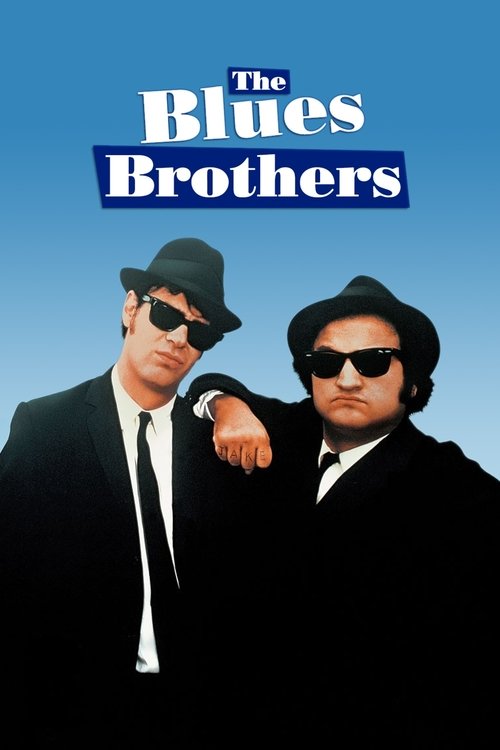
The Blues Brothers
1980 · John Landis
For a night when you want pure fun with the volume up — friends over, no thinking required, maybe singing along. Comfort viewing with a wrecking ball.
What it's about
Fresh out of prison, Jake Blues and his brother Elwood decide the only way to save the Catholic orphanage where they grew up is to reunite their old blues band and play one huge benefit show. Getting the band back together means crisscrossing Chicago, talking musicians out of day jobs, and outrunning an ever-growing mob of police, Nazis, country singers, and other people they've wronged. They insist they're on a mission from God, and the movie takes them at their word.
The experience
Loud, joyous, and gleefully excessive — a comedy that keeps stopping dead so a musical legend can bring the house down, then resumes demolishing half of Chicago. It's deadpan where you expect mugging and enormous where you expect small, and it leaves you grinning and humming.
Performances
John Belushi and Dan Aykroyd play it perfectly straight behind their sunglasses, but the real fireworks come from the musical guests — Aretha Franklin, James Brown, Ray Charles, Cab Calloway, and John Lee Hooker each get a number and each one steals the film.
The craft
The car chases are real: hundreds of actual automobiles wrecked, with a scale of practical stunt destruction almost no comedy before or since has attempted. The musical numbers are staged with genuine reverence and backed by first-rate Chicago and Memphis session players. It rewards a big screen and good speakers more than most comedies ever will.
Why it matters
It became the template for the sketch-to-movie pipeline and a durable cult favorite, but its deeper legacy is putting a generation of soul and blues giants back in front of a mass audience at full power.
Snapshot
A kinetic, ungainly, exhilarating spectacle that disguises itself as a comedy about two shambolic musicians and reveals itself as something rarer: a love letter to African American popular music dressed in the wreckage of several hundred automobiles. The Blues Brothers follows Jake (John Belushi) and Elwood Blues (Dan Aykroyd) on what they call "a mission from God"—to reassemble their old band and mount a benefit concert to save the orphanage where they were raised. The actual film is less interested in that narrative machinery than in the opportunity it creates: to put Aretha Franklin, James Brown, Ray Charles, Cab Calloway, and John Lee Hooker on screen together with the cream of Chicago and Memphis session musicians, and to detonate most of downtown Chicago in the process. Bloated, chaotic, generously overlong, and periodically transcendent, it remains one of the most peculiar objects in American studio comedy.
Industry & Production
The film originated in a sketch. Jake and Elwood Blues debuted as a musical segment on Saturday Night Live in 1977, with Belushi and Aykroyd performing in black suits and porkpie hats before a studio band composed of genuine soul veterans, including guitarist Steve Cropper and bassist Donald "Duck" Dunn—both alumni of Booker T. & the M.G.'s and foundational architects of the Stax Records sound. A live album, Briefcase Full of Blues, recorded at the Universal Amphitheatre in 1978, reached number one on the Billboard pop chart, an unlikely commercial validation that convinced Universal Pictures to back a feature film.
John Landis, fresh from National Lampoon's Animal House (1978)—which had returned enormous profit on a modest investment—was attached to direct and co-write the screenplay with Aykroyd. Aykroyd's script draft was reportedly enormous, a sprawling document that drew on his genuine obsession with blues history and Chicago geography. The final film retains that encyclopedic passion while shedding some of the more intricate plotting. Production took place largely on location in Chicago and surrounding Illinois, with the city's architecture, elevated rail system, and eventually its civic plaza serving as settings for increasingly ambitious set pieces.
The budget climbed significantly beyond its initial estimates—figures commonly cited in accounts of the production place the final cost in the range of $27–30 million, substantial for a comedy in 1980. The production was plagued by the now-legendary chaos surrounding Belushi, whose substance abuse during this period is documented in Bob Woodward's biography Wired (1984) and in oral histories of the SNL era. The shoot stretched considerably over schedule. Robert K. Weiss produced. Universal distributed.
The film performed strongly at the box office, though precise figures vary across sources; it was widely reported at the time as a major commercial success and eventually became one of the studio's significant earners of the period.
Technology
The car sequences required a level of practical stunt coordination that pushed against the available toolbox of 1980. The production amassed an enormous fleet of decommissioned police vehicles—estimates of cars destroyed across the production run into the hundreds, which was reported at the time as a record for a motion picture. The final sequence, staged in and around Chicago's Daley Plaza and City Hall, involved the stacking and compaction of vehicles in a practical pile that required careful coordination of stunts, city permissions, and camera placement. No significant digital compositing was available; everything seen on screen was physically built, crashed, or exploded.
Camera work relied on conventional 35mm cinematography. Widescreen compositions were favored for the musical numbers, which needed to contain full-band staging and audience response simultaneously. The location shooting in Maxwell Street—the legendary open-air blues market on Chicago's Near South Side—captured a district that was already under threat of demolition; the film preserves imagery of a place that was substantially gone within a decade.
Technique
Cinematography
Stephen Katz served as director of photography. The visual approach is functional rather than stylized: the film's primary obligation is legibility—of spatial geography during chases, of performance during musical numbers, of comedic timing during set pieces. The Chicago locations are used for their texture and scale rather than aestheticized; the Daley Plaza and the film's various expressway sequences communicate the horizontal sprawl of the American Midwest as an action-comedy landscape. The musical performance sequences tend toward medium-wide framings that accommodate multiple musicians while keeping the central performers readable, a staging logic closer to the variety-show broadcast aesthetic than to the more spatially inventive work of directors like Bob Fosse.
Editing
George Folsey Jr. edited the film. The editorial challenge is considerable: the film contains discrete narrative scenes, extended musical performance sequences, and car-chase action that operates by entirely different rhythmic logic. The transitions between these modes are not always smooth. The pacing flags between set pieces and recovers during them. The Aretha Franklin number and the James Brown gospel sequence are edited with particular attention to musical phrase and performance energy, cutting within the music rather than against it—a discipline the action sequences sometimes match and sometimes abandon in favor of cumulative shock.
Mise-en-scène / Staging
Landis's staging draws on his background in physical comedy and his comfort with large, chaotic ensembles. The recurrent gag of the film—that Jake and Elwood's appearance causes inexplicable catastrophe to the world around them while they remain impassive—requires precise choreography of background destruction against foreground obliviousness. The sequence in which the mall car chase plays out while the two brothers continue their conversation without apparent concern is an example of this comic geometry.
The casting of genuine musical legends in small acting roles, rather than cameo appearances at a distance, means their scenes carry dramatic weight beyond mere spectacle. Aretha Franklin as a soul food waitress, James Brown as a fire-and-brimstone preacher, Ray Charles as a music store owner, Cab Calloway as the brothers' mentor Curtis, John Lee Hooker as a Maxwell Street busker: each is given a scene with shape and resolution, not simply a clip inserted for promotional value. The staging in these sequences respects both the performer and the musical material.
Sound
The film's sound design serves music first and effect second, which was a deliberate choice. The band—Cropper, Dunn, and the assembled Blues Brothers ensemble—was recorded with fidelity to live performance rather than the polished over-production that characterized much contemporary pop. The musical numbers carry dynamic range that transfers well from the theater speaker systems of 1980 to subsequent home formats, contributing to the film's durability as a viewing experience.
The wall-to-wall music approach—the film barely rests from one number before beginning another—was unusual for a studio comedy. Songs include "Think," "Shake a Tail Feather," "Minnie the Moocher," "The Old Landmark," and a range of R&B and soul standards, creating something close to a compilation album in narrative form.
Performance
Belushi and Aykroyd operate as a unit, with the comedy arising from their contrast: Belushi's barely suppressed wildness against Aykroyd's deadpan literalism. Elwood's unfailing seriousness, his apparent inability to register that anything has gone wrong, is the film's most consistent joke. Jake is reactive, Elwood is inert; together they generate the film's peculiar immunity to consequence. The performances are physically calibrated—Belushi in particular uses his body with the precision of someone trained in sketch comedy, where every gesture must be legible from the back of the room.
The celebrity musical performers are not, in the main, experienced film actors, and Landis does not ask them to be. He gives them one thing to do and lets them do it with mastery. James Brown's gospel performance is genuinely electrifying as cinema regardless of its dramatic context.
Narrative & Dramatic Mode
The film operates in the mode of the picaresque quest, deploying a thin redemptive frame—the orphanage, the concert, the mission from God—as a pretext for a series of increasingly unhinged episodes. The narrative causality is loose; scenes accrete rather than build. Sub-plots (the country band pursuing the brothers for a grievance, the neo-Nazis repeatedly driven off the road, the vengeful woman played by Carrie Fisher pursuing Jake with military-grade weaponry) are introduced and abandoned according to the logic of revue comedy rather than classical structure.
The "mission from God" framing is treated with absolute sincerity by the characters, which is the source of much of the film's comedy—the gap between the cosmic grandeur of their self-description and the shabbiness of everything around them. This earnestness also functions as the film's emotional argument: that the music being performed matters, that these traditions are sacred, that the brothers' absurd quest is genuinely righteous. The film means it.
Genre & Cycle
The Blues Brothers belongs to several cycles at once and fits neatly into none of them. It is a musical, in that it pauses narrative for extended performance sequences and those sequences carry the film's emotional weight. It is a road movie, structurally if not quite tonally. It is an action film, in that the car sequences have a scale and ambition associated with that genre. It is a comedy built on the Saturday Night Live ensemble sensibility that would produce a string of films through the early 1980s, some successful (Ghostbusters, 1984) and some not.
Most usefully, it belongs to the cycle of revue films that appeared as the SNL cast transitioned to Hollywood: narrative features that serve primarily as delivery systems for a performance sensibility developed in live television. The film's relationship to the concert film is also significant—it can be read as a fiction wrapped around what is effectively a live document of soul and R&B performance by figures who were, in 1980, not receiving equivalent mainstream attention.
Authorship & Method
John Landis (born 1950) developed his directing sensibility through exploitation cinema and comedy, having made Schlock (1973) as a teenager and Kentucky Fried Movie (1977) before Animal House established him as a director capable of managing large-scale anarchic comedy. His method leans toward setpiece construction and physical comedy over character psychology. The Blues Brothers is his most ambitious film in logistical terms; he would follow it with An American Werewolf in London (1981), which demonstrated a different register entirely, and the Michael Jackson Thriller video (1983), which remains his most-seen work.
Dan Aykroyd as co-writer brought genuine musicological knowledge to the project; his investment in the material was not performative. He had immersed himself in blues history through the SNL years, and the film's attention to specific performers, venues, and musical genealogies reflects serious enthusiasm.
Steve Cropper and Donald "Duck" Dunn as musical architects of the Blues Brothers Band brought the credibility of the Stax house band to bear on the project. Their presence is not decorative—they are foundational to the music sounding the way it sounds.
Elmer Bernstein contributed additional orchestral scoring; the main musical weight is carried by the blues and soul repertoire rather than an original score.
Movement / National Cinema
The film is emphatically American, and specifically Chicagoan, in a way that is worth noting. The city functions as more than backdrop: the Maxwell Street market, the elevated "L" trains, the lakefront expressways, and finally the Daley Center are used as a map of a particular Chicago—working-class, Black South Side in cultural geography, soon to be substantially transformed by the urban renewal pressures of the subsequent decades. The film is, among other things, a document of a city at a specific moment.
It also belongs to a particular strand of American popular culture in which African American musical tradition is both celebrated and filtered through white performers. The brothers are white; the legends they perform alongside are Black; the music is presented as a shared inheritance. The film does not interrogate this relationship, but its sincerity distinguishes it from appropriation that is merely commercial. The question of what the film does with that structural dynamic is one that subsequent scholarship has addressed with varying conclusions.
Era / Period
1980 sits at the end of the New Hollywood decade and the beginning of a period of high-concept, effects-driven studio production. The Blues Brothers is an anomaly in this context—large-budget, star-driven, but resistant to easy franchise structure, built around musical performance rather than special effects. It reflects the late 1970s moment in which the SNL generation represented a new kind of celebrity, and in which a certain strain of knowing, camp-adjacent pop-culture omnivory felt like a legitimate artistic mode. The film was made in the window before Belushi's death in 1982, which closed one chapter of that cultural moment decisively.
Themes
The film's persistent themes are redemption, mission, and the relationship between secular and sacred expression. The "mission from God" joke is also the film's theological argument: that the preservation of musical tradition is a righteous act. Blues and soul are framed as sacred forms—James Brown's sequence makes this explicit by staging R&B as revival religion, with the congregation literally moved to ecstatic dance. The film suggests that the boundaries between the church and the juke joint are more permeable than polite society admits, a proposition with deep roots in African American musical history.
Community is a related theme: the assembly of the band is the film's central action, and the pleasure of those scenes is the pleasure of ensemble—individuals with their own inertias being drawn back into collective purpose. The orphanage as origin point, the band as family, the music as home: the film's emotional logic is elegiac as well as comic, though it never lingers long enough in any register to become sentimental.
Reception, Canon & Influence
Influences on the film: The primary formal model is the musical, particularly the MGM genre in its most elaborate mode—the film that stops for performance without apology. The car-chase tradition inaugurated or consolidated by The French Connection (1971) and Smokey and the Bandit (1977) supplies the action grammar. The cameo-heavy anthology structure of The Muppet Movie (1979) is a near-contemporary analog. The picaresque comedy of manners and the road movie as American form—from Preston Sturges to the American New Wave—can be discerned in the episodic structure.
Initial reception: Critical response was mixed to negative on release. Many reviewers found the film overlong, undisciplined, and tonally inconsistent. The gap between the spectacular musical sequences and the thinner narrative connective tissue was frequently noted. The film's length (133 minutes in its theatrical cut, with a longer director's cut subsequently released) was a consistent complaint.
Legacy and influence: The film accrued its canonical status gradually, through cable television and home video, both of which suited its anthology structure—it can be entered at any point and still deliver its central pleasures. It is now widely regarded as one of the defining cult comedies of its period and as a significant document of a musical tradition that was, in 1980, being rediscovered and repackaged for mainstream audiences. Whether the film's popularity contributed to renewed commercial interest in soul and R&B is a claim made in some popular accounts; the causal chain is difficult to establish rigorously.
The film established a template for the music-comedy hybrid—the high-concept narrative whose primary purpose is the delivery of performance footage—that can be traced in films as various as Purple Rain (1984), This Is Spinal Tap (1984, though inverting the earnestness), and School of Rock (2003). Its treatment of the ensemble musical narrative as both comedy and cultural archive has few direct imitators but broad diffuse influence.
Belushi's death two years after release gave the film an elegiac dimension it did not originally possess. Viewed now, the spectacle of his physical performance—the barely contained energy, the sudden stillnesses—acquires a quality that the film itself could not have planned. A sequel, Blues Brothers 2000 (1998), directed again by Landis with Aykroyd but without Belushi, demonstrated that the original's peculiar chemistry was not simply a function of formula.
A Deleuzian reading
The Bluesmobile bursts through the plate glass of a shopping mall, and Elwood, both hands on the wheel, says, "Disco pants and haircuts." Jake spots the Toys R Us.
The full Deleuzian reading of The Blues Brothers →
Reception
Critics in 1980 were lukewarm — it was infamous for its runaway budget and chaotic shoot, and many reviewers found it bloated. It grossed well anyway, became a home-video and midnight-screening perennial, and was added to the National Film Registry in 2020 as a certified classic.
How The Blues Brothers was received, from release to now →
Influences: the films it descends from and the films it influenced
- The General (1926) — Originated the chaos-obliviousness-contrast staging principle—stone-faced protagonist executing precise tasks while vehicular destruction unfolds around him—which Landis transplants wholesale into Jake and Elwood's expressionless impassivity amid collapsing city blocks.
- Stormy Weather (1943) — Established the revue-film architecture of thin narrative scaffolding built to present Black musical performers in full performance numbers; Cab Calloway, who performs 'Minnie the Moocher' in both films, carries the same presentational staging logic from one picture directly into the other.
- It's a Mad, Mad, Mad, Mad World (1963) — Established the comedy-of-escalating-vehicular-destruction template with an all-star ensemble pursuing a picaresque goal across American highway geography; Blues Brothers inherits its practical-stunt-record ambition and the formal logic of treating the Midwest expressway as a comedy landscape.
- A Hard Day's Night (1964) — Created the musician-in-character-role template with editing that cuts within musical phrase rather than against it, and a picaresque structure of actual musicians moving through sketch-comedy encounters—the formal organization Blues Brothers scales up and Americanizes.
- The T.A.M.I. Show (1964) — Developed the concert-film grammar of presenting soul and R&B performers—including James Brown, who appears in Blues Brothers—in widescreen multi-performer staging that keeps the central performer readable while preserving spatial context for the full ensemble.
- Wattstax (1973) — The Stax Records concert film whose specific sonic world—the Memphis rhythm section, Chicago blues tradition, and Stax soul roster—constitutes the musicological universe Aykroyd's script inhabits; live-fidelity-over-production as documentary principle is the recording philosophy Blues Brothers imports.
- Nashville (1975) — Built an ensemble narrative from actual musicians and singers playing characters within an accretion-over-causality structure converging on a climactic performance event, with widescreen staging designed to contain multiple performers simultaneously—the template Blues Brothers applies to soul rather than country.
- The Last Waltz (1978) — Elevated the concert-film-hybrid into prestige cinema by staging A-list musicians within a loose narrative frame and prioritizing live-performance fidelity over studio polish; Blues Brothers adopts the same reverential approach to the session-musician world and applies it to a comedy chassis.
- The Italian Job (1969) — Builds comic mass-vehicle carnage as a musical number, scoring escalating car destruction to pop in the lineage of Quincy Jones's chase cues.
- Purple Rain (1984) — Inherited Blues Brothers' proof-of-concept that an actual musician could carry a narrative feature film; Prince's performance integrates concert-quality production numbers into narrative using the same hybrid structure—wall-to-wall music, musician-as-protagonist—that Blues Brothers established as commercially viable.
- The Commitments (1991) — Directly inherits Blues Brothers' formula of passionate white musicians reviving Black American soul music as both narrative engine and cultural argument, with the same accretion-over-causality episodic band-formation structure, live-fidelity recording priority, and Stax/Motown repertoire as dramatic material.
- Wayne's World (1992) — Ran the same SNL-sketch-to-studio-feature pipeline with the same sketch-comedy physicality, wall-to-wall rock music as identity scaffolding, and picaresque quest structure; Blues Brothers proved this production logic commercially viable and Wayne's World is its direct institutional heir.
- O Brother, Where Art Thou? (2000) — Applies Blues Brothers' picaresque-quest-with-musician-performers formula to Depression-era roots music: an accretion-over-causality episodic structure in which musicians-in-character-roles stage climactic folk performance, with wall-to-wall period music scaffolding narrative momentum in place of causally driven plot.
- Baby Driver (2017) — Landis integrates live musical performance directly into action set-pieces, organizing car chases around diegetic numbers rather than scored underscore — establishing that spectacular action and pop-music performance can be simultaneous rather than alternating.
- Ghostbusters (1984) — Proves the Second City/SNL pipeline survives blockbuster apparatus — Aykroyd's deadpan sustained inside enormous practical spectacle, with a soundtrack single engineered as a marketing object, the model Ghostbusters repeats with optical effects in place of car stunts.
- National Lampoon's Animal House (1978) — Landis's immediately prior film established the SNL-generation studio ensemble comedy template; the Otis Day and the Knights sequences test the integration of wall-to-wall soul music as comedic scaffolding within the same aesthetic and cultural moment, functioning as the proof-of-concept Blues Brothers scales to feature length.
- This Is Spinal Tap (1984) — Rock-band picaresque quest built from sketch-comedian-musicians (Guest, McKean, Shearer) using physical comedy within musician characters; inherits Blues Brothers' formal organization of episodic encounter-comedy structured around a band's failing quest toward a climactic performance.
Similar films
- O Brother, Where Art Thou? (2000) — influence & lineage · often watched together
- The Big Lebowski (1998) — shared sensibility
- Ferris Bueller's Day Off (1986) — shared sensibility
- Sinners (2025) — shared sensibility
- Back to the Future (1985) — shared sensibility
- Chicago (2002) — shared sensibility
- Green Book (2018) — shared sensibility
- The Great Escape (1963) — shared sensibility