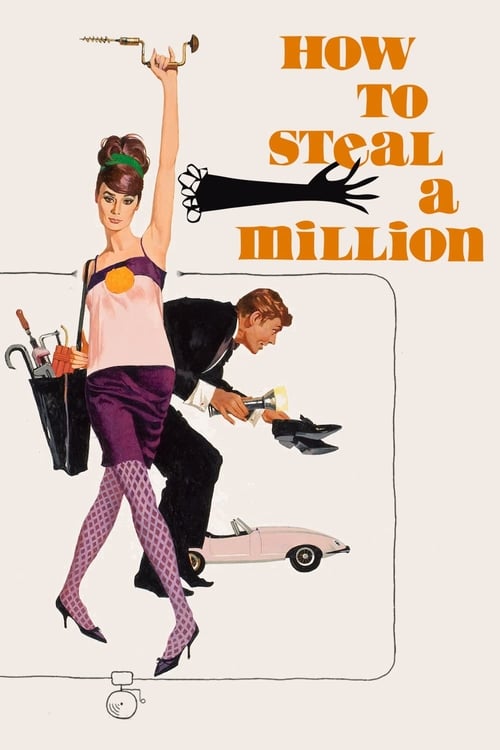
How to Steal a Million
1966 · William Wyler
For a cozy, low-stakes evening when you want glamour, romance, and a caper where nobody gets hurt — comfort viewing of the highest polish, ideal for a date night or a Sunday afternoon.
What it's about
In swinging-sixties Paris, the daughter of a cheerfully unrepentant art forger discovers that the family's prized 'Cellini' statue — actually carved by her grandfather — has been lent to a museum, where a routine insurance appraisal will expose the whole dynasty. Her only option is to steal it back, so she recruits a dashing stranger she takes for a professional burglar, having already met him mid-break-in at her own house. The heist becomes a flirtation, and the flirtation becomes the real game.
The experience
Pure champagne — light, witty, and unhurried, with the pleasure coming from banter, gorgeous clothes, and the slow mechanics of a beautifully silly museum heist. It's the kind of film that makes you grin rather than gasp.
Performances
Audrey Hepburn and Peter O'Toole are one of the great screen pairings — her precision and his amused drawl striking sparks in every scene — while Hugh Griffith has a ball as the twinkling old forger.
The craft
William Wyler, a director famous for rigor, applies it here to froth: the long central heist sequence is a small masterclass in sustained comic suspense, built from timing and patience rather than action. Givenchy's costumes for Hepburn and the widescreen Paris settings make it a feast to look at.
Why it matters
A high-water mark of the sixties caper comedy and the elegant capstone to Wyler's comedies, it fixed the image of the heist as a game played in couture — a tone generations of stylish capers have chased.
Snapshot
A Parisian confection about forgery, staged by one of Hollywood's great realists. Nicole Bonnet (Audrey Hepburn) discovers that her father Charles (Hugh Griffith) — a genial, unrepentant forger of Van Goghs and Cézannes — has lent the family's "Cellini" Venus, itself carved by her grandfather, to a private museum, where a routine insurance appraisal will expose the whole dynasty. To recover the statue she enlists a man she believes to be a burglar, Simon Dermott (Peter O'Toole), whom she has already shot in the arm during a botched break-in at her own house. He is in fact an investigator who specializes in art fraud, which makes the caper a double con and the romance a negotiation between two people lying about their professions.
Released by Twentieth Century-Fox in the summer of 1966, the film is Wyler's last comedy and his second and final collaboration with Hepburn, thirteen years after Roman Holiday (1953) made her a star and won her an Academy Award. It arrives at the tail end of a specific commercial ecology — the American studio picture shot in Europe, in anamorphic widescreen and color, built around couture, tourism, and star chemistry — and at the precise moment that ecology began to be swept away.
Industry & production
The production sits inside Fox's post-Cleopatra recovery. The 1963 Taylor-Burton epic had nearly destroyed the studio; The Sound of Music (1965) restored it; the mid-decade program that followed leaned on prestige directors, international locations, and roadshow-adjacent gloss. How to Steal a Million is a modest entry in that program: no spectacle, but every dollar visible on screen in the form of Paris, Panavision, and Givenchy.
Fred Kohlmar produced. Harry Kurnitz wrote the screenplay from a story by George Bradshaw (commonly cited under the title "Venus Rising"). Kurnitz was a house wit of the period — his credits include the Billy Wilder–directed Witness for the Prosecution (1957) — and his dialogue here works in the mode of light epigram rather than farce mechanics, which suits Wyler's unhurried tempo and also accounts for some of the film's slackness.
Shooting took place in and around Paris, with interiors at the Studios de Boulogne. The choice was economic as much as aesthetic: through the 1960s, so-called runaway production let American companies exploit favorable exchange rates, cheaper below-the-line labor, and frozen overseas earnings, while delivering the European settings that widescreen color was thought to require. The film belongs to that logic completely. Its Paris is a location and a commodity at once.
Casting reflects Wyler's habits and the industry's transatlantic mixing. Hugh Griffith had won a Supporting Actor Oscar under Wyler for Ben-Hur (1959). Eli Wallach plays the American collector Davis Leland, an acquisitive innocent whose desire for the Venus and for Nicole are indistinguishable. Charles Boyer appears as an art dealer, and the supporting bench draws on the French industry — including Marcel Dalio, whose presence carries the memory of Renoir's La Règle du jeu (1939) into a later film about collections, games, and social performance. Peter O'Toole, four years past Lawrence of Arabia (1962), was deliberately lightening his register; he had already tested comedy in What's New Pussycat? (1965).
The film's precise commercial performance is not something I will quantify here; the reliable public record is thin, and contemporary trade framing treated it as a respectable rather than outsized performer in a year whose big earners lay elsewhere.
Technology
Photographed in Panavision anamorphic 35mm with color by DeLuxe, projected at roughly 2.35:1. By 1966 anamorphic had matured past the distortions of early CinemaScope: Panavision's optics allowed closer focus, faster lenses, and less of the "scope" barrel-and-stretch that had pushed directors toward friezelike staging in the 1950s. The film exploits that maturity mainly in service of two-shots — the format's real gift to romantic comedy is the ability to hold two faces at conversational distance without cutting.
The plot's own technology is period-specific and worth noting as content rather than craft. The museum's security is an electronic alarm system with sensor coverage and a monitoring room, and the caper turns on defeating it not by superior gadgetry but by exhausting it: trip it enough times with a magnet and a boomerang and a length of string, and the humans in charge will switch it off themselves. This is a joke about the mid-1960s faith in electronic security, and it belongs to a small cycle of films fascinated by alarm systems as dramatic objects — Jules Dassin's Rififi (1955) and Topkapi (1964) most directly. Where the Bond films of the same years fetishized apparatus, Wyler's film sides with improvisation and domestic props.
Technique
Cinematography
Charles Lang shot the film — one of the most decorated cameramen in Hollywood history, with an Oscar for A Farewell to Arms (1933) and a run of nominations spanning four decades. Lang's presence is the strongest formal link between this film and Hepburn's earlier work: he photographed Sabrina (1954) and, for Stanley Donen, Charade (1963), the picture How to Steal a Million most obviously answers.
The style is high-key, clean, and unfussy in daylight, with a marked shift for the museum sequences, where the light narrows to practicals, torch beams, and the glow of vitrines. Lang's handling of Hepburn is worth attention on its own terms: the lighting is designed around the geometry of her face and around Givenchy's silhouettes, which frequently means keeping her in three-quarter figure rather than close-up so the clothes read. The film is, in a fairly literal sense, photographed to be a fashion document as well as a narrative.
Editing
Robert Swink cut the film, as he cut nearly all of Wyler's later work — Roman Holiday, Friendly Persuasion (1956), The Big Country (1958), The Children's Hour (1961), The Collector (1965), and afterward Funny Girl (1968). Wyler's method, established in the 1930s and 40s, was to shoot exhaustively and stage in depth, which produces long takes and comparatively few cuts within a scene. The consequence here is a comedy with an unusual amount of dead air by modern standards: the film runs a little over two hours, and the closet sequence in particular is allowed to expand well past its narrative function. Whether this reads as patience or as slackness is the central critical question about the picture, and both readings have been defended.
Mise-en-scène / staging
Alexandre Trauner designed the production — a fact that should reorganize how the film is seen. Trauner was the designer of Carné and Prévert's poetic realism (Le Jour se lève, Les Enfants du paradis) and later of Billy Wilder's The Apartment (1960), Irma la Douce (1963), and Witness for the Prosecution. His Bonnet mansion is a machine for concealment: a house whose visible function is display and whose actual function is fabrication, with the forger's studio tucked behind the salon. The museum, likewise, is built as a set of transparent enclosures — glass, plinths, sightlines — in which the Venus is simultaneously perfectly visible and perfectly unreachable.
Wyler stages against this architecture in the manner André Bazin praised in his 1948 essay on the director, "William Wyler, or the Jansenist of mise en scène": foreground and background held in the same shot, dramatic relations expressed by placement rather than by cutting. The broom-closet scenes invert the principle — two people jammed into a space too small for the frame, the anamorphic width filled by proximity rather than depth. It is the most formally interesting passage in the film, and its comedy is spatial before it is verbal.
Sound
The score is by John Williams, then early in a film career largely spent on light comedies and television and billed in this period on a number of assignments as "Johnny Williams." The music is jazz-inflected, small-combo, and gently ironic — closer to Henry Mancini's contemporaneous idiom than to anything Williams would become known for after 1975. It works chiefly as tonal insurance: it tells the audience that no real jeopardy is in play. The museum sequences drop the score almost entirely in favor of alarm bells, footsteps, and silence, and the contrast is the film's most effective sound gesture.
Performance
Hepburn plays Nicole as a woman perpetually managing a crisis she did not create, and the performance is calibrated to fatigue as much as charm — the exasperation of a daughter who has been the responsible adult for years. O'Toole plays Simon with a slight abstraction, as if amused by a scheme he already understands better than anyone else in it; the character's secret occupation is legible in the performance well before the plot confirms it. Griffith's Bonnet is the film's engine of moral comedy, an artist who genuinely cannot see the difference between painting a Van Gogh and being one. Wallach supplies a broader, hungrier American energy against which the European characters define themselves.
Narrative & dramatic mode
The structure is a double-deception romance grafted onto a heist. Each protagonist withholds a professional identity from the other; the caper functions as a courtship ritual in which trust is built precisely through cooperative lying. Dramatically, the heist is not the climax but the crucible — it forces sustained physical intimacy on two people who cannot yet be honest, and the confession that follows is the real third act.
The film is notably low-stakes by design. Nothing is at risk except reputation, and the moral scheme quietly exempts the forger from consequence: Bonnet's fakes are permitted to remain in circulation because they give pleasure, and because the collectors who buy them are figures of appetite rather than discernment. This is a comedy of manners in caper clothing, and its dramatic mode is closer to Lubitsch's Trouble in Paradise (1932) — thieves who love each other, property treated as a joke — than to the procedural rigor of Rififi.
Genre & cycle
How to Steal a Million belongs to the mid-1960s glamour-caper cycle: Topkapi (1964), Gambit (1966), and, at the cycle's stylish end, The Thomas Crown Affair (1968). Its more immediate model is Charade (1963), which paired Hepburn with Cary Grant, a Paris setting, a Mancini score, and an identity-shifting leading man — a film this one is plainly designed to rhyme with, down to the shared cinematographer.
It also sits at the end of a Hepburn subgenre: the Paris-and-couture romance running from Funny Face and Love in the Afternoon (both 1957) through Paris When It Sizzles (1964) and Charade. Hepburn's next film, Donen's Two for the Road (1967), takes that persona apart deliberately; Wait Until Dark (1967) abandons it entirely, and a long withdrawal from screen work followed.
Authorship & method
Wyler is the paradigmatic "invisible" studio director, and the critical fight over him is instructive. Bazin treated his restraint as a rigorous ethic, an ascetic refusal of directorial display that placed interpretive freedom with the viewer. Andrew Sarris, in The American Cinema (1968), consigned him to the category "Less Than Meets the Eye" — competent, adaptable, without a governing vision. Wyler's own working method, notorious in the industry, was volume: repeated takes until performances arrived where he wanted them, a practice that earned him the nickname "40-take Wyler."
That method is legible here in the acting, which is unusually settled for a comedy, and in the film's general refusal of pace. It is worth noting what Wyler had just made: The Collector (1965), a claustrophobic two-hander about abduction. How to Steal a Million is an emphatic change of register from a director in his sixties choosing lightness. Two films remained: Funny Girl (1968) and The Liberation of L.B. Jones (1970).
The key collaborators — Lang, Swink, Trauner, Kurnitz, Williams, and Hubert de Givenchy, who had dressed Hepburn since Sabrina — represent an assembly of very high studio craft. The authorship question the film poses is whether that much craft, applied to material this slight, constitutes a style or merely a finish.
Movement / national cinema
Formally American, geographically French, the film is a clean specimen of the transatlantic studio picture. It is not a work of any French movement — the Nouvelle Vague was by 1966 well into its second phase, and nothing in Wyler's approach engages it — but it borrows French labor and French iconography extensively, and Trauner's design in particular imports a genuine lineage of French studio filmmaking into a Fox production. The result is a Paris that is neither documentary nor entirely fantasy: a designed city, legible to American audiences, populated by French character actors carrying histories from an earlier national cinema.
Era / period
1966 is a hinge year. The Production Code was in visible collapse; Who's Afraid of Virginia Woolf? and Blow-Up forced revisions that would culminate in the 1968 ratings system. Bonnie and Clyde and The Graduate arrived the following year. Against that, How to Steal a Million is an artifact of the order about to end: genteel, chaste, expensively appointed, addressed to an adult audience that assumed sophistication meant tailoring and restraint rather than transgression.
The film's subject also has a real-world spine. The Dutch forger Han van Meegeren, whose fake Vermeers fooled the Nazi collector Hermann Göring and led to a celebrated 1947 trial, is the obvious historical precedent for Charles Bonnet, and the 1960s art market's rapid inflation gave the premise contemporary charge. The film precedes the public flowering of the Elmyr de Hory affair, which Orson Welles would turn into F for Fake (1973) — a far more radical treatment of the same idea that forgery and art may not be separable categories.
Themes
Authenticity and its uses. The film's governing joke is that the fake Venus is beautiful, the fake Van Goghs give pleasure, and the only thing a certificate of authenticity secures is price. Value here is a social agreement, not a property of objects.
Inheritance as complicity. Nicole is not a thief by temperament; she is a daughter. The heist is filial duty, and the film's warmth toward Bonnet is inseparable from her inability to expose him.
Love as mutual con. Both leads are performing a false profession, and both are more legible to each other than to themselves. The romance resolves when the deceptions cancel out.
Appetite versus connoisseurship. Wallach's collector wants to own; the Bonnets want to make. The film has affection for making, including dishonest making, and comic contempt for acquisition.
Reception, canon & influence
Contemporary notices were broadly favorable on the stars, the photography, and the design, and broadly skeptical about length and pace — a pattern consistent across the film's reviewing history, though I will not attribute specific phrases here. It has never been treated as major Wyler: the standard biographical and critical literature on the director, including Jan Herman's A Talent for Trouble (1995) and Gabriel Miller's later study, handles it briefly as a late, light entry after the heavier achievements of The Best Years of Our Lives (1946), The Heiress (1949), and Ben-Hur. Its durable life has been on television and home video, where it functions as a comfort perennial and as a primary document of the Hepburn–Givenchy collaboration; the white lace dress and the black-and-white eyelet ensemble remain among the most reproduced images of 1960s screen fashion.
Backward. The film draws on Lubitsch's thief-lovers, on Rififi and Topkapi for the mechanics of the silent theft, on Charade for tone and personnel, and on the van Meegeren case for its premise. Trauner's design carries the memory of 1930s and 40s French studio filmmaking; Dalio's presence carries Renoir.
Forward. Its influence is diffuse rather than direct, but the template it perfected — the art heist as romantic comedy, security systems as flirtation, the caper in which nobody is hurt and the wrong party keeps the loot — runs through The Thomas Crown Affair in both its 1968 and 1999 forms, Entrapment (1999), Ocean's Twelve (2004), and the 2012 remake of Gambit. The alarm-defeat set piece belongs to a lineage that reaches Mission: Impossible (1996). And the film's philosophical joke — that the forgery is as good as the thing — was taken up far more seriously by Welles in F for Fake and, differently, by Abbas Kiarostami in Certified Copy (2010).
What the film ultimately preserves is a mode of studio filmmaking at the last moment it was possible: a great director, a great cameraman, a great designer, and two enormous stars, all applied with total professionalism to a story about how little authenticity actually matters.
A Deleuzian reading
A broom closet in a Paris museum, and a screen two and a third times wider than it is tall.
The full Deleuzian reading of How to Steal a Million →
Reception
Dismissed in 1966 as frothy, minor Wyler — pretty people in pretty clothes — it's since been reappraised as one of the great comfort watches, with Letterboxd falling hard for the Hepburn–O'Toole chemistry and the whole cozy-heist mood.
How How to Steal a Million was received, from release to now →
How to watch How to Steal a Million: what to notice on a first viewing
- Watch what stays in focus behind the two people talking. Wyler holds foreground and background sharp in the same shot instead of cutting between close-ups, so a third thing in the room stays visible while two people talk. The one honest camera style in Hollywood is telling a story about forgers, and it never once cuts away to hide anything.
- Notice how close the forger's studio sits to the salon. Trauner designed the Bonnet house as one wall away from itself: a public display room and, just behind it, the room where the fakes actually get made. Every polite conversation in this house happens one wall from the crime that pays for it.
- Watch how amused O'Toole looks, like he's in on something. O'Toole plays Simon with a slight remove, as if he already understands the scheme better than anyone else caught up in it. His performance is telling you something about Simon well before the plot gets around to confirming it.
- Listen for the score to vanish once they enter the museum. John Williams keeps a light, ironic jazz combo running through the comedy scenes, then drops it almost entirely for alarm bells, footsteps, and silence. The missing music tells you this is the one place in the film where something could actually go wrong.
- Watch Hepburn's exasperation, not just her poise. Hepburn plays Nicole as a daughter worn down by years of covering for her father, fatigue built into the performance underneath the glamour. The tiredness is the tell that this is not a caper for thrills. It's a family chore she can't refuse.
The whole guide to watching How to Steal a Million, with the keys for a rewatch →
Influences: the films it descends from and the films it influenced
- Trouble in Paradise (1932) — Lubitsch's thief-lovers court by robbing each other, and the scene in which each produces the other's stolen property is the structural original of Wyler's flirtation-as-larceny — including the Lubitsch habit of cutting away from the theft itself and letting the missing object do the narrating.
- The Rules of the Game (1939) — Marcel Dalio plays the collector of mechanical automata inside Renoir's deep-staged, multi-plane blocking, and he imports that exact persona — the proprietary connoisseur fussing over objects in a crowded frame — into Bonnet, along with Renoir's habit of letting foreground and background action compete within one uncut shot.
- The Little Foxes (1941) — Wyler and Gregg Toland's deep-focus staging, where emphasis is produced by placing actors at different distances from the lens rather than by cutting between them, is the grammar Wyler carries into the Kléber-Lafarge gallery scenes — long takes, few cuts, the audience left to choose where to look.
- Children of Paradise (1945) — Alexandre Trauner's method — an entirely fabricated Paris built on stage with forced perspective and surfaces textured specifically to hold high-key light — is reproduced here in the Bonnet house and the museum, both designed as photographable architecture rather than location dressing.
- Sabrina (1954) — Origin of the Hepburn–Givenchy contract and of couture framing: the camera holds the figure full-length and lets the garment complete a plot beat, a shot-length discipline Lang repeats for the white lace and black eyelet ensembles.
- To Catch a Thief (1955) — Hitchcock establishes the glamour caper in which seduction is conducted as a technical interview about burglary method, and in which widescreen luxury display — clothes, rooms, coastline — is itself the suspense delivery system.
- Rififi (1955) — The half-hour robbery played without dialogue or score, carried entirely on diegetic sound and improvised tools, is the technique Wyler compresses into the boomerang-and-alarm sequence — theft as a silent engineering problem solved in real time.
- Charade (1963) — Shares Charles Lang's camera, Hepburn, Givenchy and a studio-lit Paris, and supplies the double-deception romance structure in which the leading man's identity is revised repeatedly while the woman's costume changes track her shifting knowledge.
- The Pink Panther (1963) — Mancini fixes the small-combo jazz idiom — vibes, muted brass, walking bass, no orchestral swell — as the scoring language of the jewel-thief comedy, which is precisely the palette John Williams works in here rather than a symphonic caper score.
- Topkapi (1964) — The direct mechanical ancestor: pressure-sensitive museum floor, thief lowered on a line, object swapped rather than simply taken, the whole set piece staged in near-silence with comic rather than criminal stakes.
- The Thomas Crown Affair (1968) — Converts the alarm-defeat into open erotic duel — the chess scene is the flirtation-through-security-system transposed to a board — and keeps the Wyler moral arrangement in which nobody is hurt, nobody is punished, and the wrong party retains the money.
- F for Fake (1973) — Takes the film's throwaway premise from the van Meegeren/de Hory forgery case and makes it a formal method: Welles edits the documentary itself as a forgery, proving the joke that a copy indistinguishable from the original is functionally the original.
- Mission: Impossible (1996) — The Langley vault sequence runs the Rififi/Topkapi silent-theft protocol at blockbuster scale — no dialogue, no score, tension generated purely from environmental variables (pressure plates, sound thresholds, temperature) and the suspended body.
- Entrapment (1999) — Makes the security system the literal medium of courtship: the beam-crawl rehearsal is staged as choreography between the two leads, alarm-avoidance functioning as sanctioned physical contact exactly as Wyler used the museum's sensors.
- Ocean's Twelve (2004) — Extends both halves of the template — the laser-grid crossing as balletic set piece, and a con whose punchline is that the forgery was substituted before the heist began, so the theft the audience watched was decorative and authenticity was never at stake.
- Certified Copy (2010) — Builds an entire film on the caper's discarded thesis — that a copy carries the value we assign the original — and stages it as a romance in which two people perform a marriage that may itself be a forgery, tested in long takes rather than heist mechanics.
- Ocean's Eight (2018) — The Givenchy-clad museum art-theft caper fusing haute-couture mise-en-scène with the elegant jewel/art grab — the fashion-world glamour register Eight transposes to the Met Gala.
- Gambit (1966) — Released the same year and running the same trick — an art theft rehearsed as flawless fantasy before the botched real version, with a lookalike/forgery at the center — so both films make the caper's plan an explicit fiction the audience is invited to disbelieve.
- Wait Until Dark (1967) — Charles Lang photographing Hepburn again in a single-set confinement piece where the geography of one room is taught to the audience in advance and then exploited in darkness — the suspense inverse of the broom-closet scenes' comic confinement.
Similar films
- Charade (1963) — influence & lineage · same viewing thread
- Trouble in Paradise (1932) — influence & lineage · same viewing thread
- Sabrina (1954) — influence & lineage · same viewing thread
- To Catch a Thief (1955) — influence & lineage
- The Thomas Crown Affair (1968) — influence & lineage
- The Pink Panther (1963) — influence & lineage
- Rififi (1955) — influence & lineage
- Breakfast at Tiffany's (1961) — same viewing thread
All the films related to How to Steal a Million →
Watch it with: curated runs of related films
- Fast Talk & Fur Coats — A run of quick-witted charmers who disguise, con, and sweet-talk their way across class lines — watch them near each other and the century between Lubitsch and Sean Baker collapses into one long, glittering grift.