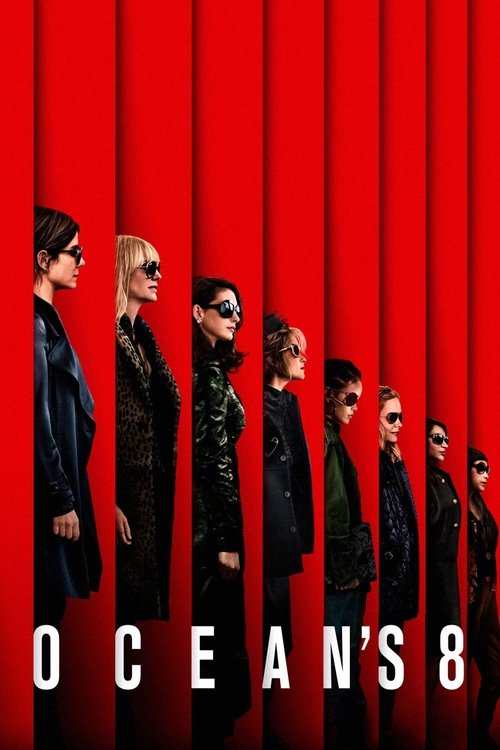
Ocean's Eight
2018 · Gary Ross
For a Friday night when you want glamour and banter without a single heavy moment — comfort viewing to put on with friends, snacks, and zero emotional risk.
What it's about
Fresh out of prison, Debbie Ocean — sister of the legendary con man Danny — has spent her sentence perfecting one plan: steal a six-pound Cartier diamond necklace off a celebrity's neck in the middle of the Met Gala, New York's most exclusive party. She assembles an all-female crew of specialists — hacker, jeweler, fence, pickpocket, fashion designer — and the caper unfolds through fittings, security schematics, and one very glamorous night.
The experience
Breezy, glossy, and low-stakes fun — the pleasure is watching stylish people be effortlessly good at their jobs amid couture and champagne. It glides rather than grips; think caper-as-hangout-movie.
Performances
Anne Hathaway steals the film as a gloriously vain movie star, clearly having the most fun of anyone on screen, while Sandra Bullock and Cate Blanchett anchor the crew with dry, unbothered cool.
The craft
The film's real spectacle is its setting — the Met Gala recreated with actual celebrity cameos and a parade of gowns and jewels that makes the heist double as a fashion show. Ross keeps the caper mechanics clean: recruitment, plan, job, and the reveal of the con inside the con.
Why it matters
A solid summer hit that became the flagship of the late-2010s wave of star-driven, female-led reboots of legacy franchises, and a frequent reference point in arguments about how to do them.
Snapshot
Ocean's Eight is a heist comedy conceived as both a spin-off and a continuation of Steven Soderbergh's Ocean's trilogy (2001–2007), transplanting that franchise's caper machinery onto an all-female ensemble. Sandra Bullock plays Debbie Ocean, sister of Soderbergh's Danny Ocean, who exits prison with a fully-formed plan to steal a Cartier diamond necklace off the neck of a celebrity at New York's Met Gala. Directed and co-written by Gary Ross, the film assembles a marquee cast — Cate Blanchett, Anne Hathaway, Mindy Kaling, Sarah Paulson, Awkwafina, Rihanna, and Helena Bonham Carter — and runs the standard caper program: recruitment, planning, the job, and the reveal of the con-within-the-con. It arrived in the summer of 2018 as a glossy, star-forward studio entertainment, positioned squarely within a late-2010s cycle of legacy franchises reconfigured around women. Its interest for an atlas of influence lies less in formal innovation than in how faithfully — and how knowingly — it inherits a house style, and in what that inheritance reveals about franchise economics, ensemble comedy, and the "gender-swap" reboot moment.
Industry & production
The film is a Warner Bros. release produced in association with Village Roadshow and Larger Than Life Productions, with Steven Soderbergh serving as a producer. Soderbergh's presence is the decisive structural fact: rather than direct a fourth Ocean's himself, he handed the property to Gary Ross while retaining a producing hand, lending the spin-off the trilogy's institutional continuity without its original author behind the camera. The screenplay is credited to Ross and Olivia Milch, with story built explicitly on Soderbergh and George Clooney's franchise architecture; the Ocean surname does the load-bearing work of connecting Debbie to Danny (referenced as deceased within the film) and licensing the audience's familiarity with the series' rules.
Production leaned heavily on access and location. The film shot in and around New York City, and its centerpiece required cooperation with the Metropolitan Museum of Art and, crucially, the cultural apparatus of the Met Gala itself — an event controlled by Vogue and Anna Wintour, who appears as herself alongside a roster of fashion-world and celebrity cameos. This is a co-production not just of studio and financiers but of a film production with a fashion institution, and the movie's texture depends on that authenticity of milieu. The casting strategy — stacking the ensemble with established stars across film, television, music, and comedy (Rihanna and Awkwafina bringing extra-cinematic followings) — is itself an industrial argument: the "eight" are a portfolio of audiences. Reported budget and grosses I will not cite to a false precision, but the film is widely understood to have been a commercial success relative to its cost, opening strongly and out-earning several individual entries in the original trilogy at the domestic level; treat any exact figure with caution unless checked against a box-office record.
Technology
Ocean's Eight is a mainstream digital-era studio production and looks it: clean, bright, high-resolution imagery with the deep, controllable latitude of contemporary digital capture. Cinematographer Eigil Bryld's work here is consistent with the Arri Alexa–class digital workflow standard for glossy Hollywood productions of the mid-2010s, though I flag that the specific camera and lens package is a technical detail I would want to verify against a camera report rather than assert from style alone. The film's real technological subject, though, is diegetic surveillance and its subversion: the plot turns on manipulating the Met's security cameras, facial-recognition and monitoring systems, and the digital infrastructure of a high-security event. Rihanna's character, "Nine Ball," is the crew's hacker, and the film stages the modern heist as an act of information control — spoofing feeds, planting images, exploiting the very camera networks meant to prevent theft. In this sense the film updates the trilogy's fascination with technological gamesmanship for an era in which the decisive tools are software and data rather than safecracking. Post-production and visual-effects work is largely invisible by design, in service of set extension, crowd augmentation, and the seamless integration of the necklace and its handling.
Technique
Cinematography
Eigil Bryld — a Danish cinematographer known to English-language audiences for In Bruges (2008) and the U.S. House of Cards — shoots the film with a polished, jewel-toned sheen appropriate to its subject. The visual register is luxury: reflective surfaces, gowns, gems, and the gilded interiors of the Met render the frame as a display case. The Gala sequence is the photographic showpiece, balancing controlled glamour lighting against the practical challenge of a crowded, movement-heavy set. Where Soderbergh (who shoots his own films under a pseudonym) favored cool, jaundiced, high-contrast palettes and restless handheld framing in the original trilogy, Bryld's work is smoother and more classically composed — legible, elegant, less idiosyncratic. The camera serves the ensemble and the plot's spatial logic (who is where, when) rather than calling attention to itself.
Editing
The film was cut by Juliette Welfling, a distinguished editor best known for her long collaboration with Jacques Audiard (The Diving Bell and the Butterfly, A Prophet, Rust and Bone) — an art-house pedigree brought to bear on a studio caper. Editing is the heist genre's defining craft, since the pleasure of the form lives in the withheld-and-revealed structure: the audience watches the job unfold, then watches it re-explained to show what was really happening. Welfling handles the montage of recruitment and planning with brisk economy and orchestrates the Gala set-piece through parallel cutting across multiple crew members executing simultaneous tasks. The signature caper move — the retrospective reveal that recontextualizes earlier images — is executed cleanly, if along conventional franchise lines rather than pushing the form.
Mise-en-scène / staging
Production design (Alex DiGerlando) and costume design (Sarah Edwards) carry an unusually heavy narrative burden here, because the film's world is the fashion world. Costume is not decoration but plot: the necklace, the gowns, the designer-and-muse relationship between Rose Weil (Bonham Carter) and Daphne Kluger (Hathaway) drive the mechanism of the theft. The staging of the Gala — red carpet, dinner, the museum's galleries and back-of-house — organizes the geography the heist exploits. Ross stages the ensemble with an eye to giving each of the eight a distinct visual and behavioral signature, a necessity in a crowded caper where the audience must track many hands at once.
Sound
Daniel Pemberton's score supplies much of the film's propulsion and wit. Pemberton — whose credits include Steve Jobs and Spider-Man: Into the Spider-Verse — is a composer inclined toward rhythmic, texturally playful, groove-driven scoring, a sensibility well matched to the caper's need for momentum and cool. The music partners with a curated soundtrack of songs to establish the film's stylish, propulsive tone, echoing the trilogy's tradition (David Holmes scored the Soderbergh films) of using music to keep the heist feeling breezy and self-aware. Sound design in the Gala sequence layers crowd, event, and the crew's covert communications to sustain tension beneath the glamour.
Performance
Performance is arguably the film's primary attraction and its most durable achievement. Bullock plays Debbie as a controlled, ironic planner — the "cool" register the franchise associates with Clooney's Danny — while Blanchett's Lou provides a laconic, sardonic counterweight, the pair's rapport recalling the Clooney–Pitt dynamic. The film is calibrated as an ensemble showcase: Hathaway's turn as a vain, insecure movie star is widely singled out as the comic high point, a knowing performance about performance; Awkwafina and Kaling bring distinct comic textures; Bonham Carter plays a faded designer with fluttering desperation; and Rihanna's deadpan hacker leverages her star persona economically. The mode is star-vehicle acting — audiences are meant to enjoy known personae in playful configuration — more than psychological realism, which is entirely in keeping with the genre.
Narrative & dramatic mode
Ocean's Eight runs the classical caper structure with textbook fidelity: exposition and motive (Debbie's grievance against ex-lover and art dealer Claude Becker, the plan hatched in prison), recruitment (the assembling of specialists), planning and rehearsal, execution, complication, and the final reveal that discloses the con's true shape — including a second target and a set-up of the antagonist. The dramatic mode is comic and cool rather than suspenseful in a life-or-death sense; stakes are financial and personal, not mortal, and the tone privileges pleasure, competence, and wit. The film uses the genre's characteristic dramatic irony (the audience is invited to feel like an insider) and its trademark withholding of information to enable the surprise. Debbie's arc doubles the heist with a revenge plot, giving the caper an emotional throughline — vindication and vindictiveness — that the more purely recreational trilogy sometimes lacked. Character depth is deliberately shallow and broad; the pleasure is choreographic and social, the spectacle of a team functioning perfectly.
Genre & cycle
The film sits at the intersection of the heist/caper film and the ensemble star comedy, and within the specific franchise lineage of the Ocean's series, which itself descends from the 1960 Rat Pack Ocean's 11. More pointedly, Ocean's Eight belongs to a late-2010s cycle of established franchises reconstituted around female casts — the most conspicuous recent precedent being Paul Feig's Ghostbusters (2016). That cycle was commercially and culturally fraught, and Ocean's Eight navigated it by choosing continuation over remake: Debbie is Danny's sister, not a replacement, which sidesteps the "they're redoing our movie" backlash while still delivering an all-women reconfiguration. The film thus functions as a case study in how studios attempted to expand franchise demographics without triggering fan hostility — extending a brand's family tree rather than overwriting its canon.
Authorship & method
Gary Ross is a Hollywood craftsman with a screenwriter's foundation — his early credits include the scripts for Big (1988) and Dave (1993) — who moved into directing with Pleasantville (1998) and Seabiscuit (2003) before launching The Hunger Games (2012). His sensibility tends toward accessible, well-upholstered mainstream storytelling rather than authorial idiosyncrasy, which makes him a logical steward for a franchise property whose "author" in style terms remains Soderbergh. The most telling authorship story here is one of inheritance and delegation: Soderbergh, the trilogy's stylist, produces but cedes direction, so the film is a house style executed by a new set of hands. Those hands are notable for their pedigree. Cinematographer Eigil Bryld and, especially, editor Juliette Welfling (Audiard's collaborator) bring European art-cinema résumés to bear on studio entertainment. Composer Daniel Pemberton supplies a contemporary rhythmic wit distinct from David Holmes's trilogy scores. Co-writer Olivia Milch shares script credit with Ross. The result is a collaborative object in which no single voice dominates; its coherence comes from franchise DNA and professional polish rather than a singular directorial signature.
Movement / national cinema
The film is a product of the American studio system — mainstream, English-language Hollywood commercial cinema — and belongs to no art movement. Its most interesting national-cinema wrinkle is at the level of crew: the importation of Danish (Bryld) and French-tradition (Welfling) craftspeople into a Hollywood production reflects the thoroughly transnational labor pool of contemporary studio filmmaking, where technical authorship routinely crosses borders even when the product is unmistakably an American star vehicle.
Era / period
Ocean's Eight is very much a film of the late 2010s. Its surveillance-and-hacking heist mechanics register the era's anxieties about data and monitoring; its casting logic reflects the platform-and-fandom economics of a moment when musicians and comedians carried transferable audiences; and its very existence reflects the franchise-and-IP imperative that dominated studio strategy after the consolidation of the cinematic-universe model. Culturally, it is legible against the backdrop of renewed public conversation about women's representation and authorship in Hollywood around 2017–2018 — the film's all-female premise was inevitably read through that lens, whatever its makers' intentions. It is a period piece about its own present: celebrity, fashion, and image as the terrain on which value is created and stolen.
Themes
Beneath the recreational surface, the film is preoccupied with image and appearance as currency. The heist targets the fashion world specifically because that is where value is manufactured out of display; the necklace's worth is a matter of who wears it and where. Related is the theme of women's visibility and invisibility: the crew repeatedly exploits the ways women are underestimated, overlooked, or reduced to surface, turning the assumption that they are decorative into the mechanism of the con. Competence and collaboration — the caper genre's perennial subject — is framed here as sisterhood and professional solidarity, an ensemble of specialists whose mutual trust is the real asset. Finally, revenge and self-vindication give Debbie's plot its personal charge, entwining the impersonal thrill of the perfect job with the satisfaction of a woman settling a score against the man who wronged her.
Reception, canon & influence
Critical reception was mixed-to-positive. Reviewers broadly praised the cast's chemistry and star wattage — Hathaway's comic performance in particular drew favorable attention — and enjoyed the film's glossy, easygoing charm, while a recurring reservation held that it was too smooth and low-stakes, lighter on genuine tension and narrative surprise than Soderbergh's Ocean's Eleven, and that several of its eight were underused. It was, in the common critical formulation, a pleasant and stylish entertainment rather than a great heist film. Commercially it performed strongly for its class, generally regarded as a success; I decline to attach exact grosses without verification.
Influences on the film (backward): The clearest lineage is Soderbergh's Ocean's Eleven (2001) and its sequels, from which Ocean's Eight inherits structure, tone, cool, and the Ocean name — themselves a remake of the 1960 Rat Pack picture. Behind that stands the whole tradition of the ensemble caper (Jules Dassin's Rififi, the "assemble a team, pull the job, reveal the trick" template) and the star-vehicle comedy. The gender-swap franchise cycle, above all the 2016 Ghostbusters, is the immediate contextual influence on its conception and marketing.
Legacy (forward): As of this writing the film's forward influence is modest and best stated with restraint. It stands as a notable data point in the late-2010s experiment of reconstituting franchises around women, and as an example of the continuation-not-remake strategy for extending a brand. It did not spawn a further sequel in the years immediately following, and its lasting cultural footprint rests more on its ensemble and its Met Gala spectacle than on any formal or generic innovation it introduced. Its most durable contribution may simply be as a proof of concept — that a female-fronted legacy caper could be assembled, marketed on the combined star power of its cast, and land as a viable commercial entertainment.
Reception
Landed in 2018 amid exhausting 'female reboot' discourse and got a shrug from critics — fun cast, low stakes. It's since settled into beloved comfort-watch status, with the retrospective consensus being the cast was better than the movie deserved.
How Ocean's Eight was received, from release to now →
How to watch Ocean's Eight: what to notice on a first viewing
- Notice how much of the frame is gold, glass, or jewels. Cinematographer Eigil Bryld shoots gowns, gems, and the Met's gilded interiors as reflective surfaces, giving the whole film a polished display-case sheen. The look sells the world the crew is stealing from before anyone explains the plan.
- Watch how much screen time costume and jewelry get. The necklace, the gowns, and the designer-and-muse bond between Rose and Daphne are not decoration. Production and costume design carry the plan's actual mechanics. Fashion here is not backdrop. It is the machine the heist runs on.
- Watch how each of the eight gets a distinct habit or tic. Ross stages the crew so each woman reads instantly: Bullock's control, Blanchett's dry cool, Hathaway's vanity, Awkwafina and Kaling's separate comic rhythms. You can track eight people at once because each one is legible on sight, not just by name.
- Listen for the rhythmic pulse under the planning scenes. Daniel Pemberton's score stays groove-driven and playful, giving montage and prep sequences forward motion without raising actual tension. The music tells you this is a game being won, not a crime with real risk.
- Notice how often a crew member goes unnoticed in plain sight. The women repeatedly use the assumption that they are decorative or invisible to move through guarded spaces unchallenged. Being underestimated is not a problem the film complains about. It is the tool the crew uses to work.
The whole guide to watching Ocean's Eight, with the keys for a rewatch →
Influences: the films it descends from and the films it influenced
- Ocean's Eleven (2001) — Supplies the inherited house grammar executed here — the recruitment-montage assembly of specialists, split-screen coverage of simultaneous action, jewel-toned lounge palette, and the withheld-then-flashback reveal that re-shows the job to expose the trick the audience missed.
- Ocean's Thirteen (2007) — Directly models the gadget-and-surveillance vault caper and the retrospective 'here's how we actually did it' editing beat that Ocean's Eight repurposes for the Toussaint necklace 3-D-print swap.
- Ocean's 11 (1960) — Origin of the star-vehicle caper as a hang-out picture where casting wattage and ensemble banter carry the film over plot mechanics — the exact commercial logic behind marketing Eight on its eight leads.
- Rififi (1955) — Codifies the assemble-the-team / execute-the-procedure structure and the near-wordless real-time set-piece, the procedural spine every Ocean's centerpiece heist still stretches out.
- Topkapi (1964) — Establishes the suspended-from-above museum jewel theft that avoids floor sensors — the vertical-intrusion museum-heist blueprint underlying the Met Gala vault sequence.
- The Sting (1973) — Perfects the con-within-a-con withheld from the viewer, then the retrospective reveal that the audience itself was played — the misdirection architecture of Eight's Debbie-had-a-second-plan finale.
- How to Steal a Million (1966) — The Givenchy-clad museum art-theft caper fusing haute-couture mise-en-scène with the elegant jewel/art grab — the fashion-world glamour register Eight transposes to the Met Gala.
- The Thomas Crown Affair (1999) — Museum heist built on decoy-crowd misdirection and treating the prized image/object as pure currency of status — the 'image-as-currency' theft staging Eight echoes.
- Out of Sight (1998) — Soderbergh's fractured-chronology, freeze-and-jazz cool established the crime-picture idiom he later franchised into Ocean's and that Eight is a downstream execution of.
- Charade (1963) — The glossy star-driven caper of serial identity reveals dressed in couture — the shifting-allegiance twist plotting and fashion-plate glamour Eight leans on for its con.
- A Prophet (2009) — Showcases editor Juliette Welfling's rhythmic elliptical cutting — compressing process into propulsive fragments — the technique she brings from Audiard's art cinema to Eight's heist montages.
- The Man from U.N.C.L.E. (2015) — Daniel Pemberton's percussive retro-groove scoring and split-panel heist wit here directly anticipate the rhythmic-comedy score he supplies for Eight in place of Holmes's trilogy sound.
- The Hustle (2019) — Extends the gender-swap con cycle Eight normalized, recasting a male grifter comedy (Dirty Rotten Scoundrels) with a female duo trading on star chemistry over caper intricacy.
- Red Notice (2021) — Carries forward the late-2010s star-wattage heist-as-brand model — glossy jewel-toned globe-trotting art theft engineered around triple-cross reveals and cast marquee value rather than procedural rigor.
- Logan Lucky (2017) — Soderbergh's own contemporary heist, made alongside producing Eight, runs the same parallel-cut set-piece and delayed-reveal editing on a redneck register — the author's signature working beside the delegated one.
- Widows (2018) — The same-year female-ensemble heist that takes the woman-led caper toward grief and social realism — the serious counterweight to Eight's glossy handling of the identical premise.
- Ghostbusters (2016) — The immediate gender-swap legacy-reboot template — reconstituting a male-branded franchise around a female comic ensemble and marketing on that swap — the production strategy Eight adopts wholesale.
Similar films
- Ocean's Eleven (2001) — influence & lineage
- Ocean's Thirteen (2007) — influence & lineage
- The Thomas Crown Affair (1999) — influence & lineage
- Out of Sight (1998) — influence & lineage
- The Man from U.N.C.L.E. (2015) — influence & lineage
- Charade (1963) — influence & lineage · often watched together
- Ocean's Twelve (2004) — shared sensibility
- The Devil Wears Prada 2 (2026) — shared sensibility