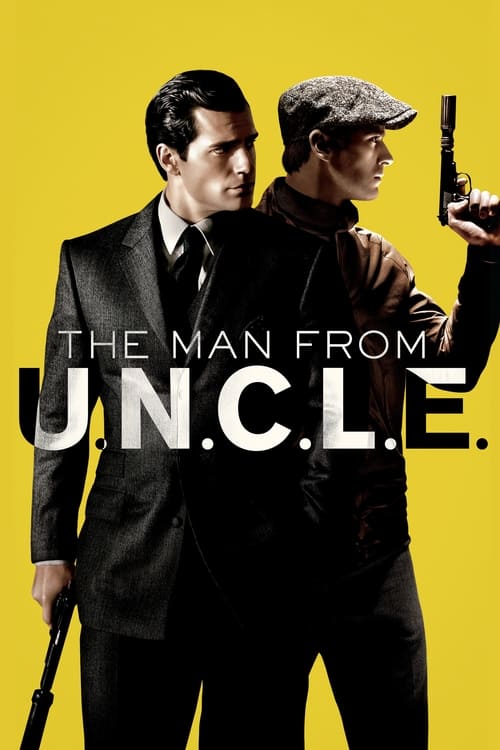
The Man from U.N.C.L.E.
2015 · Guy Ritchie
For a night when you want effortless cool — something stylish and light you can pour a drink to, no homework, no heaviness. Comfort viewing in a three-piece suit.
What it's about
At the height of the Cold War in 1963, a suave CIA operative and a hulking KGB agent are forced into a partnership neither wants: a shadowy private syndicate is close to getting nuclear weapons, and stopping it matters more than their two flags. Their way in is Gaby, an East German mechanic whose missing father is the scientist at the center of the plot. Espionage ensues, but mostly the two spies compete — over tradecraft, over tailoring, over her.
The experience
Pure lacquered pleasure — a fast, funny, gorgeous caper where the banter and the outfits matter more than the stakes, and that's the point. It glides; you grin.
Performances
Henry Cavill gives a genuinely witty, self-aware turn as Solo — all mid-Atlantic purr and impeccable timing — and Alicia Vikander steals scenes as the mechanic who refuses to be anyone's damsel.
The craft
Guy Ritchie directs it as an exercise in surface and rhythm: split screens, needle-drops, and a period production design so committed that the costumes practically get their own subplot. The action is staged with a wink — the film keeps finding elegant ways to skip the boring parts of a set piece and land on the joke.
Why it matters
A box-office underperformer that found a devoted second life on home viewing, it's now regularly cited as one of the great modern examples of the retro spy caper and a what-might-have-been franchise starter.
Snapshot
The Man from U.N.C.L.E. is Guy Ritchie's glossy, deliberately retro reboot of the 1964–1968 NBC espionage series of the same name, transplanting the show's Cold War premise into a lacquered feature-length caper set in 1963. The film pairs a CIA operative, Napoleon Solo (Henry Cavill), with a KGB agent, Illya Kuryakin (Armie Hammer), forcing two ideological antagonists into an uneasy partnership to stop a private syndicate from arming itself with nuclear weapons. Their conduit is Gaby Teller (Alicia Vikander), an East German mechanic whose father is the missing scientist at the plot's center. Released by Warner Bros. in August 2015, the picture is less a thriller than a fashion-plate divertissement — an exercise in surface, tailoring, and rhythm, in which the mechanics of the spy plot matter far less than the sparring chemistry of its leads and the period-perfect textures of its European settings. It underperformed commercially on release but has since accrued a devoted cult following that continues to lament the sequel it never received.
Industry & production
The film is the visible endpoint of one of Hollywood's longer and more troubled development sagas. The screen rights to the U.N.C.L.E. property circulated at Warner Bros. for years, attracting a rotating cast of filmmakers and stars. Steven Soderbergh was attached at one stage and departed over budgetary disagreements with the studio; other directors, including David Dobkin and Matthew Vaughn, were linked to the project across its gestation. On the acting side, George Clooney was associated with the Solo role before withdrawing (reportedly owing to a back injury), and Tom Cruise was cast as Solo at a late stage before exiting to prioritize Mission: Impossible – Rogue Nation, opening the part for the then-rising Henry Cavill. That much of this churn is well documented; the finer contractual details are best left to the trade record rather than reconstructed here.
Guy Ritchie inherited the project with his longtime producing and writing partner Lionel Wigram, with whom he had already rebuilt the Sherlock Holmes franchise for Warner Bros. The studio positioned the film as a potential franchise starter — a stylish, four-quadrant property that could seed sequels and spin the U.N.C.L.E. organization out into an ongoing series. Principal photography took place across the United Kingdom and Italy, with Rome and the surrounding Italian coast supplying the film's postcard European glamour. The picture opened in the crowded late-summer 2015 window and drew a soft domestic response; it is generally regarded as a commercial disappointment relative to its reported production budget, and no sequel followed. Given the sensitivity around exact grosses and budget figures, the safest characterization is the consensus one: the film did not perform to the level Warner Bros. needed to justify a continuation.
Technology
The film is a conventionally mounted mid-2010s studio production, and its most interesting technological choices are aimed backward — at conjuring the analog texture of early-1960s cinema rather than showcasing contemporary tools. Cinematographer John Mathieson, a committed advocate of photochemical capture, shot the film for a warm, grainy, celluloid-friendly look consistent with the period setting; the precise stock and camera configuration are technical details I won't assert without the camera reports, but the finished image reads as an emulation of vintage widescreen photography rather than clean digital sheen. Visual effects are used sparingly and largely invisibly, for environment extension, period cleanup, and the film's few large-scale action beats. The more conspicuous "technology" of the film is optical and editorial — split-screen and multi-panel compositing — deployed as a stylistic homage to 1960s montage rather than as a technical novelty. In short, the production's engineering effort went into disguising its own modernity.
Technique
Cinematography
Mathieson — best known for his work with Ridley Scott — gives the film a saturated, sun-warmed palette of ambers, teals, and creams that flatters the costume and production design. The framing favors elegant widescreen compositions, controlled camera moves, and a poise that is unusually classical for a Guy Ritchie film. Where Ritchie's crime pictures tend toward handheld aggression, here the camera often holds back, letting the tailoring, the architecture, and the movie stars do the work. The Italian exteriors are photographed as travelogue; the interiors are lit with a soft, glamorous key that recalls the studio gloss of the era the film is imitating.
Editing
Editing is where Ritchie's authorship is most legible. Longtime collaborator James Herbert cuts the film with the elliptical, self-amused rhythm familiar from the Sherlock Holmes films — compressing exposition, withholding and then replaying information, and building set pieces out of fragmentary montage. The film's signature sequence inverts action-movie convention: as Illya endures a frantic waterborne pursuit, the cut strands us with Solo, who calmly commandeers a truck, eats a sandwich, and listens to music while the chaos plays out, small and distant, through the windscreen behind him. It is a joke told entirely in the edit — a deliberate deflation of spectacle that doubles as a thesis statement about the film's priorities. Split-screen panels, used repeatedly, both quote the 1960s and let Ritchie stage parallel action with tongue firmly in cheek.
Mise-en-scène / staging
The film is, above all, a designed object. Costume designer Joanna Johnston and the production design team construct a fantasy 1963 of impeccable suits, sculptural gowns, and continental interiors, in which every frame is legible as an assemblage of textures and silhouettes. Character is communicated through wardrobe as much as dialogue: Solo's raffish tailoring, Illya's rigid gray uniform of a man, Gaby's evolving self-presentation, and Victoria Vinciguerra's (Elizabeth Debicki) icy couture. Staging tends toward the composed and the poised — spies moving through galleries, hotels, and villas — with the physical action often held at an ironic remove.
Sound
The soundtrack is central to the film's identity. Daniel Pemberton's original score is a genuine standout: a magpie assemblage of period-flavored jazz, driving percussion, harpsichord, flutes, and Italian-inflected motifs that comments on the action with wit and propulsion. It is scoring as character work, giving each spy his own sonic register. Around it, the film layers period and period-style source cues, including Italian pop of the era, to reinforce the continental setting. The sound design treats action with the same detached elegance as the images, frequently subordinating diegetic chaos to the music's rhythm.
Performance
The film lives or dies on its ensemble, and the performances are pitched as star turns rather than psychological studies. Cavill plays Solo as a knowing pastiche of mid-century leading-man suavity — an unflappable, Cary Grant-adjacent charmer. Hammer counters with a coiled, accent-heavy Illya whose repressed fury is played for both menace and comedy. Vikander gives Gaby more mischief and interiority than the plot strictly requires, and Debicki, in a breakthrough screen role, makes Victoria a genuinely seductive villain. Hugh Grant appears late as the urbane spymaster Waverly, effectively setting up an organization the franchise never got to build. The chemistry among the three leads — the film's most cited virtue — is the real engine.
Narrative & dramatic mode
The dramatic mode is comedy-caper rather than thriller. The nuclear-blackmail plot is deliberately thin, a clothesline on which to hang set pieces, double-crosses, and banter. The film's real narrative interest is the enemies-to-allies dynamic between Solo and Illya, whose mutual suspicion, one-upmanship, and grudging respect supply the emotional throughline. Ritchie structures the film around reversals and reveals, frequently using the edit to withhold how a scheme was executed and then flashing back to explain it — a heist-movie grammar applied to espionage. Stakes are kept intentionally light; danger is stylized, violence is largely bloodless and often comic, and the tone stays cool and ironic throughout. This is a film far more interested in poise under pressure than in suspense.
Genre & cycle
The Man from U.N.C.L.E. belongs to the mid-2010s revival of the stylish, retro-tinged spy film. Its most direct kin is the concurrent wave of espionage pictures that leaned into either period nostalgia or arch self-awareness: Matthew Vaughn's Kingsman: The Secret Service (2014), the ongoing Mission: Impossible series, and the reinvigorated James Bond films of the Daniel Craig era. Notably, 2015 was a banner year for Cold War cinema, with Steven Spielberg's Bridge of Spies offering a sober counterpoint to Ritchie's frivolity; the retro-spy mode would continue into Atomic Blonde (2017). The film also sits within the broader cycle of feature adaptations mining 1960s television properties, following the model of the Mission: Impossible franchise itself. Genre-wise it fuses "spy-fi," buddy comedy, and heist picture, foregrounding the pleasures of the genre — gadgets, glamour, globe-trotting — while treating its plot mechanics as an afterthought.
Authorship & method
The film is a clear expression of Guy Ritchie's mid-career studio phase — the period, bracketed by the Sherlock Holmes films (2009, 2011) and King Arthur: Legend of the Sword (2017), in which he applied his kinetic, ironic sensibility to Warner Bros. franchise material. His authorial signatures are all present: the elliptical editing, the split-screen and montage flourishes, the retroactive reveal of how a caper was pulled off, and a preference for cool wit over sincerity. Crucially, this is a Ritchie film with the aggression sanded down and the elegance turned up.
His key collaborators shape the result decisively. Co-writer and producer Lionel Wigram was Ritchie's central creative partner across this era. Cinematographer John Mathieson supplies the film's classical, celluloid-warm look. Editor James Herbert, a recurring Ritchie collaborator, executes the movie's comic timing at the cut. And composer Daniel Pemberton — for whom this was a career-elevating showcase — provides a score so distinctive it functions as co-author of the film's tone. Costume designer Joanna Johnston's contribution is equally load-bearing, given how much of the film's meaning is carried by wardrobe. The writing credits also reflect the property's long development, with the story credited to multiple hands (Ritchie and Wigram alongside earlier contributors) atop the original series created by Sam Rolfe; the character of Napoleon Solo carries the well-known lineage of Ian Fleming's early involvement in the television series' conception, though the exact division of that credit is a matter for the formal record.
Movement / national cinema
Ritchie is a British filmmaker who emerged from the late-1990s London crime-cinema scene (Lock, Stock and Two Smoking Barrels, Snatch), and The Man from U.N.C.L.E. represents his full absorption into transatlantic studio filmmaking — a Warner Bros. production shot substantially in the UK and Italy, adapting an American television property, with a mixed British-and-international cast. It is best understood not as national cinema in the auteurist sense but as globalized Hollywood product filtered through a British directorial sensibility. The film's European setting and continental styling also align it with a strain of Anglo-American cinema that trades on Old World glamour as a marker of sophistication.
Era / period
Two time frames matter. Diegetically, the film is a fantasy of 1963 — the Berlin Wall era, the height of superpower brinkmanship — rendered as pure design rather than history. Productionally, it is a artifact of mid-2010s Hollywood's franchise imperative and its appetite for reviving legacy IP: a moment when studios reflexively mined old television and film titles in search of the next cinematic universe. The film's commercial fate is itself instructive about that era, illustrating the risk in launching a franchise on a property whose brand recognition had faded with the generation that watched the original series. It arrived, in other words, as a bet on nostalgia that the broad 2015 audience did not share.
Themes
The film's most sincere theme is détente through partnership: two men trained to see each other as enemies who discover that cooperation, and even friendship, can override ideology. The Cold War functions less as political subject than as a stylish backdrop against which this rapprochement plays out. Running beneath it is a preoccupation with performance and surface — spycraft as a matter of costume, poise, and role-playing, in which identity is something worn. Gaby's arc introduces a lighter thread on agency and self-fashioning. But the film wears its themes lightly; it is fundamentally a movie about pleasure, taste, and cool, and its deepest conviction may simply be that style is its own reward.
Reception, canon & influence
Critical reception on release was mixed-to-favorable. Reviewers widely praised the film's visual polish, Pemberton's score, the chemistry of the leads, and Elizabeth Debicki's villain, while a recurring criticism held that the plot was too slight and the whole too enamored of its own surfaces to generate genuine tension. Commercially, as noted, the film disappointed, and Warner Bros. did not pursue the sequel the ending gestured toward.
Its influences run backward to the 1960s: the source television series and its Ian Fleming–adjacent origins, the Eurospy and spy-fi cinema of the decade, the split-screen montage aesthetics of the era, and the mid-century leading-man archetypes Cavill and Hammer are consciously channeling. Forward, its legacy is more cult than canonical. The film has enjoyed a strong home-video and streaming afterlife, and its fanbase remains vocal in its affection — routinely citing it among the more underrated studio films of its decade and continuing to campaign, years on, for a follow-up. Daniel Pemberton's score is frequently singled out as a launch point for a composer who went on to major acclaim (including his celebrated work on Spider-Man: Into the Spider-Verse). If the film shaped anything downstream, it is best described as a touchstone for a certain mode of self-aware, design-forward period spy filmmaking — an example admirers point to more than a template the industry widely copied. Its truest cultural position is that of the beloved commercial near-miss: a film whose reputation has steadily risen in the years since its underwhelming release.
A Deleuzian reading
A man sits in a commandeered truck, eating a sandwich.
The full Deleuzian reading of The Man from U.N.C.L.E. →
Reception
Landed with a shrug in 2015 — lost in a crowded spy summer alongside Rogue Nation and Spectre, and it underperformed at the box office. A decade on it's a certified 'we were robbed of a franchise' movie, steadily reappraised as Guy Ritchie's most stylish film.
How The Man from U.N.C.L.E. was received, from release to now →
How to watch The Man from U.N.C.L.E.: what to notice on a first viewing
- Look at the cut of each character's suit. Joanna Johnston dresses Solo in raffish tailoring, Illya in a rigid gray uniform of a man, Victoria in icy couture, and Gaby in whatever she is currently deciding to be. Nobody argues politics in this film. Two ideologies stand in a gallery in different cuts of cloth, and that is the whole Cold War here.
- Notice when the screen splits into separate panels. Ritchie and James Herbert repeatedly lay parallel action out as a grid. It quotes the graphic montages of sixties cinema and turns simultaneous events into a layout problem. Two things happening at once get solved as design rather than as suspense. You read the panels the way you read a magazine spread.
- Listen for the harpsichord, flutes, and percussion following each spy. Daniel Pemberton writes each agent his own sonic register out of period jazz, driving drums, and Italian-inflected motifs. The score keeps commenting on the action rather than swelling underneath it. The music is doing character work. Often it tells you who has the upper hand before any line of dialogue does.
- Notice how still the camera stays during the action. Mathieson shoots warm photochemical widescreen with controlled moves and classical compositions. The handheld aggression of Ritchie's crime pictures is gone. Architecture, tailoring, and movie stars are left to do the work. Poise is the effect being manufactured. A camera that refuses to get excited is what keeps the danger at a flattering distance.
- Watch how rarely Cavill lets Solo look ruffled. He plays a knowing pastiche of mid-century leading-man suavity, borrowed with real accuracy. Hammer counters with a coiled, accent-heavy Illya whose fury stays visibly clamped down. The film knows exactly which old images it is wearing. The sincerity is in how precisely the borrowing is done.
The whole guide to watching The Man from U.N.C.L.E., with the keys for a rewatch →
Influences: the films it descends from and the films it influenced
- Ocean's Eight (2018) — Daniel Pemberton's percussive retro-groove scoring and split-panel heist wit here directly anticipate the rhythmic-comedy score he supplies for Eight in place of Holmes's trilogy sound.
- The Thomas Crown Affair (1968) — Its Pablo Ferro multi-panel split-screen montages are the direct template for Ritchie's grid-frame simultaneity, treating the heist as a design problem staged across the frame.
- Grand Prix (1966) — Pioneered the roving multi-image split-screen as a rhythmic device rather than a gimmick, the '60s montage grammar U.N.C.L.E. photochemically revives.
- Charade (1963) — Establishes the glamorous enemies-to-allies caper built on shifting-loyalty banter and couture-clad movie-star chemistry over plot mechanics — U.N.C.L.E.'s tonal DNA.
- Danger: Diabolik (1968) — Pop-art Eurospy in which lacquered production and costume design carry the meaning; Debicki's Victoria and her modernist lair descend from this design-forward surface aesthetic.
- Goldfinger (1964) — Codified the Fleming-adjacent spy-fi villain, lair, and set-piece scale that U.N.C.L.E. pastiches while sanding off the sadism.
- North by Northwest (1959) — The tailored, unflappable leading man moving through glossy international espionage — the mid-century archetype Cavill's Solo is consciously channeling.
- Rififi (1955) — Its wordless, procedurally exact heist established the elliptical break-in grammar Ritchie compresses and ironizes in the Italian factory sequence.
- Topkapi (1964) — Turned the Rififi heist into a comic ensemble caper, the light-touch tone U.N.C.L.E. adopts for its infiltration set-pieces.
- Snatch (2000) — Ritchie's own template for the retroactive reveal — showing an event, then rewinding to expose how it was really pulled off — deployed here for caper payoffs.
- Sherlock Holmes (2009) — The immediate Ritchie–Wigram studio predecessor, sharing the pre-visualized slow-motion 'here's the plan' reveal and elegance-over-aggression franchise mode.
- Ocean's Eleven (2001) — Sibling in cool-wit ensemble heist editing that withholds the mechanics of the con until a late elliptical reveal, prizing style and chemistry over tension.
- Kingsman: The Secret Service (2014) — Contemporary sibling reviving the self-aware retro spy with bespoke tailoring literally weaponized as character — costume-as-identity in the same key as Joanna Johnston's wardrobe work.
Similar films
- Goldfinger (1964) — influence & lineage
- Charade (1963) — influence & lineage
- The Thomas Crown Affair (1968) — influence & lineage
- Atomic Blonde (2017) — influence & lineage
- Kingsman: The Secret Service (2015) — same viewing thread
- Skyfall (2012) — same viewing thread
- Thunderbolts* (2025) — same viewing thread
- Tinker Tailor Soldier Spy (2011) — shared sensibility
All the films related to The Man from U.N.C.L.E. →
Watch it with: curated runs of related films
- Rogue Heroes, Rigged Systems — A run of slick, propulsive 21st-century spectacle — spies, super-soldiers, sci-fi survivors, and dystopian rebels all squaring off against some vast machine or shadowy apparatus — best watched back-to-back when you want momentum, style, and a lone figure taking on the whole board.