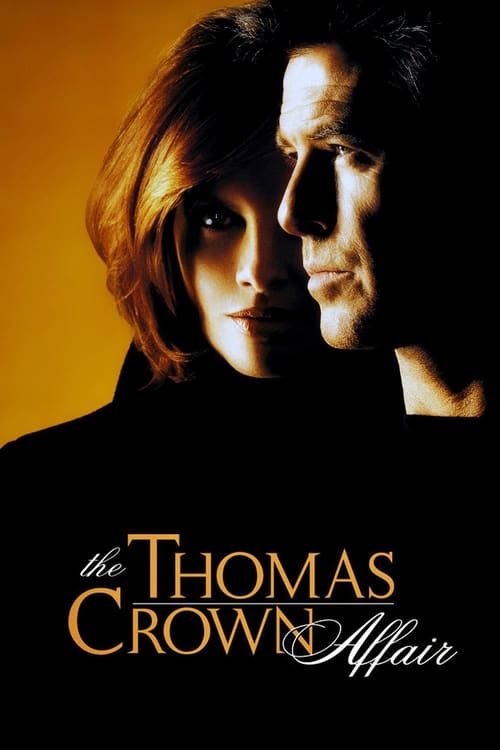
The Thomas Crown Affair
1999 · John McTiernan
For a glass-of-wine night when you want glamour, banter, and grown-up romance with a caper on top. Pure comfort viewing with a wicked streak — the cinematic equivalent of a perfectly cut suit.
What it's about
Thomas Crown is a self-made billionaire so bored with winning that he steals a Monet from the Metropolitan Museum of Art — not for the money, but for the sport. Enter Catherine Banning, the insurance investigator hired to get the painting back, who identifies her man almost immediately and decides the way to catch him is to get close. What follows is a heist story that's really a courtship: two brilliant, guarded people playing cat and mouse where neither is sure who's the cat, and falling for each other mid-game.
The experience
Sleek, flirtatious, and effortlessly confident — a film that glides. It's less about tension than about pleasure: watching two adults circle each other with wit, style, and expensive scenery.
Performances
Pierce Brosnan uses every ounce of his polish to play a man whose charm is a fortress, and Rene Russo matches him move for move — a rare Hollywood romance built around a woman in her forties who is unmistakably the smartest person in the room.
The craft
John McTiernan stages the museum sequences with the clockwork elegance of a master action director working in a tuxedo, and the film's use of Nina Simone's 'Sinnerman' turns its centerpiece into something close to musical theater. It looks like money: gleaming Manhattan interiors, Caribbean light, and heist choreography that rewards a good screen and better speakers.
Why it matters
One of the defining glossy capers of its era, it proved a remake could out-charm the original for a new generation and became the template modern 'elegant heist' films still borrow from. It also gave Brosnan his best non-Bond showcase and Russo a career-highlight role.
Snapshot
John McTiernan's The Thomas Crown Affair is a glossy, adult-skewing remake of Norman Jewison's 1968 caper, repositioning the bored-billionaire-versus-clever-investigator duel from the world of bank robbery into the rarefied milieu of fine-art theft. Pierce Brosnan plays Crown, a self-made financier who steals a Monet from New York's Metropolitan Museum of Art less for money than for the sport of it; Rene Russo plays Catherine Banning, the insurance investigator who pursues him and becomes his lover and rival in a single move. The film is essentially a two-hander dressed in the trappings of a heist picture — its real subject is seduction as a contest of intelligence, control, and self-knowledge between two people too guarded to surrender easily. Arriving in the summer of 1999 from MGM/United Artists, it functioned as a sophisticated counter-program to blockbuster spectacle: a romance for grown-ups, confident in its sensuality, its wit, and its surfaces. It remains one of the more admired Hollywood remakes of its era, and its art-museum climax set to Nina Simone is among the decade's most cited set pieces.
Industry & production
The picture was a passion project for Brosnan, whose production company Irish DreamTime co-produced it. Brosnan had relaunched James Bond with GoldenEye (1995) and Tomorrow Never Dies (1997), and Thomas Crown let him deploy that suavity in a more emotionally exposed register while building his standing as a producer-star. The property carried prestige lineage: the 1968 original, directed by Jewison and starring Steve McQueen and Faye Dunaway, was remembered as much for its style — the multi-panel split-screen montages and Michel Legrand's Oscar-winning "The Windmills of Your Mind" — as for its plot. Casting Faye Dunaway in the remake as Crown's psychoanalyst is the production's signature act of homage, threading the original's female lead through the new film as a knowing presence.
The screenplay is credited to Leslie Dixon and Kurt Wimmer, working from the 1968 film written by Alan Trustman (with story credit reflecting that source). The decisive structural change — from cash heist to museum art theft — recalibrates the whole enterprise toward taste, connoisseurship, and the iconography of high culture, which suits a protagonist defined by acquisition. Released theatrically in August 1999, the film was a solid commercial success and earned generally favorable reviews; precise budget and gross figures I won't assert here, but it performed well enough to be remembered as a hit and to anchor Brosnan's producing credibility. Talk of a sequel persisted for years without a film materializing.
Technology
The Thomas Crown Affair is a late-1990s studio production shot photochemically on 35mm, predating the digital-capture transition that would reshape the following decade. Its technological interest lies less in novel apparatus than in the integration of in-camera craft with discreet optical and emerging digital compositing for its set pieces — most visibly the climactic sequence in which the museum fills with dozens of identically dressed men in bowler hats and overcoats. That effect is built primarily through staging, costume, and choreography rather than overt visual-effects trickery, with editing and (where needed) compositing used to multiply and orchestrate the crowd. The film's surveillance-and-security motif — cameras, sensors, museum guards, the investigator's wall of monitors — also reflects a period fascination with watching and being watched, rendered through then-current production design rather than speculative technology. The picture's true "technology" is classical Hollywood polish: anamorphic-feeling widescreen compositions, location shooting in Manhattan and the Caribbean, and a glider sequence that trades on real aerial photography for romantic lift.
Technique
Cinematography
Tom Priestley Jr. photographs the film as a study in burnished surfaces — glass, marble, tailored cloth, water, and skin. The visual scheme privileges warmth and gloss: the museum's stone and the financier's penthouse are lit to flatter wealth, while the Caribbean interludes open the palette into sun and sea. Crown's world is one of clean lines and reflective materials, and the camera lingers on textures that signify money and taste. The cinematography also serves the central game of looks — who watches whom, who is seen, who controls the gaze. Framing repeatedly isolates Brosnan and Russo in compositions that put them on equal footing, two predators sizing each other up across restaurant tables, auction floors, and bedrooms.
Editing
The remake's most conspicuous formal gesture is its revival of the original's split-screen montage — Jewison's 1968 film, cut by Hal Ashby with montage design by Pablo Ferro, had made multi-panel editing a signature. McTiernan's version quotes that device for its heist and pursuit sequences, fracturing the frame to track simultaneous actions and to dramatize Crown's orchestration of many moving parts. The editing (credited to John Wright, a frequent McTiernan collaborator) otherwise favors clarity and momentum over flash; McTiernan, a director schooled in legible action geometry, keeps the caper mechanics comprehensible. The film's editorial highpoint is the museum climax, where cutting, music, and choreography converge into a sustained crescendo as the bowler-hatted men proliferate and the theft is executed in plain sight.
Mise-en-scène / staging
Production design leans into the visual vocabulary of art and wealth: museum galleries, an auction house, a glass-and-steel penthouse, a Caribbean retreat. The film's wittiest staging fuses subject and style in the climax's evocation of René Magritte — the bowler-hatted, faceless men recall The Son of Man and Golconda, and a Magritte painting figures within the scene itself, so that the heist becomes a living tableau of the artist whose work it cites. Elsewhere, staging dramatizes the central duel as a series of contests across charged spaces — a much-discussed seduction choreographed on a grand staircase, a dance, a dinner — each location functioning as a board on which the two players advance and retreat.
Sound
Bill Conti composed the score, providing a jazz-inflected, urbane underpinning suited to the film's cocktail-hour sophistication. The most celebrated sound choice, however, is the needle-drop: Nina Simone's "Sinnerman" drives the museum climax, its propulsive, gospel-charged insistence transforming the sequence into something closer to a music number than a conventional heist. The pairing of Simone's voice with the multiplying Magritte figures is the film's defining audiovisual signature and a large part of why the set piece endures in memory. The choice also functions as homage and update — where 1968 had Legrand's lush "Windmills of Your Mind," 1999 reaches for a soul-jazz icon to mark its own moment of style.
Performance
The film lives on the chemistry and poise of its two leads. Brosnan, refining the controlled charm of his Bond, plays Crown as a man whose ease masks restlessness and emotional avoidance; the role asks him to be both irresistible and faintly hollow, a billionaire who steals because nothing else still thrills him. Rene Russo's Catherine Banning is the film's most valued performance — mature, sharp, and unembarrassed by her own desire, she meets Crown as a genuine equal rather than a quarry, and Russo plays vulnerability and gamesmanship in the same breath. Denis Leary supplies abrasive contrast as the working detective who wants Banning and distrusts Crown, grounding the glamour in ordinary frustration. Faye Dunaway, in her scenes as Crown's psychiatrist, lends gravity and intertextual resonance, her presence a bridge to the original.
Narrative & dramatic mode
Structurally the film is a romance disguised as a procedural. The heist is executed early; the suspense thereafter is not primarily "will he be caught" but "what do these two people want from each other, and can either admit it." The dramatic mode is one of sustained flirtation under the cover of investigation — each scene a move in a negotiation where attraction and deception are inseparable. McTiernan and the screenwriters keep dual currents running: the mechanics of whether Crown can outmaneuver the law and the insurer, and the emotional question of whether two intimacy-averse adults can trust each other. The film's late reversals — betrayals, false moves, a second theft staged as test and proof — resolve the plot in service of the romance, privileging feeling over the caper's logic. It is a knowing, almost theatrical mode: glamorous, ironic, and ultimately tender beneath the gloss.
Genre & cycle
The film sits at the intersection of the caper/heist film, the romantic drama, and the "battle of the sexes" comedy of manners. As a heist picture it belongs to the gentleman-thief tradition — the elegant, non-violent theft as expression of style and intellect — rather than the gritty crime cycle. Its release coincided with a turn-of-the-millennium revival of the slick, ensemble or two-hander heist film, a cycle that would crest with Ocean's Eleven (2001) and its sequels, alongside other glossy remakes of 1960s caper material. Within that cycle, Thomas Crown is distinguished by its emphasis on romance and its adult sensuality, positioning itself as sophisticated counter-programming rather than franchise spectacle.
Authorship & method
John McTiernan was, by 1999, one of Hollywood's premier action craftsmen — Predator (1987), Die Hard (1988), and The Hunt for Red October (1990) had established his command of spatial clarity and escalating tension. Thomas Crown is a notable departure: a romance and character piece in which his gift for legible, mechanically satisfying sequences serves seduction and theft rather than combat. The film reveals a McTiernan attentive to surface, performance, and tempo, applying genre discipline to material driven by talk and chemistry.
His key collaborators shape the film's identity as much as he does. Cinematographer Tom Priestley Jr. supplies the lacquered visual surfaces; editor John Wright (a recurring McTiernan partner) manages the split-screen flourishes and the rhythmic build of the climax; composer Bill Conti provides the urbane score, while the curated use of Nina Simone marks the film's musical high point. Writers Leslie Dixon and Kurt Wimmer reconceived Trustman's original premise around art theft, and Brosnan's producing role through Irish DreamTime gave the project its star-driven shape. The casting of Faye Dunaway is itself an authorial gesture, binding remake to source.
Movement / national cinema
This is mainstream American studio cinema of the late 1990s — a Hollywood prestige entertainment with no allegiance to a formal movement. If it gestures beyond Hollywood, it does so through its cultivated cosmopolitan taste: European fine art (Monet, Magritte), continental glamour, and a globe-trotting wealth-fantasy geography spanning Manhattan and the Caribbean. Its lineage is the polished American genre film, refined for an adult audience, rather than any national or avant-garde school.
Era / period
The film is a quintessential turn-of-the-millennium studio product. It reflects a late-1990s appetite for luxury, surveillance imagery, and the aestheticization of wealth on the eve of the dot-com and finance booms — Crown is a fantasy of the self-made billionaire as connoisseur and rogue. It also belongs to a moment of confident Hollywood remaking, when 1960s properties were being revived with contemporary stars and gloss. Stylistically it remains photochemical and pre-digital in its capture, a film made just before the technological shift that would transform the 2000s, and its sensibility — adult romance, restrained violence, glamour over spectacle — marks it as the product of a brief window when such pictures could still command summer release.
Themes
At its core the film concerns the emptiness of acquisition and the difficulty of intimacy among those who control everything except their own feelings. Crown owns the world and is bored by it; theft is his means of feeling alive, and Catherine becomes the one possession he cannot simply buy. The film meditates on trust as the hardest currency for two guarded, self-sufficient people, and on the games — of deception, testing, and proof — through which they negotiate vulnerability. Surveillance and looking run throughout: who watches, who performs, who is truly known. The Magritte motif deepens this, with its faceless men literalizing anonymity, concealment, and the question of identity beneath the suit. Beneath the glamour, the film is about whether a man defined by control can risk being seen.
Reception, canon & influence
The Thomas Crown Affair was generally well received, praised especially for the maturity of its romance and the chemistry between Brosnan and Russo, and for the bravura museum climax; some critics judged it superior to the 1968 original in emotional substance even as it traded on the same stylistic DNA. It stands among the more respected Hollywood remakes of its period.
Its influences run backward to Jewison's original — the split-screen technique, the gentleman-thief premise, the central romantic duel, and the casting of Dunaway as explicit homage — and further back to the broader gentleman-thief and caper traditions. The art-theft conceit also draws on a long cultural fascination with the elegant heist, and the climax's iconography is a direct, deliberate citation of René Magritte.
Looking forward, the film contributed to the turn-of-the-century vogue for slick, romance-tinged heist pictures that crested with the Ocean's films, and helped consolidate the gentleman-thief as a viable contemporary archetype. Its museum sequence, fusing Nina Simone's "Sinnerman" with the multiplying bowler-hatted men, became a frequently referenced and homaged set piece, and arguably did as much to revive popular awareness of that Simone recording as any single use of it on screen. The film also affirmed Brosnan's range beyond Bond and Russo's standing as a leading woman of unusual adult authority. While it spawned no completed sequel, its template — the erotic caper as a contest of equals — remained influential in how Hollywood imagined the intersection of theft, wealth, and seduction.
A Deleuzian reading
Start with the bowler hats.
The full Deleuzian reading of The Thomas Crown Affair →
Reception
A solid, grown-up hit in summer 1999 that critics graded as 'better than the original remake' — mild praise at the time. Now it's been canonized as the poster child for the extinct sexy mid-budget movie for adults, and a key exhibit in the McTiernan auteur reappraisal.
How The Thomas Crown Affair was received, from release to now →
Influences: the films it descends from and the films it influenced
- The Thomas Crown Affair (1968) — The direct source: Pablo Ferro's multi-panel split-screen montage, the chess-as-seduction grammar, and the gentleman-thief-vs-investigator erotic duel that the 1999 film rebuilds shot-for-concept, even casting Dunaway as a bridge between the two.
- Grand Prix (1966) — Saul Bass's choreographed multi-image split-screen, dividing the frame into simultaneous tiles to compress process and tension, established the optical-montage vocabulary Ferro and later John Wright inherit.
- The Boston Strangler (1968) — Pushed split-screen from montage flourish to dramatic surveillance device — tiling the frame to render watcher and watched at once, prefiguring the film's surveillance-and-looking motif.
- To Catch a Thief (1955) — The template for the retired gentleman thief and the glamorous woman whose flirtation is also an interrogation, shot in sun-lacquered surfaces where suspicion functions as foreplay.
- Charade (1963) — Battle-of-the-sexes caper in which each lover withholds and performs a false identity, making the romance itself a procedural of who-is-conning-whom.
- Rififi (1955) — The wordless, real-time heist sequence that treats theft as choreographed manual craft — the ancestor of presenting robbery as an exhibition of precision rather than violence.
- Topkapi (1964) — Invented the suspended, no-touch museum break-in as set piece, the art-theft-by-acrobatic-restraint blueprint the 1999 film's gallery climax descends from.
- Bonnie and Clyde (1967) — Source of Faye Dunaway's screen iconography, deliberately invoked by her casting so the remake's lineage to '60s American crime-glamour is literalized in a body on screen.
- Ocean's Eleven (2001) — Crested the turn-of-millennium vogue this film seeded: the slick, jazz-scored, romance-tinged gentleman heist played for tailored cool rather than grit.
- Catch Me If You Can (2002) — Extends the charming-criminal-and-admiring-pursuer dynamic, where the cat-and-mouse is affectionate and the con man's suavity is itself the subject, scored in retro jazz idiom.
- The Score (2001) — Carries forward the art/artifact heist as a display of professional craft and restraint, the theft choreographed as a test of expertise between thieves.
- The Italian Job (2003) — Inherits the glossy, mechanically legible heist set piece — McTiernan's action-clarity discipline applied to robbery as elegant precision spectacle.
- Inside Man (2006) — Recasts the heist as an intellectual chess match between thief and investigator, the contest-of-equals structure where outwitting matters more than the loot.
- Mr. & Mrs. Smith (2005) — Extends the battle-of-the-sexes-as-combat conceit, two glamorous equals whose attraction is inseparable from their attempts to out-maneuver each other.
- Baby Driver (2017) — Builds the entire heist grammar on needle-drop, cutting action precisely to a curated soundtrack — the structural extension of fusing the gallery sequence to Nina Simone's 'Sinnerman.'
- Ocean's Thirteen (2007) — The immediate heist-revival precursor: split-screen parallel editing during the museum heist choreographs simultaneous operations as aesthetic spectacle, and the warm-saturated palette of luxury interiors codes the caper as pleasurable fantasy rather than social critique.
- Ocean's Eight (2018) — Museum heist built on decoy-crowd misdirection and treating the prized image/object as pure currency of status — the 'image-as-currency' theft staging Eight echoes.
- Out of Sight (1998) — Near-contemporary that frames thief and law-woman as cool, jazzy equals whose mutual pursuit is openly erotic — romance staged as a professional contest between adversaries.
- Entrapment (1999) — Same-year art-theft seduction built on a suave older thief and a younger investigator circling each other, the heist's tension and the courtship's tension made structurally identical.
Similar films
- The Thomas Crown Affair (1968) — influence & lineage
- Charade (1963) — influence & lineage
- To Catch a Thief (1955) — influence & lineage
- Catch Me If You Can (2002) — influence & lineage
- Rififi (1955) — influence & lineage
- Ocean's Eleven (2001) — influence & lineage
- The Mastermind (2025) — shared sensibility
- Heat (1995) — shared sensibility