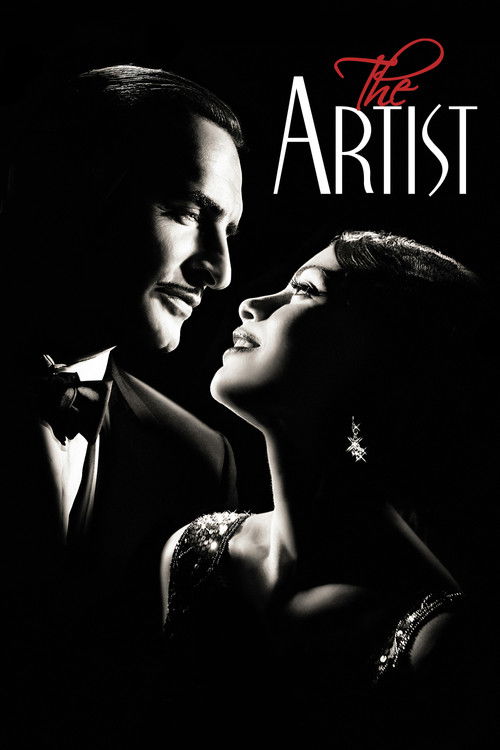
The Artist
2011 · Michel Hazanavicius
For a charming, big-hearted date night, or when you're weary of noise and want to fall for pure movie-movie pleasure — smiles, tears, tap shoes. Total comfort, zero homework required.
What it's about
Hollywood, 1927. George Valentin is a silent-movie idol at the top of the world — mustache, terrier, marquee grin — when sound arrives and threatens to make him a relic overnight. Peppy Miller is a young dancer whose career is launched by the very technology sinking his, and the film traces their entangled rise and fall through the industry's most brutal transition — told, daringly, as a black-and-white, nearly wordless silent film itself.
The experience
Effervescent and light on its feet for most of its running time — sight gags, dance, a scene-stealing dog — with a genuine ache underneath as George's world dissolves. It's the rare gimmick film where the gimmick melts away in minutes and you're simply swept up.
Performances
Jean Dujandin won the Best Actor Oscar for a performance built entirely on face and body — vanity curdling into despair without a spoken word — and Bérénice Bejo matches him with pure incandescent charm. The Jack Russell terrier Uggie became a star in his own right.
The craft
Michel Hazanavicius commits fully to the silent grammar — expressive faces, intertitles, visual jokes that would die with dialogue — shot in luminous black and white on real Hollywood locations and soundstages. Ludovic Bource's near-wall-to-wall orchestral score does the talking, and the few moments where the film plays with sound itself are among its cleverest.
Why it matters
It won Best Picture — the first largely silent film to do so since the very first Oscars ceremony — an improbable French-made triumph that briefly made the whole world nostalgic for cinema's beginnings.
Snapshot
The Artist is a French-produced, English-language, black-and-white, largely silent film about the arrival of sound in Hollywood — a conjunction so improbable that its commercial and awards success remains one of the more surprising events in twenty-first-century cinema. Written and directed by Michel Hazanavicius, produced by Thomas Langmann for La Petite Reine, and shot in Los Angeles on many of the locations and soundstages that housed the industry it depicts, the film follows George Valentin (Jean Dujardin), a silent-era matinee idol whose stardom collapses with the coming of the talkies, and Peppy Miller (Bérénice Bejo), an extra whose career rises on exactly the technological wave that sinks his. It won the Academy Award for Best Picture — the first majority-silent film to do so since Wings at the very first ceremony, and the first French-produced film to take the award — along with Best Director, Best Actor for Dujardin, Best Costume Design, and Best Original Score.
The film's central formal proposition is that its subject and its method are the same thing. A story about the loss of silence is told silently; the anxiety its protagonist feels about sound is transferred, structurally, onto the audience, who must sit inside the same absence. This is not a documentary reconstruction of silent-film grammar but a modern pastiche of it — an affectionate, legible, sometimes anachronistic approximation that borrows the late-silent style of roughly 1927–1929 (already highly mobile, already sophisticated) rather than the primitive cinema of the 1910s. The result is a film that many viewers found enchanting and many critics found charming but thin: an object whose pleasures are undeniable and whose depth has been argued over ever since.
Industry & production
The Artist originated as a passion project that Hazanavicius had reportedly nursed for years and could not finance on the strength of the idea alone. His leverage came from the two OSS 117 spy spoofs — OSS 117: Le Caire, nid d'espions (2006) and OSS 117: Rio ne répond plus (2009) — French box-office successes starring Jean Dujardin that established the director-star partnership and demonstrated Hazanavicius's facility with period pastiche. Producer Thomas Langmann, son of the director Claude Berri and himself a producer with the resources and appetite for large gambles, backed the film. The financing was French; the production was shot in and around Los Angeles, in English-speaking milieu, with a mixed French and American cast and crew.
The budget was modest by American standards — reported figures in the range of roughly fifteen million dollars circulated widely, though the exact accounting of a French production is not something to assert with precision. What matters structurally is the arbitrage: a black-and-white silent film could not have been financed inside the Hollywood studio system at any budget, but could be financed in France as a prestige auteur project and then shot in Hollywood for the authenticity of its locations. The production used real Los Angeles landmarks and studio spaces — among them locations associated with the historic studios, exteriors in and around downtown and Hollywood, and, in one widely reported instance, Mary Pickford's former screening room — so that the film's images of a lost industry were captured in the physical remains of that industry.
Distribution was handled internationally by Warner Bros. in France and, crucially for the film's trajectory, by The Weinstein Company in the United States. Harvey Weinstein's awards campaigning was, by the standards of the period, the decisive commercial mechanism: the film premiered in competition at the Cannes Film Festival in May 2011, where Dujardin won Best Actor, and was then carried through a long autumn-to-spring release and campaign that converted festival goodwill into Academy recognition. This is a case where the industrial history of a film's reception is inseparable from the film itself; The Artist was a genuine crowd-pleaser, but its path to Best Picture ran through one of the most aggressive awards operations in modern distribution. The film also won seven BAFTAs, including Best Film, and six Césars, including Best Film and Best Director.
Technology
The technological argument of The Artist operates on two levels at once: the technology it depicts, and the technology it uses to depict it.
Diegetically, the film dramatizes the sound transition of 1927–1929 — the period bracketed by The Jazz Singer and the near-total conversion of American production to sound. Its account is compressed and romanticized: in reality the transition was messier, slower, and driven less by audience taste than by exhibition economics, patent licensing, and the capital positions of Warner Bros., Fox, and RCA. The film's version — a studio head announces the future, the silent star laughs it off, the future arrives anyway — is a legible dramatic shorthand rather than an industrial history. It also compresses the fate of silent performers. The popular myth that unsuitable voices destroyed careers wholesale is only partly true; many silent stars transitioned successfully, and the casualties often fell for reasons of age, contract, changing taste, or personal circumstance. George Valentin is a composite figure who gathers several real trajectories — the physical bravura and mustachioed matinee-idol persona of Douglas Fairbanks, the vocal-anxiety mythology attached to John Gilbert, the decline narrative common to a number of stars — into one invented man.
Materially, the film was not made with period technology. It was shot on 35mm color negative and desaturated in post-production to black and white, which produced a smoother, more controlled monochrome than period orthochromatic or early panchromatic stock would have yielded — a bright, silvery, high-key image with a modern tonal range. It was projected at 24 frames per second rather than the variable, generally slower rates of the silent era, which removes the slight briskness modern audiences associate with archival silent footage. And it was framed in the 1.33:1 Academy-adjacent ratio appropriate to the period, a squared-off frame that immediately signals "before" to a widescreen-trained eye.
The film is also, importantly, not actually silent. It carries a continuous recorded score, and it deploys synchronized diegetic sound at two decisive moments. In the strictest sense it is a sound film that withholds speech — which is precisely what makes its sound design a dramatic instrument rather than a limitation.
Technique
Cinematography
Guillaume Schiffman, Hazanavicius's regular collaborator, shot the film, and his approach is best described as period-inflected rather than period-accurate. Lighting leans toward the glamour idiom of late silent and early studio Hollywood: strong key light, sculpted faces, halation and glow on Peppy, deep shadow available for Valentin's descent. There is a deliberate softness in the star close-ups that recalls the studio portraiture tradition and the diffused treatment given to leading players.
Schiffman has spoken in interviews about using older or less-corrected lenses and about the difficulty of achieving convincing monochrome from a color-negative workflow — the problem being that modern stock and lenses are too good, too even, too free of the accidents that give archival images their texture. The compensating strategy is contrast: the film's whites are luminous, its blacks are dense, and the images are built to read at a glance, as silent images had to.
Camera movement follows the late-silent rather than early-silent model. Sophisticated tracking, crane work, and mobile framing were well established by 1927 — Murnau, Vidor, and others had already demonstrated what a moving camera could do — so the film's fluid camera is not an anachronism, though its frequency and smoothness carry a modern rhythm. The film also uses angled and expressive compositions for Valentin's decline, borrowing from the German-influenced strain of late-silent Hollywood style.
Editing
Anne-Sophie Bion and Hazanavicius share the editing credit and shared the film's editing awards. The cutting is the most obviously modern element of the film's technique. Silent narrative cinema had, by 1927, developed continuity editing to a high level, but its shot durations were generally longer, its coverage sparser, and its rhythm more measured than The Artist's. The film cuts at something closer to a contemporary pace, which is a large part of why it plays easily for audiences with no silent-film literacy.
Intertitles are used sparingly — far more sparingly than in most period features, which relied on dialogue titles heavily. Hazanavicius's discipline here is real: long stretches proceed on pure visual storytelling, and the film's most celebrated title, Valentin's terse refusal near the end, lands hard precisely because titles have been rationed. The editing also carries the film's structural rhyme, cross-cutting the two careers so that Peppy's ascent and Valentin's collapse read as a single mechanism rather than two stories.
Mise-en-scène / staging
Production designer Laurence Bennett and costume designer Mark Bridges — Bridges won the Academy Award — built a Hollywood that is recognizably of the late 1920s without being archaeological. The film moves between the studio floor, the premiere, the mansion, the auction house, the diner, the apartment: a set of spaces that map economic position directly onto architecture, so that Valentin's fall is legible as a sequence of smaller and shabbier rooms.
Staging is frontal and readable in the manner of the period. Bodies are composed for silhouette; entrances and exits are clearly marked; the camera generally gives actors the full figure when movement matters, which is a real formal discipline in an era of default close coverage. The staircase sequence in which the two leads pass each other going opposite directions — one rising, one descending — is the film's thesis compressed into a single piece of blocking, and it is characteristic of the whole: meaning carried by physical arrangement rather than statement.
The dog, Uggie, is a mise-en-scène device as much as a performer, functioning as the film's mechanism for physical comedy, sentiment, and, at the climax, plot.
Sound
Ludovic Bource's score, which won the Academy Award for Best Original Score, is continuous and load-bearing. It works in the tradition of the compiled and composed silent accompaniment — leitmotif, mickey-mousing, mood-setting — but it is a modern symphonic score with modern orchestration, and it does a great deal of the emotional work that dialogue would otherwise do.
Bource's score attracted the film's most substantial controversy: the sequence that borrows Bernard Herrmann's "Love Scene" from Vertigo (1958). Kim Novak publicly objected to the use, arguing that the music carried her performance's emotional meaning and that its reuse amounted to a violation. The use was licensed and legal; the dispute was aesthetic and ethical rather than legal. Defenders read it as an act of citation consistent with the film's pastiche method; critics read it as an unearned borrowing of another film's accumulated feeling at the exact moment The Artist most needed emotional weight.
The film's two ruptures of silence are its finest formal ideas. In the nightmare sequence, Valentin discovers that objects around him make sound — a glass set down, a dog barking, a feather falling with a crash — while he himself remains mute; the world has acquired a voice and he has not. And in the final moments, sound arrives fully: the tap number is heard, and then speech, with the joke of Dujardin's French accent supplying the punchline to the entire premise. The film's silence, in other words, is revealed retroactively as a choice with a payoff, not merely a stylistic frame.
Performance
Jean Dujardin's Valentin is built on the silent-star vocabulary of large, clean gestures, held expressions, and above all the smile — a Fairbanks-derived instrument deployed as armor and then, as the film darkens, as evidence of what it is concealing. Dujardin's background in French television sketch comedy and in the OSS 117 films gave him a trained physical precision that the role requires; his win at Cannes and then at the Academy Awards made him the first French actor to take the latter.
Bérénice Bejo's Peppy operates in a different register: brighter, quicker, more contemporary in her energy, which is dramatically apt for a character who belongs to the coming era rather than the passing one. John Goodman as the studio head, James Cromwell as Valentin's chauffeur, and Penelope Ann Miller as his wife supply the American texture. The performances are, by design, broader than naturalism permits — the mode is expressive rather than psychological, and viewers accustomed to contemporary underplaying sometimes read this as thinness rather than as idiom.
Narrative & dramatic mode
The screenplay is a clean melodrama built on inversion. Two careers cross; the mechanism that destroys one creates the other; pride prevents the falling man from accepting help; love and a piece of technology together supply the rescue. The structure is close to the A Star Is Born template — a rising woman, a falling man, romance across the gap — and The Artist is transparently aware of the resemblance. Where it departs is in the ending: it refuses the tragedy that A Star Is Born insists on, and delivers instead a reconciliation in which Valentin is not saved by regaining his old form but by being reinvented into a new one, as a dancer whose art survives the transition his voice could not.
The dramatic mode is melodrama in the technical sense: externalized emotion, moral legibility, coincidence as structure, and sentiment as the intended terminus. It is also comedy for long stretches, and the tonal management — the slide from light pastiche into genuine despair around the fire and the suicide attempt, and back out into buoyancy — is the film's least discussed and most difficult achievement.
Genre & cycle
The film sits inside the durable genre of Hollywood-about-Hollywood, and specifically inside the subgenre concerned with the sound transition. Its most obvious relative is Singin' in the Rain (1952), which covers the same historical moment as musical comedy and from which The Artist takes both structural beats and the fundamental proposition that the transition can be played for joy. Its darker relative is Sunset Boulevard (1950), whose fallen silent star, decaying mansion, private screenings of former glories, and devoted retainer all echo through Valentin's decline; The Artist stages a private screening of Valentin's own films that is a direct descendant of Norma Desmond's.
It also belongs to a cycle of twenty-first-century films preoccupied with early cinema and film preservation. Hugo, released the same year, addresses the loss of Méliès's work and the fragility of the medium's material history; Miguel Gomes's Tabu (2012) and Pablo Berger's Blancanieves (2012) — the latter a silent black-and-white Spanish retelling of Snow White developed independently and released after The Artist — belong to the same moment of formal retrospection. Whether this constituted a cycle or a coincidence is genuinely arguable; the projects were largely in development simultaneously rather than in response to one another.
Authorship & method
Hazanavicius's method across the OSS 117 films and The Artist is consistent: reconstruct a historical style with enough accuracy that it functions, then work inside it. The OSS 117 films did this with 1960s Eurospy cinema, matching period process shots, scoring, and framing while playing the content as satire. The Artist applies the same procedure to late silent Hollywood but shifts the ratio — far less satire, far more sincerity. The pastiche is not a joke about silent film; it is an attempt to make one that works on its own terms while remaining visibly a modern artifact.
The key collaborators are a stable unit. Guillaume Schiffman shot the OSS 117 films and The Artist, and his ability to produce convincing period image from modern equipment is central to both. Ludovic Bource scored the OSS 117 films as well, and the continuity in the partnership shows in how completely the score is integrated into the film's structure rather than laid over it. Anne-Sophie Bion co-edited with Hazanavicius, who cuts his own films — a working method that concentrates the film's rhythm in the director's hands.
Bérénice Bejo, who plays Peppy, is married to Hazanavicius, and had appeared in OSS 117: Le Caire, nid d'espions; Dujardin starred in both OSS 117 entries. The film is thus the product of a small, established creative company that had spent two features learning how to make historical pastiche function commercially, then applied that capital to a far riskier proposition.
Movement / national cinema
The Artist is a French film in financing, authorship, and production culture, and an American film in setting, language, cast, and subject. This makes it a limit case for national cinema categories. It is not part of any French movement in the usual sense — it has no relation to the contemporary French auteur traditions or to the postmillennial French genre cinema — but it is legible as an expression of a specifically French cinephile relationship to Hollywood, one running from the Cahiers du cinéma critics' elevation of American studio directors through to a general French institutional seriousness about film history and preservation.
Its Best Picture win was widely characterized as a French victory, and it was received as such in France. But the film's more accurate position is transnational: a French production that reconstructs American film history using American locations, an international cast, and a form belonging to a period before national cinemas were divided by language at all — which is, not incidentally, a point the film's silence quietly makes.
Era / period
The film depicts 1927–1932: the last years of silent production, the conversion, and the early Depression. Its historical texture is selective. The economics of the transition are largely elided; the Depression is present mainly as the backdrop to Valentin's ruin; the labor and technical realities of early sound production — the immobilized camera in its booth, the fixed microphone, the multilingual version shoots — appear barely if at all. This is a film about the emotional experience of obsolescence set in that period, not a reconstruction of the period's working conditions.
Made in 2011, it also speaks to its own moment. The transition from film to digital capture and projection was, at the time of production, actively displacing an established craft and its practitioners; the parallel between Valentin's obsolescence and that of the film industry's own analog workforce was noted by many critics and is difficult to unsee. The film does not press the analogy, but it is available, and it accounts for a good deal of the resonance the film had inside the industry that voted for it.
Themes
The organizing theme is obsolescence — not the death of an art form but the death of a particular skill set and the person who embodies it. Valentin's tragedy is not that cinema changes but that he has organized his identity around a specific technology. The film is unusually clear that the medium is fine; it is the man who cannot cross.
Pride functions as the second engine. Valentin's refusal of help, his insistence on financing his own film, his rejection of Peppy's patronage, and his humiliation on discovering that she has been secretly buying his possessions form a coherent portrait of a masculinity that cannot survive dependence. The auction and the burning of his own films are its endpoints — the second act being simultaneously self-destruction and, in a film so conscious of preservation, a small act of cultural vandalism.
Voice, in the double sense, is the film's most elegant idea. Valentin's problem is figured as vocal but is actually a problem of authority and self-conception; the final revelation of his accent turns the whole anxiety into a joke and simultaneously confirms it — he really did have something to hide. And the film thematizes performance itself: the smile, the persona, the difference between what a star projects and what a person is, all of which the silent form makes visible in a way dialogue would obscure.
Reception, canon & influence
Critical reception at release was strongly positive and remarkably warm — the film was widely praised for its charm, Dujardin's performance, Bource's score, and the audacity of the premise. Roger Ebert and many other major critics championed it; it won a large number of critics' prizes across the autumn of 2011 before its awards sweep.
The dissent, however, was substantial and has aged into the dominant scholarly position. The core objection is that the film is nostalgic rather than analytical — that it deploys the surface of silent cinema without its formal rigor, and that its actual grammar (cutting rhythm, coverage, performance calibration) is modern enough that it never confronts the audience with what silent viewing actually demands. Critics noted that far more radical uses of silence exist in contemporary cinema, and that The Artist is finally a comfortable film about an uncomfortable rupture. Cinephile objections concentrated on the Vertigo cue and on the sense that a film celebrating film history had treated a specific piece of that history casually. There was also a persistent line of criticism that the Academy's embrace reflected Hollywood's fondness for flattering portraits of itself rather than a judgment about the year's best film — a charge that has followed the film ever since.
Its influences run backward to a specific and identifiable set: Murnau's Sunrise (1927) for the mobile camera and expressive lighting of late silent Hollywood; Fairbanks for Valentin's physical persona; Sunset Boulevard for the architecture of decline; Singin' in the Rain for the transition-as-comedy structure; A Star Is Born for the crossing-careers melodrama; and Chaplin and Keaton, particularly City Lights (1931) and The Kid (1921), for the sentiment and for Chaplin's own instructive refusal to speak well past the transition — a refusal that is the film's most direct historical antecedent and that it never explicitly acknowledges.
Forward, the legacy is more limited than the awards haul implies. The Artist did not create a silent-film revival; Blancanieves was already in development, and no sustained cycle followed. Hazanavicius himself moved on to very different work, including the Chechnya drama The Search and the Godard film Le Redoutable, neither of which found comparable reception. Dujardin's international career did not consolidate in the way a Best Actor win might have predicted. What the film did demonstrate — durably — is that a formally radical premise can achieve wide commercial success if it is executed with enough warmth and campaigned for with enough force, and that the Academy's appetite for films about its own history is close to bottomless.
Its most reliable use now is pedagogical: it is an accessible entry point to silent grammar for audiences who will not sit for Sunrise, and a productive case study in the difference between reconstructing a form and merely quoting it. That double function — genuinely effective as a film and genuinely limited as a formal argument — is why it remains contested rather than settled. It is, appropriately for its subject, a film about the past that could only have been made in the present, and whose considerable pleasures are inseparable from that fact.
A Deleuzian reading
The grin comes first.
The full Deleuzian reading of The Artist →
Reception
It swept the 2011–12 awards season as an irresistible charmer — first (mostly) silent Best Picture winner since Wings in 1929 — then almost immediately became Exhibit A in the 'forgettable Oscar winner' conversation, routinely ranked near the bottom of best-of-the-2010s Best Picture retrospectives.
How The Artist was received, from release to now →
How to watch The Artist: what to notice on a first viewing
- Watch Dujardin's grin, held into the lens a beat too long. Dujardin lifts the smile and the pencil mustache from Douglas Fairbanks, and he keeps deploying it unchanged as the story darkens. The same muscles do stardom early and denial later. The smile is a piece of professional equipment, so watching it stop working tells you everything about the man wearing it.
- Notice the glow on Bejo's face against the shadow around Dujardin. Schiffman lights Bejo with strong key, halation and a portrait softness that keeps her smooth and radiant. Dujardin gets deep blacks, angled compositions and light that cuts his face into pieces. The lighting has already decided which career is rising, before the plot says so.
- Count how rarely the camera cuts close; actors keep their full bodies. When movement matters, Hazanavicius gives you the whole figure inside a squared 1.33 frame. Bodies are composed for silhouette, entrances and exits clearly marked, feeling carried at full length rather than in close-up. You read emotion off posture and walk instead of off a magnified face, which is how silent pictures worked.
- Listen for Bource's score never stopping, even between scenes. The music runs continuously and carries the load dialogue usually takes: leitmotif for each lead, jokes scored to gesture, mood laid under every room. It never leaves you alone in silence. This is not a silent film but a sound film withholding speech, so notice what the score is doing in speech's place.
- Watch the film cut between Peppy's rise and Valentin's shrinking rooms. Bion and Hazanavicius keep crossing the two careers: her premieres and marquees against his mansion, then the auction house, then the small apartment. The rooms get shabbier on a schedule. The cutting makes one machine out of two stories. The thing lifting her is the thing sinking him.
The whole guide to watching The Artist, with the keys for a rewatch →
Influences: the films it descends from and the films it influenced
- The Last Laugh (1924) — Murnau's entfesselte Kamera and his near-total elimination of intertitles — telling an entire arc of professional humiliation through camera movement, props and faces alone — is the model for The Artist's sparing title-card economy and for staging Valentin's ruin as a series of purely visual demotions.
- Sunrise: A Song of Two Humans (1927) — The specific late-silent Hollywood look Schiffman reverse-engineers — soft glamour key with heavy fill, deep-focus studio exteriors, and a camera that tracks laterally through built sets — comes from Struss and Rosher's work here, which is also the source of the film's superimposition-as-inner-state device.
- The Mark of Zorro (1920) — Dujardin's Valentin is built on the Fairbanks physical grammar: the pencil mustache, the teeth-first grin held straight to camera, the vaulting entrances and the habit of resolving a scene with an athletic flourish rather than a title card.
- The Kid (1921) — Chaplin's calibration of sentiment — pathos earned through sustained full-figure framing of a small figure in a large frame, with the camera refusing to cut in for the emotional beat — is the template for The Artist's full-figure staging of Valentin's decline.
- City Lights (1931) — The most direct antecedent: a silent film deliberately made after the transition, carrying a fully synchronized composed score and sound effects but withholding speech as a formal principle — exactly the sound architecture Bource and Hazanavicius adopt, including the gag of mocking amplified voices.
- What Price Hollywood? (1932) — Origin of the crossing-careers structure The Artist runs on — the studio insider who makes a newcomer a star and then descends as she rises — including the ruined-star suicide sequence built from his own projected footage.
- A Star Is Born (1937) — Supplies the parallel-career crosscutting scheme and the staircase-crossing figure — the two careers physically passing on a studio stair — which The Artist stages almost as a quotation, with Peppy ascending and George descending in a single held two-shot.
- Citizen Kane (1941) — The breakfast-table montage — a marriage decomposed across repeated meals, each shorter and colder, linked by whip-pans and widening physical distance across the table — is the direct model for the Doris sequence in which Valentin's wife defaces his photographs.
- Sunset Boulevard (1950) — The architecture of decline: the obsolete star screening their own silent footage in a darkened private room, surrounded by the memorabilia of a career the industry has already written off — Valentin's projector scene is this scene, restaged without irony.
- Singin' in the Rain (1952) — Establishes the transition-to-sound as comic structure — the botched microphone test, the star whose voice betrays them, the redemption delivered as a tap number — and The Artist borrows the whole shape, ending on the same solution of dance as the medium that survives the rupture.
- Vertigo (1958) — Herrmann's 'Scène d'Amour' is lifted wholesale under the climax, importing that cue's specific device of an unresolved rising sequence scored against a circling camera — the film's most contested craft debt precisely because it borrows another film's emotional engine rather than building one.
- Silent Movie (1976) — The precedent for the modern silent pastiche whose entire structure aims at a single spoken word — Marceau's 'Non!' as the film's only audible line prefigures Valentin's final 'With pleasure,' the withheld voice deployed as a punchline rather than a rupture.
- The Tribe (2014) — The radical answer to The Artist's premise: unsubtitled sign language across long unbroken takes, forcing the audience into the reading labor of silent viewing that The Artist's modern coverage and legible performances deliberately spare them.
- Babylon (2022) — Takes the same 1927–29 sound-transition subject and inverts the tone — the sweltering single-take sound-stage sequence, where a microphone's demands destroy take after take, is the catastrophic version of the comedy The Artist inherits from Singin' in the Rain.
- Hugo (2011) — Released the same season and pursuing the same restoration impulse from the opposite technical end — Méliès's hand-tinted trick effects rebuilt in stereoscopic digital — making the pair a matched case study in reconstructing early cinema versus quoting it.
- Blancanieves (2012) — Independently developed and released alongside it, but pushes the same silent apparatus further: Academy-ratio monochrome with a far denser intertitle-free montage and genuinely period-rate cutting, where The Artist keeps a contemporary cutting pace under silent surfaces.
- Tabu (2012) — Splits the sound problem more rigorously — its second half retains full diegetic effects and voiceover while stripping synchronized dialogue entirely, achieving the withheld-speech device as an analytical structure rather than a nostalgic surface.
- WALL·E (2008) — Like WALL·E, The Artist consciously engineers silent-era pacing, gestural performance, and the expressive conventions of pantomime into a sound-era production as an aesthetic program rather than a constraint; both films treat the silent-cinema vocabulary as an emotionally richer register than dialogue for their central romantic arcs and both defend the gambit through classical Hollywood genre mechanics.
- Nouvelle Vague (2025) — Reconstructs a vanished cinematic idiom in its own period format (silent, Academy ratio) as pastiche-homage rather than mere depiction — the same fidelity-as-tribute strategy.
- La La Land (2016) — A pastiche revival of classic-Hollywood musical/silent form pitched at Academy nostalgia, part of the same 2010s wave that made a throwback song-and-dance idiom viable again.
Similar films
- City Lights (1931) — influence & lineage · same viewing thread
- The Kid (1921) — influence & lineage · same viewing thread
- Babylon (2022) — influence & lineage
- Sunrise: A Song of Two Humans (1927) — influence & lineage
- Citizen Kane (1941) — influence & lineage
- Modern Times (1936) — same viewing thread
- The Circus (1928) — same viewing thread
- Limelight (1952) — same viewing thread
All the films related to The Artist →
Watch it with: curated runs of related films
- The Great Silent Clowns — The masters of physical comedy back to back — watch these to feel the unbroken line from Chaplin's Tramp and Keaton's stone face to Tati's tiptoeing Monsieur Hulot.