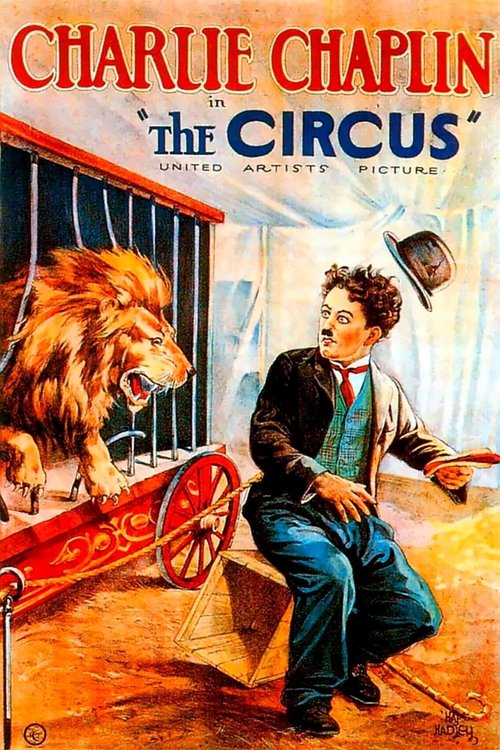
The Circus
1928 · Charlie Chaplin
When you want to laugh out loud tonight, guaranteed, with something the whole room can watch together. Comfort viewing with a bittersweet finish — the kind that leaves you smiling and a little tender.
What it's about
The Tramp, running from a policeman who's mistaken him for a pickpocket, blunders into the middle of a circus performance — and the crowd thinks he's the funniest act they've ever seen. Hired on as a handyman, he becomes the show's secret star without realizing it, and falls hard for the ringmaster's mistreated stepdaughter, a bareback rider who only has eyes for the handsome new tightrope walker.
The experience
Relentlessly funny — some of the purest, most inventive physical comedy ever filmed — with an undertow of loneliness that sneaks up on you. It's brisk and light on its feet, then quietly wistful when you least expect it.
Performances
Chaplin is at his physical peak here: the mirror-maze chase, the high-wire sequence, the gag of a man who's only funny when he isn't trying — it's clockwork comedy that also plays as heartbreak, often within the same shot.
The craft
The set pieces are engineered with astonishing precision — a hall of mirrors, a lion's cage, a tightrope act — each built so the joke and the danger escalate together. Chaplin performs real, physically risky stunts and stages them in long takes so you can see there's no trick, which makes it play beautifully to a crowd on a big screen.
Why it matters
Made as sound was arriving and Chaplin's personal life was in freefall, it earned him a special award at the very first Academy Awards and stands as proof of what silent comedy could do at its absolute height.
Snapshot
The Circus is the film Chaplin made while his life was collapsing, and it is among the funniest he ever made — a fact he seems never to have forgiven it for. The Tramp, fleeing a policeman who has mistaken him for a pickpocket, blunders into a circus mid-performance and is a riot; hired as a prop man on the strength of that accident, he discovers he is hilarious only when he does not know he is performing. Around this reflexive joke Chaplin builds a love plot of unusual bleakness: the Tramp falls for Merna, the underfed equestrienne bullied by her stepfather the ringmaster, and loses her to Rex, a tightrope walker who has everything the Tramp does not — grace, ease, height, and the ability to be admired on purpose.
Released 6 January 1928 through United Artists, three months after The Jazz Singer, it is a silent film arriving at the exact moment silence stopped being the default. It runs a little over seventy minutes, won Chaplin a special award at the first Academy Awards ceremony, made money, and was then quietly dropped from its author's own account of himself: Chaplin's 1964 My Autobiography passes over The Circus without discussion. The omission is the most eloquent piece of criticism the film has ever received.
Industry & production
By 1926 Chaplin occupied a position no other filmmaker in Hollywood held. As a founding partner of United Artists (1919, with D. W. Griffith, Mary Pickford, and Douglas Fairbanks), he owned his distribution, owned his studio on La Brea Avenue, financed his own negatives, and answered to no production executive. This bought him the thing the emerging studio system was busy engineering out of existence: unlimited time. The Gold Rush (1925) had already shown what he did with it.
The Circus shows what happens when that freedom meets catastrophe. Production began in 1926 and was serially wrecked. Early footage came back from the laboratory damaged — scratched to the point of uselessness — forcing reshoots of roughly a month's work. A fire on the studio lot destroyed the circus set, requiring it to be rebuilt. Then came the personal disaster: Chaplin's marriage to Lita Grey, contracted in 1924 under duress when she was sixteen, ended in a 1927 divorce action whose complaint was sensational enough to be printed and sold as a pamphlet. Federal authorities pursued him over back taxes. His assets were exposed to seizure, and the negative of the unfinished film was moved out of California to protect it. The studio shut down for the better part of a year.
The chronology matters for what the film is not. Chaplin's mother, Hannah, died in August 1928 — after the premiere, not during the shoot — so the grief sometimes read into the film's ending belongs to a later chapter. What was contemporaneous was the divorce, the tax exposure, and a press campaign against him that, for the first time, made his public standing genuinely precarious.
The commercial outcome was good without being Gold Rush good; the picture was a solid success in a market that still had an enormous silent-film audience. At the first Academy Awards, held in May 1929 for the 1927–28 season, the Academy withdrew Chaplin's name from the competitive categories he had been put up for and gave him instead a special award citing his versatility and genius in writing, acting, directing, and producing The Circus — an honor and a sidelining in one gesture. He returned to the film only in 1969, preparing a reissue with a score of his own composition.
Technology
The Circus is a late, fully mature silent: 35mm black-and-white, the near-square 1.33:1 aperture, hand-cranked cameras of the Bell & Howell type standard to Chaplin's studio, and exposure practice built around a mixed regime of daylight, arc, and incandescent light during exactly the years Hollywood was migrating to panchromatic stock and tungsten sources. Chaplin's technical conservatism is well documented and visible here: no crane work, no expressive optical devices, no camera flourish that would compete with the body in the frame.
Two technological facts frame the picture. The first is speed. Shot and printed for silent projection, it was designed to be run at a rate a projectionist could adjust, with a live accompaniment cued to the house; the 1969 version standardizes it at sound speed with a recorded score, which subtly changes the tempo of Chaplin's timing — a distinction worth keeping in view when comparing versions.
The second is sound itself. The Jazz Singer premiered on 6 October 1927; The Circus premiered thirteen weeks later. Chaplin did not respond by converting. He responded by spending the next decade proving that the silent Tramp could survive the talkies — synchronized score and effects but no dialogue in City Lights (1931), the same strategy plus a nonsense song in Modern Times (1936). The Circus is the last film he made before that became a deliberate, defended position rather than simply the way films were made.
Technique
Cinematography
Roland Totheroh photographed the film, as he had photographed Chaplin since 1916 and would until 1947. His style is deliberately unassertive: flat, even, high-key light; a frontal camera at roughly the distance of a good theater seat; deep enough focus to keep the whole body and the whole gag legible at once. Supporting camera credits on the production (Jack Wilson, Mark Marklatt among them) reflect Chaplin's habit of running more than one camera on difficult material to protect takes that could not be repeated. The aesthetic is not naïve. Chaplin's comedy depends on the audience seeing the entire figure and its relation to objects and floor; any expressive lighting scheme or shallow-focus emphasis would do the pointing that the performance is supposed to do itself.
Editing
No formal editing credit of the modern kind attaches to the film; Chaplin cut his pictures himself, in the studio, with Totheroh's involvement — the documentary record on the precise division of that labor is thin. What survives is method. Chaplin shot at ratios that would have bankrupted a studio production, building gags in front of the camera across dozens of variants, then cutting toward the version that played. Kevin Brownlow and David Gill's Unknown Chaplin (1983), assembled from surviving outtakes, made this process visible: the routine is discovered in shooting, not written and executed.
The cutting itself is classical and self-effacing — match-on-action, clean entrances and exits, an economy of coverage. The exception is the tightrope climax, where Chaplin intercuts more aggressively than usual: the Tramp on the wire, the slipping safety line, the monkeys, the watching crowd. It is the one sequence in the film where suspense is built by montage rather than by the unbroken duration of a body in space.
Mise-en-scène / staging
The circus ring is a found proscenium, and Chaplin uses it as such. Two audiences are stacked: the diegetic crowd in the tent and us. The film's central joke — that the Tramp destroys the show hilariously and cannot reproduce a single laugh once hired — is only legible because Chaplin stages the tent as a theater and lets us watch the watchers.
The set-pieces are constructed as machines. The hall-of-mirrors chase turns the frame into a field of false exits, multiplying pursuer and pursued until neither the characters nor the audience can locate the real body; the adjacent gag in which the Tramp freezes into an automaton on a funhouse platform is Chaplin's most concise statement of a lifelong theme, the human being passing as a mechanism to survive. The lion-cage sequence, in which the Tramp is locked in with a real animal, was shot with Chaplin actually in the cage — by many accounts across an extraordinary number of takes, though the precise figures repeated in the literature should be treated as approximate. The tightrope finale layers three escalating disasters (the untethered safety wire, the monkeys, the disintegrating trousers) onto a single sustained physical action.
Art direction was by Charles D. Hall, who had built The Gold Rush for Chaplin and who would shortly design Dracula, Frankenstein, and Bride of Frankenstein at Universal — a line of descent from the funhouse to the Gothic laboratory that is less strange than it sounds.
Sound
The film has none, and its subject is an art form made of noise: brass bands, barkers, drumrolls, the roar of a crowd, the roar of a lion. Chaplin converts every one of these into a visual event — the crowd's laughter is a mass of rocking bodies, the lion's roar a woman fainting outside the bars. Intertitles are used sparingly; the film's plot turns are carried by faces and objects.
The score most audiences now hear is Chaplin's own, composed for the 1969 reissue, when he was eighty. He wrote the theme song "Swing Little Girl" and sang it himself over the opening titles — an old man's voice introducing his young self, and one of the odder authorial gestures in film history. In 1928 the picture went out to be accompanied live.
Performance
Chaplin's Tramp here is at his least ingratiating and most technically precise. The performance is organized around a paradox that requires two distinct registers: the effortless comic (the unwitting sabotage of the magic act, the chase) and the labored one (rehearsing the barber-shop routine with the clowns, dying on his feet). Chaplin has to be authentically unfunny on purpose, which is far harder than the alternative, and he plays the failed rehearsals with a flop-sweat literalism that anticipates Limelight by twenty-four years.
Merna Kennedy, cast in her first significant screen role — she had been a childhood friend of Lita Grey, who introduced her — plays the equestrienne with a bruised watchfulness that keeps the romance from sweetening. Allan Garcia's ringmaster is a study in casual domestic cruelty; Harry Crocker, who doubled as an assistant director on the production, gives Rex the untroubled physical confidence the Tramp can only counterfeit; Henry Bergman, a Chaplin stock player for years, is the old clown.
Narrative & dramatic mode
The structure is picaresque in its first half and tightening melodrama in its second — the pattern Chaplin had worked out in The Kid and The Gold Rush for converting a short-form clown into a feature protagonist. Causality is loose by design: the Tramp arrives by accident, is hired by accident, succeeds by accident. What organizes the film is not plot but a single ironic engine, spontaneity destroyed by intention, which drives both the comedy and the love story. The Tramp cannot perform on command and cannot court on command; in both cases self-consciousness is fatal.
The dramatic mode turns on renunciation. Having learned that Merna loves Rex, the Tramp arranges their marriage, is dismissed by the ringmaster, and is left in the churned dirt of the empty lot. The last image — the Tramp sitting inside the torn paper star that Merna jumped through in the first act, then crumpling it, then walking away from the camera — is Chaplin's most economical ending. The circle of paper is the ring, the performance, the romance, and the film, all discarded in one gesture.
Genre & cycle
The film sits at the intersection of two cycles. The first is the silent comic feature, which Chaplin, Buster Keaton, and Harold Lloyd had spent the decade building out of the two-reeler — a form that had to solve the problem of sustaining a gag persona across an emotional arc. The Circus solves it by making the persona's professional competence the subject.
The second is the circus-and-carnival picture, a durable strain that treats the show as a self-contained society with its own cruelties. The Circus is an early and influential entry; the cycle runs forward through Tod Browning's Freaks (1932), Bergman's Sawdust and Tinsel (1953), Fellini's La Strada (1954) and The Clowns (1970), and DeMille's The Greatest Show on Earth (1952). Behind all of them stands the Pagliacci topos — the clown who weeps — which Chaplin both uses and refuses to sentimentalize: his Tramp is not tragic because he is a clown, he is a clown who is also being cheated of wages.
Authorship & method
Chaplin's authorship here is total in a way almost no other figure of the period could claim: he produced, directed, wrote, starred, and — four decades later — scored and sang. He worked without a shooting script, from a premise and a set, discovering material on camera at ruinous cost in film stock and time.
The key collaborators are a small, stable company. Roland Totheroh (cinematography) supplied a consistent photographic surface across thirty years, and his self-effacement is a positive artistic choice, not a limitation. Charles D. Hall (art direction) built the tent, the funhouse, and the mirror maze. Harry Crocker served as assistant director as well as playing Rex, and remained in Chaplin's orbit for years afterward. Henry Bergman functioned as performer and informal advisor. Chaplin's own score for the 1969 reissue is his most direct authorial intervention after the fact — a composer with no formal training dictating melodies to arrangers, the working method he had used since City Lights.
Movement / national cinema
The Circus is American studio-era filmmaking made explicitly outside the studios, by an English music-hall performer trained in Fred Karno's troupe before he ever saw a camera. Chaplin's grammar descends less from Griffith than from Victorian pantomime and the English halls — Grimaldi, Dan Leno, the knockabout sketch — transplanted to Los Angeles and given a lens.
His reception, meanwhile, was more European than the film's provenance suggests. Charlot was a totem for the interwar avant-garde: Fernand Léger built a jointed Chaplin figure into Ballet mécanique, the Surrealists adopted him, and Soviet filmmakers of the montage generation treated him as evidence that popular form could carry radical content. That transnational standing is part of why a modest circus picture from 1928 turns up in the ancestry of Italian neorealism and postwar Indian cinema alike.
Era / period
1928 is the hinge year. Sound conversion was underway but incomplete; theaters were wiring at different speeds; the Hays Office was consolidating self-regulation ahead of the 1930 Production Code; the majors were finishing the vertical integration that would define the next two decades. The Circus is a product of the last months in which a silent feature could be made without the fact requiring a defense.
It is also a document of the celebrity-scandal machinery that had matured since the Arbuckle trials of 1921–22. Chaplin's divorce coverage was the first sustained demonstration that the press which had built him could dismantle him — a process that would culminate in his 1952 exclusion from the United States.
Themes
Involuntary art. The film's governing idea is that comedy cannot be willed. Chaplin, who labored obsessively over every gag, made a picture whose hero is destroyed the moment he tries. It is an unusually candid piece of self-analysis from a man not otherwise given to it.
The body as machine. The automaton gag, the tightrope apparatus, the mechanized routines of circus labor — Chaplin repeatedly stages the human figure as a device that can be wound up, jammed, or hung on a wire. Modern Times is eight years off and already legible here.
Exploitation. The ringmaster withholds Merna's food and raises his hand to her; the Tramp is paid nothing until he learns his own value and demands a raise. The economics of spectacle are not background in this film, they are the plot.
Renunciation and exclusion. The Tramp's structural role is to make other people's happiness possible and then leave. The Vagabond (1916) and The Gold Rush had rehearsed this; The Circus commits to it without the reprieve, and City Lights would carry it to its most exposed conclusion.
Looking. Almost everything in the film is watched by someone — through mirrors, from bleachers, from the wings. The Tramp's tragedy is that he is only lovable when unobserved and only employable when observed.
Reception, canon & influence
Contemporary reception was warm. Reviewers welcomed the return of the Tramp after a nearly three-year absence and the film performed strongly, though it was widely measured against The Gold Rush and found to be the lesser achievement — a judgment that stuck. The Academy's special award confirmed the ambivalence: too significant to ignore, apparently too anomalous to place in a category.
Backward influence. The film's deepest debts are pre-cinematic: English music hall and the Karno sketch tradition that taught Chaplin ensemble timing; the Regency and Victorian clown lineage of Grimaldi and Leno; commedia dell'arte's stock outsider; and the sentimental-clown convention of nineteenth-century opera and melodrama. Within cinema, Max Linder's dapper screen persona is the acknowledged precedent for a comic built on character rather than pure knockabout. Chaplin also draws on himself — the closing walk away descends directly from The Tramp (1915), and the romantic self-sacrifice from The Vagabond.
Forward influence. The circus-melodrama line is the most direct: Fellini's La Strada is unimaginable without Chaplin, and Giulietta Masina's Gelsomina is a deliberate transposition of the Tramp's mask into postwar Italy; The Clowns makes the debt explicit. Raj Kapoor's Awaara (1951) and, more pointedly, Mera Naam Joker (1970) — a three-part epic about a circus clown who gives away every woman he loves — carry the Circus premise into Hindi cinema wholesale. The hall-of-mirrors sequence is a founding instance of a set-piece that runs through Welles's The Lady from Shanghai (1947) and Enter the Dragon (1973). The reflexive plot of the performer who cannot perform on command reappears in Chaplin's own Limelight (1952), the most sustained rewriting of The Circus in his filmography, and in the long subsequent tradition of films about failing comedians.
Canon status has risen slowly. Long treated as the minor work between The Gold Rush and City Lights — a reading Chaplin's own silence encouraged — the film has been recovered by later critics attentive to its formal daring and its refusal of consolation; Walter Kerr's The Silent Clowns (1975) is representative of the reappraisal, and the restorations undertaken through the Chaplin Project at the Cineteca di Bologna have made the picture available in a state that supports serious looking. What emerges is not a lesser Gold Rush but something stranger: a comedy about the impossibility of comedy, made by a man in the middle of losing everything, ending with its hero alone in an empty field holding a torn paper hoop.
A Deleuzian reading
He is up on a platform in the funhouse, swinging one arm from the elbow, head clicking round on the neck.
The full Deleuzian reading of The Circus →
Reception
A hit in 1928 and honored at the very first Oscars, it then slipped into the shadow of The Gold Rush and City Lights — Chaplin barely spoke of it, scarred by the miserable production. Today it's the go-to pick for 'most underrated Chaplin,' steadily reclaimed as top-tier work rather than a footnote.
How The Circus was received, from release to now →
How to watch The Circus: what to notice on a first viewing
- Notice the camera never moves closer than a theater seat. Totheroh shoots flat, even, high-key light with enough depth to keep Chaplin's whole body and the floor around him legible in a single frame. You have to see the whole body to get the joke, so the camera never hides any of it.
- Watch the hall of mirrors chase closely for the real body. The frame fills with false exits and doubled figures until neither the characters nor you can locate who is actually being chased. The gag turns confusion itself into the entertainment, rather than resolving into a clean escape.
- Watch how the crowd's laughter is shown without any sound. In a silent film about a noisy art form, Chaplin turns the audience's laughter into a mass of visibly rocking bodies instead of an audible roar. Every sound the circus makes gets converted into something you watch instead of hear.
- Watch the Tramp freeze into a wind-up mechanical man. On a funhouse platform he swings one arm and clicks his head round like a toy, and the policeman hunting him walks right past. Becoming a thing instead of a man is exactly what saves him.
The whole guide to watching The Circus, with the keys for a rewatch →
Influences: the films it descends from and the films it influenced
- The Tramp (1915) — Supplies the exact exit figure The Circus reproduces — locked-off camera, the Tramp walking away from the frame into empty ground, resolved by iris rather than cut — which Chaplin repeats shot-for-shot in 1928 with the torn paper hoop added as the only new element.
- The Vagabond (1916) — Establishes Chaplin's renunciation structure at a fixed structural position: the Tramp's romantic claim is surrendered to a better-placed rival in the final reel, converting an accumulated picaresque gag-string into melodrama at a single hinge.
- Seven Years Bad Luck (1921) — Linder builds an entire comic architecture from an empty mirror frame and a double aping the master's movements; Chaplin scales the same reflection-as-gag-engine principle from one frame to a navigable maze, and inherits Linder's character-first dapper persona in which gags issue from a defined man rather than from knockabout.
- Safety Last! (1923) — Codifies height-suspense montage — a performer intercut against a genuine drop, with sightline inserts and rigged foreground platforms making peril read as continuous — the precise grammar Chaplin's tightrope sequence borrows and then complicates with escaped monkeys and a slipping safety wire.
- Sherlock Jr. (1924) — Keaton's projectionist becomes a performer by accident and executes real physical hazard inside unbroken full-body wide framing that authenticates the stunt without a cutaway; the Tramp's promotion from accidental funny man to booked act, and the lion-cage business played in sustained wide, use the same certification strategy.
- He Who Gets Slapped (1924) — Sjöström frames the circus ring as a proscenium shot to camera and cuts to the paying audience so the clown's humiliation registers as their laughter — the reverse-to-the-crowd structure Chaplin repurposes for 'unfunny on purpose,' where laughs arrive only when the Tramp is not trying to earn them.
- Variety (1925) — Dupont and Karl Freund make the apparatus of the aerial act itself a camera subject — swinging trapeze POV, rigging geometry, the crowd seen from the wire — establishing the aerialist vocabulary Chaplin deliberately inverts by holding the camera flat and static so the mechanics of the gag stay legible.
- The Gold Rush (1925) — Fixes the Totheroh photographic surface The Circus inherits — flat high-key frontal light, deep-focus full-body framing that never cuts the comedian at the knees — and the teetering-cabin model of a suspense set-piece built from a rigged practical set intercut with the performer's whole body in frame.
- City Lights (1931) — Converts the ring-as-proscenium into the boxing match, choreographing referee, opponent and Tramp as one rotating unit inside a sustained frontal wide take; it also inaugurates the dictated-melody scoring method Chaplin would apply retroactively to The Circus in 1969.
- The Lady from Shanghai (1947) — Welles's mirror-maze shootout is the canonical inheritance of Chaplin's funhouse chase — multiplied bodies, an antagonist unable to locate the real target among reflections, and a resolution achieved only by shattering the images rather than by hitting the man.
- Limelight (1952) — Chaplin's most sustained rewriting of his own premise: the comedian who cannot be funny on command is promoted from gag engine to subject, and the renunciation ending is kept intact as Calvero yields Terry to the younger rival.
- Sawdust and Tinsel (1953) — Bergman makes the public humiliation of a circus performer before a paying audience the film's central formal event, using the ring as an arena of exposure rather than spectacle — Frost's beach ordeal is Chaplin's laughed-at-not-with structure pushed past the point where comedy can absorb it.
- La Strada (1954) — Masina's Gelsomina is a direct transposition of the Tramp's mask — the silhouette, the blank-to-radiant face, gestural pantomime carried without dialogue — while the tightrope walker Il Matto reprises Rex's structural function as the graceful aerial rival whose skill the clown can never match.
- Playtime (1967) — Tati extends the human-as-mechanism gag and the deep-focus, full-body, unpointed frame in which comedy is discovered in glass, reflection and architecture rather than delivered by close-up — the viewer must locate the joke unaided, the same withholding Chaplin uses for the 'unfunny on purpose' routines.
- Mera Naam Joker (1970) — Carries The Circus premise wholesale into Hindi cinema — a clown who must perform in the ring while losing each woman he loves, with makeup-as-armor and 'the show must go on' staging retained — produced under a total-authorship model (produce/direct/star) consciously patterned on Chaplin's.
- The King of Comedy (1982) — Sustains a whole feature on Chaplin's device of comedy performed without laughter: Pupkin's routines are shot in flat static frames and denied any supporting reaction track, so the collapse of timing becomes the film's actual subject rather than an interlude.
- Project A (1983) — The bicycle chase and clocktower fall rebuild silent-comedy method directly — real hazard certified in full-body wide framing, gags derived from the mechanics of props and architecture, and material discovered through an enormous shooting ratio of repeated takes rather than written in advance.
- Terrifier 3 (2024) — Art's kill scenes are structured as silent-clown gags — the held look to camera, the anticipatory beat before the payoff, business improvised from props at hand — with atrocity substituted for the punchline.
- Laugh, Clown, Laugh (1928) — Same-year working of the sentimental-clown convention: Chaney's Tito must manufacture laughter while grieving and yields the girl to a younger rival — but arrives there through makeup-built pathos and held close-ups where Chaplin arrives through deliberately failed timing in wide shot.
Similar films
- City Lights (1931) — influence & lineage · same viewing thread
- Limelight (1952) — influence & lineage · same viewing thread
- Sherlock Jr. (1924) — influence & lineage
- La Strada (1954) — influence & lineage
- The Kid (1921) — same viewing thread · often watched together
- Modern Times (1936) — same viewing thread
- The General (1926) — same viewing thread
- The Artist (2011) — same viewing thread
All the films related to The Circus →
Watch it with: curated runs of related films
- The Great Silent Clowns — The masters of physical comedy back to back — watch these to feel the unbroken line from Chaplin's Tramp and Keaton's stone face to Tati's tiptoeing Monsieur Hulot.