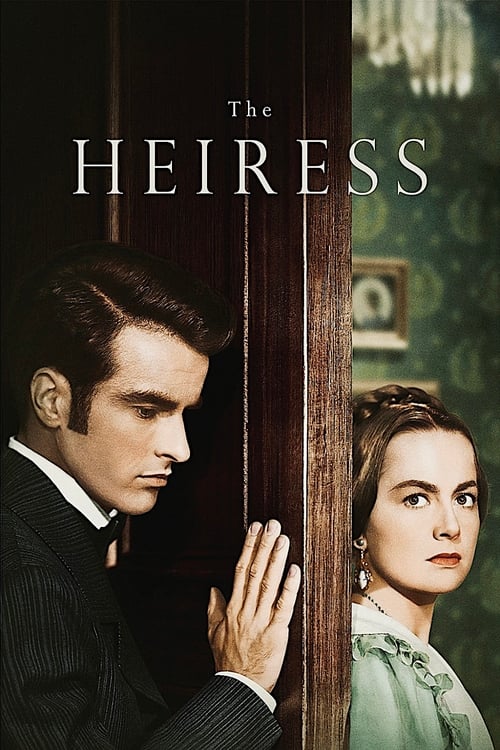
The Heiress
1949 · William Wyler
When you want a psychological drama that cuts deep and trust an old black-and-white film to go harder than most modern ones — reach for it when you're up for cruelty served with perfect manners.
What it's about
In 1840s New York, Catherine Sloper — plain, shy, and heir to a fortune — is suddenly courted by Morris Townsend, a charming young man with no money of his own. Her coldly brilliant father is certain Morris wants only her inheritance, and says so to her face. What follows is a three-way battle of love, doubt, and control fought almost entirely inside one elegant house on Washington Square.
The experience
A slow-tightening vise — polite, candlelit, and increasingly merciless. The suspense isn't about events but about a person changing in front of you, and the final stretch is as chilling as any thriller.
Performances
Olivia de Havilland won the Oscar for Catherine, transforming from eager awkwardness to diamond-hard resolve without a false note; Ralph Richardson's surgically cruel father and Montgomery Clift's unreadable suitor keep you guessing where the truth lies.
The craft
Wyler stages the whole drama in one house and makes the staircase, the parlor, and even Catherine's embroidery carry the story's shifting power. Adapted from the Broadway play drawn from Henry James, it's chamber filmmaking of total precision, down to its Oscar-winning score.
Why it matters
A multiple Academy Award winner that remains the benchmark for bringing Henry James to the screen, and one of the great studio-era demonstrations that a single drawing room can hold a war.
Snapshot
The Heiress is William Wyler's adaptation of the 1947 Broadway play by Ruth and Augustus Goetz, which was itself drawn from Henry James's 1880 novella Washington Square. It is a chamber drama of almost forbidding concentration: a plain, socially awkward young woman, Catherine Sloper (Olivia de Havilland), is courted by the charming and impecunious Morris Townsend (Montgomery Clift) and simultaneously undermined by her father, Dr. Austin Sloper (Ralph Richardson), who tells her plainly that no man could want her for anything but her money. The film's action takes place almost entirely inside one house on Washington Square, and its central movement is not external but psychological — the slow conversion of a pliant, eager-to-please daughter into a woman capable of a cruelty as exact as any her father managed.
The film sits at a hinge point in postwar Hollywood. It belongs to the prestige literary adaptation, a form the studios had refined through the 1930s and 1940s, but it is unusually severe within that form: no reconciliation, no redemptive coda, an ending that leaves the audience with a bolted door and a woman ascending a staircase by candlelight. It won four Academy Awards, including Best Actress for de Havilland and Best Score for Aaron Copland, and it consolidated Wyler's reputation as the American cinema's foremost director of interior dramatic space — the filmmaker who could make a staircase, a doorway, and a sustained take carry the weight that another director would give to montage.
Industry & production
The Heiress was produced and directed by Wyler at Paramount, where he had established an arrangement giving him substantial control after the extraordinary success of The Best Years of Our Lives (1946) at Samuel Goldwyn's independent unit. Wyler had co-founded Liberty Films with Frank Capra and George Stevens in 1945 — an attempt by three of Hollywood's most bankable directors to produce independently — and when Liberty was absorbed by Paramount in 1947, Wyler's contractual obligations moved with it. The Heiress was made under that Paramount arrangement, with Wyler serving as his own producer, an unusual degree of authority for a director in the late studio era and one he used to control casting, rehearsal, and the length of the shooting schedule.
The source was a proven stage property. The Goetzes' The Heiress opened on Broadway in 1947 with Wendy Hiller in the title role and Basil Rathbone as Dr. Sloper, and ran successfully. Wyler saw the play and pursued the rights; the Goetzes were engaged to write the screenplay themselves, which gives the film an unusually direct continuity with its theatrical source. That continuity is worth stating precisely, because the film's structure is inherited: the Goetzes had already made the crucial dramaturgical decisions in adapting James — most consequentially, the invention of a second-act return for Morris and a final confrontation at the door that has no direct equivalent in the novella, where James's ending is quieter and more diffuse.
The casting reflects the transitional moment. De Havilland was at the peak of her postwar standing, having won the Academy Award for To Each His Own (1946) after her landmark lawsuit against Warner Bros. — the "de Havilland decision" of 1944, which limited studios' ability to extend contracts by suspension and materially loosened the seven-year contract system across the industry. She came to The Heiress as an established star with genuine leverage. Montgomery Clift, by contrast, arrived from the New York stage as one of the first major Method-trained actors to be absorbed into Hollywood, with Red River (filmed 1946, released 1948) and The Search (1948) establishing him almost overnight. Ralph Richardson was imported from the British stage, where he was among the pre-eminent classical actors of his generation; The Heiress is one of his relatively rare major Hollywood appearances of the period. Miriam Hopkins, as Aunt Lavinia, was a veteran of Wyler's own earlier work, having appeared in These Three (1936) and The Old Maid (1939, for Edmund Goulding).
The film won Academy Awards for de Havilland (Actress), Copland (Score), Harry Horner and John Meehan with Emile Kuri (Art Direction/Set Decoration), and Edith Head with Gile Steele (Costume Design). Wyler was nominated for Director and the film for Best Picture; Richardson was nominated for Supporting Actor. The commercial record is more equivocal than the awards suggest — the film is generally described as a disappointment relative to its cost, though precise figures vary between sources and I will not assert a number here.
Technology
The Heiress was shot in black and white on 35mm at a moment when Hollywood's technological energies were being directed elsewhere — toward Technicolor for spectacle and, within a few years, toward widescreen and stereophonic sound as responses to television. Wyler's choice of monochrome for a period picture in 1949 was not a limitation but a decision consistent with his practice: the film's visual argument depends on gradations of shadow within a single interior, on the way lamplight and candlelight isolate faces against dark paneling, and on a depth of field that keeps foreground and background simultaneously legible.
That depth is the film's most significant technical commitment, and it depended on the fast lenses and high-speed panchromatic stocks that had become dependable through the 1940s, together with heavy lighting levels to permit small apertures. Wyler and cinematographer Leo Tover were working within a tradition Wyler had developed with Gregg Toland across These Three, Dead End (1937), Wuthering Heights (1939), The Little Foxes (1941), and The Best Years of Our Lives — the tradition that André Bazin would famously theorize as profondeur de champ, deep-focus staging in which dramatic relationships are composed within the shot rather than assembled by cutting. Toland died in 1948; The Heiress is Wyler applying the method with a different collaborator, and doing so in a space far more confined than the wide interiors of The Little Foxes or the drugstore and living rooms of Best Years.
The other technology that matters is architectural rather than optical. Harry Horner's set for the Sloper house was built as a practical, largely continuous space with real spatial logic — a hall, a staircase, a parlor, an upstairs landing — so that camera and actors could move through it in extended takes. This is a production-design decision with direct consequences for shooting method: the deep-focus long take is only available if the set is built to be traversed.
Technique
Cinematography
Leo Tover's photography is the film's most disciplined element. The controlling principle is that the camera stays at a certain distance and holds, allowing the actors to arrange and rearrange themselves in depth; the cut, when it comes, is an event. Faces are lit with a hardness unusual for a star vehicle of the period — de Havilland is deliberately photographed without glamour in the early sequences, her plainness a matter of lighting and framing as much as makeup and posture.
The house is lit as a place of unequal illumination. Pools of lamplight define zones of safety and exposure; the staircase, which the film will make its central symbol, is repeatedly shot so that its upper reaches disappear into darkness. The most cited image in the film is its last: Catherine climbing the stairs with a lamp, moving away from the camera and upward into shadow while Morris hammers at the bolted front door below. It is an image that works because the entire film has taught the viewer the meaning of that staircase — as the route to her father's judgment, as the path she takes when dismissed, and finally as an ascent she makes on her own terms.
Wyler's compositions consistently place figures at different distances from the lens to make hierarchy visible. Dr. Sloper is frequently positioned so that Catherine is subordinated within the frame — foreground bulk against a diminished background figure, or a doorway that boxes her. This is the deep-focus grammar Bazin praised in Wyler: the composition does the analysis that another director would perform with a reaction shot.
Editing
William Hornbeck, one of the most respected editors of the era (he had edited for Capra and would later cut A Place in the Sun and Shane for Stevens), cuts the film sparely. The dominant unit is the sustained take within a stable frame; cutting is reserved for shifts of dramatic pressure rather than for the ordinary rhythm of dialogue coverage. When the film does cut in — to Catherine's face at the moment she absorbs her father's verdict on her, or during the long night of waiting for a carriage that never arrives — the effect is disproportionately strong because the surrounding style has been withholding.
The film's two great structural set pieces are constructed by duration rather than by assembly. The waiting sequence, in which Catherine has packed her trunk and sits through the night for an elopement that Morris has abandoned, works by refusing to accelerate. And the ending's power depends on the audience being made to wait through Morris's knocking while Catherine simply keeps walking.
Mise-en-scène / staging
The Heiress is nearly a single-set film, and its staging is its argument. Harry Horner and John Meehan's Washington Square house is a dense, upholstered, mid-nineteenth-century interior — heavy drapery, dark wood, a crowded parlor that reads simultaneously as wealth and as constriction. Emile Kuri's set decoration is period-specific without being museum-like; the objects are used, and the film pays attention to what characters do with them: embroidery, a decanter, a lamp.
The staircase is the organizing structure. It divides the house vertically into the social floor and the private one, and Catherine's movements up and down it chart her position in the household. Doorways function similarly as instruments of framing and exclusion — the film repeatedly composes a character seen through a door from an adjoining room, watched or excluded.
Edith Head's costumes track Catherine's transformation with precision: the early dresses are ill-fitting in a way that reads as a young woman dressed by others and uncertain in her body; the later ones are severe, correct, and self-possessed. The famous cherry-red dress worn to a party early in the film registers, in black and white, as a value rather than a hue — dark, conspicuous, wrong for her.
Sound
Aaron Copland's score is the film's most discussed sonic element and its most contested. Copland — by 1949 the pre-eminent American concert composer working in film, having scored Of Mice and Men (1939), Our Town (1940), and The Red Pony (1949) — wrote music of restraint and modal astringency, working against the lush romanticism the material might have invited. Copland was notably unhappy about the studio's handling of his main title, which was replaced with an arrangement of "Plaisir d'amour"; he wrote publicly about his dissatisfaction with the practice of altering film scores after the fact. The award went to the score as heard.
"Plaisir d'amour," the eighteenth-century French song, functions as the film's motif in a more interesting way than a simple love theme: Morris sings it at the piano during his courtship, and it becomes an object attached to him, so that its later recurrences carry the memory of a performance rather than a feeling.
Beyond music, the film uses silence and small sounds with unusual attention — the scratch of a pen, the settling of a house at night, and finally the knocking at the door, which is the only violent sound in a film that has otherwise kept everything under a lid.
Performance
De Havilland's Catherine is a performance built on a physical arc. In the first half she is bodily awkward — a slight stoop, hands that don't know where to go, a voice pitched to placate. In the second half nothing is added; things are removed. The stillness is the change. The famous line delivered to Aunt Lavinia near the end — that she has been taught by masters — lands because the performance has withheld any suggestion that Catherine was learning.
Ralph Richardson's Dr. Sloper is the film's most difficult achievement, because the part could easily be played as villainy and Richardson refuses. His Sloper is a man of genuine intelligence and taste whose grief for a dead wife has curdled into a lifelong verdict on his daughter. The cruelty emerges in tone — reasonable, affectionate in manner, devastating in content.
Montgomery Clift's Morris is the film's contested performance, then and since. Clift's Method-derived naturalism sits somewhat at odds with Richardson's classical technique and with the period diction, and the actor himself was reportedly dissatisfied with his work in the film. But the friction is arguably productive: Morris is supposed to be a modern, unplaceable presence in a rigid house. Whether he loves Catherine at all is left genuinely open — Clift plays neither a pure fortune-hunter nor a wronged suitor, and the film never resolves the question, which is precisely its cruelty.
Narrative & dramatic mode
The film is a chamber tragedy in a domestic register. Its dramatic mode is closer to the well-made play than to classical Hollywood's usual causal architecture: unities of place and, largely, of action, with a limited cast, a confined setting, and a structure organized around a small number of extended confrontations. Where Hollywood narrative typically distributes exposition across many short scenes, The Heiress concentrates it in long dialogue sequences played nearly in real time.
The narration is restricted to Catherine's field of experience without being subjective in any formal sense — no voiceover, no dream imagery, no optical point-of-view devices. The audience knows what Catherine knows, and the film's central withholding — Morris's actual motive — is maintained by simply never granting a scene in which he is alone and unguarded. This is the structural key to the film's moral difficulty: the viewer is placed in Catherine's epistemic position and therefore shares her inability to settle the question, which makes both her belief and her final refusal comprehensible.
The transformation is a two-part structure hinged on the failed elopement. Before it, Catherine acts from hope; after it, from knowledge. The final act's reversal is a revenge that is also a self-condemnation: in refusing Morris she becomes her father's daughter, using his methods, and the film declines to celebrate it.
Genre & cycle
The Heiress belongs most obviously to the prestige literary adaptation, the cycle in which studios converted canonical fiction and successful plays into awards-oriented product. It also belongs to a cluster of late-1940s Hollywood films drawn from or set in the nineteenth century and organized around a woman's constrained situation — a group that includes Max Ophüls's Letter from an Unknown Woman (1948), Wyler's own Carrie (1952, from Dreiser), and the several Gothic-inflected woman's pictures of the decade.
Its relation to the "woman's picture" is real but oblique. It has the form's central preoccupations — marriage as an economic transaction, the father's authority, the house as world — but it withholds the form's characteristic emotional release. There is no cathartic weeping, no vindication.
The film also stands adjacent to the Hollywood Gothic cycle running from Rebecca (1940) through Gaslight (1944) and The Spiral Staircase (1946): an isolated woman, a great house, an ambiguous man, a question of whether she is being deceived. What distinguishes The Heiress is that the persecutor is not the suitor but the father, and that the deception is never dispelled by revelation — it is simply outlived.
Authorship & method
Wyler's method was famously exacting: extensive rehearsal, many takes, and a preference for the sustained shot in which performance and staging carry meaning. His nickname among crews — "Forty-Take Wyler" — reflects a working process of repetition until something specific emerged, a process actors described variously as clarifying and punishing. His authorial signature is not a visual flourish but a consistent set of choices about where to put the camera and how long to leave it there, and a career-long attraction to material about people trapped in rooms with each other — The Little Foxes, The Best Years of Our Lives, Detective Story (1951), The Children's Hour (1961), The Collector (1965).
Wyler's critical standing has oscillated. Bazin's championing of his deep-focus, long-take practice made him a theoretical exemplar in the 1950s; the Cahiers-derived auteurism of the 1960s, and Andrew Sarris's American extension of it, demoted him as a skilled but impersonal craftsman. Later scholarship has largely restored him, arguing that the very restraint the auteurists read as anonymity is itself a consistent and demanding style.
The key collaborators: Ruth and Augustus Goetz, who adapted their own play and whose dramaturgical inventions — especially the final door — define the film's shape; Leo Tover, whose photography sustains the deep-focus method after Toland's death; William Hornbeck, whose sparing cutting makes the long takes readable as choices rather than as inertia; Harry Horner and John Meehan, whose set makes the staging possible; Emile Kuri; Edith Head, whose costume arc carries a significant part of the characterization; and Aaron Copland, whose austere score refuses the material's invitation to sentiment.
Movement / national cinema
The film is a product of the American studio system at the end of its classical phase, and it registers the pressures of that moment. The 1948 Paramount consent decrees had begun the dismantling of vertical integration; television was arriving; the House Un-American Activities Committee hearings of 1947 had already reshaped Hollywood's political climate — Wyler was among the founders of the Committee for the First Amendment, formed in 1947 to oppose the investigations. The move toward director-producer arrangements like Wyler's at Paramount is part of the same structural loosening that would produce the independent production model of the following decades.
Culturally, the film participates in a mid-century American reappraisal of Henry James. James's critical reputation rose substantially in the 1930s and 1940s, and The Heiress is among the earliest significant screen engagements with his work — preceding the wave that would include The Innocents (1961, from The Turn of the Screw) and, much later, the Merchant Ivory and Campion adaptations of the 1990s.
Stylistically, the film sits at the meeting of two national traditions: the American deep-focus studio style and the British classical stage acting Richardson brings. Clift's presence adds a third — the incoming Method — making the film a document of American acting in transition.
Era / period
Set in the 1840s, made in 1949, the film's period is doubled. Its 1840s New York is a society of settled money and rigid form, where Washington Square represents a moment of patrician stability just before the city's commercial explosion; James, writing in 1880, was already looking back at a vanished order, and the film inherits that double distance.
The 1949 context matters too. Postwar American culture was preoccupied with the family, with the returning veteran's reintegration, and with a newly popularized Freudianism that made the father-daughter relationship legible to audiences in psychological terms. The Heiress does not name any of this, but its central proposition — that a parent's withheld love can determine an entire life — belongs recognizably to the moment when psychoanalytic vocabulary entered American middlebrow culture.
Themes
The father's verdict. The film's engine is Dr. Sloper's judgment that his daughter is not lovable, delivered with the authority of a rational man and internalized completely. The tragedy is not that he is cruel but that he may be partly correct about Morris and entirely wrong about Catherine, and that being partly right is enough to destroy her.
Money as the medium of love. Every relationship in the film is denominated in dollars — Catherine's inheritance, her mother's separate legacy, Morris's lack. The film refuses to sentimentalize this: it takes seriously the possibility that in this society, affection and calculation are not separable.
The house as psyche. The Washington Square interior is the film's world; nearly everything happens within it. Its vertical division and its doorways externalize the family's structure of authority and exclusion.
Plainness and value. The film is unusually direct about physical unremarkability as a social fact for women, and about the way a woman denied the currency of beauty is made to substitute money.
Learning cruelty. The final movement is the transmission of a method. Catherine's revenge is precisely her father's technique — the withheld verdict, the courtesy that conceals — and the film's chill is that inheritance, in this house, means inheriting a manner as much as a fortune.
Reception, canon & influence
Contemporary critical reception was strong, particularly for de Havilland's performance and for the film's craft, and the Academy recognition confirms its standing as a prestige success. Its commercial performance was less impressive, and the film is often cited as an example of a critically honored picture that underperformed — though I'd note that specific figures reported for it vary and I won't assert one.
Backward: the film's primary source is James's Washington Square, and behind that a nineteenth-century novelistic tradition of the marriage plot as economic negotiation. Its immediate ancestor is the Goetzes' stage play, and its theatrical inheritance is visible in every structural choice. Cinematically, it descends from Wyler's own deep-focus practice with Toland, from the Hollywood Gothic woman's picture of the 1940s, and from the studio prestige adaptation as a form.
Forward: the film's most durable legacy is as a demonstration of what sustained, undemonstrative technique can accomplish with confined material — a reference point for later chamber dramas and literary adaptations that resist the temptation to open the material up. Its ending has become one of the most cited in American cinema, a shorthand for the closed door as an image of refusal. De Havilland's performance is a standard case in discussions of screen acting as physical transformation without prosthetic disguise. Copland's score occupies a particular place in film-music history as an instance of a major concert composer working in Hollywood on his own terms, and his public complaint about the substituted main title is frequently cited in accounts of composers' limited authority in the studio system.
The material itself has been returned to: Agnieszka Holland directed Washington Square (1997) from James directly rather than through the Goetz play, and the contrast is instructive — Holland's version restores James's quieter ending and, in doing so, throws into relief how much of The Heiress's force comes from the theatrical invention Wyler inherited.
Within Wyler's career, the film sits between The Best Years of Our Lives and Detective Story and Carrie, in a run of work concerned with confined social spaces and the damage people do inside them. In the long revaluation of Wyler — from Bazin's exemplar to the auteurists' craftsman to a more recent recovery — The Heiress is consistently among the two or three films offered as the case for the defense.
A Deleuzian reading
A woman climbs a staircase carrying a lamp.
The full Deleuzian reading of The Heiress →
Reception
In 1949 it was an awards juggernaut — eight Oscar nominations, four wins — that still managed to lose money at the box office. Time has settled the argument: it entered the National Film Registry in 1996, and Olivia de Havilland's Catherine Sloper is now routinely ranked among the greatest screen performances ever given.
How The Heiress was received, from release to now →
How to watch The Heiress: what to notice on a first viewing
- Watch which floor of the house each scene happens on. The staircase divides the Sloper house into an upstairs private floor and a downstairs social one, and characters' movement between them tracks their standing. You learn the family's structure of power by watching who goes up and who stays below.
- Notice how often a character is framed through a doorway. The film repeatedly composes someone seen from an adjoining room through a door, watched or shut out of the conversation. The doorways show exclusion without anyone having to say a word about it.
- Watch how far Wyler keeps his camera during arguments. The camera holds at a distance and lets actors arrange themselves in depth, so a cut becomes a rare, significant event. The lack of cutting makes you watch both people's reactions at once, instead of being told whose reaction matters.
- Notice how Catherine's dresses change from ill-fitting to severe. Edith Head's costumes move from clothes that look chosen by someone else to garments that read as exact and self-possessed. Her clothes chart a change in her that the story has not yet put into words.
- Listen for the song Morris sings at the piano. The tune, Plaisir d'amour, attaches itself to him during the courtship and returns later carrying the memory of that one performance. The song becomes evidence of a scene, not proof of a feeling.
The whole guide to watching The Heiress, with the keys for a rewatch →
Influences: the films it descends from and the films it influenced
- Dodsworth (1936) — Wyler's earlier Sidney Howard stage adaptation set the template he reuses here — keep the well-made-play's act architecture intact rather than 'opening it up,' play the marital cruelty in unbroken two-shots staged across drawing-room doorways, and end on a departure composed in a threshold instead of a speech.
- Rebecca (1940) — Establishes the Hollywood Gothic woman's-picture grammar The Heiress converts into class economics: a heroine deliberately lit and costumed into plainness against a house that outranks her, with the staircase as the stage of her public humiliation (the costume-ball descent).
- Our Town (1940) — Copland's first major Hollywood score — sparse open-interval woodwind and string writing that underscores restraint rather than swelling under emotion — is the concert-composer method he brings to Catherine's humiliations, and the same battle over studio-imposed main titles recurs on this film.
- Citizen Kane (1941) — Toland's coated-lens wide-angle deep focus with practical lamps and visible ceilings is the grammar Leo Tover sustains after Toland's death: foreground face and background doorway held in the same plane of sharpness so a room's entire social geometry is legible without a cut.
- The Little Foxes (1941) — The direct precedent for staircase-as-moral-architecture and for Wyler's refusal of the reaction shot — Regina held immobile in sharp foreground while Horace dies climbing the stairs in deep background, cruelty and its victim locked in one unbroken frame.
- The Magnificent Ambersons (1942) — Cortez's lamplit period interiors and the great staircase as the literal spine of a family drama — characters' standing measured by who ascends, who waits below — is the staircase-as-class-barometer device the Sloper house inherits.
- Gaslight (1944) — Supplies both the gaslamp-as-motivated-source chiaroscuro scheme and, structurally, the final-scene reversal in which the tormented woman calmly withholds rescue from her tormentor — retribution played as controlled quiet rather than outburst, exactly Catherine's register.
- The Best Years of Our Lives (1946) — Wyler and Toland's practice of putting a scene's emotional climax in the deep background while the foreground holds static (the drugstore phone-booth shot) — duration and depth doing the work a cut would do — is precisely what Tover's staging and Hornbeck's sparing cutting carry forward.
- The Innocents (1961) — The other landmark James adaptation: Freddie Francis holds candle-practical foreground faces and deep-background apparitions in one CinemaScope plane with masked edges, extending Wyler's principle that a wide, sharp, held frame can carry dread without a single cut to explain it.
- Who's Afraid of Virginia Woolf? (1966) — The fullest inheritance of the deglamorized-star single-set play: Wexler lights Elizabeth Taylor into coarse plainness the way Tover flattens de Havilland, and the long takes let a theatrical text's cruelty run at its written duration instead of being cut into beats.
- The Godfather (1972) — The closing office door shut on Kay — camera left outside with the excluded woman as the frame narrows to black — is the Goetzes' bolted-door invention inverted, and the reason the closed door became American cinema's default shorthand for a verdict delivered without dialogue.
- The Age of Innocence (1993) — Builds a period drama whose climax is a refusal to cross a threshold — Newland sitting below Ellen's window and walking away — the withheld ascent answering Catherine's withheld descent, with candlelit interiors and narration standing in for the novel's free indirect voice.
- The Remains of the Day (1993) — The prestige literary adaptation as an exercise in subtraction: Hopkins plays refusal through stillness and micro-adjustment rather than expression, doorway framings keep the two principals sealed in separate rooms, and the parting is staged as a closing threshold, not a confession.
- Washington Square (1997) — Adapts James directly rather than through the Goetz play and restores the novel's quieter ending, which by subtraction proves the point — the bolted door and 'I have been taught by masters' are theatrical inventions, not James, and they are where the 1949 film's force lives.
- The House of Mirth (2000) — Films the marriage plot as literal bookkeeping in sustained, near-static lamplit takes, with a deglamorized Gillian Anderson whose gowns darken and simplify by degrees as her market value drops — costume-as-character-arc run on a descending curve rather than Catherine's hardening one.
- A Streetcar Named Desire (1951) — Single-house psychological-cruelty drama adapted from the stage, a model of claustrophobic chamber construction and slow emotional strangulation.
- Dangerous Liaisons (1988) — Model for the literary costume drama as a chamber piece of emotional cruelty, using reaction-shot rhythm on a wronged woman to convert period decorum into devastating betrayal.
- The Color Purple (1985) — Wyler's deep-staged interiority of a repressed, plain woman finding agency — sustained close attention to a face withholding emotion — anticipates the privileging of Whoopi Goldberg's silent interiority.
- The Proposition (1998) — A fortune-hunting suitor instrumentalizes a woman while period interiors and clenched, restrained performance carry the suppressed feeling.
- Roman Holiday (1953) — Wyler's own immediately prior study in duty-versus-desire ending on a heroine's hard renunciatory closing of a door — the same self-denying final beat structurally rhymed here.
- Letter from an Unknown Woman (1948) — Same-year staircase melodrama of unreturned love built on stair-and-doorway framings and a recurring musical phrase used as a memory trigger, like the 'Plaisir d'amour' motif — Ophüls tracks where Wyler holds, making the two a controlled experiment on identical material.
- Detective Story (1951) — Pushes the chamber method further in the same run: one squad-room set, near-continuous time, deep-focus blocking that keeps three simultaneous actions legible in a single frame, and the same principle of refusing to inflate a stage source with exteriors.
- Carrie (1952) — The companion piece — another nineteenth-century novel of money and social ruin, Victor Milner's lamplit boarding-house interiors, a deglamorized star (Jennifer Jones) photographed against her image, and a closing image of a man abandoned at a threshold.
Similar films
- The Age of Innocence (1993) — influence & lineage
- The Little Foxes (1941) — influence & lineage
- Rebecca (1940) — influence & lineage
- The Remains of the Day (1993) — influence & lineage
- Gaslight (1944) — influence & lineage
- The Magnificent Ambersons (1942) — influence & lineage
- The Portrait of a Lady (1996) — shared sensibility
- Howards End (1992) — shared sensibility