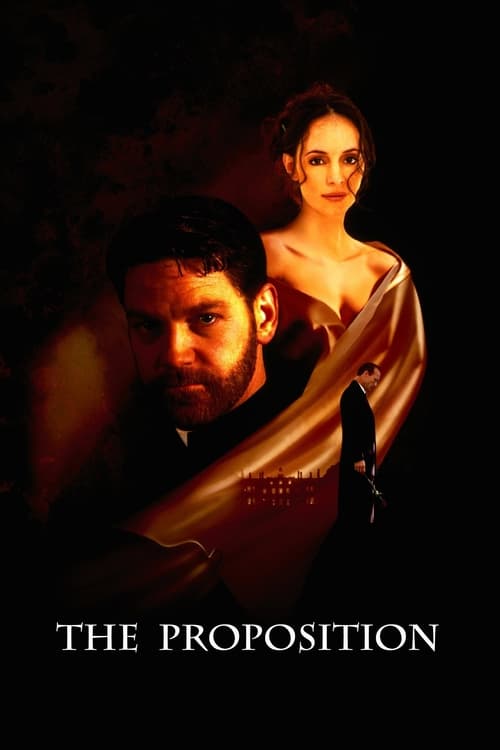
The Proposition
1998 · Lesli Linka Glatter
For a rainy-afternoon wallow in a sweeping, secrets-and-sacrifice romance — when you want the plush, tearful pleasures of a vintage-style melodrama and don't mind it laying the emotion on thick. Pure comfort-drama territory.
What it's about
In Depression-era Boston, a wealthy couple who cannot conceive strike a secret, morally fraught bargain: they quietly engage a young Harvard law student to father the child the husband cannot. Into this web arrives a new priest from abroad who pointedly avoids the family — hinting at a buried connection — while the arrangement begins to tangle hearts it was never supposed to touch.
The experience
An unhurried, deliberately old-fashioned melodrama — hushed, handsome, and earnest, trading in secrets, guilt, and forbidden feeling. It moves at a stately pace and aims for the heart rather than the head.
The craft
Director Lesli Linka Glatter, one of television's most accomplished hands, gives the film a polished period sheen — 1930s Boston rendered in warm, burnished tones — and stages its moral collisions with a classic studio-era sense of restraint and swell. It consciously courts the feel of an old-fashioned 'woman's picture.'
Why it matters
A modest release in its day, it stands mainly as a curiosity in the careers of its cast and of Glatter, who went on to become one of the most influential directors in prestige television.
Snapshot
The Proposition is a period melodrama set in Depression-era Boston, built around a morally fraught bargain: the patrician but sterile Arthur Barret and his wife Eleanor, unable to conceive, secretly engage a young Harvard law student, Roger Martin, to father the child Arthur cannot. The arrangement curdles when Roger falls in love with Eleanor, and the design is further complicated by Father Michael McKinnon, an Irish-trained priest whose conspicuous avoidance of the Barrets signals a buried connection to the family. Directed by Lesli Linka Glatter — by 1998 already one of American television's most accomplished episodic directors — and written by Rick Ramage, the film is a handsome, deliberately old-fashioned exercise in literary romanticism, closer in temperament to a studio-era "woman's picture" than to anything in the prestige-indie current of the late 1990s. It was released by PolyGram Filmed Entertainment and gathered an unusually strong ensemble — Kenneth Branagh, Madeleine Stowe, William Hurt, Neil Patrick Harris, Robert Loggia, Blythe Danner, Josef Sommer — but it landed without commercial or critical traction and has since receded into obscurity. The honest scholarly position is that the documentary and critical record on this film is thin; much of what can be said responsibly concerns its craft pedigree and its place within recognizable generic traditions rather than a robust history of its making or its afterlife.
Industry & production
The film belongs to the late-1990s ecosystem of mid-budget, star-driven adult dramas produced under the PolyGram Filmed Entertainment banner, a European-financed venture that for a few years sustained exactly this kind of literate, mid-tier project before PolyGram's film operations were absorbed into the Universal/Seagram orbit at the end of the decade. The Proposition is in many respects a casualty of that transitional moment: a tasteful period picture without a high-concept hook, arriving as the theatrical marketplace was tilting decisively toward either franchise spectacle or low-budget independent provocation, leaving the "middlebrow prestige drama" increasingly homeless.
The casting reflects an ambition that the finished film's reception did not reward. Kenneth Branagh, then near the height of his profile as an actor-director of literary adaptations, anchors the film as the priest; Madeleine Stowe and William Hurt, both associated with intelligent adult drama, play the Barrets; and Neil Patrick Harris, transitioning out of his "Doogie Howser" child-star identity toward adult roles, takes the pivotal part of Roger. That this concentration of talent failed to generate sustained attention is itself the most telling industrial fact about the film. Beyond the broad outlines of its release and personnel, granular production history — budget, schedule, shooting locations, financing specifics — is not well documented in accessible sources, and it would be irresponsible to supply figures the record does not support.
Technology
The Proposition was produced and exhibited as a conventional 35mm photochemical feature, entirely within the analog norms of late-1990s mainstream filmmaking; it predates the digital-intermediate workflows that would standardize across studio production only in the following decade. There is no indication that the film engaged any notable technological innovation — no unusual format, no early digital effects program, no experimental capture method. Its technological interest, such as it is, lies precisely in its conservatism: it uses the mature, fully refined toolkit of traditional color cinematography and optical/photochemical finishing in service of a meticulously reconstructed historical past, the technology effectively self-effacing in the service of period illusion.
Technique
Cinematography
The visual program is one of burnished classicism: warm, controlled interiors, a restricted and tasteful palette, and a compositional language that favors the stability and symmetry appropriate to a story about social propriety and concealed transgression. The cinematography is credited to Peter Sova, the Czech-American director of photography whose body of work — including Diner, Good Morning, Vietnam, and Donnie Brasco — demonstrates a facility for atmospheric naturalism and period texture, and that sensibility is consistent with the film's evident aim of immersive, unshowy historical reconstruction. The lighting strategy leans on the soft, sourced warmth of lamplight and hearth that connotes "old Boston" gentility, with the camera generally serving performance and décor rather than calling attention to itself.
Editing
The cutting is in the classical-continuity register: measured, legible, organized around performance and the gradual disclosure of motive. The film's structure depends on the slow revelation of Father McKinnon's relationship to the Barrets and on the parallel tightening of Roger and Eleanor's forbidden attachment, and the editing accordingly privileges clarity and emotional accumulation over rhythmic aggression or elliptical compression. I cannot reliably confirm the editor's credit from memory, and rather than risk a false attribution I note only that the assembly follows the conventional, performance-first grammar typical of the studio-adjacent prestige drama of its moment.
Mise-en-scène / staging
Production and costume design carry much of the film's expressive weight. The Barret household functions as a moral and social container — the gleaming surfaces of upper-crust Brahmin Boston staged as both refuge and trap — and the staging repeatedly contrasts the controlled, decorous spaces of wealth with the charged proximity that the central arrangement forces upon strangers. Blocking tends to exploit the etiquette of period social space (the dinner table, the parlor, the church) to dramatize desire pressing against decorum. The rectory and ecclesiastical settings supply a counterweight of guilt and confession that mirrors the domestic plot.
Sound
The score, credited to Stephen Endelman, operates in a lush, romantic-orchestral idiom that underlines the film's avowedly emotional ambitions; music is deployed to elevate the central love story toward tragedy in the manner of the classical melodrama rather than to complicate or ironize it. The overall sound design is naturalistic and period-appropriate, with dialogue and music carrying the dramatic load and ambient texture serving the historical setting.
Performance
Performance is the film's principal asset and its principal critical fault line. The ensemble works in a register of restraint-under-pressure suited to a story of suppressed feeling: Hurt's Arthur as a man whose dynastic anxiety overrides conscience, Stowe's Eleanor caught between duty and awakening desire, Harris's Roger as the idealistic intruder undone by sincerity, and Branagh's McKinnon carrying the film's burden of secret history and moral gravity. The difficulty, in the reception that exists, is that the material's contrivance can leave even committed actors stranded in a melodrama whose machinery shows; the performances are frequently more persuasive than the plot that motivates them.
Narrative & dramatic mode
The dramatic mode is full-blooded melodrama in the classical sense — a narrative organized around moral dilemma, secret kinship, forbidden love, and the collision of private desire with social and religious law. The screenplay layers two engines: the central "proposition" (a procreative contract that treats a human being as an instrument and then is wrecked by genuine feeling) and a mystery of withheld identity (the priest's reason for shunning the Barrets). This second strand pushes the film toward the territory of the secret-past "revelation" plot, in which the disclosure of a hidden relationship retroactively reorganizes the meaning of everything preceding it. The mode is fundamentally tragic-romantic and morally legible: it asks the audience to feel the wrongness of the bargain and the inevitability of its emotional consequences, and it resolves through revelation and loss rather than through irony or ambiguity. The risk inherent in this mode — that coincidence and contrivance overwhelm credibility — is the one most often charged against the film.
Genre & cycle
The Proposition sits at the intersection of the period costume drama and the "woman's picture" melodrama, two traditions it consciously revives. Its premise — a marriage of social standing destabilized by a sexual-reproductive arrangement and the intrusion of authentic love — places it in a lineage of melodramas about desire constrained by class and religion. It can be productively read alongside the late-1990s and turn-of-the-millennium cycle of literary-feeling, costume-clad adult romances, though it lacks the source-novel prestige that lifted the more successful entries in that cycle. Its Catholic-guilt subplot and Boston-Brahmin setting also tie it loosely to a strain of American films preoccupied with the social weight of religion and old-money respectability. The film is best understood as a deliberately retrograde genre exercise — an attempt to make a studio-era melodrama in the late 1990s — and its mixed fortunes reflect the difficulty of selling that mode to contemporary audiences.
Authorship & method
The dominant authorial signature here is, paradoxically, that of a director far better known for television than for features. Lesli Linka Glatter came to film through the acclaimed short Tales of Meeting and Parting (1985), which earned an Academy Award nomination, and built a distinguished career directing prestige episodic television — work on Twin Peaks among other series in this early period, and later sustained, celebrated runs on Mad Men, Homeland, and beyond. Her feature filmography is comparatively small (Now and Then, 1995, being her best-known theatrical work before this), and The Proposition reflects the strengths associated with her television craft: sensitive direction of actors, tonal control, and an unfussy classical command of scene. The film's emphasis on performance and emotional clarity over directorial flourish is consistent with that sensibility.
The screenplay is credited to Rick Ramage, and the contrivance-heavy, secret-revelation construction is the most distinctive — and most contested — authorial element of the project. Among the key collaborators, the cinematographer Peter Sova brings a proven gift for period atmosphere, and the composer Stephen Endelman supplies the romantic-orchestral underscoring central to the melodramatic effect. As noted above, I am not able to confirm the editor's credit reliably and decline to invent one. The "method" of the film, broadly, is one of traditional, script-driven, performance-centered studio craftsmanship rather than any auteurist or formally experimental program.
Movement / national cinema
The film belongs squarely to mainstream American narrative cinema and is not affiliated with any identifiable movement or school. If it has a national-cinema dimension, it lies in its self-conscious attempt to extend the Hollywood melodramatic tradition — the studio-era "prestige romance" — into a period when that tradition had largely migrated to television (where, not incidentally, Glatter would do her most lasting work). Its European financing through PolyGram is an industrial footnote rather than an aesthetic influence; the film's sensibility is thoroughly Hollywood-classical.
Era / period
Two senses of period are relevant. As a setting, the film reconstructs Boston around 1935, mobilizing the iconography of the Depression-era Brahmin upper class, Irish-Catholic clergy, and Harvard to stage its drama of dynasty, fertility, and faith — a milieu in which questions of lineage, propriety, and religious conscience carry maximal weight. As a product of its own moment, the film is a late-1990s artifact, made at the tail end of the era in which mid-budget adult dramas could still find studio-level backing. The tension between these two periods — a 1930s-style story told with 1990s production values, on the cusp of the medium's structural shift away from exactly this kind of film — is central to understanding its character and its commercial difficulty.
Themes
The film's governing themes are fertility, lineage, and the instrumentalization of the body: the Barrets' bargain treats procreation as a transaction and a person as a means, and the drama traces the moral cost of that reduction. Surrounding this is a constellation of related concerns — the conflict between duty and desire, the persistence of secret pasts and concealed kinship, and the heavy presence of Catholic guilt and clerical conscience embodied in Father McKinnon. Class is everywhere: the bargain is enabled by wealth and by the social imperative to produce an heir, and the tragedy is sharpened by the gulf between the patrician Barrets and the borrowed young man. Above all the film is about the irrepressibility of authentic feeling — love arriving where it was contractually forbidden — and the wreckage that ensues when human attachment refuses to obey the terms set for it.
Reception, canon & influence
The candid assessment is that The Proposition made little impression on either critics or audiences and occupies no meaningful place in the canon; the surviving critical record is sparse and tends toward the lukewarm, with the recurring reservation that a strong cast is undone by an over-engineered, coincidence-driven plot. It is not, in any standard sense, an influential or widely revived film, and I will not manufacture box-office figures, award outcomes, or specific reviews to suggest otherwise.
Its backward influences are the more legible side of the ledger: the film draws on the classical Hollywood melodrama and the "woman's picture," on the costume-drama tradition, and on the durable narrative apparatus of secret-kinship revelation and forbidden love across class lines. These are inheritances of genre and mode rather than direct citations of specific predecessors.
Its forward legacy is essentially negligible as a discrete work — but it is not without significance as a career marker. The film stands as one of Lesli Linka Glatter's relatively few theatrical features before she became one of the most respected directors in American prestige television, and in that light it reads as a transitional credit for a major episodic director rather than as a film that shaped subsequent cinema. A naming coincidence is worth flagging to prevent confusion: this 1998 American melodrama is entirely distinct from the far better-known 2005 Australian Western The Proposition, written by Nick Cave and directed by John Hillcoat, with which it shares only a title. For Sightlines' purposes, the most accurate placement of the 1998 Proposition is as a well-cast, craftsmanlike, commercially unsuccessful late effort in the Hollywood melodramatic tradition — a film more interesting for the company it keeps and the tradition it revives than for any influence it exerted.
A Deleuzian reading
Watch how Father McKinnon moves through a room.
The full Deleuzian reading of The Proposition →
Reception
Critics swatted it down in 1998 — Variety called it 'melodrama piled upon melodrama' and the New York Times filed it under soap opera in period costume — and unlike many 90s flops, no revival ever came; it remains a footnote even in its own stars' filmographies.
How The Proposition was received, from release to now →
Influences: the films it descends from and the films it influenced
- Letter from an Unknown Woman (1948) — Supplies the withheld-paternity 'secret revealed too late' architecture that drives the woman's-picture engine, the same revelation mechanism Ramage's script reuses.
- Stella Dallas (1937) — Maternal-sacrifice woman's picture founded on the instrumentalization of the female body as bearer/mother, with restraint masking interior anguish.
- Now, Voyager (1942) — Max Steiner's wall-to-wall romantic-orchestral underscoring is the emotional grammar Endelman's score directly descends from.
- All That Heaven Allows (1955) — Class-crossing forbidden love rendered as score-swelled woman's-picture melodrama, the template for restraint colliding with social transgression.
- The Heiress (1949) — A fortune-hunting suitor instrumentalizes a woman while period interiors and clenched, restrained performance carry the suppressed feeling.
- Camille (1936) — Costume melodrama of doomed love across class with a sacrificial heroine and lush romantic-orchestral scoring as affective spine.
- Brief Encounter (1945) — Establishes repression and restraint-under-pressure as the central performance mode for staging forbidden attraction.
- The House of Mirth (2000) — Woman's picture in which a woman is socially and economically instrumentalized, told through restrained performance and period exactitude.
- Far from Heaven (2002) — Explicit scholarly revival of Sirkian woman's-picture melodrama with an Elmer Bernstein romantic-orchestral score driving emotion.
- The Painted Veil (2006) — Period costume-melodrama of a strained marriage built on slow secret-revelation, restraint, and romantic-orchestral scoring.
- Atonement (2007) — A withheld secret/false-accusation revelation serves as the melodramatic mechanism, photographed in period sourced-warmth classicism.
- Brooklyn (2015) — Irish-Catholic period woman's picture turning on a secret-marriage revelation, immigrant restraint, and a romantic-orchestral score.
- The Age of Innocence (1993) — Burnished period classicism and period-etiquette staging in which social ritual and decor encode thwarted desire.
- The Remains of the Day (1993) — Merchant-Ivory restraint-under-pressure that achieves emotional clarity through suppression and meticulous period decorum.
- The Handmaid's Tale (1990) — Builds its drama on the instrumentalization of the female body for reproduction, the same premise driving the Boston couple's bargain.
- The End of the Affair (1999) — Catholic guilt plus a secret-past revelation structures the love triangle, carried by Michael Nyman's romantic-orchestral underscore.
- Now and Then (1995) — Same director's performance-centered, tonally controlled classical command of scene and period nostalgia, the authorial method she carries into this film.
Similar films
- The Age of Innocence (1993) — influence & lineage
- Letter from an Unknown Woman (1948) — influence & lineage
- The Heiress (1949) — influence & lineage
- Now, Voyager (1942) — influence & lineage
- All That Heaven Allows (1955) — influence & lineage
- Last Tango in Paris (1972) — shared sensibility
- Glengarry Glen Ross (1992) — shared sensibility
- The Cider House Rules (1999) — shared sensibility