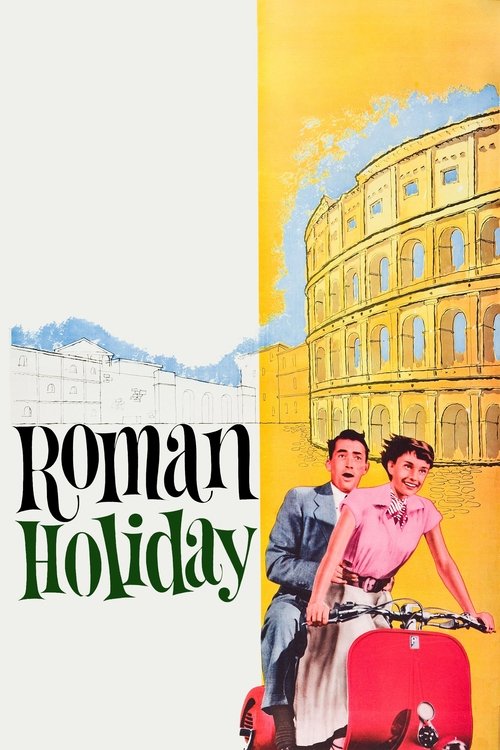
Roman Holiday
1953 · William Wyler
For a cozy night in when you want to fall in love with a person and a city at the same time — pure comfort, with just enough bittersweetness to make it stick.
What it's about
A young crown princess on a smothering goodwill tour of Europe slips her handlers for one stolen night in Rome — and, thanks to a sedative, wakes up in the apartment of an American reporter. He recognizes her, keeps it to himself, and bets his editor he can turn her runaway day into the scoop of his career. What follows is a whole city explored in secret: scooters, gelato, dancing on a barge, two people pretending to be strangers to their own lives.
The experience
Light on its feet and quietly aching underneath — it plays as a breezy, funny escapade while a clock you can feel but never see ticks in the background. It's charming in a way almost nothing modern manages, and it leaves a lump in your throat it fully earns.
Performances
Audrey Hepburn's star-making turn as Ann is one of the great screen debuts — mischievous, regal, and heartbreakingly open — and it won her the Best Actress Oscar. Gregory Peck plays the cynical reporter with a warmth that keeps sneaking past his own angle.
The craft
Wyler shot on location in actual postwar Rome rather than a backlot, and the city — the Spanish Steps, the Mouth of Truth, the Colosseum — is practically a third lead. The black-and-white photography turns sightseeing into romance, and the whole thing runs on precision-built comic timing that never shows its seams.
Why it matters
It introduced Audrey Hepburn to the world and minted her as an icon overnight, and its royal-incognito premise became one of the most imitated templates in romantic comedy.
Snapshot
Roman Holiday is William Wyler's 1953 Paramount romantic comedy, a fairy-tale-in-reverse set against the real streets of postwar Rome and remembered above all as the film that introduced Audrey Hepburn to international audiences. Its premise is a deceptively simple inversion of the Cinderella story: Ann, the young crown princess of an unnamed European country, is on a goodwill tour of Rome, exhausted and rebellious under the weight of protocol; she slips her handlers for a night, is overtaken by a sedative on a park bench, and is taken in — at first reluctantly, then opportunistically — by Joe Bradley, an expatriate American newspaperman. Recognizing his sleeping guest as the runaway princess, Joe conceals what he knows and bets his editor he can engineer an exclusive, enlisting a photographer friend, Irving Radovich, to capture candid pictures while he shows Ann the city she has never been allowed to see. Over a single stolen day of Vespa rides, sidewalk cafés, and sightseeing, the journalistic con curdles into genuine feeling, and the film resolves not with union but with renunciation: both lovers, having learned the other's secret, choose duty and discretion over romance, and Joe pointedly declines to file or sell the story. The picture's lasting power lies in this bittersweet restraint — a comedy that earns laughter and charm across its length and then ends on a note of grown-up melancholy — and in its discovery of a star whose poise, fragility, and unaffected modernity would reshape an entire idea of screen femininity.
Industry & production
Roman Holiday was a Paramount production made substantially on location in Rome, and its most consequential industrial decision was precisely that choice to shoot in the city rather than reconstruct it on a Hollywood backlot. The move was unusual for a major studio romantic comedy of the period, when controlled soundstage production remained the economical norm, and it has been widely reported that the location work raised costs and contributed to the decision to shoot in black and white rather than color — a creative and budgetary calculation that, whatever its origins, became central to the film's identity. The on-location method exposed the production to the practical difficulties of working in public Roman spaces, with crowds, weather, and light beyond the studio's control, and it lent the finished film a documentary texture rare in the genre.
The film's other defining production circumstance is the political one. The story originated with Dalton Trumbo, one of the "Hollywood Ten" then blacklisted for refusing to cooperate with the House Un-American Activities Committee. Because Trumbo could not be credited, the screen credit for the original story went to Ian McLellan Hunter, who acted as Trumbo's front, while the screenplay was credited to Hunter and John Dighton. This arrangement is firmly documented and was eventually corrected by the industry (discussed under Authorship below). The casting, too, became part of the film's legend: the relatively unknown Hepburn was cast in the central role opposite the established Gregory Peck, and it is well attested that Peck, recognizing the strength of her performance during production, advocated that her billing be raised to share top billing — an unusually generous gesture from a star at the height of his standing. The film was a commercial and critical success on release; I avoid citing specific box-office figures, which vary across sources, but its profitability and prestige are not in doubt, and it launched Hepburn's career with extraordinary force.
Technology
Roman Holiday is not a technological landmark, and its interest on this axis is modest and mostly tied to the logistics of location production. It was shot photochemically on 35mm black-and-white film in the standard Academy ratio, predating the widescreen revolution that Hollywood was about to embrace (CinemaScope arrived the same year). The technical achievement is less in any new instrument than in the disciplined deployment of existing tools under uncontrolled conditions: lighting and exposing for real Roman exteriors, capturing usable sound and coverage amid public spaces, and matching location footage with whatever interior or process work was completed in the studio. The decision to forgo Technicolor — at a moment when color was increasingly used as a competitive weapon against television — is the film's most notable "technological" choice, and it proved aesthetically decisive: monochrome gave the location photography a sober, almost neorealist gravity that color might have prettified. Beyond this, the film relies on conventional period craft rather than any innovation in capture or processing.
Technique
Cinematography
The cinematography is credited to Franz Planer and Henri Alekan, a pairing that reflects the production's split between location and studio work, and the black-and-white photography is among the film's quiet glories. The Roman exteriors are shot with a clarity and depth that treats the city as a co-star: the Spanish Steps, the Mouth of Truth, the Colosseum, and the café terraces are framed as recognizable, sunlit, lived-in places rather than painted backdrops. The camera observes Hepburn with particular care, finding the long neck, the wide eyes, and the gamine silhouette that would become iconic, and the lighting flatters without glamorizing into unreality. Where the genre often favored soft, high-key studio glow, Roman Holiday admits a harder, more naturalistic daylight that grounds the romance in a real world. Alekan, a master of French monochrome (later celebrated for La Belle et la Bête and, decades on, Wings of Desire), and Planer, a seasoned Hollywood craftsman, together produce images that are elegant but unpretentious, keeping the human faces legible against the grandeur of the city.
Editing
The editing, credited to Robert Swink — a frequent Wyler collaborator — serves the director's preference for performance and continuity over montage flash. Wyler was famous for shooting many takes and covering scenes thoroughly, and the cutting reflects a sensibility that lets scenes breathe, holds on actors, and builds comedy and feeling through timing rather than through aggressive cross-cutting. The film's structure is essentially a single-day itinerary, and the editing manages the shift in register from the early farce of mistaken identity through the buoyant midsection of sightseeing to the muted, elongated rhythms of the parting and the final press-conference coda. That closing sequence in particular — a long, restrained exchange of glances and formal courtesies that the audience reads as heartbreak — depends on patient cutting that trusts the actors and withholds emphasis. The editing's discretion is part of the film's adult tone.
Mise-en-scène / staging
Staging is where Wyler's directorial intelligence is most visible. The film exploits real Roman geography as dramatic architecture: the contrast between the gilded, ceremonial interiors of Ann's embassy world — ordered, symmetrical, suffocating — and the open, contingent spaces of the street is built into the blocking. Wyler stages the day's escapade as a progressive loosening, the princess physically inhabiting wider and freer spaces as she sheds protocol, before the geometry of confinement reasserts itself in the final official setting. Set pieces are choreographed around landmarks that double as emotional beats: the scooter ride through traffic as exhilarated abandon, the Mouth of Truth as a test of trust played for a scare, the riverside dance and brawl as the point where the masquerade nearly collapses. Throughout, Wyler's deep-focus instincts keep foreground and background alive, situating the lovers within the crowd and the city rather than isolating them in close-up.
Sound
The sound design is conventional for its moment but well integrated with the location aesthetic, mixing the ambient life of Roman streets into the romantic comedy in a way that reinforces the documentary feel. The score is by Georges Auric, the French composer associated with Les Six and with a substantial career in film music on both sides of the Channel; his contribution supplies a light, lyrical, recognizably Continental musical voice that supports the film's charm without overwhelming its restraint, and that turns elegiac in the closing movement. Dialogue carries the comedy — the banter between Joe and the oblivious princess, the running deception with Irving — and the performances depend on verbal timing that the sound recording, much of it managed under difficult location conditions, had to preserve.
Performance
Performance is the film's center of gravity. Audrey Hepburn's Ann is the discovery: a portrait of constrained youth that moves from petulant exhaustion through giddy liberation to a final, devastating composure, and she plays the arc with a transparency and physical grace that made her an immediate star and won her the Academy Award for Best Actress. Gregory Peck, the established lead, performs an act of generosity in the role of Joe, modulating his natural gravity into wry, slightly rumpled romantic-comedy ease and ceding the picture's emotional focus to his co-star; his restraint in the final scenes is essential to their effect. Eddie Albert, as the photographer Irving, supplies broad comic relief and earned an Oscar nomination. A frequently retold anecdote concerns the Mouth of Truth scene, in which Peck improvised the gag of pretending the stone face had bitten off his hand; Hepburn's startled reaction is widely reported to be genuine, a small instance of how the production's looseness fed the film's spontaneity. (I flag this as a well-circulated account rather than a fully documented fact.)
Narrative & dramatic mode
The film's dramatic mode is romantic comedy shaded toward the bittersweet, structured as a "holiday" — a bounded interval of license outside ordinary life, after which the characters must return to their roles. It runs on dramatic irony: the audience and Joe know Ann's identity while she believes herself anonymous, and later Ann grasps that Joe is a reporter, so that the two leads spend the second half each secretly protecting the other. This double secret converts a potentially cynical premise — a journalist exploiting a vulnerable young woman for a scoop — into a story about discretion and self-denial. The narrative deliberately refuses the genre's expected consummation: instead of the lovers' union, it delivers renunciation, with both choosing duty, and a final press conference that stages their goodbye in public, coded language. Joe's decision not to publish, and Irving's gift of the photographs to Ann as a private keepsake, are the moral climax — a renunciation of the very scoop the plot was built to obtain. The result is a comedy whose ending earns genuine pathos, an unusually mature resolution for a Hollywood romance of its era.
Genre & cycle
Roman Holiday sits within the Hollywood romantic comedy but inflects it in two distinctive ways: through its "princess in disguise" fairy-tale armature and through its location realism. The masquerade-and-mistaken-station plot has deep roots in screwball and in older theatrical and literary traditions of royalty slumming among commoners, and the film stands at the head of a durable cycle of "European holiday" romances in which American protagonists find love and self-knowledge abroad — a cycle that flourished through the 1950s and beyond as postwar travel and Continental glamour became marketable. It also belongs to the run of Audrey Hepburn vehicles that the film itself inaugurated, films built around her particular combination of aristocratic poise and ingénue freshness. Its fusion of light comedy with a melancholy, anti-fantasy ending distinguishes it from the more purely wish-fulfilling entries in the genre and gives it a tonal sophistication that has helped it endure.
Authorship & method
The authorship of Roman Holiday is a story of strong directorial control over a distinguished team, complicated by the politics of the blacklist. William Wyler — one of the most honored directors of the studio era, with Mrs. Miniver, The Best Years of Our Lives, and The Heiress behind him and Ben-Hur ahead — brought his characteristic method of meticulous, many-take direction and his preference for deep, performance-centered staging, and he was reportedly central to the choices to shoot in Rome and in black and white. His collaborators were formidable: cinematographers Franz Planer and Henri Alekan; editor Robert Swink; composer Georges Auric; and costume designer Edith Head, whose work on the film won the Academy Award for Costume Design and whose styling of Hepburn helped codify a new, simpler silhouette of mid-century elegance.
The writing credit is the film's most significant authorship issue and is firmly part of the historical record. The original story was written by the blacklisted Dalton Trumbo, who was fronted by Ian McLellan Hunter; the screenplay was credited on release to Hunter and John Dighton. The Academy Award for Best Motion Picture Story was awarded to Hunter as the credited author. The industry later corrected this: the Academy posthumously recognized Trumbo's authorship and presented an Oscar to his widow in the early 1990s, and his on-screen credit was subsequently restored. The episode makes Roman Holiday one of the most prominent films to carry the hidden authorship of the blacklist, and it complicates any tidy account of the picture's wit and warmth with the knowledge that they were conceived by a writer the industry had cast out.
Movement / national cinema
Roman Holiday is a Hollywood film, but its sensibility is shaped by a transatlantic encounter with postwar European cinema, and specifically with the Italian context in which it was shot. By 1953 Italian neorealism had taught a generation to value real locations, natural light, and the texture of streets and crowds, and while Roman Holiday is a glossy commercial romance rather than a neorealist work, its decision to film among the genuine spaces of Rome absorbs something of that influence — the city is observed, not invented. The film thus belongs to a moment of growing American production in Europe (the so-called "runaway" productions and the use of Italian studios and locations) and to a cross-pollination between Hollywood polish and European realism. It is not part of any avant-garde movement; rather it represents the prestige wing of the American studio system reaching outward, importing both the look of a real European capital and, in figures like Alekan and Auric, European craft talent.
Era / period
The film is firmly of the early 1950s. It reflects a postwar America fascinated by a recovering Europe, an era of expanding travel, Marshall Plan reconstruction, and a vogue for Continental glamour, all of which the "Roman holiday" itself embodies. It arrives at the threshold of Hollywood's widescreen-and-color counterattack against television, and its choice to remain in intimate black-and-white Academy ratio marks it as a film looking slightly backward in form even as its location method looked forward. Most pointedly, it is a product of the blacklist years, and the concealed authorship of its screenplay is an indelible period signature — a charming comedy made in the shadow of HUAC. Watched today, it is both a luminous time capsule of 1950s Rome and a document of the industry's political wounds.
Themes
The film's governing theme is the tension between duty and desire, dramatized through a protagonist whose very identity is an obligation. Ann's escapade is a parable about the cost of public role: she is permitted one day of private selfhood before duty reclaims her, and the film treats that reclamation with sober respect rather than rebellion, affirming responsibility even as it mourns what responsibility forecloses. Closely related is the theme of freedom and its limits — the holiday as a bounded space of liberty that cannot become a life. The film also reflects on authenticity and performance: nearly every relationship in it begins as a deception (Joe's hidden profession, Ann's hidden rank), and its moral movement is toward honesty and the refusal to exploit. In Joe's choice not to publish, the film stages a small ethics of journalism and of love alike — the privileging of another person's dignity over personal gain. Underlying all of this is a mature acceptance of loss: the recognition that some experiences are precious precisely because they end.
Reception, canon & influence
Roman Holiday was warmly received on release and quickly recognized as both a charming entertainment and a star-making event. It earned a substantial slate of Academy Award nominations — including Best Picture, Best Director, and Best Supporting Actor for Eddie Albert — and won three: Best Actress for Audrey Hepburn, Best Costume Design for Edith Head, and Best Motion Picture Story (credited at the time to Ian McLellan Hunter, later restored to Dalton Trumbo). Critical opinion has remained durably affectionate; the film is enshrined as a classic of the romantic comedy and as the definitive launch of Hepburn's career. I avoid quoting specific contemporary reviews I cannot reproduce precisely, but the consensus of its lasting high standing is secure.
Looking backward, the film draws on a long tradition of disguise-and-mistaken-rank comedy, on the screwball legacy of warring-then-falling lovers, and on the example of Italian location realism that gave its Rome such conviction. Its understated, renunciatory ending owes something to the adult romance of films like Brief Encounter in its valuing of feeling sacrificed to duty.
Looking forward, its influence is considerable. It established the "Audrey Hepburn" persona that would define a decade of films and a lasting fashion ideal, with Edith Head's costuming helping to set a template of pared-down elegance. It inaugurated and popularized the Hollywood European-holiday romance and the modern variant of the princess-in-disguise story, a template visibly echoed in later films and television, including comparatively recent royal romantic comedies that recycle its premise of a royal escaping protocol to taste ordinary life. Its specific locations — above all the Mouth of Truth and the Spanish Steps — became tourist landmarks partly through the film's fame, a measure of its grip on popular imagination. And as one of the most celebrated films to carry a blacklisted writer's concealed work, it occupies a permanent place in the history of the Hollywood blacklist, its eventual restoration of Trumbo's credit standing as a small act of justice attached to an enduringly beloved film.
A Deleuzian reading
Put your hand in the Mouth of Truth and, the old Roman legend says, it bites the liar's fingers off.
The full Deleuzian reading of Roman Holiday →
Reception
A hit on release — it won Audrey Hepburn the Best Actress Oscar in her first Hollywood lead — and unlike many 50s crowd-pleasers it never dipped: it's only climbed from 'charming studio romance' to untouchable genre cornerstone.
How Roman Holiday was received, from release to now →
Influences: the films it descends from and the films it influenced
- Brief Encounter (1945) — Model for the renunciation ending in which mutual feeling is consciously surrendered to social duty, played in restrained underacting rather than melodrama — Wyler's parting on the Palazzo dei Conservatori floor lifts its emotional logic directly.
- It Happened One Night (1934) — Established the runaway-heiress-incognito structure and the screwball warring-then-falling-lovers arc with a newspaperman angling for a scoop — the exact engine Trumbo retools with Joe Bradley's hidden press motive.
- Queen Christina (1933) — Royal-renunciation template: a sovereign who slips protocol to taste anonymous ordinary life and ultimately chooses crown over love, the regal-melancholy register Hepburn's princess inherits.
- Rome, Open City (1945) — Source of the Italian location-realism that lets Wyler shoot in real Roman streets and squares for documentary conviction rather than backlot Rome.
- Bicycle Thieves (1948) — Neorealist practice of staging fiction against unstaged city life — crowds, markets, ambient diegetic noise — that gives Roman Holiday's Vespa rides and piazzas their lived-in texture.
- The Best Years of Our Lives (1946) — Wyler-Toland deep-focus, performance-centered staging in long takes — keeping actors in sustained spatial relationships within the frame — the directorial method he carries into Roman Holiday with Planer and Alekan.
- The Heiress (1949) — Wyler's own immediately prior study in duty-versus-desire ending on a heroine's hard renunciatory closing of a door — the same self-denying final beat structurally rhymed here.
- Ninotchka (1939) — The Continental sophisticated-comedy mode of an official figure thawed into ordinary pleasure by a foreign city, the worldly tone Roman Holiday domesticates for postwar tourism.
- Sabrina (1954) — Immediate Paramount follow-up exploiting the Hepburn gamine persona and Edith Head's pared-down silhouette established here, repeating the class-crossing romance built around her new star image.
- Three Coins in the Fountain (1954) — Direct launch of the Hollywood European-holiday romance cycle Roman Holiday inaugurated — Rome as postcard backdrop with landmark-tour shooting (Trevi Fountain) as narrative spine.
- Funny Face (1957) — Built entirely on the Hepburn fashion-icon persona codified by Edith Head's styling here, transplanting the pared-elegance silhouette into a Paris musical.
- Breakfast at Tiffany's (1961) — Consummates the 'Audrey Hepburn' ideal — gamine elegance, bittersweet romance, fashion-as-character — that Roman Holiday manufactured as a durable star template.
- Two for the Road (1967) — Carries the Hepburn-led European-travel romance forward, using continental location shooting as the canvas for a relationship anatomy descended from the holiday-romance cycle.
- Notting Hill (1999) — Modern inversion of the celebrity-meets-commoner premise with the same fame-versus-private-life renunciatory tension, echoing the closing press-conference reunion of public role and private feeling.
- The Princess Diaries (2001) — Direct heir to the princess-escaping-protocol-to-live-ordinarily premise Roman Holiday modernized, recycling royal-incognito comedy for a later generation.
- To Catch a Thief (1955) — Wyler's Paramount production established the Hollywood-internationalism logistical and aesthetic template To Catch a Thief directly deploys: marquee stars photographed against authenticated European architecture, with Continental location treated as aspirational spectacle and as the studio model for major-unit location production in postwar Europe.
- Charade (1963) — Establishes Hepburn's screen identity as a luminous innocent discovering a continental city under the protection of a charming stranger; Charade presupposes this persona as audience knowledge, allowing Regina Lampert to inherit it fully formed without re-establishing it.
- Red, White & Royal Blue (2023) — Establishes the royalty-incognito romance whose motor is the collision between institutional duty and stolen private desire; RWRB keeps the constrained-royal blueprint and its bittersweet 'the role wins' tension while flipping the ending to wish-fulfillment.
- The Children's Hour (1961) — Franz Planer's luminous, restrained black-and-white cinematography, the same collaborator and tonal palette Wyler brought directly to this film.
- Jab We Met (2007) — The single-journey romance where a woman fleeing her prescribed life and a wary man are transformed by shared travel, carrying a bittersweet counter-current beneath the comedy that Jab We Met's darker second half echoes.
- Summertime (1955) — Extends the location-shot European-holiday romance ending in renunciation — Katharine Hepburn's Venice idyll surrendered to reality — pairing real-city cinematography with the duty-over-love close.
- Roman Holiday's press-conference finale → La Dolce Vita (1960) — Shares the real-Rome location aesthetic and the journalist-pursuing-celebrity dynamic — Fellini's paparazzi swarm is the darker sibling of Joe and Irving's covert royal scoop.
Similar films
- Breakfast at Tiffany's (1961) — influence & lineage · same viewing thread
- Sabrina (1954) — influence & lineage · same viewing thread
- It Happened One Night (1934) — influence & lineage
- Rome, Open City (1945) — influence & lineage
- Charade (1963) — same viewing thread
- How to Steal a Million (1966) — same viewing thread
- La Dolce Vita (1960) — shared sensibility
- The Great Beauty (2013) — shared sensibility
All the films related to Roman Holiday →
Watch it with: curated runs of related films
- Fast Talk & Fur Coats — A run of quick-witted charmers who disguise, con, and sweet-talk their way across class lines — watch them near each other and the century between Lubitsch and Sean Baker collapses into one long, glittering grift.