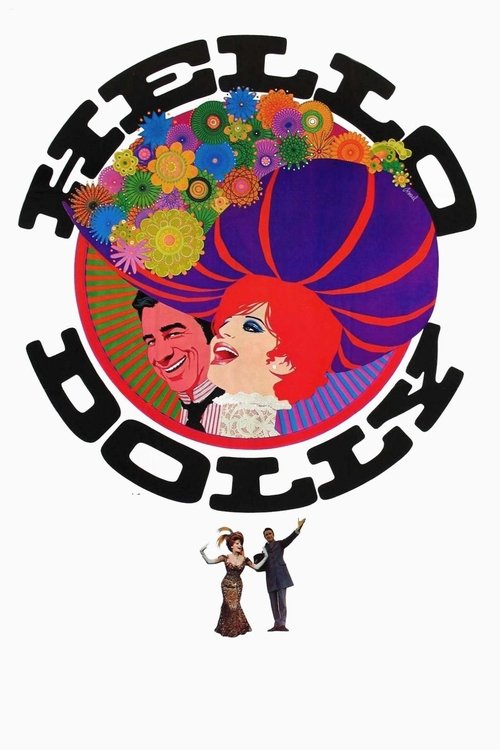
Hello, Dolly!
1969 · Gene Kelly
For when you want pure spectacle and showtunes — a rainy-Sunday, whole-family kind of watch, comfort viewing on the grandest possible scale.
What it's about
Dolly Levi, a widowed matchmaker with a scheme for everything, travels to Yonkers to arrange a wife for Horace Vandergelder, a rich and famously miserly merchant — while quietly deciding the right match is herself. Her machinations sweep his two shop clerks, his niece, and assorted lovers off to New York City for a day and night of romantic chaos, capped by a spectacular evening at the Harmonia Gardens restaurant.
The experience
Enormous, glossy, and unabashedly old-fashioned — wall-to-wall production numbers, thousands of extras, and not an ounce of irony. It's a three-hour sugar rush that asks nothing of you but to sit back and let it parade past.
Performances
Barbra Streisand, just twenty-seven and playing a middle-aged widow, powers through on sheer star wattage and voice, and her title-number duet with Louis Armstrong — in one of his final screen appearances — is a keeper. Walter Matthau makes a reliably sour foil.
The craft
Gene Kelly directs the last gasp of the giant roadshow musical: massive sets recreating 1890s New York, armies of dancers, and Jerry Herman's brassy score, all shot in widescreen 70mm splendor. The Harmonia Gardens sequence is production-number maximalism at full throttle — the bigger the screen, the better.
Why it matters
One of the colossally expensive musicals whose box-office failure helped end the studio roadshow era, it has survived as a beloved artifact of that vanished scale — and found an unlikely afterlife decades later when its songs featured prominently in a hit animated film.
Snapshot
Hello, Dolly! is the sound of an industry spending its last chips on a bet it had already lost. Adapted from the 1964 Jerry Herman/Michael Stewart Broadway hit — itself drawn from Thornton Wilder's The Matchmaker (1955), which Wilder had rebuilt from his own flop The Merchant of Yonkers (1938), which he had lifted from Johann Nestroy's Viennese farce Einen Jux will er sich machen (1842), which came in turn from John Oxenford's English one-act A Day Well Spent (1835) — the film arrives after a century of transatlantic recycling, and arrives in 70mm, with a cast of thousands, at the precise moment the American audience for such things evaporated.
Barbra Streisand, twenty-seven, plays a widowed middle-aged matchmaker. Walter Matthau plays the Yonkers skinflint she intends to marry. Gene Kelly, in his last musical as a director, stages it with a craftsman's fidelity to a form he had helped perfect twenty years earlier and could no longer refresh. The result won three Academy Awards, was nominated for Best Picture in the year of Midnight Cowboy and Easy Rider, and lost enough money to help push 20th Century-Fox into the crisis that ended the Zanuck regime. It is, simultaneously, an object of genuine craft — the Harmonia Gardens sequence is one of the great pieces of physical staging in any late studio musical — and the most legible tombstone of the roadshow era.
Industry & production
Fox bought Hello, Dolly! in the flush of The Sound of Music (1965), which had rescued the studio from Cleopatra and appeared to prove that enormous, reserved-seat, intermission-bearing musicals were a renewable resource. They were not. Fox followed The Sound of Music with Doctor Dolittle (1967) and Star! (1968), both expensive failures, and Hello, Dolly! was already in motion when the pattern became undeniable. The studio was, in effect, obliged to finish paying for a strategy it had stopped believing in.
The rights deal is itself part of the story. Broadway producer David Merrick negotiated terms restricting release until the stage production had closed or a specified date had passed; the show was still running when Fox, needing the picture in the marketplace, moved to release in December 1969. Accounts of the additional consideration paid to Merrick vary, and the precise figures are not reliably documented in public sources — but the structural fact holds: Fox released a film that was competing with its own source.
Ernest Lehman produced and wrote the screenplay, an unusual double role for a writer of his standing (North by Northwest, West Side Story, The Sound of Music, Who's Afraid of Virginia Woolf?, which he also produced). Budget figures commonly cited fall in the low-to-mid twenty-millions, which would have made it among the most expensive musicals ever produced; rentals fell well short. Readers should treat specific dollar amounts in circulation with caution — studio accounting of the period was not transparent and later reissue and television revenue muddies the ledger. What is not in doubt is that the picture was a major loss, that it compounded the losses on Dolittle and Star!, and that the resulting bloodletting at Fox reshaped the studio's management within two years.
The casting of Streisand was contested from the announcement. Carol Channing had originated Dolly on Broadway and was closely identified with her; Dolly Levi is written as a woman past middle age, decades into widowhood. Fox wanted the star of Funny Girl (1968), and got her. Streisand has spoken over the years with notable frankness about her discomfort in the part. The on-set friction between Streisand and Matthau is among the better-documented antagonisms of the period — accounts differ in detail and both parties gave varying versions later, but the hostility was real and Kelly spent considerable energy mediating it.
Technology
The film was shot in Todd-AO 70mm, Fox's house roadshow format, with six-track magnetic stereo sound — a technology package designed for hard-ticket presentation in a small number of equipped theaters before a general 35mm reduction release. Todd-AO's roughly 2.2:1 frame and its enormous negative area produce the film's characteristic look: extreme depth of detail, minimal grain, and a wide, shallow rectangle that rewards lateral staging and punishes clutter.
This was a technology optimized for an exhibition model that was collapsing. The roadshow depended on scarcity and event pricing; by 1969 the audience that filled those seats was aging out and the audience replacing it was buying tickets to films shot in 35mm on location with handheld cameras. The Best Sound Oscar (Jack Solomon and Murray Spivack) recognizes real achievement in multi-track music recording and playback-based production — but it is an achievement in a delivery format most viewers would encounter, then and after, as a flattened reduction print or a pan-and-scan television transfer. Much of what the film's crew actually built is invisible in the form in which the film was most widely seen for its first thirty years.
Technique
Cinematography
Harry Stradling Sr. shot the film and was Oscar-nominated for it — his last significant credit before his death in 1970. Stradling had photographed My Fair Lady (1964) and Funny Girl, and he brings to Dolly! the same high-key, honeyed palette and the same carefully engineered treatment of Streisand's face, which he understood better than any cameraman of the period. His lighting is frankly theatrical: sourced for beauty rather than plausibility, with warm fill that keeps period interiors glowing rather than gaslit.
The camera work is built around the crane. Kelly and Stradling favor long, elevated, sweeping moves that cover a full musical phrase without a cut — a technique Kelly had used since the 1940s and which the 70mm frame makes both more impressive and more demanding, since the format's depth exposes every extra who is not fully committed. The parade sequence and the Harmonia Gardens material are the showpieces; the smaller scenes are photographed with less invention, and the difference is felt.
Editing
William Reynolds — who had cut The Sound of Music and The Sand Pebbles, and would go on to The Godfather and The Sting — was nominated for Best Film Editing. His approach honors the staging: within numbers, cuts are relatively sparse and motivated by choreographic phrase rather than by beat, preserving the integrity of the dancing in a way that later musicals abandoned. The problem is not the cutting of the numbers but the architecture between them. The film runs long, and the dramatic connective tissue — Vandergelder's household, the Yonkers business, the parallel courtships — is paced as though the audience has already sat through the overture and intermission of a stage production. A film built for a captive roadshow audience is edited for one.
Mise-en-scène / staging
This is the film's strongest department and the one the Academy recognized: John DeCuir and Jack Martin Smith's art direction, with set decoration by Walter M. Scott, George Hopkins and Raphael Bretton, took the Oscar. Exteriors for Yonkers were shot on location in Garrison, New York, whose preserved riverfront landing and station stand in for the 1890s town with a specificity no backlot could fake. Against that, the production built a vast period Manhattan street for "Before the Parade Passes By" — routinely described in production histories as among the largest sets constructed in the late studio era — and filled it with thousands of extras, marching bands, floats and horses.
Michael Kidd's choreography is the other pillar. Kidd, who had made Guys and Dolls, Seven Brides for Seven Brothers and The Band Wagon, and had worked with Kelly on It's Always Fair Weather (1955), builds numbers out of labor: the "Waiters' Gallop" at the Harmonia Gardens turns restaurant service into a controlled catastrophe of trays, flambé and collision, staged in depth and covered in long takes so that the audience can verify nothing is faked. It is the single sequence that most justifies the format. Reports of tension between Kelly and Kidd over authority on the floor have circulated for decades; the specifics are not firmly established, and it is fairer to say only that two strong choreographic sensibilities occupied the same picture.
Sound
Playback recording — vocals pre-recorded and mimed on set, orchestra sweetened after — was standard practice, and the six-track magnetic mix exploits it: Streisand's voice sits forward and dry against a wide, reverberant orchestral field, an artificial balance that is nonetheless the correct one for a form where the voice is the argument. Lennie Hayton and Lionel Newman's adaptation and conducting won the Oscar for musical score. The most interesting sonic event in the film is Louis Armstrong's appearance in the title number — Armstrong's 1964 recording had been the improbable hit that displaced the Beatles at the top of the American singles chart, and putting him on screen with Streisand is an act of commercial memory as much as casting. It is among his final screen appearances; he died in 1971.
Performance
Streisand's Dolly is a performance of technique deployed against a role. Denied the character's actual age and history, she substitutes vocal invention — a broad, drawling comic register in "Just Leave Everything to Me" that plays as pastiche of an older comedienne's manner, alternating with the unguarded straight singing of "Before the Parade Passes By" and "Love Is Only Love." The straight singing is superb and the pastiche is a strategy for covering a gap. Matthau plays Vandergelder as pure irascible mass, which is right for the part and gives the film its only real friction, though he and Streisand are almost never plausibly in the same emotional scene.
The supporting company is better than the film's reputation suggests: Michael Crawford's Cornelius Hackl is genuinely light and frightened in the right proportions — nearly two decades before The Phantom of the Opera made him a different kind of star — with Danny Lockin, Marianne McAndrew and E. J. Peaker as the second couple. Tommy Tune, as Ambrose Kemper, is here at the start of a career that would make him one of Broadway's major directors and choreographers.
Narrative & dramatic mode
Beneath the spectacle the machinery is pure nineteenth-century farce: clerks who abscond from the shop for a day in the city, mistaken identities, hiding in closets, a restaurant where every plot line converges and collides. Nestroy's structure survives intact through Wilder and Stewart, and it is a sturdy structure — comedy of appetite, in which every character wants more life than their circumstances allow and lies in order to get it.
Wilder's contribution, retained in the book, is the moral overlay: Dolly's addresses to her dead husband Ephraim, in which she asks permission to rejoin the living, and the recurring argument that money, like manure, is worthless unless spread around to make young things grow. That gives the farce a spine — the film is about a woman deciding to stop mourning — but it sits uneasily against the casting. A twenty-seven-year-old asking her late husband's blessing to live again is asking a question the film cannot make weigh anything. The scenes play; they don't land.
Genre & cycle
Hello, Dolly! is a terminal specimen of the studio roadshow musical, the cycle that runs from Oklahoma! (1955) through West Side Story, My Fair Lady and The Sound of Music and expires in a cluster of expensive failures at the end of the decade: Doctor Dolittle, Star!, Sweet Charity (1969), Paint Your Wagon (1969), Goodbye, Mr. Chips (1969), Darling Lili (1970). Several of these are good films. All of them were made for an audience that had gone somewhere else. Within the cycle, Dolly! belongs to the specifically nostalgic sub-strain — turn-of-the-century Americana, straw hats and gaslight, the register of Meet Me in St. Louis and The Music Man — which by 1969 had acquired an involuntary poignance: a studio depicting an innocent past while its own past ended.
Authorship & method
Kelly's direction is best understood as curatorship. As a performer-choreographer at MGM he had been an innovator — the camera integrated into the dance, the number pushed off the stage and into the street. Directing here without dancing, working from a Broadway property he had not shaped, with a choreographer of equal stature and a star imposed by the studio, he functions as the guarantor of a house style rather than its author. What he protects is real: the numbers are covered so that the dancing is legible, the crane moves in service of the choreography, the geography of the Harmonia Gardens is always clear. What he cannot supply is a reason for the film to exist in 1969.
The authorship is genuinely distributed. Lehman wrote and produced. Kidd owns the dance. Jerry Herman supplied two songs specifically for the film — "Just Leave Everything to Me," written to replace Dolly's stage introduction with something built for Streisand, and "Love Is Only Love," a ballad originally written for Mame and unused there. Stradling owns the light, Reynolds the cutting, DeCuir the world, Irene Sharaff the Oscar-nominated costumes, Hayton and Newman the sound of the orchestra. It is a producer's film in the classical sense, and its virtues are the virtues of a system rather than of a sensibility.
Movement / national cinema
The relevant context is not a movement but a rupture. 1969 is the year of Easy Rider, Midnight Cowboy, The Wild Bunch, Medium Cool — the arrival of New Hollywood, with its location shooting, its ambivalence, its unresolved endings, its rejection of exactly the aesthetic Dolly! embodies. Midnight Cowboy took the Best Picture Oscar for which Hello, Dolly! was nominated. The two films, released within months of one another, share only a studio system and a city; one made it a nightmare of failed migration, the other a parade.
Dolly!'s deeper lineage is Central European rather than American — Nestroy's Viennese Posse tradition of servant-farce, mediated through Wilder's Americanization. Tom Stoppard would return directly to Nestroy for On the Razzle (1981), taking the same source in the opposite direction: toward verbal density rather than spectacle.
Era / period
The film is set in the 1890s and made at the end of the 1960s, and both dates matter. The period setting is not incidental nostalgia; it is the culmination of a Hollywood habit of locating American innocence in the decade before the automobile. Made in 1969, that gesture reads differently than it would have in 1944. The film's confidence in abundance — the parade, the banquet, the massed extras, the sheer expenditure — was already an anachronism when the cameras rolled, and viewers have registered that ever since. What the film records, without meaning to, is the last moment at which an American studio could afford to build a city block to shoot a song.
Themes
Appetite is the governing subject: for food, for money, for adventure, for another person. Every character is under-fed in some register, and the plot is a series of trespasses committed to get more. Wilder's economic argument — wealth is inert unless circulated — gives Dolly her justification for interfering in everyone's life, and makes matchmaking a form of redistribution.
Against that sits the theme of re-entry: the parade that will pass by if you don't join it. Hello, Dolly! is structurally a story about grief ending, about a widow granting herself permission to want things. The film states this theme clearly and cannot fully dramatize it, for reasons of casting. Third, and most persistently, there is the city as engine of transformation — Yonkers as the place where nothing happens, New York as the place where a clerk can lie his way into a life. That opposition drives "Put On Your Sunday Clothes," the film's most infectious sequence and, as it turned out, its most durable.
Reception, canon & influence
Contemporary notices were divided and, on balance, unkind. Reviewers admired the physical production, Kidd's choreography and Streisand's voice while objecting to the scale, the length, and above all the casting — the mismatch between a young star and an aging character was the near-universal complaint, and the critical consensus of the period treated the film as an emblem of studio excess rather than as a work to be judged on its own terms. The Academy split the difference, giving it seven nominations including Best Picture and three wins — Art Direction, Score of a Musical Picture, and Sound — all in categories rewarding craft rather than conception.
Looking backward, the film's inheritance is unusually deep and unusually well-documented: Oxenford to Nestroy to Wilder twice over to Stewart and Herman, with a prior screen version in Joseph Anthony's The Matchmaker (1958), where Shirley Booth played Dolly at an appropriate age with Anthony Perkins and Shirley MacLaine as the runaway clerks. Its formal inheritance runs through MGM's Freed unit by way of Kelly and Kidd, and through Fox's own post-Sound of Music house style.
Looking forward, the influence is bifurcated. In industry history, Hello, Dolly! functions as a permanent cautionary exhibit — cited in nearly every account of the collapse of the studio system, of the end of the roadshow, and of the financial crisis that reshaped Fox at the turn of the 1970s. Its afterlife is as evidence.
Its aesthetic afterlife is stranger and more affectionate. Andrew Stanton built WALL·E (2008) around "Put On Your Sunday Clothes" and "It Only Takes a Moment," using the film's own images and Michael Crawford's voice as the last surviving artifact of human longing on a dead Earth — a robot learning what wanting is from a 70mm musical about clerks running away to the city. It is one of the most inventive uses of quotation in modern animation, and it returned Hello, Dolly! to a generation that had never encountered it, in a context that treats its innocence as precious rather than embarrassing.
Beyond that, the film survives as a record: of Louis Armstrong near the end, of Michael Kidd's craft at full stretch, of Harry Stradling's last light, of Gene Kelly closing out the form he had done more than almost anyone to invent. The gap between what the picture accomplishes and what it was for remains its defining feature — a superbly made answer to a question the audience had stopped asking.
Reception
In 1969 it was the poster child for Hollywood bloat — one of the most expensive musicals ever made, and despite decent grosses and a Best Picture nomination it lost Fox a fortune and helped kill the roadshow musical. Decades later it got an unlikely second life when WALL-E made a whole generation fall in love with its songs.
How Hello, Dolly! was received, from release to now →
How to watch Hello, Dolly!: what to notice on a first viewing
- Watch a musical number play out in one long, elevated crane shot. Kelly and Stradling favor sweeping, high crane moves that cover an entire musical phrase without cutting away, letting you see a whole dance unfold in continuous space. You get proof the dancing and the scale are both real, not assembled from pieces in the edit.
- Notice the warm, glowing light on every period interior. Stradling lights the film for beauty rather than plausibility, keeping rooms honeyed and bright and giving Streisand's face the same careful glamour treatment he brought to his other stars. The light alone tells you this is meant to be looked at, not lived in.
- Watch the waiters carry trays through the Harmonia Gardens chaos. Michael Kidd stages the restaurant sequence as a controlled catastrophe of trays, flambé, and near-collisions, shot in depth and in long takes so nothing can be faked. The sequence earns its spectacle by making sure you can verify every near-miss is real.
- Listen for how close and dry the singing voice sounds. The vocals were pre-recorded and mimed on set, then mixed so Streisand's voice sits forward against a wide, reverberant orchestra, an artificial balance built to keep the voice as the clear focus. The mix is doing exactly what a musical needs: making sure the singing always wins the argument with the orchestra.
- Notice how enormous and detailed the period street looks. The production built one of the largest sets of the late studio era for the parade sequence, filling it with thousands of extras, marching bands, floats, and horses. The scale itself is the argument the film is making for spending this kind of money on a musical at all.
The whole guide to watching Hello, Dolly!, with the keys for a rewatch →
Influences: the films it descends from and the films it influenced
- On the Town (1949) — Kelly's own breakthrough of shooting musical numbers to playback on real streets with the camera held at full-figure height so the dance reads unbroken is the doctrine he applies at 70mm scale to the Yonkers depot and 14th Street numbers.
- Singin' in the Rain (1952) — Established Kelly's coverage rule — a number filmed in sustained wide takes that keep the whole body in frame, with cuts placed on the musical phrase rather than on physical action — which is precisely the grammar he polices as a non-dancing director here.
- Seven Brides for Seven Brothers (1954) — Michael Kidd's barn-raising — athletic ensemble dance built from work implements, near-miss collisions and competitive labor — is the direct template for the Waiters' Gallop, which swaps axes and planks for trays, flambé pans and swinging kitchen doors.
- Oklahoma! (1955) — The first Todd-AO production, it fixed the exact exhibition package Dolly is engineered for — 65mm negative, six-track magnetic stereo, reserved-seat roadshow presentation — and with it the habit of staging laterally across a very wide frame rather than in depth toward the lens.
- Guys and Dolls (1955) — Kidd choreography set on Oliver Smith's deliberately oversized, stylized soundstage New York is the working precedent for DeCuir's hyperbolic 14th Street: a period city built larger than life specifically to give ensemble dance lateral running room.
- The King and I (1956) — The Fox wide-gauge house team of John DeCuir and Irene Sharaff running the same formula — one enormous interior lit high-key and staged in lateral depth so the frame fills side to side — which the Harmonia Gardens reproduces almost as a remake of the ballroom.
- High Society (1956) — Louis Armstrong appears as himself inside the fiction, addressing the camera and functioning as an emcee-narrator rather than a character — the precise cameo device Dolly reuses for his bandstand duet with Streisand.
- The Matchmaker (1958) — The prior screen version of Wilder's play, which preserved the stage farce's fourth-wall asides and the double-runaway-clerk structure; Lehman's script converts those direct addresses into sung soliloquy and inherits Anthony's restaurant-farce blocking of doors, screens and near-discoveries.
- West Side Story (1961) — Model for the split authorship Kelly and Kidd reproduce — a director covering a choreographer's material for 70mm — and for choreographic phrase cutting, where the edit lands on the musical phrase rather than the dramatic beat.
- My Fair Lady (1964) — Harry Stradling's near-shadowless high key, which keeps every plane of an art-directed period set legible at once so the costume and décor read as the subject, is the lighting scheme he carries directly into Dolly's Sunday-clothes parade and Harmonia Gardens.
- The Sound of Music (1965) — Ernest Lehman's adaptation method — open the stage property with a location prologue, reassign and replace songs to new dramatic positions, and time the whole to overture/intermission/exit-music length — is the blueprint he reuses as Dolly's writer-producer, down to commissioning new Herman numbers.
- Funny Girl (1968) — Stradling's specific lighting scheme for Streisand — three-quarter key that protects the profile while holding a bright period showbiz world behind her — plus the vehicle template of building a turn-of-century musical around her belt-and-comedy persona, imported wholesale a year later.
- Fiddler on the Roof (1971) — The last commercially successful roadshow adaptation, keeping the overture/intermission architecture and importing the stage choreography intact, but replacing Dolly's high-key studio Americana with Oswald Morris's stocking-filtered location naturalism — proof the format could survive only by abandoning the light.
- Newsies (1992) — Revives the Kidd athletic male-ensemble labor dance — props, newspapers and street furniture as partners — on an oversized period-New-York backlot street, staged laterally and covered in sustained takes cut on the musical phrase.
- WALL·E (2008) — Builds its protagonist's entire gestural vocabulary from a degraded transfer of 'Put On Your Sunday Clothes' and 'It Only Takes a Moment,' using Dolly's own 70mm frames and Michael Crawford's vocal as the diegetic artifact from which a machine learns courtship blocking.
- La La Land (2016) — Deliberate reconstruction of the Kelly rule Dolly was the last studio example of — numbers staged laterally in CinemaScope and covered in unbroken crane takes with full figures held in frame ('Another Day of Sun,' 'A Lovely Night') rather than assembled from Fosse-style fragments.
- Star! (1968) — Fox's other post-Sound of Music Todd-AO roadshow, using the same 70mm/six-track package and the same lavish period-showbiz reconstruction around an imposed star, and failing in the same way — the pair together ended the reserved-seat engagement.
- Sweet Charity (1969) — The opposite solution to the identical problem, released the same year: Fosse fragments the number into freeze frames, altered shutter speeds and cut-in isolated body parts, where Kelly holds the wide take — the two films mark the fork in choreographer-director screen practice.
Similar films
- Sweet Charity (1969) — influence & lineage
- Funny Girl (1968) — influence & lineage
- La La Land (2016) — influence & lineage
- West Side Story (1961) — influence & lineage
- Singin' in the Rain (1952) — influence & lineage
- Annie Hall (1977) — shared sensibility
- Chicago (2002) — shared sensibility
- All That Jazz (1979) — shared sensibility