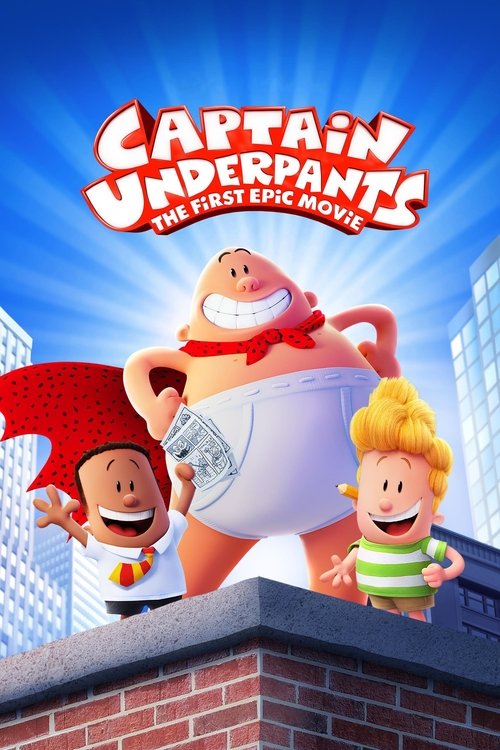
Captain Underpants: The First Epic Movie
2017 · David Soren
For family movie night when you need a guaranteed good laugh, or when you just want something zero-stress that celebrates being a goofball. Pure comfort, zero homework.
What it's about
George and Harold are fourth-grade best friends, prank masterminds, and co-authors of homemade comic books starring a superhero who fights crime in his underwear. When their joy-crushing principal threatens to split them into separate classes, they hypnotize him with a cereal-box ring — and he comes to believe he actually is their creation, Captain Underpants, just as a genuinely sinister new science teacher arrives at school.
The experience
Fast, silly, and relentlessly inventive — a barrage of potty jokes, sight gags, and fourth-wall breaks that somehow lands with real sweetness about friendship and imagination. Kids howl; adults are surprised how often they laugh too.
Performances
Ed Helms is the secret weapon, voicing both the joyless Principal Krupp and the gloriously dim Captain Underpants as two hilariously distinct people sharing one body; Kevin Hart and Thomas Middleditch make George and Harold a genuinely warm double act.
The craft
Made on a fraction of a typical studio animation budget, it turns thrift into style — bouncing between CG, flip-book gags, sock puppets, and hand-drawn comic panels whenever the boys' imaginations take over. The mixed-media playfulness honors the scrappy, kid-drawn spirit of the books better than polish ever could.
Why it matters
Proof that a modestly budgeted studio cartoon could be freer and formally bolder than its blockbuster siblings, it closed out the books' long run as a phenomenon of grade-school reading — and of library ban lists.
Snapshot
An eighty-nine-minute cartoon about two fourth-graders who hypnotize their principal into believing he is a superhero whose costume is a pair of briefs and a red curtain. Captain Underpants: The First Epic Movie is, on its face, the most disposable kind of studio product: a family comedy adapted from a children's book series best known for potty jokes and for appearing repeatedly on the American Library Association's lists of most-challenged books. It is also one of the more formally interesting American studio animated features of its decade — a film made cheaply enough to be strange, and directed with enough conviction to make the cheapness legible as style rather than compromise.
The film arrived at a hinge moment for DreamWorks Animation. Produced on a budget a fraction the size of the studio's house norm, animated largely outside the studio's own facility, and released through a distribution partnership that was about to end, it functions as a small proof-of-concept: that a CG feature could abandon the surface-density arms race — fur, cloth simulation, subsurface scattering, photoreal environments — and be funnier and more distinctive for it. Its most-cited sequence is a "Flip-O-Rama," in which the film stops being a film and becomes two drawings alternating, exactly as Dav Pilkey's books instructed children to flip pages with a thumb. That gag is the whole thesis: the movie keeps interrupting its own medium to remind you that animation is a trick performed by hand.
Industry & production
The source is Dav Pilkey's The Adventures of Captain Underpants, first published by Scholastic's Blue Sky Press in 1997 and continued across a long-running series. Pilkey has spoken frequently and publicly about inventing the character as a second-grader who was regularly sent to sit in the school hallway, and about his own childhood ADHD and dyslexia — a biography that maps directly onto the books' sympathy for disruptive children and hostility toward the adults who punish them. The books' reputation is genuinely double-sided: enormous commercial success and a durable place on lists of challenged and banned titles, cited for offensive language and for encouraging insubordination. Any adaptation was therefore adapting a controversy as well as a property.
DreamWorks Animation held the rights for several years before the film reached production, and the version that finally got made was shaped by the studio's 2015 restructuring — a round of layoffs and consolidation that closed the former PDI/DreamWorks facility in Redwood City and forced a rethink of what a DreamWorks feature had to cost. Captain Underpants was the clearest expression of the new arithmetic. It was produced for a reported budget in the high-thirty-million range, against house norms that had regularly run three to four times that, and the bulk of the animation was executed by Mikros Image (later Mikros Animation), a French-Canadian studio with facilities in Paris and Montréal, rather than in-house at Glendale.
That outsourcing is the most consequential industrial fact about the film. It reflects the broader dispersal of animation labor toward jurisdictions with favorable tax credits and lower costs — a pattern that had already reshaped visual effects and was, by the mid-2010s, arriving at animated features. It also meant the design had to be built around a pipeline that could not, and did not need to, chase photoreal complexity.
The film was released in June 2017 through 20th Century Fox, which had distributed DreamWorks Animation since 2013; it was among the last titles under that arrangement, arriving after Comcast/NBCUniversal's acquisition of the studio had closed and before Universal assumed distribution. Commercially it was a modest performer by DreamWorks standards but a profitable one relative to its cost — the low budget was precisely what made a mid-sized gross acceptable. Producing credits went to Mireille Soria and Mark Swift; Nicholas Stoller, best known for live-action comedies including Forgetting Sarah Marshall and Neighbors, wrote the screenplay and was closely involved in the film's development.
Technology
The interesting technological story here is subtractive. Contemporary CG animated features had, by 2017, largely defined their production value through simulation: hair and fur systems, cloth, fluids, global illumination, ever-denser environments. Captain Underpants opts out. Characters are built from simple, readable volumes with minimal surface detail; hair reads as a shape rather than a groom; costumes are modeled rather than simulated. Lighting is bright, high-key, and comparatively flat, with a saturated, limited palette that reads as poster art rather than as photography.
This is a technology decision disguised as an art decision, or vice versa. A pipeline that does not need to solve hair dynamics or full global illumination is a pipeline that can be run by a mid-sized studio at a fraction of the cost, and can iterate faster on the thing the film actually needs, which is comic timing. The film also mixes media freely — hand-drawn 2D for the boys' comic books, sock puppets, and craft-material sequences using felt and yarn — which in a conventional photoreal pipeline would register as a jarring rupture, but here sits comfortably alongside a CG world already tuned toward flatness and handmade texture.
The Flip-O-Rama sequence is the extreme case: the film deliberately drops to two alternating images, discarding the frame rate that is animation's basic technological premise. It is the cheapest possible animation, presented as a set piece.
Technique
Cinematography
The camera work is organized around cartoon legibility rather than cinematic realism. Compositions in the school are frontal, wide, and symmetrical — corridors and classrooms staged as flat proscenium boxes, the geometry of institutional boredom. The boys' treehouse and their imaginative flights are shot with more depth and more mobility, so that space itself becomes a measure of freedom.
Where the film does move the camera, it moves it as a gag: whip-pans that overshoot, sudden pushes into a reaction, comic-book panel wipes and split-screens that borrow directly from the source's page layouts rather than from live-action grammar. Lens choices favor short focal lengths and mild distortion, which flatters the exaggerated character designs and keeps faces enormous in frame. The camera-department credits for CG features of this scale are not consistently documented in accessible sources, and the record on this film's specific layout and lighting leads is thin; the approach, however, is unambiguous on screen.
Editing
David Ian Salter, whose credits include Finding Nemo, cut the film, and the pacing is one of its real achievements. At eighty-nine minutes it is short even by family-film standards, and it is cut aggressively — sequences are entered late and left early, exposition is frequently replaced by a smash cut to the consequence, and the film repeatedly uses the boys' narration to elide whole stretches of plot ("and then this happened") rather than dramatize them.
The editing also handles the film's mode-shifts, which are numerous: from CG to 2D comic, to sock puppets, to Flip-O-Rama, and back. These transitions are cut hard rather than dissolved, treating the change of medium as a punchline in itself. The rhythm owes more to television sketch comedy and to Stoller's live-action background than to the three-act architecture of most animated features.
Mise-en-scène / staging
Production designer Nate Wragg's world is built on a single opposition: gray institution versus color-saturated imagination. Jerome Horwitz Elementary — named, in Pilkey's books, after Jerome Lester Horwitz, better known as Curly of the Three Stooges — is rendered as a beige, right-angled, joy-suppressing box, its principal's office a bunker of confiscated toys. Against it, the treehouse of Treehouse Comix is a riot of paper, marker, and cardboard.
Character design retains Pilkey's deliberately crude line: thick contours, potato-shaped heads, eyes as dots. The film resists smoothing this into conventional CG cuteness, and the animation supports it with squash-and-stretch, held poses, and smears drawn from classic 2D practice rather than from the weight-and-inertia realism that dominates CG performance. Captain Underpants himself is the design thesis — a middle-aged man's soft, unheroic body in briefs and a curtain, staged constantly in heroic superhero poses that his physique refuses to sustain.
Sound
Theodore Shapiro, a composer whose background is largely in live-action comedy, scores the film with brass-forward Silver Age superhero pastiche, deployed with deliberate over-seriousness against the absurdity on screen. "Weird Al" Yankovic contributed the film's theme song, a piece of casting that is itself a statement of lineage: Yankovic's career is built on the same premise as Pilkey's, that parody and juvenile humor can be executed with genuine craft.
The sound design leans on cartoon-vaudeville vocabulary — boings, whistles, exaggerated impacts — and the film is unusually rigorous about the timing of its scatological gags, composing them in rhythm rather than scattering them. The joke is never merely that a sound is rude; it is that the rude sound lands on a downbeat.
Performance
Kevin Hart (George) and Thomas Middleditch (Harold) play the friendship as a genuine comic duo, with overlapping, improvisational-sounding rhythms rare in animation, where actors are typically recorded in isolation. Ed Helms carries the film's hardest assignment as both Mr. Krupp and Captain Underpants — the same voice, differentiated almost entirely by register and tempo, from clenched bureaucratic fury to open-throated idiot delight.
Nick Kroll's Professor Poopypants is played as wounded pomposity, and Jordan Peele — voicing the humorless prodigy-snitch Melvin Sneedly in the same year Get Out was released — finds a precise deadness that makes the character genuinely unsettling rather than merely irritating. Kristen Schaal rounds out an ensemble drawn heavily from American alternative comedy, which is a significant part of why the dialogue does not sound like children's-film dialogue.
Narrative & dramatic mode
The film is narrated by its protagonists directly to the audience, and it never pretends to be anything other than a constructed story. George and Harold introduce themselves, comment on the plot, argue about how to tell it, and occasionally take over the medium entirely. The title's "The First Epic Movie" is itself a fourth-wall joke about franchise ambition.
Beneath the anarchy, the dramatic engine is conventional and well-built. The inciting threat is not the villain but separation: Krupp intends to place George and Harold in different classes, which for two children whose identity is a collaborative creative partnership is an existential threat. The hypnosis is an accident of desperation, and the film's climax turns on the boys having to choose between the chaos they have created and the friendship it endangers. Professor Poopypants — whose grievance is that people laugh at his name, and whose plan is to eliminate the human capacity for humor — is a villain constructed so that defeating him is a thematic argument rather than a physical one.
Genre & cycle
It sits at the intersection of the school-comedy, the superhero parody, and the children's-book adaptation. The superhero material is timed against the peak of the Marvel-dominated 2010s: the film's joke is that a man who believes he is invulnerable and can fly, and who is neither, is funnier and more touching than one who actually is.
Within the adaptation cycle, it belongs with films that chose to preserve their source's visual identity rather than translate it into house CG style — The Peanuts Movie (2015) most directly, and further back the anarchic television-derived comedy of The SpongeBob SquarePants Movie (2004). It also belongs to the small tradition of children's films that take the child's-eye view of adult authority as fundamentally absurd, a line running from Home Alone through Matilda.
Authorship & method
David Soren came to the film from Turbo (2013), and before that from story and additional-direction work within DreamWorks, including the Madagascar films. Captain Underpants is his most personal-seeming work in the sense that its formal restlessness — the constant medium-switching, the refusal to sustain a single register — reads as an authorial choice rather than a studio template.
Nicholas Stoller's screenplay is the other decisive authorial contribution. Stoller's live-action comedies are built on relationship dynamics carried by verbal riffing, and that is what he brings here: the film's structure is an odd-couple friendship comedy with a superhero plot attached, not the reverse. Theodore Shapiro's score and David Ian Salter's cutting both work in that live-action-comedy idiom. Nate Wragg's design work is the element that keeps the film tethered to Pilkey. The collaboration is best understood as a comedy-writing sensibility imposed on an illustrator's visual world, with a director willing to let both stay visible.
Movement / national cinema
Nominally American studio animation; materially, a transnational production. The creative leadership was American, the animation labor substantially French and Canadian. This is not incidental — it is representative of how mid-2010s animation economics worked, with production dispersed toward tax-advantaged jurisdictions and mid-sized international studios taking on work that a decade earlier would have stayed in-house in California. The film is, among other things, an artifact of that restructuring.
Era / period
2017 was a crowded year in animation — Coco, Despicable Me 3, The LEGO Batman Movie, The Boss Baby, Ferdinand — and a transitional one for DreamWorks, absorbed into NBCUniversal and moving toward a leaner model. The film also lands at a specific cultural moment for its source: a decade of arguments about book challenges in American schools and libraries, in which the Captain Underpants series was a recurring test case. A film whose villain's plan is the surgical removal of humor, released into that context, is making a fairly pointed argument.
Themes
The film's central claim is that laughter is not frivolous but load-bearing — that a world stripped of it is the actual dystopia, and that the adults who police it are the ones behaving irrationally. Melvin Sneedly, a child who cannot laugh, is the film's most genuinely disturbing figure, and Poopypants is what such a child becomes.
Secondarily, the film is about creative partnership. George and Harold are a two-person publishing house; their friendship is inseparable from their work, and the threat of separation is a threat to authorship itself. There is a third, gentler strand about the interiority of unpleasant adults: Krupp is revealed as lonely rather than evil, and the film extends him a sympathy the books grant more sparingly.
Reception, canon & influence
Critical reception was substantially better than the premise led anyone to expect — broadly positive, with reviewers repeatedly noting that the film was cleverer, faster, and more formally inventive than its marketing suggested, and that it had resisted the temptation to sand down the source's vulgarity into something respectable. The recurring critical observation was that the film treats juvenile humor as a craft with rules, rather than as a lowest common denominator.
Backward: the film's lineage runs through Pilkey's books first, but its animation sensibility draws on classic American cartoon practice — Tex Avery's smears and extremes, the Three Stooges (invoked directly in the school's name) — and on the 1990s television renaissance of Ren & Stimpy and Rocko's Modern Life, which established that children's animation could be grotesque and stylistically aggressive. Its multi-media interludes have precedents in Monty Python's cutout animation and in the craft-material aesthetics of children's television. Within CG, Cloudy with a Chance of Meatballs (2009) and Genndy Tartakovsky's Hotel Transylvania (2012) had already argued for cartoon timing over physical realism.
Forward: the film's most durable influence is arguably industrial. It demonstrated that a stylized, low-cost, largely outsourced CG feature could be both distinctive and profitable, at exactly the moment the American animation industry was reconsidering the photoreal-maximalist default. It preceded Spider-Man: Into the Spider-Verse (2018) by a year and a half, and while it did not have that film's technical ambition or its cultural impact, it belongs to the same reorientation toward CG that looks drawn. DreamWorks' own later stylized work, including The Bad Guys, sits downstream of the argument Captain Underpants made first and more cheaply.
Directly, the property continued on television: Netflix's The Epic Tales of Captain Underpants ran from 2018, followed by specials including an interactive choose-your-own-adventure entry. No theatrical sequel followed, which leaves the "First" in the title as an unfulfilled joke — and, in retrospect, a fitting one for a film whose entire method was to promise more than the form could deliver and then flip the page anyway.
Reception
A warmly reviewed modest hit in summer 2017, it got a little lost in DreamWorks' shadow of bigger franchises — but it's since become a quiet 'actually, this one's great' pick, praised as one of the most faithful book-to-screen adaptations in kids' animation.
How Captain Underpants: The First Epic Movie was received, from release to now →
How to watch Captain Underpants: The First Epic Movie: what to notice on a first viewing
- Watch for the movie freezing into two alternating drawings. During a Flip-O-Rama sequence the film stops being CG animation entirely and becomes two hand-drawn images flipping back and forth, exactly like a kid's thumb on a book page. The gag reminds you that animation is a trick performed by hand.
- Compare the beige school hallways to the treehouse colors. Jerome Horwitz Elementary is built from flat, right-angled, beige boxes, while the boys' treehouse is a riot of paper, marker, and cardboard color. The two spaces argue the film's whole case without a word of dialogue.
- Listen for the same voice playing both Krupp and Captain Underpants. Ed Helms voices both characters with one voice, shifting almost entirely through register and tempo, from clenched bureaucratic fury to open-throated idiot delight. One actor's range is doing the work a costume change usually does.
- Watch Captain Underpants strike heroic poses in his soft body. The character is staged constantly in classic superhero postures that his middle-aged, unheroic physique in briefs and a curtain visibly cannot sustain. The joke is built entirely into how his body is posed, not what he says.
- Notice George and Harold talking straight to the camera. The boys introduce themselves, comment on their own story, and sometimes argue about how to tell it, breaking the fourth wall throughout the film. You are always aware this is a story two kids are actively telling you.
The whole guide to watching Captain Underpants: The First Epic Movie, with the keys for a rewatch →
Influences: the films it descends from and the films it influenced
- Monty Python and the Holy Grail (1975) — Gilliam's cutout interludes interrupt the live-action register with a visibly different physical material rather than blending into it — the exact hard-cut medium-shift logic behind the sock-puppet, construction-paper and Flip-O-Rama detours.
- Superman (1978) — John Williams' triple-tongued brass fanfare and march-trio structure is the specific object of Theodore Shapiro's pastiche, which quotes the orchestration grammar so the parody registers musically before any joke is spoken.
- Ferris Bueller's Day Off (1986) — Establishes direct-address narration as the motor of an imagination-versus-administration plot: the kid breaks frame to explain his scheme while an obsessive principal hunts him, the structure George and Harold run against Krupp.
- UHF (1989) — 'Weird Al' Yankovic's parody-as-discipline — he supplies the theme song here — and UHF's structure of abruptly interpolated fake-media segments cut hard against the plot is the same mode-shift editing rhythm.
- South Park: Bigger, Longer & Uncut (1999) — Demonstrates crudity as a formal rule rather than a shortfall: flat frontal proscenium staging, deliberately unrefined construction-paper line, and scatological material organized by rigorous musical and structural craft.
- The SpongeBob SquarePants Movie (2004) — Cuts hard between drawn animation, live action and stop-motion inside a single narrative line, treating the medium switch itself as the gag beat — plus kid-logic heroes toppling a managerial villain.
- Cloudy with a Chance of Meatballs (2009) — Built CG rigs for squash-and-stretch and extreme short-focal-length caricature instead of anatomical plausibility, making non-simulated cartoon physics a legitimate feature pipeline choice.
- Diary of a Wimpy Kid (2010) — Keeps the author's crude notebook line alive as animated marginalia inside the film rather than translating it into a polished house style — the same preservation strategy Nate Wragg applies to Pilkey's drawing.
- Hotel Transylvania (2012) — Imports Tex Avery timing into a 3D pipeline — animation stepped on 2s and 3s, drawn-style smears, wildly held extremes — proving CG could privilege cartoon timing over weight simulation.
- Turbo (2013) — Soren's own prior calibration of lens-distorted character staging and speed smears in DreamWorks CG, the caricatural wide-angle vocabulary he brings forward wholesale.
- The Lego Movie (2014) — CG constrained to obey a physical material's rules — brick joints, stepped stop-motion cadence, no simulation cheats — the same non-simulated craft-material logic as flipbook pages and sock puppets, inside the same imagination-versus-institution plot.
- The Peanuts Movie (2015) — Rigs deliberately hobbled to protect an illustrator's line: flat frontal staging and drawn-on facial features that snap between poses rather than rotating in space, the precedent for keeping Pilkey legible in 3D.
- The Mitchells vs. the Machines (2021) — Layers hand-drawn doodles, scribbled emphasis marks and hard-cut interpolated media over CG, extending the practice of letting a kid's crude drawing hand visibly deface the rendered image.
- The Bad Guys (2022) — DreamWorks' graphic-line house style — inked contours, halftone texture, stepped animation, wide-lens caricature — is the studio's formalization of the low-cost stylization Captain Underpants proved could sell.
- Dog Man (2025) — Continues the Pilkey adaptation method directly: crude line preserved through the CG render, comic-page devices staged frontally, and chapter-heading direct address structuring the narrative.
- Spider-Man: Into the Spider-Verse (2018) — Pursues the same 'CG that looks drawn' reorientation with animation on 2s, comic-panel inserts and in-frame onomatopoeia; Captain Underpants made the cheaper version of the argument eighteen months earlier.
- Teen Titans Go! To the Movies (2018) — Superhero parody constructed from the same parts — direct-address narration, deliberately flat crude character design, and Silver Age brass fanfare pastiche deployed as a structural gag rather than décor.
Similar films
- The Lego Movie (2014) — influence & lineage
- Spider-Man: Into the Spider-Verse (2018) — influence & lineage
- The Mitchells vs. the Machines (2021) — influence & lineage
- The Lego Batman Movie (2017) — shared sensibility
- Minions & Monsters (2026) — shared sensibility
- Shrek (2001) — shared sensibility
- The Incredibles (2004) — shared sensibility
- The Sheep Detectives (2026) — shared sensibility
All the films related to Captain Underpants: The First Epic Movie →