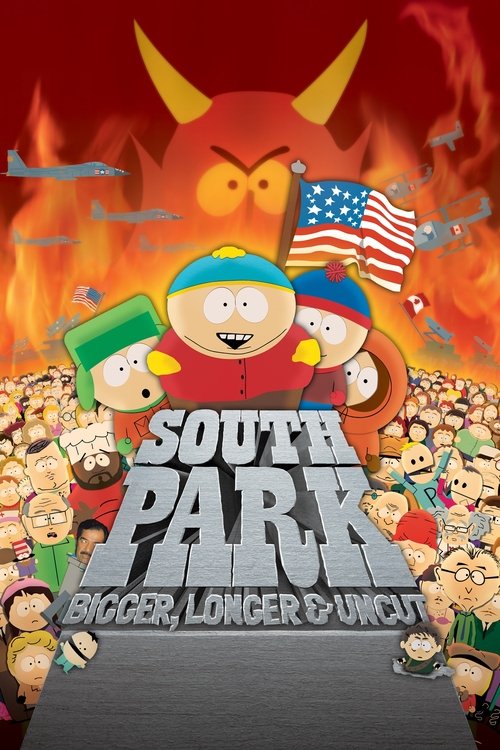
South Park: Bigger, Longer & Uncut
1999 · Trey Parker
For when you need to laugh hard at something gleefully offensive — an ideal group watch, provided nobody in the room is easily scandalized.
What it's about
The third graders of South Park sneak into an R-rated film by the ultra-vulgar Canadian TV duo Terrance and Phillip and come home with vocabularies that scandalize the town. The parents' outrage snowballs into a national censorship crusade and then an actual war with Canada — with a boy's soul, capital punishment, and the literal forces of Hell getting dragged into the escalation.
The experience
Relentlessly profane and genuinely hilarious, but the real surprise is that it's a full-blown musical — with earworm numbers staged and sung with complete conviction. It moves like a rocket and the laughs come with a sharp satirical afterburn.
The craft
The stroke of genius is structural: every obscenity is the plot — the kids swear, the adults panic, and the moral panic about the movie is the movie. The songs are the other marvel, sincere show-tune craft welded to filthy lyrics, parodying the musical form while beating it at its own game.
Why it matters
An Oscar-nominated song, a high-water mark for adult animation, and one of the sharpest censorship satires ever made — its warning about outrage politics has only aged into relevance.
Snapshot
A television spin-off that turned its own censorship into its subject, South Park: Bigger, Longer & Uncut arrived roughly eighteen months after Comedy Central's crudely animated series became a cultural event, and it took the unusual position of biting the hand that had made it profitable. Trey Parker and Matt Stone, working with co-writer Pam Brady, built the film as a full-blown musical — a form neither the series nor its audience had much reason to expect — in which four Colorado third-graders see a profane Canadian film, repeat what they hear, and precipitate a moral panic that escalates into war, capital punishment, and the literal opening of Hell.
The film's central maneuver is structural rather than merely provocative. Every obscenity in it is diegetically motivated: the children swear because they have seen an R-rated film, the parents panic because the children swear, and the panic supplies the plot. Parker and Stone thereby made the MPAA ratings process itself into narrative material, and the well-documented back-and-forth with the ratings board over the film's title and content became inseparable from its reception. Its lasting significance rests on three things: the seriousness of its musical construction, its argument about censorship as displaced parental failure, and its demonstration that a cheaply animated television property could sustain a feature that was formally more ambitious than its source.
Industry & production
South Park premiered on Comedy Central in August 1997 and became, very quickly, the network's defining asset — a series whose merchandising and ratings profile far exceeded its production budget. A feature film was a predictable next step, and Paramount Pictures took distribution, with Warner Bros. handling international release; Comedy Central's parent structure at the time placed the series and Paramount within adjacent corporate territory, which smoothed the path considerably compared to a spin-off shopped cold.
The film's budget was modest by 1999 studio standards — animation of this kind is inexpensive, and the cost sat far below live-action comedies of comparable ambition. Its commercial performance was solid rather than spectacular in domestic terms, and profitable against its cost. Precise figures circulate widely but inconsistently in secondary sources, and rather than repeat a number I cannot verify, the accurate summary is: it was a clear financial success relative to its outlay, without approaching the blockbuster tier of its release summer, which included Star Wars: Episode I and The Sixth Sense.
The production's most-discussed episode is its negotiation with the Motion Picture Association of America. Parker and Stone submitted the film repeatedly and were rejected for an NC-17 on multiple passes before securing an R. The title itself went through revision; the working title was South Park: All Hell Breaks Loose, which the MPAA objected to, and the eventual Bigger, Longer & Uncut is a double entendre the board apparently did not parse — a detail the filmmakers have recounted with evident satisfaction in interviews and which functions as a joke the finished film is in on. The rating fight is not incidental color. It is the film's own plot happening to it.
Scheduling pressure was severe. Parker and Stone were simultaneously producing the series, and the film's animation was completed on a compressed timeline that would be implausible for a conventionally animated feature. That compression is legible in the finished work — not as sloppiness, but as a deliberate embrace of the series' construction-paper aesthetic at feature scale, with the added resources going into music, orchestration, and the number of setups rather than into rendering polish.
Technology
The series began, famously, with actual construction paper — the 1992 short Jesus vs. Frosty and the 1995 The Spirit of Christmas were stop-motion cutout animation, shot frame by frame. By the time of the television series proper, production had migrated to computer software that simulated the cutout look: paper textures, visible edges, limited articulation, and flat planar compositing, all executed digitally so that assets could be reused and animated far faster than physical manipulation allowed. The studio's pipeline of the era was built around PowerAnimator and later Maya, used not to produce dimensional CG but to drive two-dimensional cutout puppets — an idiosyncratic application of high-end tools to a deliberately low-end look.
The feature retains this apparatus wholesale. There is no upgrade in fidelity, no attempt at the textural richness that the same year's Toy Story 2 was demonstrating. The technological argument of the film is that the constraint is the style, and that scaling it up means scaling up scope rather than resolution: more characters on screen, larger crowd tableaux, deeper multiplane backgrounds, and — critically — a full orchestral music production that could not have been supported by the television budget.
Widescreen framing is the one genuine format change. The series was produced for 4:3 television; the film composes for the theatrical frame, which alters how the cutout figures sit against their backgrounds and permits the horizontal ensemble arrangements that the musical numbers require.
Technique
Cinematography
There is no photography in the conventional sense — no camera, no lenses, no lighting instruments — and the film has no cinematographer of record. What it has is a synthetic camera logic, and it is more considered than the series had needed.
The house style is resolutely frontal and planar: characters face the viewer or turn in flat profile, staged in shallow layers against backgrounds that read as painted flats. The film keeps this as its baseline and then deviates for effect. The musical numbers introduce sweeping lateral moves, rising crane-equivalents, and scale shifts that the series' fixed framing rarely attempted — "Blame Canada" builds through escalating crowd compositions, and the Satan and Saddam Hussein material in Hell uses vertical staging and depth cues to establish a genuinely different spatial register from South Park's flat street-level world.
The gag depends on the gap. When the film borrows the visual grammar of the studio musical — the widening frame, the tracking sweep across a chorus, the isolated figure in a pool of implied light — it applies that grammar to figures made of construction-paper ovals. The seriousness of the framing is what makes the crudity funny, and the crudity is what keeps the framing from tipping into pastiche without a point.
Editing
Cut rhythm is the film's most underrated technical achievement. The picture runs a lean eighty-odd minutes and carries a very large amount of plot: a moral panic, a war, a death-row narrative, a resistance movement, an afterlife subplot, and roughly a dozen songs. The editing achieves this by refusing transitional material almost entirely. Scenes begin at their point and end at their punchline; establishing beats are elided; the film cuts from consequence to consequence.
The musical numbers are the exception, and the contrast is deliberate. The extended sequence that intercuts multiple characters' simultaneous solos — the film's clearest debt to the Broadway "quodlibet" or ensemble-counterpoint tradition — requires the cutting to hold each thread long enough to register while keeping the musical line continuous. That the film sustains this with cutout figures, where performance nuance is unavailable and the cut must carry all the emphasis, is a real feat of construction.
Mise-en-scène / staging
The film's spatial world is organized by a small number of contrasting registers. South Park itself is flat, pastel, and generic-suburban: identical houses, a school, a bus stop, snow. Canada is rendered as a deliberate cartoon of a cartoon — its inhabitants drawn with flapping halved heads and beady eyes, a visual joke about crudeness within a crude style. Hell is the film's one genuinely designed space, with lava, scale, and a vertical axis that the rest of the film lacks.
Within scenes, staging is theatrical: characters arrange themselves in lines facing outward, groups assemble as choruses, and crowd scenes are built by multiplication rather than individuation. This is a limitation of the technique converted into a musical asset. Cutout animation cannot do naturalistic blocking, but it can do the frontal, presentational arrangement that stage musicals have always used, and the film leans into that correspondence rather than fighting it.
Sound
Sound is where the film spends its money, and it is the element that most decisively separates it from the series. Marc Shaiman — a Broadway and film composer with an established pedigree in comic scoring — collaborated with Parker on the songs and handled orchestration and score. The result is a genuine musical score: full orchestra, layered vocal arrangements, and pastiche that is accurate enough to function as the thing it parodies.
The individual numbers are written in identifiable idioms. "Mountain Town" is a Disney-Renaissance "I want" opening in the Beauty and the Beast mold, establishing place and character before the plot arrives. "Blame Canada" is a civic-outrage production number, and it earned an Academy Award nomination for Best Original Song — a fact that says a good deal about how seriously the musicianship was taken outside the film's own comic frame. "Uncle Fucka" is a deliberately juvenile vaudeville-scatological turn placed early to set the film's terms. "Up There" is a straight-faced Menken-style villain's yearning ballad given to Satan. "La Résistance" is the ensemble counterpoint piece. The consistency of craft across these — that each one is a competent example of its target genre before it is a joke — is the score's central strategy.
The vocal performances are almost entirely Parker and Stone, and the sound mix has to distinguish a large cast rendered by very few throats. Pitch, processing, and mic placement do work that casting would normally do.
Performance
Parker and Stone voice the overwhelming majority of the speaking roles, a practice carried over from the series where it was originally a budget necessity and became a signature. The voices are heavily processed — pitch-shifted, filtered, deliberately unbeautiful — and the film does not correct this for theatrical presentation.
The performances that matter most are the sung ones, and here the film is unexpectedly disciplined. Parker sings a great deal of the score himself and does so competently; the numbers are not sung badly for comic effect. Isaac Hayes returns as Chef, bringing an actual soul-vocal instrument into a cast of cartoon voices, and the contrast is part of the joke and part of the pleasure. Mary Kay Bergman voiced the majority of the film's female characters; her death shortly after the film's release makes this among her last major work and gives the performance a retrospective weight it did not have at the time.
Narrative & dramatic mode
The film's structure is a chain of escalations, each formally reasonable and cumulatively insane. Children see a film; children swear; parents blame the film rather than themselves; parents blame the film's country of origin; a nation goes to war; the war triggers an apocalyptic prophecy. Each link is a small satirical proposition about displaced responsibility, and the film's rigor lies in never breaking the chain — the absurdity is arrived at by consistent steps, not asserted.
Against this runs a second mode entirely: the musical's emotional grammar, which the film plays largely straight. Kyle's relationship with his mother, Stan's romantic longing, Satan's abusive relationship with Saddam Hussein — these are given real melodic and dramatic seriousness. The film's tonal signature is the collision of a sincere musical with obscene content, and it does not resolve that collision. Neither register wins.
There is also a Bildungsroman skeleton: the children discover that the adults are not competent, that authority is self-serving, and that they must act. That is the oldest children's-adventure structure there is, and the film uses it unironically as its load-bearing frame.
Genre & cycle
The film sits at an intersection of three lines. It is an adult-animation feature, descending from Fritz the Cat (1972) and the Ralph Bakshi tradition, through Heavy Metal (1981), and immediately preceded in television by The Simpsons (1989–) and Beavis and Butt-Head, whose 1996 feature Beavis and Butt-Head Do America established the commercial precedent for a crude-animation TV property going theatrical.
It is also a musical, and specifically a parody-musical operating in the tradition of Monty Python and the Holy Grail and Mel Brooks — comedy that achieves its effects by executing the target form correctly. And it is a satirical film about American moral panic, a cycle with a long history that includes Dr. Strangelove (1964), whose logic of institutional escalation toward apocalypse the film reproduces almost structurally.
The late 1990s is the relevant cycle context: the aftermath of Columbine (April 1999, three months before release), the Clinton-era culture wars, V-chip legislation, and congressional attention to media violence. The film was made before Columbine but released into its aftermath, and its argument — that blaming media is a way for adults to avoid examining themselves — landed in a national conversation that was making exactly the opposite argument.
Authorship & method
Trey Parker directed, co-wrote with Matt Stone and Pam Brady, co-wrote the songs, and performed a large share of the vocals. This is unusually consolidated authorship for a studio feature, and the film is legible as a personal work in a way spin-offs rarely are. Parker's musical-theater background — evident earlier in Cannibal! The Musical (1993) and later fully realized in The Book of Mormon (2011) — is the key biographical fact. The film is not a comedy that happens to have songs; it is a musical made by someone who wanted to make musicals.
Marc Shaiman is the essential collaborator. His involvement supplied the orchestral craft that makes the pastiche land, and the working relationship produced songs that function as songs first. Stone's contribution is harder to isolate from Parker's, as their collaboration is genuinely intertwined, but the writing partnership's characteristic move — the argument that arrives at a moral position through the most offensive available route — is a joint signature.
Because the film has no cinematographer and its animation is a studio-wide pipeline product, the conventional department-head model does not map cleanly. Editing credit and animation direction sit with the South Park Studios team; the record on individual contributions within that pipeline is thinner in published scholarship than for a live-action production of comparable profile, and it would be a mistake to attribute specific choices to named individuals without documentation.
Movement / national cinema
American, and specifically American in a way the film keeps foregrounding. Its Canada is not a place but a projection — the convenient foreign body onto which domestic anxiety is displaced. The film belongs to no formal movement; if it has a lineage, it is the American satirical-comedy tradition running from Brooks and the Zucker-Abrahams-Zucker school through the alternative-comedy sensibility of the 1990s.
Its relationship to the animation establishment is adversarial. The Disney Renaissance had by 1999 established a dominant grammar for the animated musical, and this film's entire musical strategy is a détournement of that grammar — using Menken-and-Ashman structural conventions to carry content that the form was built to exclude.
Era / period
1999 is a well-noted year in American cinema, and the film's release into it is instructive. The same year produced Fight Club, Being John Malkovich, The Matrix, Magnolia, and Election — a cluster of formally restless, institutionally skeptical films. South Park belongs to that mood, arriving from an unexpected direction.
The specific period conditions matter: the tail end of the Clinton administration, an ascendant culture-war politics around media content, the Telecommunications Act's V-chip provisions, and — three months before release — Columbine, which made "violent media corrupts children" a mainstream governing assumption rather than a fringe complaint. The film's thesis was contrarian at exactly the moment it was most contrarian to hold.
It also arrives at the end of the traditional animation era. Within a few years, hand-drawn feature animation would be commercially displaced by CG. That the most formally interesting animated musical of 1999 was made of construction paper is a small historical irony.
Reception, canon & influence
Critical reception was strong and, for many reviewers, surprised. The prevailing note was that a film expected to be merely offensive turned out to be structurally sophisticated — that the songs were real songs and the satire had an argument. It appeared on a number of year-end critics' lists and drew serious critical defense, notably from writers who had not been sympathetic to the series. The Academy Award nomination for "Blame Canada" formalized the shift; the song's presence at the 2000 ceremony, performed by Robin Williams, remains the most visible institutional acknowledgment the film received. Dissent came from critics who found the vulgarity exhausting regardless of its motivation, and from advocacy groups who read the film as exactly the corrupting object it satirized.
Influences on the film run backward along three lines. The Disney Renaissance musical supplies the formal template — the "I want" song, the villain's ballad, the ensemble counterpoint, the reprise structure. Monty Python and the Holy Grail and the Brooks tradition supply the method of parody-by-competent-execution. Dr. Strangelove supplies the escalation-to-apocalypse plot logic and the satirical premise that institutions pursue catastrophe through individually rational steps. Behind all of it sits the cutout-animation tradition — Terry Gilliam's Python animations most directly, in the flat, jointed, deliberately artificial figure work.
Forward, its influence is substantial and diffuse. It legitimized the adult-animated feature as a form with real ambitions, and its commercial success helped sustain a run of television-to-theater animation projects. More significantly, it established Parker and Stone's central method — extreme offense in service of a defensible moral argument — as a repeatable and even prestigious mode, a trajectory that culminated in The Book of Mormon, whose entire structural approach (sincere Broadway craft carrying transgressive content) is prefigured here. The film also functioned as a durable text in media-effects and censorship debates, cited in discussions of the ratings system with a frequency unusual for a comedy.
Its canonical position is secure but odd. It is routinely named among the best animated films of its decade and among the strongest American film musicals of the period, while remaining a work that a substantial portion of the film-critical establishment will not discuss in those terms. That double status — formally admired, culturally quarantined — is arguably the most accurate measure of what the film set out to demonstrate.
Reception
Critics were startled in 1999 that a foul-mouthed cash-in cartoon turned out to be a genuinely great movie musical — and its stock has only risen since, now routinely called one of the best film musicals of its era, with Stephen Sondheim among its famous admirers.
How South Park: Bigger, Longer & Uncut was received, from release to now →
How to watch South Park: Bigger, Longer & Uncut: what to notice on a first viewing
- Watch how flat and frontal the characters stay in normal scenes. Characters mostly face the viewer or turn in flat profile, staged in shallow layers against painted-flat backgrounds, the show's baseline look. That flatness is the plain floor the musical numbers are about to break.
- Watch the camera sweep and rise only during the songs. 'Blame Canada' builds through escalating crowd compositions and lateral moves the flat street-level scenes never attempt, borrowing the grammar of the studio musical. Applying serious musical camerawork to construction-paper figures is exactly what makes the crudity land as funny.
- Listen for a full orchestra under each musical number. Marc Shaiman's score gives each song a full orchestra and layered vocals accurate enough to function as the genre it is parodying, not just joke music. The songs work as real songs first, which is exactly why the filthy lyrics land so hard.
- Notice how few transitions the film bothers to show you. Scenes begin at their point and end on their punchline, cutting straight from one consequence to the next, which is how a huge plot fits into eighty minutes. The missing connective scenes are what let the escalation from swear word to war feel inevitable instead of padded.
- Watch for one space with real depth: Hell. South Park itself stays flat and pastel, but Hell is built with lava, scale, and a vertical axis nothing else in the film has. Giving only the afterlife real dimension tells you which threat the film actually takes seriously.
The whole guide to watching South Park: Bigger, Longer & Uncut, with the keys for a rewatch →
Influences: the films it descends from and the films it influenced
- The Spirit of Christmas: Jesus vs. Santa (1995) — The literal construction-paper stop-motion short whose hinged, torn-edge figures and frontal planar staging the feature's Maya-based 2D puppet rig exists to simulate frame-for-frame.
- Monty Python and the Holy Grail (1975) — Gilliam's interstitial cutout animation established the jointed-paper figure with visible pivot points and abrupt collage cuts as a comic register — the exact articulation vocabulary Parker's mouths, limbs and God/Satan reveals inherit.
- Dr. Strangelove or: How I Learned to Stop Worrying and Love the Bomb (1964) — Supplies the escalation-chain architecture: a trivial local incident ratchets through institutional actors each behaving rationally until it terminates in apocalypse, with the war-room/military-briefing scene as recurring structural node.
- The Little Mermaid (1989) — Ashman-Menken's 'I want' song ('Part of Your World') is the exact template Cartman's 'Kyle's Mom's a Bitch' inverts and Satan's 'Up There' plays straight — same key change, same longing-upward staging on a vertical axis.
- Beauty and the Beast (1991) — The town-introduction opening number ('Belle'), with its walking tour, overlapping townsfolk verses and reprise payoff, is the structural model for 'Mountain Town' down to the protagonist-threading-through-the-square blocking.
- West Side Story (1961) — The 'Tonight' quintet — separate parties singing incompatible melodies simultaneously toward a shared catastrophe — is the ensemble-counterpoint device 'La Résistance' executes with full orchestral craft rather than as gag.
- The Producers (1967) — 'Springtime for Hitler' proves the load-bearing method: stage the transgressive number with genuine production-number competence — real choreography, real orchestration — so the offense lands through craft rather than despite it.
- Blazing Saddles (1974) — Parody-by-correct-execution of a studio idiom (Tiomkin-style main title, Marlene Dietrich-pastiche torch number) combined with deliberately infantile vulgarity as satirical instrument — the campfire scene's logic is 'Uncle Fucka's.
- Fritz the Cat (1972) — Invented the commercial proposition Parker exploits: an X-rated animated feature released theatrically to adults, using flat limited animation rather than full animation, with the rating itself as marketing and provocation.
- Cannibal! The Musical (1993) — Parker's own prototype — earnest Rodgers-and-Hammerstein pastiche (a genuine 'I want' opener, a trotting traveling song) carrying grotesque content, establishing that he writes musicals first and comedy second.
- Beavis and Butt-Head Do America (1996) — The immediate precedent for scaling a deliberately crude, thick-line TV animation style to 2.35:1 without cleaning it up, and for building the feature as a national escalation chain around two vocally-doubled leads.
- Team America: World Police (2004) — Ports the method to Supermarionation: an obsolete artificial figure technique kept visibly artificial, a Broadway-grade song score played straight, and the same escalation from a local provocation to a staged geopolitical apocalypse.
- The Simpsons Movie (2007) — The clearest inheritor of the widescreen-conversion problem — a flat TV design given synthetic camera moves and a CG-assisted depth axis — plus the town-quarantined-by-federal-overreach escalation plot South Park had already run.
- Sausage Party (2016) — Opens with a full Menken-composed Disney-style ensemble production number as the explicit delivery vehicle for transgression — the exact 'Mountain Town' gambit, credentialed by hiring the composer being parodied.
- Captain Underpants: The First Epic Movie (2017) — Demonstrates crudity as a formal rule rather than a shortfall: flat frontal proscenium staging, deliberately unrefined construction-paper line, and scatological material organized by rigorous musical and structural craft.
- Orgazmo (1997) — Parker's NC-17 fight with the MPAA over this film is the direct production source of the ratings-board satire; both films run the same argument that classification bodies police vocabulary while ignoring violence.
- Hairspray (2007) — Marc Shaiman's other pastiche score: the same working method of writing period-idiom numbers that survive as actual songs outside their comic frame, with the orchestration doing the sincerity the lyrics undercut.
- Enchanted (2007) — Menken parodying the Disney Renaissance idiom he built — 'Happy Working Song' and 'That's How You Know' deploy the same authentic-craft-as-parody principle, staged as ensemble numbers that function straight while reading as satire.
- Bowling for Columbine (2002) — Its construction-paper cut-out animation idiom is the direct stylistic source for the 'Brief History of the United States' segment, which lampoons American fear in the same crude-cutout satirical register.
- Jim Queen and the Quest for Chloroqueer (2026) — High-concept satirical feature that weaponizes crude cartoon exaggeration against a moral-panic/epidemic scenario, escalating a public-health premise into total social farce.
Similar films
- Blazing Saddles (1974) — influence & lineage
- Dogma (1999) — shared sensibility
- Buddy (2026) — shared sensibility
- Jim Queen and the Quest for Chloroqueer (2026) — shared sensibility
- Bowling for Columbine (2002) — shared sensibility
- Shrek (2001) — shared sensibility
- The Lego Movie (2014) — shared sensibility
- Toy Story 3 (2010) — shared sensibility
All the films related to South Park: Bigger, Longer & Uncut →