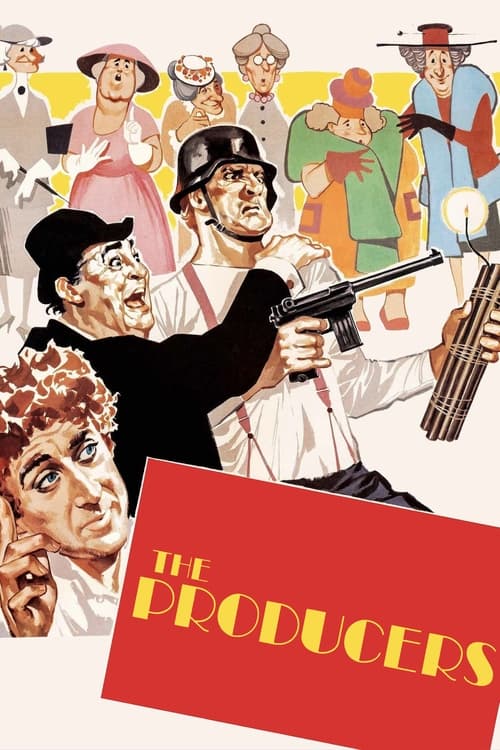
The Producers
1968 · Mel Brooks
When you need a good laugh and want it outrageous — comedy as a dare, best watched with other people so you can gasp together. Pure comfort for anyone whose comfort includes bad taste.
What it's about
A washed-up Broadway producer keeps afloat by romancing wealthy old widows out of their savings — until his timid accountant stumbles on a loophole: with creative bookkeeping, a producer could make more from a flop than a hit. So the two set out to stage the worst play ever written, a tasteless musical valentine to Adolf Hitler, oversell the shares, and wait for it to close in one night. Scheming this dumb, of course, has a way of misfiring.
The experience
Loud, shameless, and gaspingly funny — a farce that keeps escalating past the point where you think it can. Half the pleasure is watching two desperate men egg each other into catastrophe; the other half is disbelief at what the film gets away with.
Performances
Zero Mostel is a force of nature as Bialystock, sweating and scheming at maximum volume, while Gene Wilder's Oscar-nominated turn as the hysterical, blanket-clutching Leo Bloom is one of the great neurotic performances in comedy.
The craft
Mel Brooks's Oscar-winning script builds like clockwork farce — every absurd premise paying off bigger later — and the centerpiece production number is one of the most audacious set pieces ever staged in a comedy. Shot cheaply in New York, it puts every dollar into performance and timing rather than polish.
Why it matters
Brooks's directing debut and a landmark of taboo-breaking comedy — it tested what could be laughed at barely two decades after the war, launched one of American comedy's great careers, and decades later became a record-breaking stage musical.
Snapshot
Mel Brooks's first film as director is a chamber farce with a detonator inside it. A washed-up Broadway producer, Max Bialystock (Zero Mostel), survives by seducing wealthy widows for investment checks; his neurotic auditor, Leo Bloom (Gene Wilder), notices in passing that under creative accounting a producer could make more money from a flop than from a hit — provided the show closes fast and nobody audits the oversold shares. The two set out to mount the worst play ever written, a musical valentine to Adolf Hitler penned by an unreconstructed Nazi living on a Manhattan rooftop with his pigeons. The show is a hit. They go to prison and start selling shares in the prison show.
Roughly ninety minutes long, shot cheaply in New York outside the studio system, and released into a culture still deciding what could be said aloud about the Nazi period, The Producers is at once a two-hander of enormous performative appetite, a backstage-musical parody, and an argument about comedy itself: that ridicule is the one weapon that reduces a tyrant to nothing. Brooks won the Academy Award for original screenplay for it — the only competitive Oscar of his filmmaking career — and Wilder was nominated in the supporting category. The film's commercial life was modest and its critical reception divided; its canonization was slow, arriving through repertory houses, television, and finally a Broadway adaptation that turned the joke into an institution.
Industry & production
The film belongs to a specific late-1960s American condition: the major studios were losing their grip, and a picture with no stars of the first magnitude and an unsellable premise could be assembled independently in New York and pushed out through a distributor with a taste for risk. Producer Sidney Glazier — who had come off the Oscar-winning documentary The Eleanor Roosevelt Story (1965) — backed Brooks's script when the material had already been turned down elsewhere; financing and distribution came through Joseph E. Levine's Embassy Pictures, the outfit that had made its reputation importing and hard-selling films rather than manufacturing them.
Brooks has consistently described the project as one that changed form before it found its medium: conceived first as a novel, then as a play, and only then as a screenplay. Its raw material came from his own proximity to the Broadway margins — the small-time producers who financed shows on the affections of elderly investors. The title was a casualty of the distribution logic: Levine judged that exhibitors would not put Springtime for Hitler on a marquee, and the film was renamed for its two protagonists, a piece of commercial timidity that inadvertently gave the picture its cooler, more clinical frame.
Production was a New York affair, mixing Manhattan location work — the Lincoln Center plaza and its fountain, the Bialystock office, rooftops — with interior stage work, on a schedule and budget that left no margin for indulgence. Accounts from the shoot describe friction between Brooks, a first-time director with an unyielding sense of his own material, and Mostel, a stage titan of formidable will who had reportedly to be persuaded into the part at all. The picture had a regional test engagement in late 1967 before going into general American release in 1968, and its early commercial performance was unspectacular. Word of mouth did the work distribution could not: the actor Peter Sellers, having seen it privately, took out trade-press advertising championing the film, an intervention widely credited with giving the release a second wind.
Technology
Technically the film is unassuming by design: 35mm, color, spherical lenses, standard widescreen framing — the ordinary industrial toolkit of the period, deployed without any of the formal restlessness that marked the American films arriving around it. The relevant technological context is less about equipment than about two adjacent systems. The first is television. Brooks's craft was formed in the live and near-live comedy of the 1950s, where a sketch was covered efficiently so that performers could sustain an unbroken run of playing; that logic governs much of The Producers, where the camera's job is to stay out of the way of two actors detonating in a small room.
The second is the regulatory apparatus. The film was made and released as the Production Code collapsed and just before the MPAA ratings system replaced it in late 1968. Its casual profanity, its frank grotesquerie about sex and money, and above all its willingness to stage Hitler as a light-entertainment property were possible in a narrow window when the old prohibitions had lost their force and the new labeling regime had not yet organized transgression into marketable categories.
A third technological fact shaped the film's afterlife rather than its making: The Producers built its reputation on television broadcast, repertory revival, and home video, formats in which a cult can accumulate across decades without theatrical returns. Its restoration and reissue history is substantially a function of the 2001 stage musical and the 2005 film derived from it, which retroactively made the 1968 original a catalog asset.
Technique
Cinematography
Joseph Coffey's photography is functional in the most deliberate sense: bright, flat, evenly lit, closer to the visual grammar of television comedy than to the shadowed, grainy naturalism then fashionable in New York filmmaking. (The biographical record on Coffey is thin, and it would be invention to claim more of his background than that he worked in the New York production milieu of the period.) The camera holds still for long stretches, framing Mostel and Wilder in two-shots that refuse to cut away from an escalation, and the deep, saturated color is used for comic ugliness — Bialystock's cardboard-belt shabbiness, De Bris's townhouse, the neon garishness of the Broadway strip.
Against this baseline, two set-pieces break format. The Lincoln Center fountain sequence lets the water surge in synchrony with Bloom's decision, the one moment where the image goes frankly lyrical. And the "Springtime for Hitler" number abandons the flat coverage entirely for a full-scale musical staging, culminating in an overhead kaleidoscope shot of chorus dancers revolving into a swastika — a direct citation of Busby Berkeley's geometric abstractions of the 1930s, repurposed as an obscenity. The gag is structural: the film's visual competence rises precisely when its taste collapses.
Editing
The editing is the film's most consequential craft contribution, and it is unusually well documented because the editor wrote about it. Ralph Rosenblum — whose credits include The Pawnbroker and A Thousand Clowns, and who would go on to cut Annie Hall — devoted a chapter of his memoir When the Shooting Stops... the Cutting Begins (1979, with Robert Karen) to The Producers. By his account he inherited a troubled assembly from a first-time director and rebuilt the picture's shape in the cutting room, arguing Brooks out of material and into structure.
The result is visible in the film's rhythmic strategy. Dialogue scenes are allowed to run: cutting is sparse, and the comedy is carried by performance duration. Then, at the premiere of Springtime for Hitler, the film switches into aggressive intercutting between the stage number and the faces of the paralyzed audience — jaws slack, programs lowered — so that the joke is relocated from the spectacle to its reception. That montage is the hinge of the entire film: it converts an offensive number into a study of how an audience decides what it is watching.
Mise-en-scène / staging
The film is organized around three enclosed worlds, each staged as a small theater. Bialystock's office is a monument to failure — peeling grandeur, a couch, a desk, the mounted evidence of past flops — and it functions as a proscenium for Mostel's performance. Franz Liebkind's rooftop, with its pigeon coop, helmet, and armband, is a fascist diorama absurdly transplanted to Manhattan. Roger De Bris's townhouse, where the director receives in an evening gown attended by his assistant Carmen Ghia, is a set-piece of high theatrical camp, staged in the mid-1960s vocabulary that Susan Sontag had recently named — and rendered here in broad, stereotyped strokes that are among the film's most obviously dated elements.
The pattern of the staging is a comic ascent from squalor to spectacle: shabby office, cramped rooftop, gilded townhouse, and finally the full Broadway stage. The physical scale of each environment increases in exact proportion to the scheme's moral degradation.
Sound
John Morris — who would score nearly all of Brooks's subsequent films — provides the orchestral fabric, but the crucial songs are Brooks's own: he wrote the words and music for "Springtime for Hitler" and for "Prisoners of Love," the prison-yard finale. The choice matters. Brooks does not parody a bad show tune from outside; he writes a genuinely accomplished one, with a competent march, a sincere ballad structure, and lyrics whose cheerfulness is the entire outrage. Alan Johnson's choreography works the same way, executing Berkeley's idiom straight.
Elsewhere the soundtrack is built on human noise: Mostel's roars and wheedling coos, Wilder's characteristic modulation from a strangled whisper into full-throated hysteria, Kenneth Mars's clotted Bavarian consonants, the pigeons, and the peculiar hush that falls over the theater audience once the number begins. The film's most effective sound cue is silence — the several seconds of collective shock before anyone in the fictional audience decides to laugh.
Performance
The Producers is fundamentally a performance film, and its central pairing is a study in opposed comic scales. Mostel, a giant of the Broadway stage whose career had been broken and rebuilt after the anti-Communist blacklist of the 1950s, plays Bialystock outward — bulging eyes, sweat, physical seizure, a Yiddish-theater and burlesque expansiveness that treats the camera as a balcony to be reached. Wilder plays Bloom inward, in a register of contained terror that detonates without warning; the blue security blanket and the "I'm hysterical" aria remain his defining early screen work, and the role effectively launched a film career that Brooks would build much of the next decade around.
The supporting playing is deliberately outsized: Kenneth Mars's Liebkind as an unassimilated true believer, Christopher Hewett's De Bris and Andréas Voutsinas's Ghia as a camp double act, Dick Shawn's Lorenzo St. DuBois — "L.S.D." — as a counterculture caricature who wins the part of Hitler by being the only auditioner too stoned to take it seriously, Lee Meredith's Ulla as a pure object of farce, and Estelle Winwood among the ranks of Bialystock's investors. The film's method is to let each of these turns run to the end of its idea rather than trimming for pace.
Narrative & dramatic mode
The screenplay's engine is a piece of impeccable comic logic: if a producer sells more than a hundred per cent of a show and the show closes immediately, no investor asks for an accounting. The premise inverts the caper film — the heist here is a deliberate failure — and then inverts itself again when the failure succeeds. That double reversal gives the film a shape rare in farce: an ironic structure in which the protagonists' catastrophe is caused by an audience being cleverer, or at least more permissive, than they were.
The mode is theatrical rather than cinematic. Long scenes of two men negotiating in a room; escalation by verbal aggression; a seduction plot in which Bialystock's courtship of Bloom is played, unmistakably, as a romance — pursuit, resistance, capitulation, a honeymoon of spending, betrayal, reconciliation in a prison cell. The trial and coda close the loop by refusing moral resolution: the pair are convicted, and immediately begin overselling Prisoners of Love to the inmates. The joke is eternal recurrence — the con is not a lapse but a temperament.
Genre & cycle
The film sits at the intersection of three lines. It is a backstage musical parody, borrowing the 1930s architecture of rehearsal, opening night, and triumph, and corrupting each beat. It is a confidence-man comedy in a tradition running from Gogol through Ilf and Petrov — a lineage Brooks made explicit by adapting The Twelve Chairs as his next film. And it belongs to the 1960s cycle of American black comedy that had been opened by Dr. Strangelove (1964) and extended by The Loved One (1965), and that would continue through M\A\S\H and Catch-22* (both 1970): films that treated mass death, institutional authority, and national piety as legitimate comic material.
What distinguishes Brooks within that cycle is register. Kubrick's satire is cold and architectural; Brooks's is hot, vulgar, and rooted in the Jewish-American vernacular comedy of the Catskills resorts, the Yiddish stage, and the postwar television writers' room. The Producers is black comedy performed at the volume of burlesque.
Authorship & method
Brooks arrived at directing from writing. He had served as a combat engineer in the European theater in the Second World War, then written for Sid Caesar's Your Show of Shows and Caesar's Hour alongside a generation of American comedy writers; improvised the 2000 Year Old Man routines with Carl Reiner; co-created the spy parody Get Smart with Buck Henry; and won an Academy Award for the animated short The Critic (1963). Every one of those forms leaves a mark here: the sketch structure, the improvisatory verbal riffing, the parodic relation to a genre's conventions, the taste for a single idea pushed past endurance.
His stated method regarding Hitler has been consistent across decades of interviews, and it is the film's governing principle: one cannot defeat such a figure with argument or solemnity, but one can strip him of power by making him ridiculous. Comedy, in this account, is a form of revenge available to the powerless.
The key collaborators shaped what that principle became on screen. Rosenblum's cutting gave the material its architecture. Morris's orchestrations gave the fake show real production value, which is what makes the parody land. Alan Johnson's choreography committed to Berkeley without a wink. And the casting of Mostel — an actor whose own career had been damaged by a political inquisition — as the man who sells Hitler for profit adds a layer of historical irony the film never mentions.
Movement / national cinema
The Producers is an American independent production made in New York in the same eighteen months as Bonnie and Clyde and The Graduate, and it is instructive precisely because it is not a New Hollywood film. It borrows nothing from the European art cinema that was reorganizing American style — no jump cuts, no ambiguity, no cool. Its lineage runs instead through vaudeville, the Broadway musical, the Marx Brothers, and live television.
Nationally, it is a landmark of American-Jewish cultural self-expression at a moment of unusual visibility, arriving between Lenny Bruce's transgressive stand-up, Fiddler on the Roof on Broadway, and Philip Roth's Portnoy's Complaint (1969) — works that moved Jewish idiom, anxiety, and historical memory from the margins of American culture into its commercial center, and did so partly by refusing decorum.
Era / period
The film's context is the American late 1960s in its full contradiction: Vietnam, the counterculture that Dick Shawn's character crudely caricatures, and a rapid liberalization of what screen comedy could touch. Just as important is the state of Holocaust memory. The Eichmann trial of 1961 and Hannah Arendt's Eichmann in Jerusalem (1963) had pushed the subject into mainstream Western discourse; the 1967 Arab–Israeli war had raised its temperature further. The Producers was made in the first period when the Nazi past was simultaneously public knowledge and not yet a codified zone of solemnity — which is why the film's central provocation reads as reckless rather than merely offensive. Twenty years earlier the subject was too raw for the marketplace; some decades later, the protocols around its representation had hardened.
Themes
The film's deepest subject is not Hitler but taste — specifically, the impossibility of controlling how a work is received. Bialystock and Bloom fail because their audience decides the show is satire. That is a joke about interpretation with real teeth, and it doubles as the film's own defense: the same ambiguity that ruins the characters licenses Brooks.
Around that core cluster several others. Money as the engine of art: theater is presented not as a temple but as a mechanism for converting affection, fraud, and sexual transaction into capital. Failure as a business model, and by extension the American faith that any position, including catastrophe, can be arbitraged. Desire and coupling: the Bialystock–Bloom relationship is the film's genuine love story, complete with liberation — Bloom's account-ledger life cracked open by a man who tells him he can be a producer. And blasphemy as therapy: laughter is offered as the only available act of retaliation against an evil too large for any proportionate response.
Reception, canon & influence
Contemporary reviews were sharply divided. A significant strand of criticism found the film crude in execution and repellent in subject, objecting both to its technical looseness and to the premise itself; another found it the funniest American film in years. The Academy's screenplay award and Wilder's supporting-actor nomination gave it institutional legitimacy that the box office did not, and the picture's commercial rescue owed much to advocacy — Sellers's trade advertisement most famously — rather than to studio marketing. It was, in the strict sense, a slow-burning cult film before it was a classic.
Its backward influences are legible. Chaplin's The Great Dictator (1940) and Lubitsch's To Be or Not to Be (1942) established the terms of anti-Nazi comedy, and Brooks's relation to the latter was later made explicit when he starred in and produced the 1983 remake. Berkeley's overhead musical geometry supplies the "Springtime" staging; the Marx Brothers supply the model of anarchy loosed inside a cultural institution; the Yiddish theater and Borscht Belt supply the performance scale; and the con-artist novel supplies the plot mechanics.
Forward, its consequences are considerable. It established Brooks as a director and inaugurated a decade of American genre parody that peaked with Blazing Saddles and Young Frankenstein (both 1974) and shaped a whole subsequent industry of spoof filmmaking. It launched Gene Wilder's screen career and, through him, a line of comic performance built on the sudden fracture between meekness and rage. It licensed a generation of comedy — from National Lampoon and the early Saturday Night Live through to South Park and Curb Your Enthusiasm, the latter of which built a full season arc around Larry David being cast as Bialystock on Broadway — in which offense is the mechanism rather than the failure.
The most concrete measure of its canonization is its second life. Selected for the Library of Congress's National Film Registry in 1996 and later ranked among the top entries on the American Film Institute's list of the hundred funniest American films, it was adapted by Brooks and Thomas Meehan into a stage musical directed and choreographed by Susan Stroman, which opened on Broadway in 2001 and swept the Tony Awards in record numbers; a film version of that musical followed in 2005. The trajectory is the film's final irony, and one it anticipated: a work about a Hitler musical too offensive to succeed became a Hitler musical that succeeded beyond any measure its own characters could have imagined.
A Deleuzian reading
A program comes down.
The full Deleuzian reading of The Producers →
Reception
Critics in 1968 were genuinely split — plenty found the central gag in appalling taste and reviews ranged from rapturous to disgusted — yet Brooks walked off with the Best Original Screenplay Oscar, and the film has since hardened into consensus comedy canon, complete with a National Film Registry spot and a Broadway afterlife that re-canonised it all over again.
How The Producers was received, from release to now →
How to watch The Producers: what to notice on a first viewing
- Notice how each setting grows grander as the scheme escalates. Bialystock's shabby office, Liebkind's cramped rooftop, De Bris's gilded townhouse, and finally the full Broadway stage rise in scale exactly as the con gets worse. The physical scale of each room tracks the moral scale of the scheme.
- Watch Mostel play everything outward and Wilder play everything in. Mostel plays Bialystock with bulging eyes and physical seizure, a burlesque expansiveness aimed at the back row, while Wilder's terror stays contained until it detonates. Two opposite comic scales are set directly against each other in the same room.
- Notice how long the camera holds on two men talking. Cutting stays sparse through the dialogue scenes, letting Mostel and Wilder's escalation play out in extended two-shots rather than being chopped up for pace. The comedy comes from duration, not from quick editing tricks.
- Listen for the silence before the audience decides to laugh. Several seconds of collective shock sit on the soundtrack before anyone in the fictional theater audience commits to a reaction, and the film lets that silence run. Silence here is doing more comic work than any punchline could.
- Watch the fountain surge right when Bloom makes his choice. At Lincoln Center the water rises in sync with Leo Bloom's decision to join the scheme, the one frankly lyrical shot in an otherwise flatly lit film. The world briefly does the acting a timid man can't quite do himself.
The whole guide to watching The Producers, with the keys for a rewatch →
Influences: the films it descends from and the films it influenced
- The Great Dictator (1940) — Established the burlesque-impersonation grammar Brooks hands to Dick Shawn's L.S.D. — Hitler rendered powerless by being played as a preening physical clown whose body betrays him, with the dictator's own oratory cadence turned into nonsense vocal music.
- To Be or Not to Be (1942) — Supplies the structural device of a working theater company whose backstage vanity and onstage Nazi impersonation are the same machine, so that the play-within-the-film's success or failure drives the plot rather than decorating it — Brooks acknowledged the debt by producing and starring in the 1983 remake.
- Duck Soup (1933) — Model for anarchy loosed inside a cultural institution and for Mostel's playing scale: dialogue delivered outward at burlesque volume, with the camera holding flat and frontal rather than cutting to protect the joke, so the performer's stage energy survives intact on film.
- Footlight Parade (1933) — Berkeley's overhead kaleidoscope geometry — chorus bodies abstracted into rotating patterns shot from a hole in the stage roof — is quoted without irony in the 'Springtime for Hitler' swastika formation, the parody landing precisely because Alan Johnson's choreography and the crane setup are executed straight.
- A Funny Thing Happened on the Way to the Forum (1966) — Immediate precedent for filming Zero Mostel: the Yiddish-theatre/burlesque instrument — sweat, wheedling asides, sudden pivots to conspiratorial address — captured by giving him room in the frame and letting a take run past the point where a film comedy would normally cut.
- A Thousand Clowns (1965) — Ralph Rosenblum's prior job on a stage-bound comedy that he restructured in the cutting room, inventing montage passages to give a talky two-hander architecture and rhythm — the same editorial rescue he performs on the reaction-shot montage of the 'Springtime' premiere audience.
- The Fortune Cookie (1966) — The corrupting two-hander template: a voluble schemer talks a passive, morally squeamish partner into a fraud, played in long sustained scenes in enclosed rooms where the comedy is the slow erosion of the innocent's resistance rather than any gag.
- A Night at the Opera (1935) — Stages its climax as catastrophe inside a formal cultural ritual before a paying audience — the sabotaged-performance finale codified here — with the theater's own conventions of decorum doing the comic work.
- The Twelve Chairs (1970) — Brooks immediately re-runs the greed two-hander — a fallen grandee and a young opportunist bound by a scheme — keeping the refusal of moral resolution and the Mostel-scale performance, but swapping enclosed theatrical spaces for picaresque location work.
- Blazing Saddles (1974) — Scales the film-within-a-film logic to a whole genre: the parody is built by reproducing the target's production values exactly — Morris-style scoring, real Western staging — then rupturing them, and it repeats the Wilder function of a quiet man attached to a loud operator.
- Young Frankenstein (1974) — Perfects the debt to Gene Wilder discovered here — the sudden fracture between meek diffidence and full-throated shrieking rage — and formalizes Brooks's rule that parody must commit to the original's craft, going so far as to shoot in black-and-white on Kenneth Strickfaden's surviving 1931 lab equipment.
- To Be or Not to Be (1983) — Directed by the choreographer of 'Springtime for Hitler' and produced by Brooks, it closes the loop by rebuilding Lubitsch around a full production number, treating the Nazi-impersonation plot as material for staged musical spectacle rather than drawing-room wit.
- Waiting for Guffman (1996) — Inherits the backstage-musical parody's hardest requirement: the terrible show must be staged with total sincerity, written, choreographed and photographed as if it were good, so that the humiliation of the performance plays in real time on an audience's faces in reaction shots.
- South Park: Bigger, Longer & Uncut (1999) — Builds its comedy on the 'Springtime' principle that a fully orchestrated, structurally correct Broadway production number is the most efficient delivery system for material designed to be unspeakable — including its own singing, dancing Hitler-adjacent villain in Satan's power ballad staging.
- Jojo Rabbit (2019) — Applies Brooks's stated method directly — you cannot defeat the figure with argument, only by making him ridiculous — with the director himself playing Hitler as a fatuous imaginary vaudevillian, the performance pitched as impersonation-of-an-impersonation rather than as characterization.
- Bamboozled (2000) — Supplies the show-within-a-show mechanics — a program engineered to be maximally offensive and to fail, which instead becomes a runaway hit, driving Bamboozled's 'Mantan: The New Millennium Minstrel Show' plot.
- Watership Down (1978) — Zero Mostel's broad Yiddish-theater attack — the barked consonants, the elongated vowels, the comic tempo built for a house of 1,200 — is imported intact as Kehaar's vocal performance, deliberately unassimilated to the underplayed British stage ensemble around him so the gull registers as a foreign body in the warren.
- Take the Money and Run (1969) — The other Rosenblum-edited debut by a TV sketch writer turned director, assembled the same way: shapeless sketch footage given a spine in the cutting room by an editor who imposed structure and cut for comic duration rather than coverage.
- Where's Poppa? (1970) — Brooks's *2000 Year Old Man* partner applies the same principle that offense is the mechanism and not the failure — Jewish-neurotic hysteria escalated past the point of taste, with the camera staying flat and uninflected so the audience has no stylistic cue telling them it's safe to laugh.
- The Front (1976) — Extends the casting-as-argument move Brooks made by hiring Mostel — an actor whose career was wrecked by a political inquisition — placing him and other blacklisted performers on screen as blacklist victims so that the biography of the body in frame carries meaning the script never states.
- Dirty Rotten Scoundrels (1988) — Carries forward the inverted-caper architecture — a con-man two-hander whose comedy is the double reversal that leaves the swindlers unpunished and unreformed — with the mismatched pairing of a florid old operator and a hysterical younger amateur as its engine.
Similar films
- The Great Dictator (1940) — influence & lineage · same viewing thread
- To Be or Not to Be (1942) — influence & lineage · same viewing thread
- Duck Soup (1933) — influence & lineage · same viewing thread
- Blazing Saddles (1974) — influence & lineage
- Cabaret (1972) — same viewing thread
- The Graduate (1967) — often watched together
- Sunset Boulevard (1950) — often watched together
- Moulin Rouge! (2001) — often watched together
All the films related to The Producers →
Watch it with: curated runs of related films
- Comedy Declares War on Fascism — A run of satires and cabaret turns that meet tyranny with ridicule — watch these together to see performers puncture dictators and expose the void behind the uniform.