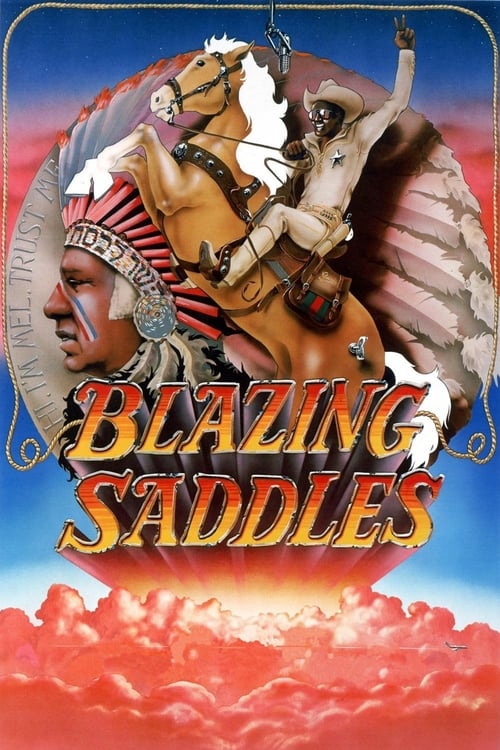
Blazing Saddles
1974 · Mel Brooks
For when you need to laugh hard — a rowdy group-viewing pick or a solo pick-me-up, best approached with a tolerance for comedy that goes deliberately, pointedly too far.
What it's about
The railroad needs to run through Rock Ridge, so scheming attorney general Hedley Lamarr hatches a plan to empty the town: appoint Bart, the first Black sheriff in the West, and let the citizens' bigotry do the rest. Bart — quicker and cooler than everyone around him — teams up with Jim, a washed-up gunslinger drying out in his jail cell, and takes the town, the plot, and eventually the movie itself apart.
The experience
Anarchic, joke-a-second, and gleefully vulgar, with a fourth wall that doesn't so much break as collapse entirely — it's the rare comedy that's still genuinely shocking and still genuinely funny. Some gags land in your gut before your brain catches up to what they're saying about racism.
Performances
Cleavon Little's unflappable cool is the engine of the whole film, Gene Wilder brings unexpected sweetness as the Waco Kid, Madeline Kahn earned an Oscar nomination for her exhausted saloon chanteuse, and Harvey Korman's preening villain steals every scene he can carry.
The craft
Mel Brooks wrote it with a team that included Richard Pryor, and the script's secret is fluency: it knows the Western's every convention cold, which is what lets it dismantle them so precisely. The escalating chaos of the final act is one of the boldest structural jokes ever put in a studio comedy.
Why it matters
One of the biggest comedy hits of its decade, it set the standard for genre parody and remains a permanent reference point in arguments about what comedy is allowed to do with race.
Snapshot
Blazing Saddles is the film in which the American Western, having spent seven decades constructing a national myth, is compelled to sit still while a comedian reads its own dialogue back to it in a voice it cannot control. Mel Brooks's third feature as director — arriving in February 1974, ten months before Young Frankenstein completed the most commercially remarkable single year of his career — takes the frontier town, the black-hatted land grabber, the drunk gunfighter, the saloon chanteuse, and the arriving lawman, and leaves each structurally intact while poisoning the assumptions that made them legible. The town of Rock Ridge needs a sheriff; the Attorney General Hedley Lamarr, wanting the land for the railroad, sends a Black man in the expectation that the citizens will collapse in outrage. They do. And then, over the course of ninety-three minutes, the film uses that outrage as its engine, its subject, and its punchline.
What separates the film from parody as a formal exercise is that Brooks and his co-writers — Andrew Bergman, whose original story and screenplay ("Tex X") began the project, along with Norman Steinberg, Alan Uger, and Richard Pryor — treat the Western's racial silence as the genre's constitutive lie rather than as one detail among many. The frontier was built by Black cowboys, Chinese railroad labor, and Indigenous people whose land it was; the Western as Hollywood practiced it had largely erased all three. Blazing Saddles puts the erasure onscreen and makes the townspeople say the word, repeatedly, in the flat unembarrassed register of people who have never been asked to justify themselves. Cleavon Little's Bart absorbs it with a performance of tactical composure — he is the only person in the film who is never confused — and Gene Wilder's Jim, the alcoholic ex-gunslinger called the Waco Kid, becomes his ally not through a conversion arc but because he has already seen enough of the frontier's inhabitants to have lost interest in defending them.
The film ends by demolishing its own containment: the climactic brawl bursts through the wall of the Warner Bros. backlot into an adjacent musical soundstage, then into the studio commissary, then onto Hollywood Boulevard, where Bart and Jim watch the premiere of Blazing Saddles before riding into the sunset in a chauffeured car. This is not a gag appended to a satire. It is the satire's conclusion: the Western is not a place, it is a production, and the only way out of a myth is out of the frame.
Industry & production
The project originated with Andrew Bergman, then a young writer whose story and script — under the title "Tex X," a pun on Malcolm X — reached Brooks and was optioned. Brooks assembled a writers' room around it, an approach carried over from his television apprenticeship on Your Show of Shows and its successors, where comedy was generated collectively and loudly. The room included Bergman, Norman Steinberg, Alan Uger, and Richard Pryor. Pryor's contribution is the most historically consequential and the most frequently discussed: Brooks has said in interviews over the years that Pryor was his choice to play Bart, and that the studio would not insure or approve him. The precise mechanics of that refusal are the kind of detail that varies between retellings, and the record on internal Warner Bros. deliberations is thinner than the anecdote's familiarity suggests; what is not in doubt is that Pryor wrote on the film, did not star in it, and that Cleavon Little — a Tony winner for Purlie — took the role.
The film was produced by Michael Hertzberg and released by Warner Bros. It was, by any measure, an enormous commercial success, one of the top-grossing films of 1974 and the picture that converted Brooks from a respected comic writer-director with a cult item (The Producers, 1967) and a troubled follow-up (The Twelve Chairs, 1970) into a bankable studio filmmaker. Specific gross figures for the film circulate widely in reference sources with variations depending on rerelease accounting; the durable fact is that it outperformed expectations decisively enough to give Brooks the leverage he immediately spent on Young Frankenstein — which he made for Twentieth Century-Fox, in black and white, on the strength of what Blazing Saddles had proven.
The film's institutional friction is part of its history. Brooks has described studio resistance to the language, to the campfire flatulence sequence, and to Mongo punching a horse, and has described declining to cut them — his account is that he had final cut or fought successfully to keep the material. The production also drew on Warner Bros.' own infrastructure in a way that became thematic: shooting on the studio's backlot and locations in California's high desert, with the climax deliberately staged to violate the boundary between the Western set and the rest of the lot. Casting reached backward into the genre's own history: Slim Pickens, veteran of decades of Westerns (and of Dr. Strangelove), plays Taggart; Alex Karras, the Detroit Lions defensive tackle, plays Mongo; and Brooks cast himself in two roles, Governor William J. Le Petomane and a Yiddish-speaking Indigenous chief.
Technology
Blazing Saddles is not a technologically adventurous film, and its indifference on that front is worth stating plainly rather than inflating. It was shot in color on 35mm in an anamorphic widescreen process — the Panavision-derived scope framing that had become the Western's default since the 1950s — and it uses that format not for landscape grandeur but as a citation of landscape grandeur. The technology is the genre's technology, deployed straight so that the content can go crooked.
Two production-technology facts do bear on the film's meaning. The first is the sheer availability of a functioning Western infrastructure in 1974: standing sets, wranglers, stunt riders, period wardrobe, and a labor pool of performers who had spent careers in the form. Brooks could make a film that looked authentically like a Warner Bros. Western because the apparatus that made Warner Bros. Westerns was still, barely, in operating condition. Five years later much of that ecosystem would be substantially diminished. Blazing Saddles is a parody that had the good fortune to be built with the original tooling.
The second is the film's use of nondiegetic apparatus as visible object. When Frankie Laine's title song swells over the opening credits, the film is using the full resources of studio scoring — orchestra, whip cracks, chorus — in earnest. Later, when Bart rides across the desert to a Basie big band, the film physically produces the orchestra in the sand: the Count Basie Orchestra, playing "April in Paris," sitting in the middle of the frontier. The joke depends on the audience's total naturalization of orchestral scoring as invisible technology, and on Brooks's willingness to make the invisible literal. It is the same instinct that runs the climax through the wall of the soundstage: the film keeps converting cinematic technique into physical fact.
Technique
Cinematography
Joseph Biroc shot the film, and his participation is the single most important formal decision in it. Biroc was not a comedy specialist; he was a veteran studio cinematographer whose credits ranged from It's a Wonderful Life (as one of the photographers) through Robert Aldrich's hard-edged pictures — Hush… Hush, Sweet Charlotte, The Flight of the Phoenix, The Longest Yard — and who would share an Academy Award for The Towering Inferno, released the same year as Blazing Saddles. He photographs Rock Ridge as if he were photographing a Western.
That commitment is the mechanism of the comedy. The desert exteriors have real depth and real heat; the low-angle compositions of Taggart and his men have the weight of genuine menace; the interiors of the saloon are lit with the amber pooling and shadowed corners that the genre had made standard. Nothing in the image is winking. When Bart rides into town in a Gucci-trimmed outfit, the frame does not comment; the frame is a Western frame, and the incongruity has to be carried entirely by the audience's own genre literacy. Brooks understood — and this distinguishes his best work from the flatter parodies that followed in the 1980s — that satire of a visual style requires the style to be reproduced with fidelity, not caricatured. The cheaper alternative would have been to shoot the film like a television sketch. Biroc shoots it like Vera Cruz.
Editing
John C. Howard and Danford Greene cut the picture. The editorial logic is fundamentally that of live sketch comedy transposed to film: the film's basic unit is the bit, and the cutting protects the bit's timing above continuity, atmosphere, or narrative momentum. Sequences are permitted to run to their limit and then stop hard. The campfire scene is the clearest case — an escalating rhythm sustained past the point where a conventionally paced film would have moved on, precisely because the joke is about duration and social permission.
Two structural editorial choices matter more than the local timing. The first is the crosscutting in the climax, which cuts between the fabricated Rock Ridge and the "real" studio in a way that grows progressively less able to distinguish them — the geography of the film dissolves through montage, not through dialogue. The second is the film's recursive final movement, in which Bart and Jim enter a theater to watch the film we are watching. The editing has to sell a paradox that cannot be shot; it does so by simply cutting, without emphasis, from the auditorium to the screen and back, treating the impossible as continuity.
Mise-en-scène / staging
The production design (Peter Wooley) and the costuming reproduce Western iconography with straight-faced accuracy and then insert one wrong element per scene. Rock Ridge is a credible false-front frontier town; the joke is that everyone in it is named Johnson. The Governor's office is an appointed period interior; the joke is what happens on the desk. The most celebrated visual gag in the film — the fake Rock Ridge, a full-scale duplicate town built to detain the marauders — is a piece of production design about production design, a set built inside the film to trap people who cannot tell a set from a place. That gag is the film's entire thesis rendered in plywood.
Staging repeatedly relies on the disciplined use of offscreen and framing conventions. Lili Von Shtupp's seduction plays out with the lights going down and the sound continuing, a deployment of the classical-era ellipsis that Hollywood used to obey by law; Brooks obeys the convention and lets the soundtrack violate its purpose. Similarly, the arrival of Bart at the town gathering is staged as a classical hero's entrance — the crowd, the raised platform, the anticipatory hush — and the composition simply holds while the meaning inverts.
Sound
John Morris, Brooks's regular composer from The Producers onward, wrote the score, and its central move is total sincerity. The title song, with lyrics by Brooks and Morris and performed by Frankie Laine — the voice of Gunfight at the O.K. Corral and 3:10 to Yuma — is a real Western ballad, sung by the man who defined the form, apparently without his having been told the film was a comedy (Brooks has recounted this in interviews; it is anecdote rather than document, but Laine's delivery on the recording is unambiguously earnest). It was nominated for an Academy Award. "I'm Tired," Madeline Kahn's number, is a precise pastiche of Marlene Dietrich in Destry Rides Again, written by Brooks, and it functions as musical criticism: Kahn performs exhaustion as erotic technique and exposes the mechanism of the Dietrich persona from inside it.
The sound design's other governing idea is the audible seam. Diegetic and nondiegetic collapse into one another — the Basie orchestra, the theme music that turns out to be a band, the whip cracks. And the film's most notorious sound sequence, the campfire, works because film sound had never been permitted to represent that noise. The gag is not scatological invention; it is the removal of a prohibition.
Performance
The film's performances operate in at least three registers simultaneously, and the fact that they cohere at all is a directorial achievement. Cleavon Little plays Bart from a position of complete interior control: he is unflappable, faster than everyone, and — crucially — the only character who understands both the town and the film. His comedy is reactive and often silent, a raised eyebrow at absurdity that the other characters cannot perceive. Gene Wilder, replacing Gig Young (who was cast as the Waco Kid and left the production early in shooting, an episode Brooks has described as arising from Young's illness on set), plays Jim in a register of gentle depletion — quiet, warm, precise — that grounds the picture. The Bart–Jim scenes are the film's emotional floor, played almost straight.
Madeline Kahn's Lili Von Shtupp earned an Academy Award nomination for Best Supporting Actress, and deservedly: she builds an entire comic architecture out of vowel placement and fatigue. Harvey Korman's Hedley Lamarr is theatrical villainy performed by a man audibly delighted with his own diction, and his running insistence on the correction of his name is the film's most efficient joke about vanity. Slim Pickens brings genuine Western authority to Taggart, which makes him funnier than any comedian could be in the role. And Brooks's own Le Petomane is broad vaudeville — a deliberate tonal outlier, the film's acknowledgment that its own author is one of the frauds.
Narrative & dramatic mode
Structurally, Blazing Saddles is a faithful Western. A town is threatened by a land-grabbing interest; a lawman arrives; he earns the community's trust; he defeats the villain in a climactic confrontation and rides away. Brooks does not deviate from that skeleton until the final act, and the fidelity is deliberate — the film needs a working narrative machine to demonstrate what the machine has always concealed.
The dramatic mode layered onto that skeleton is anarchic and reflexive. The film breaks the fourth wall repeatedly and by escalation: first through anachronism (Gucci, Hedy Lamarr's lawyers), then through direct address, then through the physical rupture of the diegesis in the climax. This escalation is the film's real plot. The Western narrative resolves on schedule; the film itself does not resolve so much as escape.
Two consequences follow. First, the film is structurally unable to end conventionally, and Brooks does not try — the closure is metafictional, and the sunset ride is into a limousine. Second, the reflexivity is not decorative postmodernism. Because the film's subject is a myth that Hollywood manufactured, breaking the frame is an argument: it locates the lie in the studio rather than in the frontier. Compare Mad Magazine parody, which stays inside its target. Blazing Saddles insists on showing the wall.
Genre & cycle
The film belongs to the Western's demolition phase. By 1974 the genre had absorbed a decade of revisionism: Leone's Italian Westerns had already estranged its iconography; The Wild Bunch (1969) had put its violence and its exhaustion onscreen; Little Big Man (1970) and Soldier Blue (1970) had turned it toward the frontier's atrocities; McCabe & Mrs. Miller (1971) had drained its romance. Blazing Saddles is the comic terminus of that sequence, and it takes on a subject the dramatic revisionists had mostly left alone: the genre's whiteness as an artifact of casting and script rather than of history.
The film also sits inside a specific lineage of comic Westerns — Ruggles of Red Gap, Destry Rides Again, Bob Hope's The Paleface, Cat Ballou (1965), and Brooks's own contemporary Support Your Local Sheriff! (1969). What distinguishes it is scope of target. Those films joke about Western situations. Blazing Saddles jokes about Western films — about the industry, the conventions, the score, the set, and the audience's training.
Within Brooks's own filmography, it inaugurated the genre-parody cycle he would run for two decades: Young Frankenstein (Universal horror), Silent Movie (1976), High Anxiety (1977, Hitchcock), History of the World, Part I (1981), Spaceballs (1987), Robin Hood: Men in Tights (1993), Dracula: Dead and Loving It (1995). Blazing Saddles and Young Frankenstein are the two that transcend the formula, and for opposite reasons — Young Frankenstein through immaculate stylistic devotion, Blazing Saddles through refusal to stay inside any style at all.
Authorship & method
Brooks's method was collective, verbal, and volume-driven. The writers' room he ran on Blazing Saddles reproduced the conditions of 1950s live television comedy: multiple writers pitching against each other, the funniest survival winning. Brooks has described the room as deliberately unrestrained, working on the principle that the film should say the things the era's polite comedies would not. Bergman supplied the premise and structure; Steinberg and Uger the joke architecture; Pryor, by Brooks's account, the willingness to write the racial material with real teeth rather than as gentle irony. It is the least authorially unified film of Brooks's major work and arguably his best because of it — the tonal collisions are a feature.
His key collaborators were largely craftspeople from the studio tradition, and he used them for legitimacy. Joseph Biroc, cinematographer, gave the film its unironic surface. John Morris, composer on nearly every Brooks feature, provided orchestral music that never signals comedy. Peter Wooley designed sets that could pass. Editors John C. Howard and Danford Greene worked to sketch rhythm rather than classical continuity. The performing company — Wilder, Kahn, Korman, Dom DeLuise, and Brooks himself — became a stock troupe that carried into Young Frankenstein and High Anxiety, functioning much as a repertory company does: audiences learned the players and read new performances against old ones.
Brooks's authorship, then, is less a matter of visual signature than of curation and permission. He assembles orthodox studio craft, hires the best comic actors available, writes with a room, and then refuses to remove the material that makes everyone nervous. The signature is the nerve.
Movement / national cinema
The film is a product of American New Hollywood, though it sits awkwardly in that category. It shares with the period's canonical films an appetite for institutional critique, a distrust of national myth, and a director-driven production model made possible by studio uncertainty. It shares almost nothing of the movement's visual program — no location realism as an aesthetic creed, no European art-cinema borrowing, no ambiguity of ending. Brooks's New Hollywood credentials are commercial and thematic rather than formal: the studios let him make the film because they no longer knew what would work.
Its other national-cinema context is Jewish-American comedy. The film's sensibility descends from the Borscht Belt, Yiddish theater, and the postwar New York comedy writers' rooms, and it makes that lineage explicit — Brooks's Indigenous chief speaks Yiddish, and the scene is the film's most direct statement about who is telling this story: an outsider's genealogy inserted into the founding American myth. Read that way, the film's alliance between a Black sheriff and a Jewish author is not incidental. It is the organizing premise of a comedy about who was written out of the frontier.
Era / period
1974 is the pivot of the American 1970s: Watergate ending in August with Nixon's resignation, the civil rights movement's legislative victories a decade old and its social consequences unresolved, the Production Code replaced by the ratings system in 1968 and its permissions being tested annually. Blazing Saddles is unimaginable five years earlier, both because the language would not have cleared and because the audience for a film that mocked the Western required a Western tradition visibly in decline.
The film's specific historical intelligence is about the gap between legal and social change. The townspeople of Rock Ridge are not Klansmen; they are ordinary property owners whose racism is casual, reflexive, and entirely compatible with their eventually accepting Bart when he proves useful. That portrait — bigotry as unexamined default rather than ideological commitment — reads as a comment on the post-Brown, post-Civil Rights Act North as much as on the frontier. The film's satirical target is not the villain; Hedley Lamarr is merely greedy. The target is the town.
Themes
The myth as product. The film's controlling idea is that the Western frontier as Americans know it was manufactured on soundstages, and it prosecutes that idea until the soundstage literally appears. Every reflexive gag serves it.
Racism as ordinary infrastructure. Bart's competence is never in question; the town's resistance is never argued. The film shows prejudice functioning as ambient social fact — pervasive, unreflective, adaptable — and gets its most uncomfortable laughs from how easily the townspeople slide between hatred and dependence.
Language and permission. The film's use of racial slurs is deliberate saturation: repeated until the audience registers that the genre's silence about race was a choice, and that the word's absence from earlier Westerns did not mean its absence from the West. The film's larger project is a systematic test of what a studio comedy could be permitted to say in 1974 — about race, sex, bodies, and Hollywood itself.
Capital versus community. Beneath the jokes, the plot is about a railroad and a land grab: the actual economic engine of Western settlement, generally romanticized in the genre as progress. Hedley Lamarr's motive is real-estate value. The film's frontier is a property market.
Complicity of the audience. Because the comedy depends on genre literacy, the film only works on viewers who know the Western well — which is to say, on viewers who have enjoyed the myth. It makes them laugh at their own fluency.
Reception, canon & influence
Contemporary criticism split, and predictably. The film's champions responded to its energy and nerve; its detractors found it vulgar and structurally slack, a series of sketches rather than a film. Vincent Canby in The New York Times was among the notably unenthusiastic voices, and complaints about the film's dependence on shock and its unevenness were common in 1974 reviews. Audiences overrode the objections decisively; the film was one of the year's biggest hits and became a durable television and home-video perennial. It received three Academy Award nominations: Madeline Kahn for Supporting Actress, the title song for Original Song, and John C. Howard and Danford Greene for Film Editing.
Its influences run backward into two distinct traditions. From the Western: the John Ford and Howard Hawks town-and-sheriff architecture, the visual grammar of the 1950s scope Western, Frankie Laine's ballad tradition, and Dietrich's Destry Rides Again persona. From comedy: the Marx Brothers' assault on decorum and on narrative itself, the reflexive vaudeville of Hope and Crosby's Road pictures speaking to the camera, Warner Bros. animation — Tex Avery and Chuck Jones, whose cartoons had been breaking frames and revealing apparatus for thirty years — and the collective writers' room of 1950s live television.
Its forward legacy is substantial and uneven. The most direct line runs to the Zucker-Abrahams-Zucker school (Airplane!, 1980; The Naked Gun, 1988), which industrialized the density-of-gags parody form, though generally without the target-specific argument that gives Blazing Saddles its edge. It licensed reflexive studio comedy at scale, a permission visible in everything from The Muppet Movie to Wayne's World to the Deadpool films. And it stands as a reference point in the long argument about satire and offense: the film is regularly invoked from both directions — as proof that comedy has been constrained, and as an example of satire whose meaning depends on precise targeting rather than on license to offend. Brooks himself has said in interviews that the film could not be made today, a claim that has become part of its reception history in its own right.
The Library of Congress selected Blazing Saddles for the National Film Registry in 2006, citing the criteria of cultural, historical, or aesthetic significance. That institutional canonization is worth noting for its irony: a film whose final act tears through the wall of a Hollywood studio is now preserved by the American state as a national treasure. Fifty years on, the Western it parodied has largely ceased to be produced, while the parody remains in circulation — which is, in a sense, the film's last joke, and it landed after the fact.
A Deleuzian reading
Bart rides out across the desert and a big-band chart comes up under him.
The full Deleuzian reading of Blazing Saddles →
Reception
A smash in 1974 — it out-grossed everything else that year despite baffled, sometimes hostile reviews — and it's since hardened into canon (National Film Registry, #6 on AFI's comedy list) while becoming the permanent exhibit A in the 'they couldn't make this today' discourse.
How Blazing Saddles was received, from release to now →
How to watch Blazing Saddles: what to notice on a first viewing
- Watch how seriously the desert and saloon are photographed. Joseph Biroc shot this the way he shot real Westerns. Deep hot exteriors, low angles that give Taggart actual menace, amber saloon light with shadowed corners. Nothing in the image winks. The joke happens in you rather than in the picture, because the picture is playing it completely straight.
- Listen for the big band while Bart rides. A swing chart comes up under the desert crossing, and then Brooks shows you the Count Basie Orchestra set up in the sand in tuxedos. Frankie Laine sings the title ballad in earnest. Music that belongs outside the story keeps turning into an object inside it, which is the film's basic move.
- Watch Cleavon Little's face while the townspeople talk. Bart is never rattled and never confused. Little plays him with complete composure and a raised eyebrow at absurdities nobody else in the scene can perceive. Much of his comedy is silent. He is the only person here who understands both the town and the movie he is standing in.
- Notice the one wrong detail in each period set. Rock Ridge is a credible false-front frontier town where everybody is named Johnson. The Governor's office is dressed accurately and then used wrongly. Peter Wooley builds it right, then plants one thing. The sets pass as the real article, so every wrong element registers against a straight background.
- Watch how flatly the townspeople use the slur. Nobody disputes Bart's competence and nobody bothers to justify the hatred. The word arrives in the unembarrassed register of people who have never once been asked to explain themselves. Prejudice plays as ordinary infrastructure rather than villainy, which is what makes these laughs so uncomfortable.
The whole guide to watching Blazing Saddles, with the keys for a rewatch →
Influences: the films it descends from and the films it influenced
- Sherlock Jr. (1924) — Keaton's projectionist walking into the screen he is watching establishes the recursive-self-viewing device Brooks inverts in the finale, when Bart and Jim buy tickets to watch the end of their own picture.
- Duck Soup (1933) — The Freedonia war finale abandons narrative logic mid-scene for pure gag accumulation and costume-anachronism montage — the structural permission for Brooks's climax, where the plot stops being a plot and the film simply keeps escalating.
- Destry Rides Again (1939) — Dietrich's saloon-singer number and its lounging, half-sung boredom are the direct performance text Madeline Kahn pastiches as Lili Von Shtupp, down to the accent, the chair-draped posture, and the chorus-of-cowboys staging.
- Hellzapoppin' (1941) — Opens on its own soundstage and repeatedly cuts to the projection booth to interrupt the film in progress — the apparatus-reveal architecture Brooks rebuilds as a set-within-a-set when the brawl crashes through the wall into the Busby Berkeley number next door.
- Road to Morocco (1942) — Hope and Crosby address the camera about the studio and the script while remaining inside the adventure plot, modeling the aside-without-collapse that Bart and Jim use throughout before the film finally does collapse.
- Duck Amuck (1953) — Strips the frame to blank paper and pans off to expose the animator's hand — the Warner cartoon logic of treating the film's own materials as the joke, which Brooks scales up to a Warner Bros. backlot torn open by its own characters.
- 3:10 to Yuma (1957) — Frankie Laine's booming ballad-over-credits sets the exact vocal and orchestral template Brooks hired Laine himself to reproduce sincerely — the singer reportedly not told it was a comedy, which is why the whipcrack lands as genre and not as wink.
- Rio Bravo (1959) — The sheriff-and-ruined-gunman pairing, with the drunk deputy's steadiness proven by a single trick shot, is the load-bearing structure under Bart and the Waco Kid, including the Kid's redemption staged as a demonstration of hand speed.
- Cat Ballou (1965) — Nat King Cole and Stubby Kaye's balladeers wander into the frame they are narrating, breaking the diegetic/nondiegetic membrane in a Western — the precedent for Bart riding past the Count Basie orchestra playing in open desert.
- The Producers (1967) — Brooks's own discovery that transgressive material must be staged with total production sincerity — 'Springtime for Hitler' shot as a real Berkeley number — is the method Biroc's unironic scope photography and John Morris's straight orchestral score apply to the Western.
- Support Your Local Sheriff! (1969) — James Garner plays a lawman whose comedy is entirely reactive — unflappable composure against escalating idiocy, never mugging — the exact performance register Cleavon Little sustains while everyone around him plays broad.
- Ulzana's Raid (1972) — Joseph Biroc's hard, sun-flattened location photography of the late revisionist Western is the credential Brooks bought two years later: the same eye lighting Rock Ridge as if the film meant it, so the jokes have a real Western to sit on.
- The Muppet Movie (1979) — The characters read the screenplay of the film they are appearing in, and the finale collapses the soundstage set on itself — both devices lifted from Brooks's recursive-viewing and set-breaching endgame.
- Airplane! (1980) — Industrialized the Brooks principle of casting straight-faced genre veterans — Robert Stack, Leslie Nielsen, Peter Graves reading absurd lines in full dramatic register — while raising gag density past the point where any single joke needs to carry a scene.
- Spaceballs (1987) — Literalizes the Blazing Saddles theater scene by having the villains watch the videocassette of Spaceballs to find out what happens next, converting the recursive-self-viewing gag from an ending into a plot mechanism.
- Deadpool (2016) — Sustains direct-address commentary on its own studio, budget and casting while keeping the action photographed and scored entirely straight — the Brooks configuration of sincere surface plus reflexive narration, applied to the comic-book film.
- Shrek (2001) — Genre-subversion via lowbrow anachronism — the campfire fart scene is the direct comic ancestor of Shrek's scatological gags puncturing a mythologized genre.
- The Lego Batman Movie (2017) — Model for affectionate genre-demolition via fourth-wall breaks and anachronistic meta-commentary that satirize the conventions of a beloved form without hating the form itself.
- Deadpool & Wolverine (2024) — Pioneered the genre parody whose narrative literally bursts off the studio backlot as characters acknowledge the film's own production apparatus and the industry paying for it.
- Top Secret! (1984) — Genre-total pastiche shot in the genre's own idiom — studio backlot western street, a Frankie Laine title ballad played entirely straight — and the demonstration that anachronism can be load-bearing structure, not a single gag, which Top Secret! converts into its WWII-resistance-plot-inside-a-1980s-East-Germany premise.
- South Park: Bigger, Longer & Uncut (1999) — Parody-by-correct-execution of a studio idiom (Tiomkin-style main title, Marlene Dietrich-pastiche torch number) combined with deliberately infantile vulgarity as satirical instrument — the campfire scene's logic is 'Uncle Fucka's.
- Young Frankenstein (1974) — Shot the same year with the identical fidelity strategy pointed at Universal horror — Kenneth Strickfaden's actual 1931 lab equipment, 1.85 black-and-white, iris wipes — proving the method was a system, not a one-off Western gag.
- Monty Python and the Holy Grail (1975) — Ends by having modern police arrest the cast and a hand cover the lens, dissolving the period frame rather than resolving the plot — arrived at independently within a year, the same solution to a sketch-built film that cannot end conventionally.
- High Anxiety (1977) — Establishes the Brooks genre-deconstruction method and the John Morris parody-scoring idiom, the precedent for treating an entire genre's grammar as the object of comedy.
- Gintama: The Final Chapter - Be Forever Yorozuya (2013) — Precedent for sustained fourth-wall demolition staged inside a straight genre pastiche — its characters' awareness of being in a movie prefigures Gintama's cast addressing budget, censors, and the audience mid-scene.
Similar films
- Monty Python and the Holy Grail (1975) — influence & lineage
- Destry Rides Again (1939) — influence & lineage
- Rio Bravo (1959) — influence & lineage
- The Big Lebowski (1998) — shared sensibility
- The Producers (1968) — shared sensibility
- Hundreds of Beavers (2024) — shared sensibility
- Black Dynamite (2009) — shared sensibility
- The Hateful Eight (2015) — shared sensibility